Welding Training Programs: The Complete Beginner-to-Career Guide
If you’re considering a career in the skilled trades, welding remains one of the most practical paths with opportunities across manufacturing, construction, energy, aerospace, automotive, shipbuilding, and infrastructure.
But becoming a successful welder isn’t just about learning how to strike an arc, it starts with choosing the right welding training program.
A well-structured program helps you build technical knowledge, master hands-on skills, understand industry safety standards, and prepare for certifications that employers value.
The demand for trained welders continues to be strong despite advances in automation. According to the U.S. Bureau of Labor Statistics (BLS), more than 457,000 welders were employed in the United States in 2024, with an estimated 45,600 job openings every year over the next decade due to retirements, career changes, and ongoing industry demand.
The BLS also reports a median annual wage of $51,000, with experienced welders in specialized industries often earning considerably more.
Industry data paints an even bigger picture. The American Welding Society (AWS) estimates the U.S. welding workforce at approximately 771,000 professionals, while projecting that over 157,000 welders are nearing retirement.
To keep pace with manufacturing, infrastructure, and energy projects, the industry is expected to need more than 320,000 new welding professionals by 2029. These figures highlight why high-quality welding education and career training have become more important than ever.
However, not all welding training programs are created equal. Some focus on beginner-friendly vocational education, while others specialize in advanced processes, robotic welding, welding inspection, certification preparation, pipeline welding, underwater welding, or industry-specific applications.
Choosing the wrong path can cost both time and money, whereas the right program can accelerate your career and open doors to higher-paying opportunities.
That’s where this guide comes in.
Instead of covering only one aspect of welding education, this master guide explains the entire welding training ecosystem. You’ll learn how welding training programs work, the different types of training available, how to choose the right welding school or training center, what courses you’ll study, training costs, program duration, certification options, career opportunities, and much more.
I’ll also introduce every major category of welding training and link to dedicated in-depth guides, making this the central resource for anyone who wants to build a successful welding career, from complete beginners to experienced professionals looking to advance their skills.
What Are Welding Training Programs?

A welding training program is a structured educational program designed to teach students the knowledge, practical skills, and safety practices required to become professional welders.
Whether you’re entering the trade for the first time or expanding your existing skills, these programs combine classroom instruction with extensive hands-on training to prepare you for real-world welding jobs.
Unlike watching online tutorials or learning informally on the job, a formal welding training program follows a proven curriculum.
Students start with the fundamentals such as welding safety, metal identification, blueprint reading, welding symbols, equipment setup, and basic welding theory, before progressing to practical welding techniques in a controlled lab environment.
This step-by-step approach helps beginners build confidence while developing the skills employers expect.
Most welding training programs also introduce students to multiple welding processes, including Shielded Metal Arc Welding (SMAW), Gas Metal Arc Welding (GMAW/MIG), Gas Tungsten Arc Welding (GTAW/TIG), and Flux-Cored Arc Welding (FCAW).
Depending on the school or training institute, students may also gain experience with pipe welding, structural welding, robotic welding, fabrication, welding inspection, or specialized industrial applications.
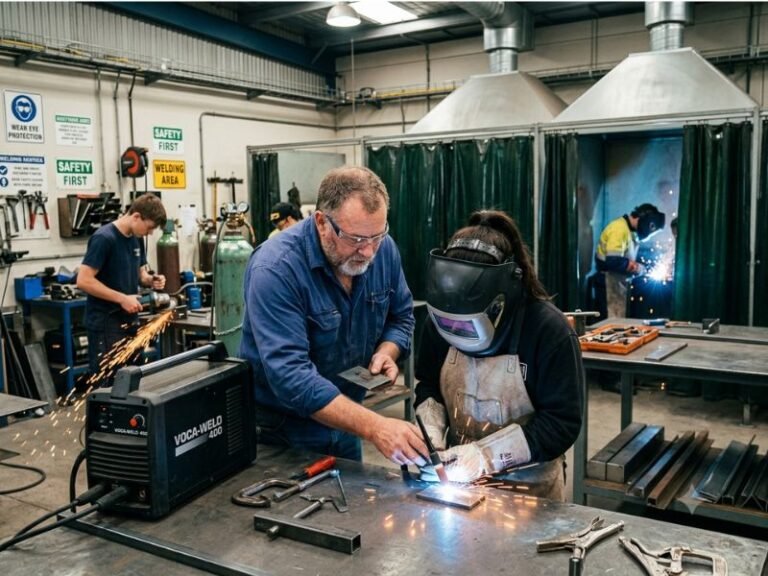
Hands-on practice is the foundation of every quality welding program. Instead of spending all your time in a classroom, you’ll work directly with welding machines, cutting equipment, metals, and safety gear under the supervision of experienced instructors.
This practical training helps develop the muscle memory, precision, and problem-solving skills needed for professional welding careers.
Today’s welding training programs are offered through several types of institutions, including:
- Trade and vocational schools
- Community and technical colleges
- Private welding training institutes
- Apprenticeship programs
- Union training centers
- Employer-sponsored training programs
- Military and government workforce development programs
The length of a welding program varies based on its goal. Some certificate programs can be completed in a few months, while diploma, associate degree, apprenticeship, and advanced specialty programs may take one to four years.
Many programs also prepare students for industry-recognized certifications that improve employability and career advancement.
In short, a welding training program is far more than simply learning how to weld. It’s a complete career preparation pathway that builds technical knowledge, practical experience, workplace safety awareness, and professional qualifications.
Throughout this guide, you’ll learn about every major type of welding training program so you can choose the learning path that best matches your career goals.
Who Should Enroll in a Welding Training Program?

One of the biggest advantages of welding is that it’s a career open to people from many different backgrounds. Whether you’re entering the workforce, changing careers, or looking to upgrade your skills, there’s a welding training program designed to match your experience level and career goals.
Beginners With No Welding Experience
If you’ve never welded before, a beginner-friendly training program is the best place to start. These programs teach everything from welding safety and equipment setup to basic welding techniques, giving you the confidence to perform quality welds before moving on to more advanced projects.
High School Graduates
Many recent high school graduates choose welding instead of a traditional four-year college degree. Vocational welding training can often be completed in less time while providing hands-on skills that lead directly to entry-level employment in manufacturing, construction, fabrication, and other skilled trades.
Career Changers
A welding career isn’t limited to young students. Many adults transition into welding after working in retail, hospitality, transportation, military service, or other industries. Since many welding training courses focus on practical, job-ready skills, career changers can enter the workforce relatively quickly.
Experienced Welders Looking to Advance
Even experienced welders continue their education throughout their careers. Advanced training programs help professionals learn new welding processes, prepare for industry certifications, improve inspection skills, or specialize in high-demand fields such as pipeline, aerospace, robotic, or underwater welding.
Women Entering the Skilled Trades
The welding industry is becoming more diverse, and many schools, trade organizations, and employers actively encourage women to pursue welding careers. Today, you’ll find welding training programs for women, scholarship opportunities, mentorship initiatives, and supportive learning environments that help increase participation in the skilled trades. Success in welding depends on skill, precision, and training—not gender.
Veterans and Military Personnel
Many veterans use education benefits to attend welding training programs after military service. Their experience with discipline, teamwork, and technical equipment often makes the transition into welding careers smoother, especially in industries such as manufacturing, defense, and heavy equipment.
Employers Looking to Upskill Their Workforce
Companies also enroll employees in specialized welding training to improve productivity, meet industry standards, or introduce new welding technologies. This may include certification preparation, welding inspection, robotic welding, safety training, or advanced fabrication techniques.
No matter your background, the right welding training program should match your current skill level, career objectives, and preferred learning style. In the next section, we’ll explore the major types of welding training programs available and explain how each one supports a different career path, with links to detailed guides for every category.
Different Types of Welding Training Programs

Not all welding training programs follow the same curriculum or prepare students for the same career path. Some programs teach the fundamentals needed for entry-level welding jobs, while others focus on advanced processes, specialized industries, quality inspection, automation, or professional certifications.
Understanding these categories is important because it helps you choose a training program that aligns with your interests, career goals, and the type of welding work you want to perform. Rather than trying to learn everything at once, most successful welders build their expertise step by step—starting with core skills and then pursuing specialized training as their careers progress.
In the following sections, you’ll find an overview of every major type of welding training program. Each overview introduces the purpose of that training category and links to a dedicated guide where you’ll learn everything in greater detail.
Welding Training by Type
Every professional welder begins by learning one or more welding processes. Training programs in this category focus on developing practical skills in techniques such as Stick (SMAW), MIG (GMAW), TIG (GTAW), Flux-Cored (FCAW), Gas Welding, Oxy-Acetylene Welding, and other common welding methods.
Each process has its own equipment, applications, advantages, and skill requirements, making process-specific training the foundation of a successful welding career.
Our dedicated guide explains each welding process, what you’ll learn during training, the industries that use it, and how to choose the right welding method based on your career goals.
Material-Specific Welding Training
Different metals require different welding techniques. Welding aluminum, stainless steel, titanium, cast iron, or plastics isn’t the same as welding mild steel. Material-specific training teaches welders how different materials react to heat, filler metals, shielding gases, and welding parameters while helping them avoid common defects such as cracking, distortion, and contamination.
If you’re planning to work in industries like aerospace, food processing, marine manufacturing, or custom fabrication, this specialized training can significantly expand your career opportunities.
Industry-Specific Welding Training
Many industries have unique welding standards, codes, equipment, and quality requirements. Industry-specific training prepares welders for careers in pipeline construction, structural steel, shipbuilding, oil and gas, power generation, aerospace, automotive manufacturing, railroads, and heavy equipment fabrication.
Instead of learning only general welding techniques, these programs focus on the real-world applications, safety regulations, and industry standards employers expect within a particular sector.
Robotic & Automation Welding
Automation is becoming increasingly common in modern manufacturing, but skilled welders are still needed to operate, program, maintain, and troubleshoot robotic welding systems. Robotic and automation training introduces students to welding robots, robotic programming, automated production systems, welding simulators, and quality control processes used in high-volume manufacturing.
This category is ideal for welders who want to combine traditional welding knowledge with advanced manufacturing technology.
Welding Inspection & QA Training
Producing a weld is only part of the job—ensuring its quality is equally important. Welding inspection and quality assurance (QA) training teaches students how to inspect welds, identify defects, interpret welding codes, read inspection reports, and verify compliance with industry standards. This training is valuable for experienced welders who want to move into supervisory, inspection, or quality control roles.
Welding Certification
Many employers prefer or require industry-recognized certifications when hiring welders. Certification training helps students prepare for performance qualification tests and certification exams offered by organizations and industry bodies. These programs focus on meeting established welding procedures, codes, and testing standards while improving employability and long-term career growth.
Welding Safety Training
Safety is one of the most important parts of every welding career. Welding safety training covers personal protective equipment (PPE), fire prevention, electrical hazards, ventilation, confined-space safety, compressed gas handling, and safe equipment operation. Whether you’re a beginner or an experienced professional, understanding workplace safety helps prevent accidents and ensures compliance with industry regulations.
Online Welding Training
Online learning has become a valuable supplement to traditional welding education. Although practical welding skills must be developed through hands-on practice, online welding training is useful for learning welding theory, blueprint reading, metallurgy, welding symbols, safety procedures, certification preparation, and equipment operation.
Many training providers now combine online coursework with in-person lab sessions to create flexible learning options.
Apprenticeship & Job Training
Many welders begin their careers through apprenticeship programs or employer-sponsored job training. These programs combine paid work experience with classroom instruction, allowing students to earn an income while developing practical skills under experienced mentors.
Apprenticeships are often offered by unions, contractors, manufacturers, shipyards, and government workforce development programs.
Training Equipment & Welding Simulators
Modern welding education relies on more than just welding machines. Students often train using welding booths, virtual reality simulators, robotic trainers, cutting equipment, positioners, measuring tools, and inspection instruments.
Understanding how welding training equipment works can help you choose a school with facilities that provide realistic, industry-relevant experience.
Training Cost, Duration & Requirements
Before enrolling in any program, it’s important to understand the investment involved. Training costs, program length, admission requirements, financial aid, scholarships, and certification fees vary depending on the school and program type. Knowing these factors in advance helps you compare programs and choose one that fits your budget, schedule, and long-term career plans.
Specialized Welding Training
As welders gain experience, many choose to specialize in advanced fields such as underwater welding, orbital welding, laser welding, friction stir welding, ultrasonic welding, electron beam welding, or thermite welding.
These highly specialized programs require additional training but can lead to unique career opportunities in industries with demanding technical requirements and higher earning potential.
Welding Training Schools, Centers & Institutes
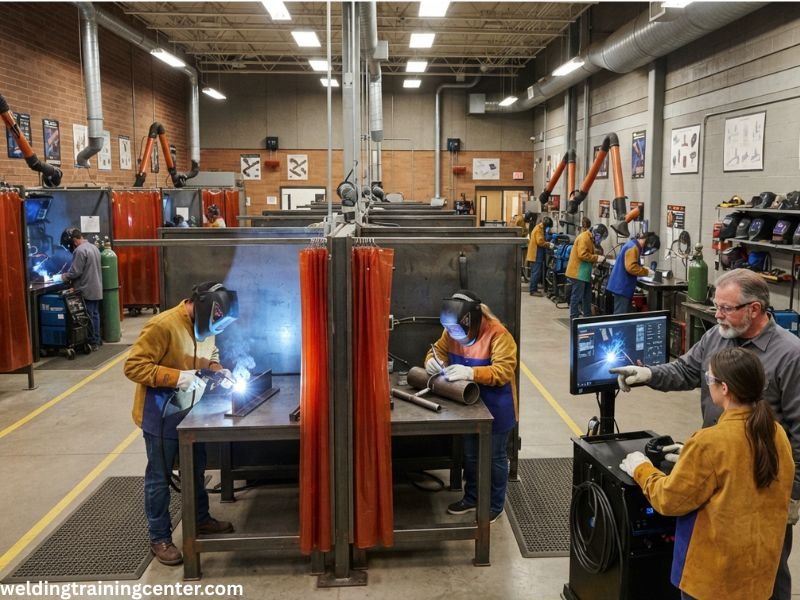
Choosing the right place to learn is just as important as choosing the right welding program. While many people use terms like welding school, training center, and welding institute interchangeably, they don’t always offer the same type of education, facilities, or career opportunities.
Some organizations focus on teaching beginners the fundamentals of welding, while others specialize in advanced certifications, apprenticeship training, or industry-specific skills. Understanding these differences will help you invest your time and money in a program that supports your long-term career goals.
Welding Schools
Welding schools are dedicated educational institutions that focus primarily on welding and related metal fabrication skills. Their programs are usually career-oriented and designed to prepare students for entry-level welding positions in industries such as manufacturing, construction, automotive, and structural fabrication.
Most welding schools offer:
- Comprehensive welding fundamentals
- Hands-on lab training
- Multiple welding processes
- Welding safety education
- Blueprint reading
- Certification preparation
- Career placement assistance
Private welding schools often have flexible schedules and accelerated programs, allowing students to enter the workforce more quickly.
Vocational and Technical Schools
Vocational schools and technical colleges include welding as part of a broader skilled trades curriculum. In addition to welding, students may study machining, industrial maintenance, fabrication, CNC operations, or electrical technology.
These schools are ideal for students who want a wider technical education alongside welding skills.
Community Colleges
Many community colleges offer certificate, diploma, and associate degree welding programs. Compared to private schools, they often have lower tuition costs while providing accredited education, experienced instructors, and access to financial aid.
Community colleges are also a good option for students who may want to continue their education later in engineering, manufacturing technology, or industrial management.
Welding Training Centers
A welding training center typically focuses on practical, skills-based education rather than academic coursework. These centers are commonly operated by:
- Private training companies
- Manufacturers
- Trade organizations
- Government workforce programs
- Union apprenticeship programs
Many training centers specialize in areas such as welding certification, robotic welding, pipeline welding, inspection training, or employer-specific workforce development.
Welding Institutes
A welding training institute generally offers more comprehensive education than a short-term training center. Institutes may provide beginner programs, advanced technical courses, certification preparation, instructor training, and continuing education for experienced welders.
Some institutes also partner with manufacturers, certification organizations, and employers to ensure their curriculum reflects current industry standards and hiring needs.
Employer and Union Training Facilities
Many large manufacturers, shipyards, fabrication companies, and labor unions operate their own welding training facilities. These programs often combine classroom instruction with paid apprenticeships, allowing students to gain real-world experience while earning an income.
Employer-sponsored training is especially valuable because students learn using the same equipment, procedures, and quality standards they’ll encounter on the job.
What Should You Look for in a Welding Training Facility?
Not every welding training facility offers the same learning experience. Before enrolling, compare several programs and evaluate the overall quality of the school—not just the tuition price.
A high-quality welding training facility should offer:
- Experienced, industry-certified instructors
- Modern welding equipment and well-maintained labs
- Plenty of hands-on practice time
- Small instructor-to-student ratios
- Comprehensive safety training
- Preparation for industry-recognized certifications
- Strong employer partnerships and job placement support
- Positive graduate employment outcomes
The best school isn’t necessarily the most expensive—it’s the one that provides the right combination of quality instruction, practical experience, recognized credentials, and career support.
In the next section, we’ll look at the subjects and practical skills you’ll typically learn during a welding training program, from welding fundamentals to advanced technical concepts.
Welding Training Courses You Can Expect
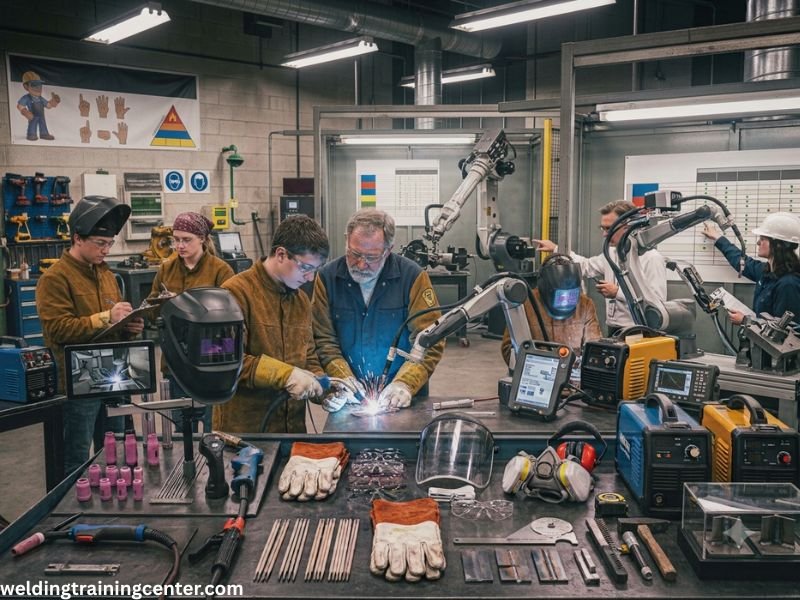
Although every welding school has its own curriculum, most quality welding training programs follow a similar learning path. Students begin with the fundamentals before progressing to more advanced welding techniques, industry standards, and real-world fabrication projects.
The goal isn’t simply to teach you how to make a weld. A good program develops the technical knowledge, practical skills, and professional habits needed to perform safe, accurate, and code-compliant welds in the workplace.
Here’s what you can typically expect to learn during a welding training course.
Welding Fundamentals
Every beginner starts with the basics. This stage builds the foundation you’ll use throughout your welding career.
Common topics include:
- Introduction to welding processes
- Welding terminology
- Metal properties and identification
- Heat transfer and weld penetration
- Joint types and weld positions
- Welding symbols and terminology
- Basic shop mathematics
- Measuring and layout techniques
Mastering these welding fundamentals makes it much easier to learn advanced welding techniques later.
Welding Safety and Workplace Practices
Safety is integrated into every stage of welding education. Before students begin hands-on welding, they learn how to protect themselves and others while working around high temperatures, electricity, compressed gases, sparks, and heavy equipment.
Typical safety lessons include:
- Personal protective equipment (PPE)
- Fire prevention
- Electrical safety
- Fume extraction and ventilation
- Cylinder handling
- Machine safety
- Emergency procedures
- Safe workshop practices
Hands-On Welding Practice
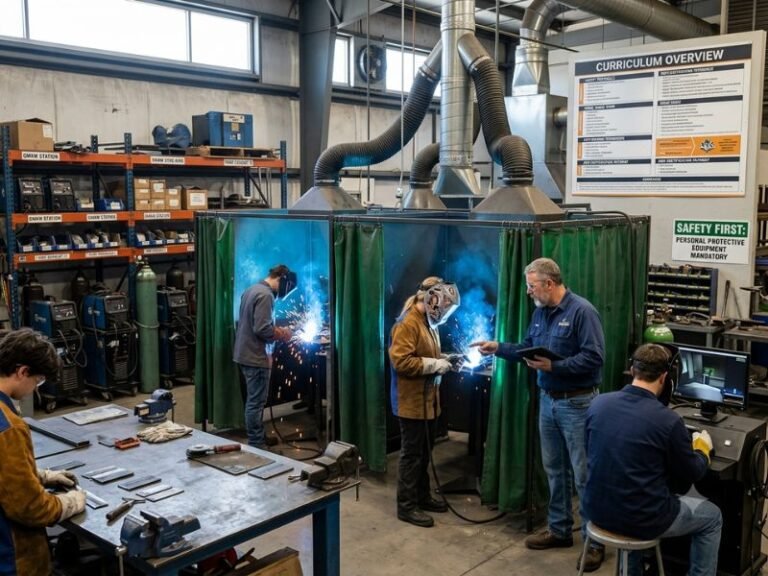
Practical training is the heart of every welding program. Students spend a significant portion of their training in welding booths, applying classroom knowledge to real welding projects.
Hands-on practice often includes:
- Equipment setup
- Arc starting and stopping
- Bead placement
- Joint preparation
- Fillet welds
- Groove welds
- Welding in flat, horizontal, vertical, and overhead positions
- Welding different material thicknesses
As students gain confidence, instructors gradually introduce more challenging projects and welding positions.
Multiple Welding Processes
Most welding training courses introduce students to several common welding methods instead of focusing on just one process.
Depending on the program, you’ll likely receive training in:
- Shielded Metal Arc Welding (SMAW/Stick)
- Gas Metal Arc Welding (GMAW/MIG)
- Gas Tungsten Arc Welding (GTAW/TIG)
- Flux-Cored Arc Welding (FCAW)
- Oxy-Fuel Cutting and Heating
- Plasma Cutting
Some advanced programs also include robotic welding, orbital welding, laser welding, or other specialized processes.
Blueprint Reading and Welding Symbols
Professional welders rarely work from verbal instructions alone. That’s why students learn how to read fabrication drawings and interpret welding symbols.
This training helps you understand:
- Engineering drawings
- Weld symbols
- Dimensions and tolerances
- Material specifications
- Fabrication layouts
- Welding procedures
These skills are essential for producing accurate, high-quality welds in manufacturing and construction environments.
Welding Inspection and Quality Control
Good welding isn’t just about appearance—it’s about meeting quality standards. Many training programs introduce basic inspection techniques to help students evaluate their own work.
Topics may include:
- Visual weld inspection
- Common welding defects
- Causes of weld failures
- Measuring weld quality
- Repair procedures
- Introduction to welding codes
These concepts prepare students for more advanced inspection and certification training later in their careers.
Real-World Fabrication Projects
Toward the end of many welding programs, students complete practical projects that simulate workplace tasks. These projects help reinforce the skills learned throughout the course while building confidence before entering the workforce.
Projects may involve:
- Structural assemblies
- Pipe joints
- Fabrication exercises
- Repair welding
- Production-style welding
- Team-based projects
These hands-on assignments also help students build a portfolio of work they can discuss during job interviews.
Certification Preparation
Many welding training courses conclude with preparation for industry-recognized certification tests. Students practice welding procedures, improve consistency, and perform mock qualification tests to become familiar with certification requirements.
While certification requirements vary depending on the employer and industry, graduating from a program that includes certification preparation can significantly improve your employment opportunities.
A comprehensive welding training course combines classroom instruction with extensive hands-on experience, ensuring graduates are ready for entry-level jobs and prepared to continue advancing their skills through specialized training and professional certifications.
How to Choose the Right Welding Training Program
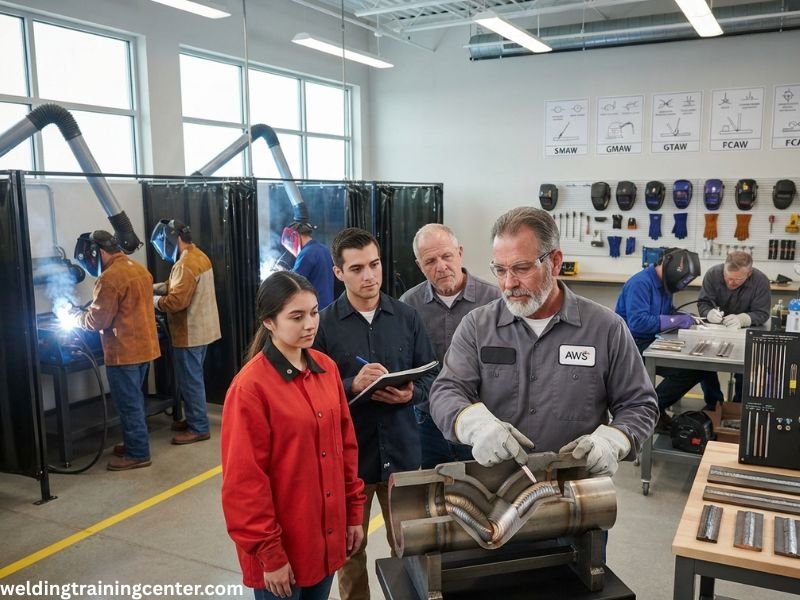
With hundreds of welding schools, technical colleges, apprenticeship programs, and private training centers available, choosing the right welding training program can feel overwhelming. The best program isn’t simply the one that’s closest to home or the least expensive—it’s the one that provides quality instruction, extensive hands-on experience, and a clear pathway to employment.
Before enrolling, compare multiple programs using the following criteria.
Look for a Well-Structured Curriculum
A quality program should cover more than basic welding techniques. It should combine classroom instruction with practical training and gradually build your skills from beginner to job-ready.
Look for programs that include:
- Welding fundamentals
- Multiple welding processes
- Welding safety
- Blueprint reading
- Welding symbols
- Fabrication projects
- Basic inspection techniques
- Certification preparation
A balanced curriculum ensures you develop both technical knowledge and practical experience.
Prioritize Hands-On Training
Welding is a hands-on trade, so practical experience should make up a large portion of your education. Spending hours in a welding booth under instructor supervision is far more valuable than learning theory alone.
When evaluating a program, ask questions such as:
- How many hours are spent in the welding lab?
- Will every student have access to their own welding booth?
- What types of welding equipment are available?
- How much instructor supervision is provided during practical sessions?
Programs with extensive lab time generally produce more confident and job-ready graduates.
Evaluate the Quality of the Training Facility
The learning environment plays a major role in your overall experience. Modern equipment, clean workshops, and organized training spaces help students practice safely and efficiently.
A good welding training facility should have:
- Modern welding machines
- Proper ventilation systems
- Well-equipped welding booths
- Quality safety equipment
- Metal preparation tools
- Cutting equipment
- Inspection tools
- Welding simulators, if available
Training with industry-standard equipment makes the transition to the workplace much smoother.
Check Instructor Experience
Experienced instructors do more than teach welding techniques—they share practical knowledge gained from years of working in the industry.
Look for instructors who have experience in areas such as:
- Structural fabrication
- Pipe welding
- Manufacturing
- Inspection
- Industrial construction
- Welding supervision
Learning from professionals who understand real job-site challenges can provide valuable insights that textbooks alone cannot.
Consider Certification Preparation
If your career goals include working in industries with strict quality standards, choose a program that prepares students for industry-recognized welding certifications.
Certification-focused programs typically provide:
- Procedure practice
- Qualification testing
- Weld evaluations
- Mock certification exams
- Guidance on industry standards
This preparation can improve your confidence and make you more competitive in the job market.
Review Career Support Services
Many quality welding schools assist graduates with finding employment after training.
Career services may include:
- Resume assistance
- Interview coaching
- Employer networking
- Internship opportunities
- Apprenticeship placement
- Job fairs
- Graduate employment support
Strong relationships with local employers can make it easier to secure your first welding job.
Compare Cost and Program Value
While tuition is important, don’t choose a program based on price alone. A slightly more expensive program may offer better equipment, experienced instructors, certification preparation, and stronger job placement support—providing better long-term value.
When comparing schools, consider:
- Tuition and fees
- Equipment costs
- Books and supplies
- Certification fees
- Financial aid availability
- Scholarship opportunities
- Graduate employment rates
Read Reviews and Visit the Campus
Whenever possible, visit the training facility before making a decision. Seeing the classrooms, welding labs, and equipment in person can tell you much more than a brochure or website.
You should also:
- Read student reviews
- Speak with instructors
- Ask current students about their experience
- Learn about graduate success stories
- Compare multiple schools before enrolling
Choose a Program That Matches Your Career Goals
Finally, think beyond graduation. If you already know the type of welding career you want, choose a program that supports that path.
For example:
- If you want to work in manufacturing, look for programs that include MIG welding, robotic welding, and fabrication.
- If you’re interested in construction or structural steel, prioritize Stick welding and structural fabrication training.
- If your goal is pipeline or pressure vessel work, choose a program with advanced pipe welding and certification preparation.
- If you hope to move into inspection or quality assurance, select a school that introduces welding inspection and industry codes.
Choosing the right welding training program is one of the most important decisions you’ll make in your welding career. Taking the time to compare schools, evaluate facilities, and understand each program’s strengths will help you build a solid foundation for long-term success in the welding industry.
You have not enough Humanizer words left. Upgrade your Surfer plan.
Welding Training Cost
One of the first questions most prospective students ask is, “How much does welding training cost?” The answer depends on several factors, including the type of program, the training provider, program length, location, and whether you’re pursuing a certificate, diploma, apprenticeship, or college degree.
While cost is an important consideration, it shouldn’t be the only factor when choosing a welding training program. A program with experienced instructors, modern equipment, certification preparation, and strong job placement support often provides far greater long-term value than simply choosing the lowest tuition.
Want a detailed cost breakdown? Read our complete guide to Welding Training Cost to compare tuition, equipment expenses, certification fees, financial aid, and ways to reduce your overall training costs.
What Affects Welding Training Costs?
Several factors influence the total price of a welding program, including:
- Type of training provider (trade school, community college, private institute, or apprenticeship)
- Program length
- Certificate, diploma, or degree program
- Lab and workshop fees
- Welding equipment and tools
- Personal protective equipment (PPE)
- Books and learning materials
- Certification and testing fees
- Location of the school
Because of these variables, two programs with similar course titles can have significantly different overall costs.
Expenses Beyond Tuition
When planning your budget, remember that tuition is only one part of the total investment. Many students also need to budget for:
- Welding helmet
- Welding gloves
- Protective clothing
- Safety boots
- Hand tools
- Textbooks
- Consumables used during training
- Certification exams
- Transportation or housing (if relocating)
Some schools include these items in the tuition, while others require students to purchase them separately.
Financial Aid and Funding Options
Many welding training providers offer financial assistance to help students manage education costs. Depending on your location and the institution you choose, funding options may include:
- Federal or state financial aid
- Scholarships
- Workforce development grants
- Veterans’ education benefits
- Employer-sponsored training
- Union apprenticeship programs
- Flexible payment plans
Exploring these options can significantly reduce your out-of-pocket expenses.
Think About Return on Investment
Instead of focusing only on the upfront price, consider the long-term value of your education. A high-quality welding program can help you develop in-demand skills, earn professional certifications, and qualify for better-paying job opportunities.
Graduates from reputable training programs often recover their educational investment through increased earning potential and stronger career opportunities over time.
The total cost of welding training varies widely, but understanding what influences tuition and knowing which expenses to expect will help you make an informed decision. In the next section, we’ll look at another important factor—how long welding training programs typically take to complete and what affects their duration.
How Long Does Welding Training Take?
The length of a welding training program depends on the type of education you choose, your career goals, and whether you attend full-time or part-time. Some students complete basic job-ready training in just a few months, while others spend several years earning advanced qualifications through degree programs or apprenticeships.
There isn’t a single timeline that fits everyone. The right program length depends on the level of skills you want to develop and the type of welding career you’re pursuing.
Looking for a detailed timeline? Check out our complete guide on Welding Training Duration, where we compare certificate programs, diplomas, associate degrees, apprenticeships, and advanced specialty training.
Certificate Programs
Certificate programs are typically the fastest route into the welding industry. They focus on practical skills and prepare students for entry-level positions.
Most certificate programs include:
- Welding fundamentals
- Safety training
- Basic welding processes
- Hands-on practice
- Introductory fabrication
- Certification preparation
These programs are ideal for students who want to enter the workforce quickly.
Diploma Programs
Diploma programs usually provide more comprehensive training than short certificate courses. In addition to practical welding skills, they often include blueprint reading, metallurgy, welding codes, fabrication, and quality control.
Graduates generally leave with broader technical knowledge and greater confidence when applying for welding jobs.
Associate Degree Programs
Community and technical colleges often offer associate degree programs in welding technology or welding engineering technology.
These programs typically combine:
- Advanced welding techniques
- General education courses
- Manufacturing concepts
- Industrial mathematics
- Technical communication
- Welding inspection
- Fabrication projects
An associate degree can be a good choice for students interested in supervisory, technical, or long-term career advancement.
Apprenticeship Programs
Apprenticeships take longer than traditional classroom programs because students combine paid work experience with formal instruction.
During an apprenticeship, students learn directly from experienced welders while gradually developing practical skills on real job sites. This approach provides valuable industry experience and often leads to full-time employment after completion.
Specialized Training Programs
Experienced welders often return to school for specialized training in areas such as robotic welding, welding inspection, pipeline welding, underwater welding, or laser welding.
These advanced programs are generally much shorter because they build upon existing welding knowledge rather than teaching the fundamentals from scratch.
Factors That Affect Training Duration
Several factors influence how long your welding education will take, including:
- Your previous welding experience
- Full-time or part-time enrollment
- Program curriculum
- Certification requirements
- Attendance schedule
- Learning pace
- Hands-on training hours
- Specialized career goals
Students pursuing multiple certifications or advanced specializations may spend more time in training than those preparing for entry-level positions.
Should You Choose the Shortest Program?
Not necessarily. While shorter programs allow you to enter the workforce sooner, longer programs often provide broader technical knowledge, additional hands-on experience, and stronger preparation for career advancement.
When comparing schools, focus on the overall quality of the training rather than the completion time alone. A program that offers extensive lab practice, experienced instructors, and certification preparation may provide greater long-term value than simply finishing as quickly as possible.
Ultimately, the best welding training program is one that balances time, cost, and career opportunities. Before enrolling, make sure the program length aligns with your personal goals, budget, and the type of welding career you want to build.
Welding Training Requirements
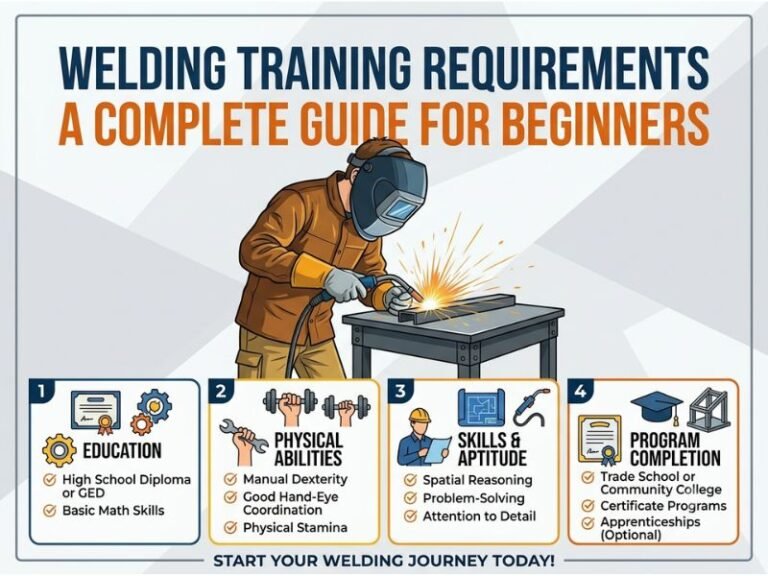
Before enrolling in a welding training program, it’s important to understand the admission requirements. The good news is that most beginner-level welding programs have straightforward entry requirements, making the trade accessible to a wide range of students. However, requirements can vary depending on the school, training provider, certification level, or specialized program.
Need a complete checklist? Read our in-depth guide on Welding Training Requirements to learn about admission criteria, age limits, educational qualifications, physical requirements, and documents you’ll need before applying.
Minimum Age Requirements
Most welding schools require applicants to meet a minimum age requirement, which is typically the legal age for vocational education or employment in their region. Some high school career and technical education (CTE) programs also allow younger students to begin learning welding before graduation.
If you’re applying for an apprenticeship or employer-sponsored training program, age requirements may differ depending on local labor laws and company policies.
Educational Qualifications
One of the reasons welding is an attractive career is that many entry-level programs don’t require a college degree.
Common educational requirements may include:
- High school diploma or equivalent (often preferred or required)
- Basic reading and writing skills
- Fundamental math skills for measurements and calculations
Some advanced programs or community college degrees may have additional academic prerequisites, but most beginner courses are designed for students with little or no prior welding experience.
Physical and Medical Requirements
Welding is a physically demanding trade, so students should be prepared for hands-on work in a workshop environment.
Depending on the program, you may need to:
- Stand for extended periods
- Lift and move metal materials or equipment
- Work in different welding positions
- Wear personal protective equipment (PPE) for long periods
- Have adequate vision (or corrected vision) to safely perform welding tasks
Some employers or apprenticeship programs may also require a medical examination before employment.
Safety Awareness
Safety is a fundamental part of every welding career. While you don’t need prior safety training before enrolling, you should be willing to learn and consistently follow safe work practices.
Students are expected to:
- Wear appropriate PPE
- Follow workshop safety rules
- Operate equipment responsibly
- Respect instructor guidance
- Maintain a safe working environment
A strong commitment to safety is just as important as technical ability.
Required Documents
Application requirements vary by institution, but many schools ask students to submit basic documents such as:
- Completed application form
- Proof of identity
- Educational transcripts or diploma (if required)
- Proof of residency (for certain public institutions)
- Financial aid or scholarship documents (if applicable)
It’s always a good idea to review the school’s admissions checklist before applying.
Do You Need Previous Welding Experience?
In most cases, no. Beginner welding training programs are specifically designed for students with no prior experience. Instructors start with the fundamentals, teaching everything from equipment setup and welding safety to basic welding techniques and practical skills.
Advanced or specialized training programs, however, may require previous welding knowledge or professional experience before enrollment.
Skills That Will Help You Succeed
Although they aren’t formal admission requirements, developing certain personal qualities can make learning welding easier and improve your long-term career success.
Helpful skills include:
- Attention to detail
- Good hand-eye coordination
- Mechanical aptitude
- Problem-solving ability
- Patience and precision
- Willingness to learn
- Strong work ethic
These traits can often be developed over time through consistent practice and hands-on experience.
The entry requirements for most welding training programs are intentionally accessible because the focus is on teaching students the skills they need from the ground up. As long as you meet the basic admission criteria and are committed to learning, you can begin building a rewarding career in the welding industry.
Free & Paid Welding Training Options
One of the biggest advantages of pursuing a welding career is the variety of training options available. Depending on your location, financial situation, and career goals, you may be able to enroll in a paid welding training program, receive financial assistance, or even qualify for free welding training through government, military, union, or workforce development initiatives.
While free programs can reduce your education costs, they aren’t always the best choice for everyone. It’s important to compare the quality of instruction, hands-on training opportunities, certification preparation, and job placement support—not just the price.
Paid Welding Training Programs
Most welding students choose paid training through trade schools, community colleges, technical institutes, or private welding academies. These programs typically offer structured curricula, experienced instructors, modern equipment, and dedicated welding labs.
A quality paid program often includes:
- Comprehensive classroom instruction
- Extensive hands-on welding practice
- Multiple welding process training
- Safety education
- Certification preparation
- Career counseling and job placement assistance
Although tuition requires an upfront investment, these programs are often the fastest and most reliable path to developing job-ready skills.
Free Welding Training Opportunities
In some situations, you may be able to receive welding training at little or no cost. Free programs are commonly offered through public workforce initiatives or organizations that aim to address skilled labor shortages.
Potential sources of free or low-cost training include:
- Government workforce development programs
- Community grants
- Military and veterans’ education benefits
- Nonprofit organizations
- High school career and technical education (CTE) programs
- Employer-sponsored workforce initiatives
Availability varies by country, state, and local funding, so it’s worth researching programs in your area.
Read More Details : Free Welding Training – How to Learn Welding Skills Without Paying
Apprenticeships That Pay You While You Learn
Apprenticeships offer one of the most attractive pathways into the welding profession. Instead of paying full tuition, apprentices earn a wage while receiving structured on-the-job training and classroom instruction.
Benefits of apprenticeship programs include:
- Paid work experience
- Mentorship from experienced welders
- Real-world job-site training
- Industry-recognized skills
- Potential full-time employment after completion
For many students, apprenticeships provide the ideal balance of education and income.
Employer-Sponsored Welding Training
Some manufacturers, fabrication companies, shipyards, and construction firms invest in training new employees. Depending on the employer, training may be provided before employment or after you’re hired.
Employer-sponsored programs often focus on:
- Company-specific welding procedures
- Equipment operation
- Workplace safety
- Quality standards
- Production welding
- Certification preparation
These programs can be especially valuable because they train employees according to the company’s actual production requirements.
Scholarships and Financial Assistance
Even if you don’t qualify for free training, you may still be able to reduce your education costs through financial aid.
Common funding options include:
- Merit-based scholarships
- Need-based grants
- Federal or state financial aid
- Workforce development funding
- Veterans’ education benefits
- Employer tuition assistance
- Flexible payment plans offered by schools
Many students combine multiple funding sources to make welding education more affordable.
Which Option Is Right for You?
There’s no single “best” training option. The right choice depends on your budget, career goals, schedule, and preferred learning style.
If you want to enter the workforce quickly with comprehensive instruction, a reputable paid welding school may be the best fit. If minimizing education costs is your priority, exploring apprenticeships, government-funded programs, or employer-sponsored training could provide an excellent alternative.
Regardless of which path you choose, focus on the overall quality of the program. Extensive hands-on practice, experienced instructors, modern equipment, certification preparation, and strong job placement support will have a much greater impact on your career than whether the training was free or paid.
Welding Training Jobs After Graduation
Completing a welding training program is only the beginning of your career. The skills you develop during training can open doors to a wide range of entry-level and advanced positions across multiple industries. From manufacturing plants and construction sites to shipyards and energy facilities, trained welders continue to play a critical role in building and maintaining the infrastructure that supports modern life.
The exact job opportunities available to you will depend on your training, certifications, experience, and the welding processes you’ve mastered. As you gain additional skills and specialized qualifications, your career options—and earning potential—can continue to grow.
Common Entry-Level Welding Jobs
Most graduates begin with entry-level positions where they can apply the skills learned during training while gaining valuable real-world experience.
Common starting roles include:
- Production Welder
- MIG Welder
- TIG Welder
- Stick Welder
- Fabrication Welder
- Structural Welder
- Maintenance Welder
- Manufacturing Welder
- Welding Technician
- Metal Fabricator
These positions help new welders build confidence, improve productivity, and prepare for more specialized roles.
Industries That Hire Trained Welders
Welding is used in nearly every major industrial sector. As a result, graduates can pursue careers in a variety of industries, including:
- Manufacturing
- Construction
- Structural steel fabrication
- Automotive manufacturing
- Heavy equipment production
- Shipbuilding and marine repair
- Aerospace manufacturing
- Oil and gas
- Energy and power generation
- Railroad and transportation
- Agricultural equipment
- Mining and industrial maintenance
Each industry may require different welding processes, certifications, and quality standards, making continued training an important part of long-term career growth.
Career Advancement Opportunities
As your experience increases, you may choose to specialize or move into higher-level positions.
Possible career paths include:
- Certified Welder
- Pipe Welder
- Welding Inspector
- Welding Supervisor
- Welding Instructor
- Welding Engineer
- Quality Control Inspector
- Robotic Welding Technician
- Welding Programmer
- Welding Project Manager
Many of these roles require additional certifications or specialized training, but they often come with increased responsibility and higher earning potential.
The Importance of Continuing Education
The welding industry continues to evolve with new materials, automation technologies, and stricter quality standards. Successful welders regularly invest in professional development to stay competitive.
Continuing education may include:
- Advanced welding certifications
- Robotic welding training
- Welding inspection courses
- Specialized industry training
- Safety certifications
- Leadership and supervisory training
Expanding your skills not only improves your job prospects but also prepares you for leadership roles later in your career.
Building a Long-Term Welding Career
Your first welding job is rarely your final destination. Many professionals begin with basic production or fabrication work before moving into specialized industries such as pipeline welding, aerospace manufacturing, underwater welding, or welding inspection.
The combination of hands-on experience, industry certifications, and continuous learning often has a greater impact on career growth than the first position you accept after graduation.
A quality welding training program provides the foundation, but your willingness to keep learning and developing new skills will ultimately determine how far your welding career can take you.
In the next section, we’ll explore how welding training software, virtual reality simulators, and digital learning tools are changing the way future welders learn both inside and outside the classroom.
You have not enough Humanizer words left. Upgrade your Surfer plan.
Welding Training Software & Virtual Learning
Technology is transforming the way welders learn. While nothing can replace real hands-on welding experience, modern welding training software, virtual reality (VR) simulators, and digital learning platforms have become valuable tools for improving knowledge, reducing training costs, and helping students practice before working with live equipment.
Today, many welding schools, technical colleges, manufacturers, and apprenticeship programs combine traditional classroom instruction with digital learning to create a more effective training experience.
What Is Welding Training Software?
Welding training software is designed to help students understand welding concepts through interactive lessons, simulations, videos, and assessments. Instead of relying only on textbooks, learners can study welding theory using digital tools that make complex topics easier to understand.
Depending on the platform, welding training software may include:
- Interactive welding lessons
- Equipment setup tutorials
- Welding process animations
- Blueprint reading exercises
- Welding symbol practice
- Safety training modules
- Knowledge quizzes and progress tracking
These resources allow students to build a strong theoretical foundation before entering the welding lab.
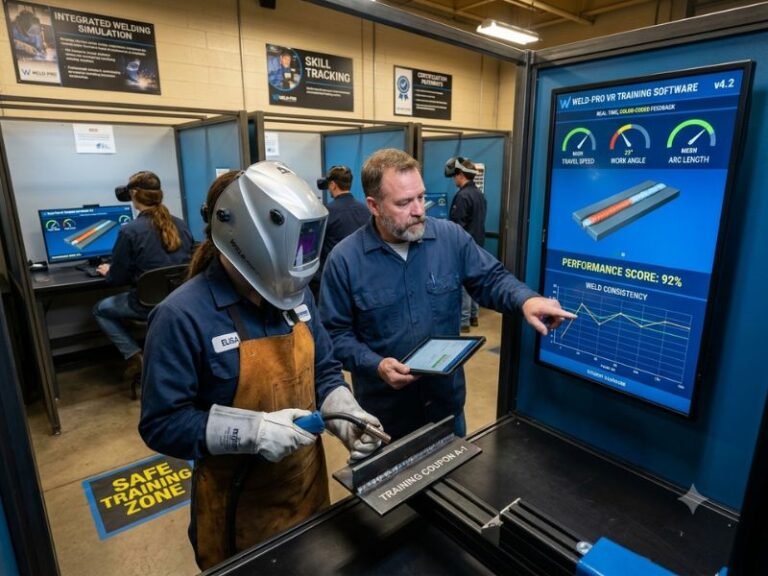
Virtual Reality (VR) Welding Simulators
One of the biggest innovations in welding education is the use of VR welding simulators. These systems recreate realistic welding scenarios in a virtual environment, allowing students to practice techniques without consuming metal, filler material, shielding gas, or electricity.
A VR simulator can help students improve:
- Torch angle
- Travel speed
- Arc length
- Welding position
- Hand coordination
- Technique consistency
Many simulators also provide instant feedback, helping students identify mistakes and improve before performing live welds.
Benefits of Digital Learning
Modern training technologies offer several advantages for both students and instructors.
Some of the key benefits include:
- Safe learning environment for beginners
- Reduced material waste
- Lower training costs
- Immediate performance feedback
- Flexible self-paced learning
- Better understanding of welding theory
- Increased classroom engagement
These tools are especially useful for introducing new concepts before students begin practical welding exercises.
The Limitations of Online and Virtual Training
Although digital learning has improved significantly, it cannot fully replace hands-on welding practice. Professional welders must still develop real-world skills by working with actual welding equipment, different metals, and various welding positions.
Virtual learning cannot fully replicate:
- Heat control
- Weld puddle behavior
- Material distortion
- Physical positioning
- Equipment handling
- Real workplace conditions
For this reason, the best welding training programs use technology to support practical education—not replace it.
The Future of Welding Education
As automation and digital manufacturing continue to expand, technology will play an even larger role in welding education. Artificial intelligence, advanced VR systems, augmented reality (AR), robotic welding simulators, and cloud-based learning platforms are already being introduced in many training facilities.
These innovations help students learn faster, make fewer mistakes, and become familiar with the technologies used in modern manufacturing environments.
However, regardless of how advanced training software becomes, successful welders will always need extensive hands-on practice. The strongest welding programs combine digital learning with real workshop experience, giving students the best of both worlds.
Welder Salary: How Much Can Welders Earn?
One of the biggest reasons people choose welding as a career is its strong earning potential. While salary varies depending on your experience, certifications, industry, location, and specialization, skilled welders can earn competitive wages with opportunities to increase their income throughout their careers.
Unlike many professions where salary growth depends primarily on years of experience, welders often increase their earnings by developing new skills, earning certifications, and specializing in high-demand industries.
Want detailed salary data? Check out our complete guide to Welder Salary, where we break down earnings by experience, welding process, industry, state, and specialty.
Entry-Level Welder Salary
New graduates typically begin in entry-level positions such as production welding, fabrication, or manufacturing. While starting salaries vary by employer and location, entry-level jobs provide valuable experience that helps welders qualify for higher-paying positions over time.
Employers often place greater value on practical skills, reliability, and a willingness to learn than on years of experience alone.
Mid-Career and Experienced Welders
As welders gain experience, improve productivity, and earn additional certifications, they often qualify for better-paying roles. Experienced professionals may move into structural welding, pipe welding, industrial fabrication, maintenance, or supervisory positions that offer higher compensation and greater responsibility.
Specializing in complex welding projects can significantly improve long-term earning potential.
Highest-Paying Welding Specialties
Some welding careers offer substantially higher salaries because they require advanced technical skills, specialized certifications, or challenging working conditions.
Higher-paying specialties often include:
- Pipeline welding
- Underwater welding
- Aerospace welding
- Nuclear welding
- Offshore welding
- Robotic welding
- Welding inspection
- Certified welding supervision
These positions usually require additional training and experience but can provide excellent career growth opportunities.
Factors That Affect Welder Salary
Several factors influence how much a welder earns, including:
- Experience level
- Welding certifications
- Welding process expertise
- Industry
- Geographic location
- Overtime opportunities
- Union or non-union employment
- Specialized technical skills
Investing in continuous training and professional development is one of the most effective ways to increase earning potential over the course of a welding career.
Is Welding a High-Paying Career?
For many skilled trades professionals, the answer is yes. While not every welding position offers the same salary, welders who continually improve their skills, earn industry-recognized certifications, and specialize in high-demand sectors often enjoy stable employment and competitive compensation.
Rather than focusing only on your starting salary, consider welding as a career with multiple advancement opportunities. As your expertise grows, so can your responsibilities, job options, and earning potential.
Common Mistakes to Avoid When Choosing a Welding Training Program
Choosing a welding training program is a major investment in your future. Unfortunately, many students make decisions based on price, convenience, or advertising without carefully evaluating the quality of the program. These mistakes can lead to poor training, limited job opportunities, and unnecessary expenses.
Before you enroll, avoid these common pitfalls.
1. Choosing the Cheapest Program
Low tuition can be appealing, but the least expensive program isn’t always the best value. A school with outdated equipment, limited lab time, or inexperienced instructors may leave you underprepared for the workforce.
Instead of comparing tuition alone, evaluate what the program includes, such as hands-on training, certification preparation, instructor qualifications, and career support.
2. Ignoring Hands-On Training Hours
Welding is a practical skill that can only be mastered through repeated practice. If a program spends too much time in the classroom and too little time in the welding lab, you’ll have fewer opportunities to develop real-world skills.
Ask how much of the curriculum is dedicated to practical welding and whether students have regular access to welding booths and equipment.
3. Overlooking Instructor Experience
Experienced instructors bring valuable industry knowledge that goes beyond textbooks. They can teach practical techniques, troubleshoot welding problems, and prepare students for real job-site expectations.
Before enrolling, learn about the instructors’ professional backgrounds and industry experience.
4. Not Researching the School’s Reputation
A school’s reputation can tell you a lot about the quality of its training. Read graduate reviews, speak with former students if possible, and find out whether employers regularly hire graduates from the program.
Strong employer relationships often indicate that a school consistently produces skilled welders.
5. Focusing Only on Graduation Speed
Completing training quickly may sound attractive, but shorter isn’t always better. Some accelerated programs sacrifice depth and practical experience to reduce training time.
Choose a program that gives you enough time to build confidence and develop consistent welding skills.
6. Forgetting About Certification Preparation
Many employers value industry-recognized welding certifications. If a program doesn’t prepare students for certification testing, you may need additional training later.
Look for schools that integrate certification preparation into their curriculum.
7. Ignoring Career Services
Finding your first welding job can be easier when a school offers career support. Resume assistance, interview preparation, employer partnerships, internships, and job placement services can all improve your employment prospects after graduation.
8. Not Visiting the Training Facility
Photos on a website don’t always reflect the quality of the actual training environment. If possible, visit the campus and inspect the welding labs, equipment, classrooms, and safety practices before making a decision.
A personal visit also gives you the opportunity to meet instructors and ask questions.
9. Choosing a Program That Doesn’t Match Your Career Goals
Different welding careers require different skills. For example, someone interested in pipeline welding will need different training than someone planning to work in automotive manufacturing or robotic welding.
Choose a program that aligns with the industry, welding processes, and certifications required for your desired career path.
10. Forgetting to Compare Multiple Programs
One of the biggest mistakes students make is enrolling in the first school they find. Comparing several programs allows you to evaluate curriculum quality, facilities, instructor experience, tuition, certification opportunities, and graduate outcomes.
Taking the time to research your options can help you find a program that provides better value and stronger long-term career opportunities.
Avoiding these common mistakes can save you both time and money while helping you build a stronger foundation for your welding career. A well-chosen training program will not only teach you how to weld but also prepare you for certification, employment, and long-term professional growth.
With the right education and commitment to continuous learning, you’ll be well-positioned to succeed in one of today’s most essential skilled trades.
Frequently Asked Questions (FAQs)
1. What is a welding training program?
A welding training program is a structured course that teaches students the knowledge, practical skills, and safety procedures needed to become professional welders. Most programs combine classroom instruction with hands-on welding practice and may also prepare students for industry-recognized certifications.
2. How long do welding training programs take?
The length of a welding training program depends on the type of course and the institution offering it. Short certificate programs can often be completed in a few months, while diploma, associate degree, and apprenticeship programs typically require a longer commitment.
3. How much does welding training cost?
The cost varies depending on the school, program length, location, and equipment requirements. Besides tuition, students should also budget for welding tools, personal protective equipment (PPE), books, certification exams, and other training-related expenses.
4. Do I need previous welding experience to enroll?
No. Most beginner welding training programs are specifically designed for students with no prior experience. Instructors start by teaching welding fundamentals before progressing to more advanced techniques.
5. Can I learn welding online?
You can learn welding theory, safety procedures, blueprint reading, and welding symbols through online courses. However, practical welding skills require hands-on training with real equipment under instructor supervision.
6. Are welding certifications included in training programs?
Many welding training programs include certification preparation as part of their curriculum, but not every program provides certification testing. Always check whether certification preparation and examination fees are included before enrolling.
7. What welding processes will I learn?
Most comprehensive programs introduce students to several common welding methods, including MIG (GMAW), TIG (GTAW), Stick (SMAW), and Flux-Cored Arc Welding (FCAW). Advanced programs may also cover robotic welding, pipe welding, laser welding, and other specialized processes.
8. Are there free welding training programs?
Yes. Depending on your location, free or low-cost training may be available through government workforce programs, apprenticeship programs, veterans’ education benefits, community organizations, or employer-sponsored initiatives.
9. Can women enroll in welding training programs?
Absolutely. Welding is a career open to everyone. Many schools, trade organizations, and employers actively support women entering the skilled trades through scholarships, mentorship programs, and inclusive training environments.
10. What jobs can I get after completing a welding training program?
Graduates can pursue careers such as production welder, fabrication welder, structural welder, welding technician, maintenance welder, metal fabricator, or manufacturing welder. With additional experience and certifications, opportunities expand into inspection, supervision, robotic welding, pipeline welding, and other specialized fields.
11. How do I choose the best welding training program?
Compare programs based on curriculum, hands-on training hours, instructor experience, equipment quality, certification preparation, job placement assistance, tuition costs, and graduate outcomes. Choosing a program that aligns with your career goals is more important than simply selecting the cheapest or shortest option.
12. Is welding a good career choice?
For many people, yes. Welding offers opportunities in a wide range of industries, competitive earning potential, career advancement through specialized training, and strong demand for skilled professionals. Success depends on developing quality skills, maintaining safety standards, and continuing to learn throughout your career.
Conclusion
Choosing the right welding training program is the first and most important step toward building a successful career in the welding industry. Whether your goal is to become a production welder, specialize in pipe welding, work with robotic welding systems, or eventually move into inspection or quality assurance, your training provides the foundation for everything that follows.
Throughout this guide, we’ve covered the complete welding training journey—from understanding how training programs work to choosing the right school, exploring costs, duration, admission requirements, career opportunities, and the latest learning technologies. Rather than viewing welding education as a single course, think of it as a long-term career pathway that evolves as you gain experience and pursue specialized skills.
This guide serves as the central hub for our welding training content. Each major training category introduced here has its own in-depth guide that explores the topic in far greater detail. If you’re ready to continue your learning, explore our dedicated resources on welding processes, certification, safety, inspection, online training, apprenticeships, specialized welding, and other training pathways to find the option that best fits your career goals.
With the right training, consistent practice, and a commitment to lifelong learning, you’ll be well-equipped to build a rewarding and successful future in the welding profession.