How Much Does a Marine Welder Make: Practical Guide and Tips
A marine welder in the United States commonly earns about $45,000 to $75,000 per year, while experienced welders in specialized or high-overtime roles can earn over $90,000.
At first glance marine welding looks like a straightforward path to premium pay difficult work demanding environments and specialized skills should mean a large paycheck The counterintuitive detail.
That makes a modest-looking hourly offer potentially worthwhile in one situation and disappointing in another A welder earning 30 per hour with steady overtime and employer-paid travel may. This guide examines “how much does a marine welder make” and explains the details that matter in practice.
This guide explains how much does a marine welder make what changes the number how shipyard and offshore jobs compare which certifications have practical value and how to.
- ✓Marine welding pay often falls between $45,000 and $75,000 annually, but overtime and specialty work can raise total compensation substantially.
- ✓Location, vessel type, clearance requirements, welding process, and schedule can matter as much as years of experience.
- ✓Base pay, overtime rules, per diem, travel reimbursement, benefits, and time off should be compared together.
- ✓Underwater welding is not an automatic shortcut to high income; commercial diving qualifications and actual project demand are essential.
How Much Does a Marine Welder Make
Marine welders repair fabricate and maintain metal structures exposed to water vibration corrosion and heavy loads Their work may involve ships barges submarines offshore platforms docks pipelines ferries.
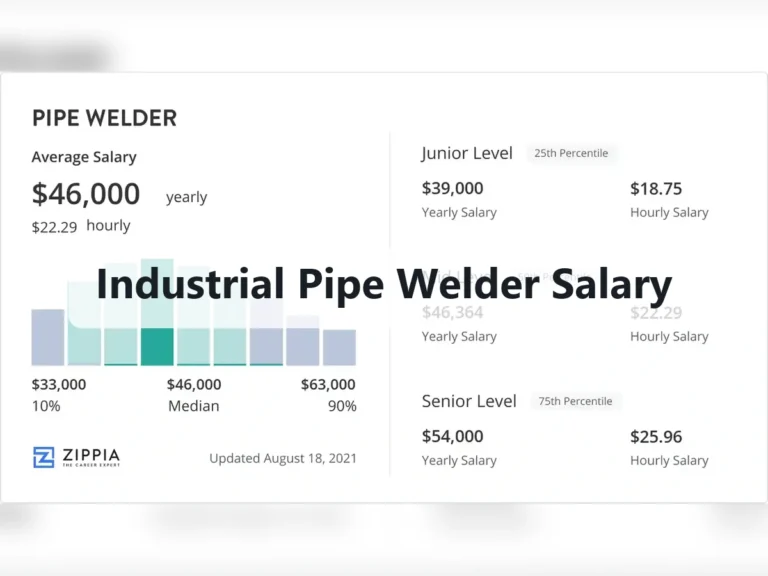
A practical estimate is about 22 to 36 per hour for many employed marine welders or roughly 45 000 to 75 000 annually before taxes when working a.
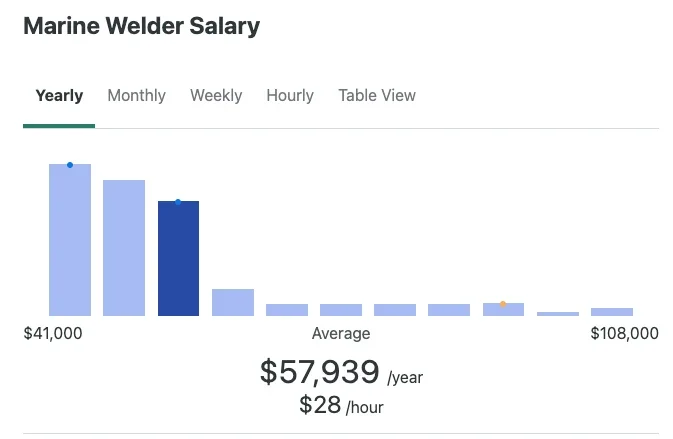
- Entry level: Approximately $18 to $25 per hour while building shop experience, procedure familiarity, and credentials.
- Mid-career: Often $25 to $36 per hour with reliable production skills and several years of marine work.
- Specialized: Roughly $36 to $50 or more per hour for difficult alloys, critical structures, defense work, supervision, or high-demand assignments.
- Annual totals: May vary widely because overtime, seasonal contracts, rotation schedules, and unpaid time between projects affect actual income.
These figures are planning ranges, not guaranteed wages. A shipyard welder paid hourly may have predictable local employment, whereas a traveling repair welder may have a higher gross total but irregular assignments and more personal disruption.
Hourly pay versus annual salary
Hourly compensation is common in shipyards and repair facilities because production schedules change and overtime is tracked closely An hourly rate of 30 equals 62 400 at 40.
For example 10 hours of overtime each week can materially change the result if those hours are paid at a premium rate However overtime is not a permanent.
Why salary websites disagree
Online salary estimates may combine shipyard welders, pipe welders, structural welders, underwater welders, welding supervisors, and general fabrication workers. Some reports show base wages; others include bonuses, overtime, or self-reported total pay.
Job location also affects comparisons A wage that seems high in a low-cost coastal town may be less.
What Factors Change Marine Welding Pay?
The largest pay differences usually come from the kind of work being performed rather than the word marine in the job title A welder working on thin noncritical.
Employers pay more when a worker can produce sound welds under difficult conditions interpret drawings follow qualified procedures pass inspections and solve problems without constant supervision Reliability matters.
- Project risk: Critical structural or pressure-related work generally demands tighter procedures and stronger inspection records.
- Work environment: Confined spaces, awkward positions, heat, noise, and marine exposure can support premium compensation.
- Schedule intensity: Nights, weekends, emergency repairs, and extended rotations often increase gross earnings.
- Labor market: Ports with shipbuilding, naval work, offshore energy, or heavy repair activity may offer more opportunities.
Experience and demonstrated skill
Years on the job help but employers often value evidence of performance more than time alone A welder who can consistently pass visual and nondestructive inspections read weld.
Entry-level workers commonly begin with preparation, tack welding, grinding, material handling, and supervised production. Advancement comes from taking on more difficult joints, positions, materials, and responsibility while maintaining safety and documentation standards.
Welding process and material
Marine work may involve shielded metal arc welding gas metal arc welding flux-cored arc welding gas tungsten arc welding and cutting or gouging processes Flux-cored and structural applications.
No process automatically guarantees higher pay The premium comes from a combination of demand scarcity procedure qualification production speed and the consequences of defects A worker who can.
Industry and vessel type
Commercial ship repair new construction military shipbuilding offshore energy recreational vessel construction and port infrastructure each have different.
Emergency repair can pay well because downtime is expensive. The trade-off is irregular scheduling, short notice, travel, and pressure to complete work safely under a tight deadline.
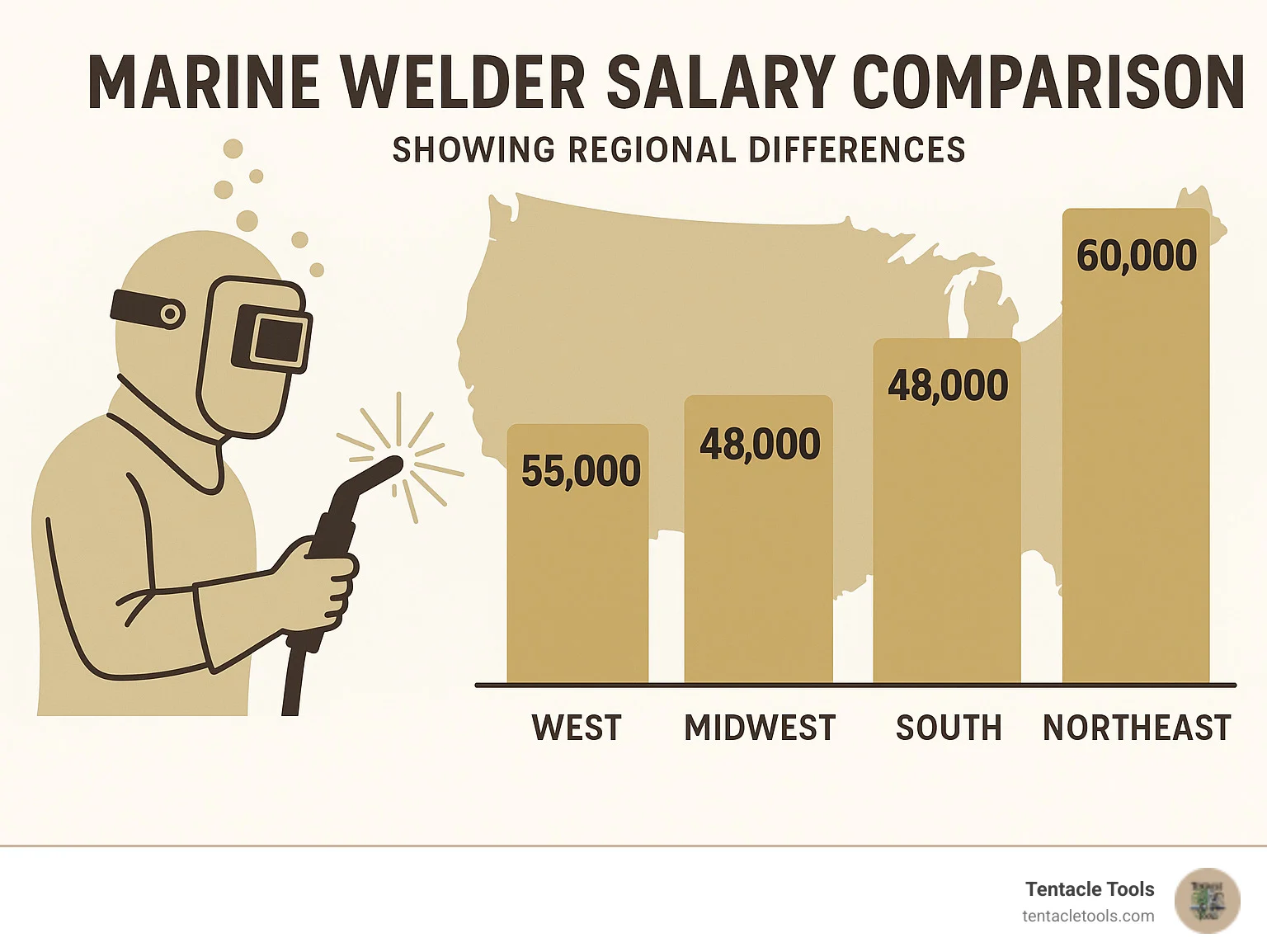
Location and regional demand
Coastal states with major ports tend to provide more marine welding opportunities, but inland shipyards and government facilities also employ welders. Pay is influenced by local labor supply, union presence, shipyard size, housing costs, and the number of competing industrial employers.
Before relocating for a higher wage compare rent transportation taxes insurance costs and the likelihood of year-round work.
How Overtime, Travel, and Benefits Affect Total Compensation
Many people searching for how much does a marine welder make are really asking how much they can expect to earn in a demanding year The answer depends.
Consider two hypothetical offers Job A pays 28 per hour for a steady 40-hour week with good health coverage Job B pays 25 per hour but typically offers.
- Overtime formula: Confirm when premium pay begins and whether weekends or holidays have separate rates.
- Per diem: Ask whether the allowance covers meals and lodging, and whether it is paid for every travel day.
- Travel time: Find out which travel hours are paid and whether transportation is provided.
- Benefits: Include health insurance, retirement contributions, paid leave, tool allowances, and training support.
Estimating annual earnings
Use a conservative calculation rather than the employer’s best-case projection. Multiply the base hourly rate by expected regular hours, add realistic overtime, then include guaranteed allowances separately from conditional bonuses.
- Calculate regular pay using the hours you are confident will be available.
- Estimate overtime from the actual schedule, not from a busy month or recruiter promise.
- Add shift premiums, project bonuses, and per diem only after checking whether they are guaranteed.
- Subtract unpaid gaps, travel expenses, tool purchases, insurance deductions, and taxes when estimating take-home pay.
For example, a $30 hourly wage with 2,080 regular hours produces $62,400 before overtime. If the worker also completes 300 overtime hours paid at time-and-a-half, the additional gross pay would be $13,500, bringing the combined total to $75,900 before other compensation.
Understanding per diem
Per diem is not the same as wages. It is generally intended to offset eligible travel expenses, and its value depends on whether the employer pays lodging directly, provides a fixed allowance, or requires the worker to cover costs first.
A large per diem can make a contract appear highly paid but it may not increase long-term earning power or retirement contributions Ask whether the amount is taxable.
Union and nonunion differences
Union marine jobs may provide a published wage scale, formal apprenticeship progression, overtime rules, health coverage, and retirement benefits. Nonunion employers may offer more flexibility or negotiate directly for specialized experience, but conditions can vary considerably from one company to another.
Compare the entire package instead of assuming one structure is always better. A slightly lower hourly wage with strong employer-paid benefits may exceed a higher wage with expensive insurance and no retirement contribution.
Which Marine Welding Jobs Usually Pay More?
Higher-paying roles tend to combine technical difficulty limited labor supply inconvenient schedules or significant project consequences That does not mean every difficult job is well paid The employer. This distinction matters when answering “how much does a marine welder make”.
Marine welders can increase their options by developing adjacent skills. Fit-up, blueprint reading, rigging awareness, inspection preparation, corrosion repair, pipe work, and basic fabrication planning can make a worker useful across more phases of a project.
- Critical structural work: Hulls, frames, decks, and load-bearing components may require strict procedure control and inspection.
- Defense shipbuilding: Government vessels can offer stable work but may involve eligibility and security requirements.
- Emergency repair: Rapid response work can command premiums when vessel downtime is costly.
- Travel assignments: Shipyard shutdowns and remote projects may add overtime, lodging, or per diem.
Shipyard production welder
Shipyard production welders work on new construction or major refits. The work may be repetitive in some phases, but production targets, overhead welding, confined spaces, and inspection requirements can make it physically demanding.
Large yards may provide a clearer advancement ladder and more consistent hours. Smaller yards may offer broader experience because one worker handles fitting, welding, repair, and field installation.
Marine repair welder
Repair welders diagnose damage, remove defective material, prepare surfaces, and restore components that may be dirty, corroded, difficult to access, or affected by previous repairs. Adaptability is especially valuable because repair conditions rarely match a clean shop setup.
Emergency and traveling repair work can raise earnings, but workers should examine how often projects occur and whether downtime between assignments is paid. The annual result may be less predictable than the hourly rate suggests.
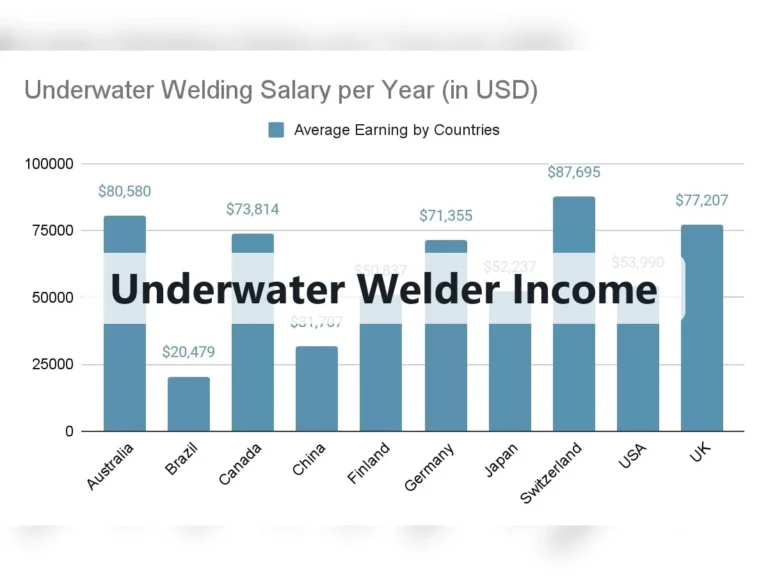
Underwater welding
Underwater welding is frequently described as a premium specialty, but it is not simply ordinary welding performed underwater. It generally involves commercial diving training, underwater construction knowledge, decompression procedures, surface-supplied equipment, and strict safety controls.
Income varies with diving experience project type depth season travel and whether the worker is employed by a diving contractor A person should not pursue this path solely.
Lead welder or welding supervisor
Leadership positions may pay more because they involve coordinating crews, reviewing drawings, tracking production, supporting inspections, and communicating with supervisors or inspectors. The job can involve less continuous welding and more accountability for quality and schedule.
Strong communication and documentation skills matter at this level. A lead who can identify a fit-up problem early and prevent widespread rework may save more money than a faster individual welder working alone.
Certifications and Skills That Can Improve Pay
Credentials can help an applicant pass an initial screening, but they do not replace practical ability. The most valuable certification is usually one connected to the employer’s actual work, accepted procedures, and customer requirements.
Before paying for training, review local job postings and ask target employers which qualifications they regularly use. A credential with no demand in your market may add expense without improving your opportunities.
- Procedure qualifications: Build capability in the processes, positions, thicknesses, and materials used by nearby employers.
- Blueprint literacy: Learn weld symbols, dimensions, tolerances, joint details, and revision control.
- Inspection readiness: Understand visual inspection and the basic purpose of methods such as magnetic particle, dye penetrant, ultrasonic, and radiographic testing.
- Safety competence: Treat confined-space, hot-work, fall-protection, respiratory, and marine access training as essential, not optional.
Welding certifications
Recognized welding tests can demonstrate that a worker can make an acceptable weld under specified conditions. Their usefulness depends on whether the certification is current, properly documented, and relevant to the employer’s procedures.
Some employers conduct their own qualification tests even when an applicant has previous credentials. This is normal because the company must verify performance under its materials, equipment, procedures, and quality system.
Inspection and quality skills
A welder does not need to become an inspector to benefit from understanding inspection. Knowing why defects occur, how discontinuities are identified, and what documentation inspectors need can reduce rework and improve trust.
Common failure points include poor cleaning, incorrect preheat, contaminated consumables, wrong settings, inadequate fit-up, excessive heat input, and failure to follow the qualified procedure. Preventing these problems is often more valuable than repairing them later.
Reading drawings and procedures
Welders who can interpret fabrication drawings and welding procedure specifications are easier to place on complex jobs. They can verify joint preparation, consumable requirements, positions, sequencing, and inspection hold points before striking an arc.
This skill also supports advancement into fitting, quality coordination, estimating, and supervision. It improves earning potential because it expands the range of work a person can perform accurately.
How to Evaluate a Marine Welder Job Offer
The best offer is not necessarily the one with the highest advertised hourly rate. A careful comparison should show how much work is guaranteed, what expenses the employer covers, and which conditions could reduce the projected total.
Request the details in writing whenever possible. If a recruiter gives only an annual estimate, ask for the hourly base, normal weekly hours, overtime assumptions, assignment length, and benefit deductions used to create that estimate.
- Guaranteed work: Determine whether the schedule is year-round, seasonal, project-based, or dependent on customer demand.
- Actual duties: Confirm whether the role includes fitting, grinding, rigging, confined-space entry, travel, or underwater work.
- Expenses: Identify who pays for lodging, transportation, meals, tools, protective equipment, medical exams, and required training.
- Exit conditions: Ask about layoffs, assignment cancellation, probation, repayment clauses, and notice requirements.
Questions worth asking
- What is the base hourly wage, and when are raises normally considered?
- How many hours were actually available to workers in the previous comparable project?
- Is overtime voluntary, expected, or dependent on production needs?
- Are travel days, waiting days, weather delays, and training days paid?
- What tests, certifications, tools, and personal protective equipment must I provide?
- What benefits begin immediately, and what payroll deductions apply?
Red flags in compensation claims
Be cautious when an employer emphasizes a very high annual figure without explaining the number of weeks worked. A projection based on constant overtime may not be realistic, especially in seasonal repair or shutdown work.
Other warning signs include vague per diem language unpaid travel unclear lodging arrangements pressure to purchase expensive training.
Common Challenges That Affect Earnings and Career Longevity
Marine welding can be physically demanding and technically unforgiving Workers may deal with awkward positions heat noise vibration fumes wet surfaces ladders confined spaces and changing weather These.
Fatigue is also a financial issue Long overtime periods can increase gross pay in the short term but may reduce concentration and raise the.
- Follow the site plan: Hot-work permits, gas testing, ventilation, fire watches, and confined-space controls are part of the job.
- Protect capacity: Use correct respiratory, eye, hearing, hand, fall, and skin protection for the task.
- Respect fatigue: Report unsafe exhaustion and avoid treating overtime as automatically worth the risk.
- Keep records: Track qualifications, training, procedures, projects, and inspection results for future applications.
Career longevity improves when workers maintain fitness, use safe lifting and positioning practices, manage exposure to fumes and noise, and learn to recognize when equipment or conditions are unsafe. No wage premium makes bypassing a required control sensible.
Frequently Asked Questions About Marine Welder Pay
Can a marine welder earn six figures?
Yes, but six-figure earnings are not typical for every marine welder. They are more plausible when a worker combines a high base rate with extensive overtime, travel premiums, emergency repair work, specialized defense or offshore projects, supervision, or long rotations.
Ask whether the six-figure number reflects a normal year or an unusually busy period. Gross income may also include allowances that do not provide the same value as wages or benefits.
Do marine welders make more than construction welders?
They can, but the comparison depends on specialization, location, union status, overtime, and project type. Marine work may pay more for difficult access, corrosion exposure, critical structures, or travel, while a specialized construction welder may earn more in a different regional market.
Compare the full compensation package and schedule rather than relying on industry labels.
Does underwater welding pay more than shipyard welding?
It may offer higher project or daily compensation, but underwater welding requires additional commercial diving skills and often involves irregular work, travel, and significant physical demands. The annual income is not automatically higher for every diver-welder.
Training costs, equipment, downtime, insurance, and the availability of diving projects should be included in the decision.
How much experience is needed to get a marine welding job?
Some shipyards hire entry-level workers for helper or trainee positions, particularly when applicants have basic welding-school experience and a strong safety record. More advanced structural, pipe, defense, or repair assignments usually require demonstrated production experience and relevant qualifications.
Practical shop hours, a clean testing history, blueprint reading, and dependable attendance can help compensate for limited marine experience.
What certification helps a marine welder earn more?
The most useful credential is one recognized by employers in the market where you want to work and connected to the procedures they use. Structural, pipe, process, position, material, inspection, and commercial diving qualifications can each matter in the right setting.
Contact target employers before enrolling. Their requirements will reveal whether a particular certification improves eligibility or merely adds a line to a résumé.
Are marine welding jobs paid hourly or by salary?
Hourly pay is common because shipyards and repair contractors track production time and overtime. Salaried roles are more likely at supervisory, project coordination, estimating, or management levels.
An hourly job may produce more annual income during a busy project, while a salary may provide steadier pay between production changes. Read the overtime and scheduling terms carefully.
What is the best way to increase marine welding income?
Build a combination of reliable weld quality, relevant procedure qualifications, drawing interpretation, inspection awareness, and flexibility across processes or materials. Then target employers with steady projects rather than focusing only on the highest advertised rate.
Negotiating is easier when you can document passed tests, difficult assignments, reduced rework, leadership responsibilities, and the specific skills the employer needs.
Conclusion
How much does a marine welder make depends on more than a job title A realistic U S range is often 45 000 to 75 000 annually with.
Evaluate base wage, guaranteed hours, overtime, per diem, benefits, training costs, safety conditions, and assignment stability together. A strong career decision balances income with sustainable work and verified qualifications.
Compare three current marine welding offers using guaranteed annual pay, realistic overtime, benefits, expenses, and schedule—not the advertised maximum.