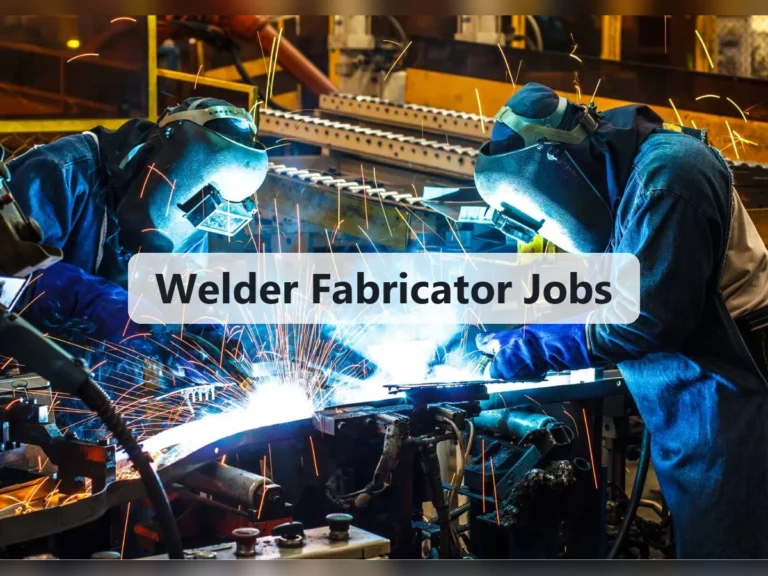
Welder Job Responsibilities: Clear Overview and Expert Insights
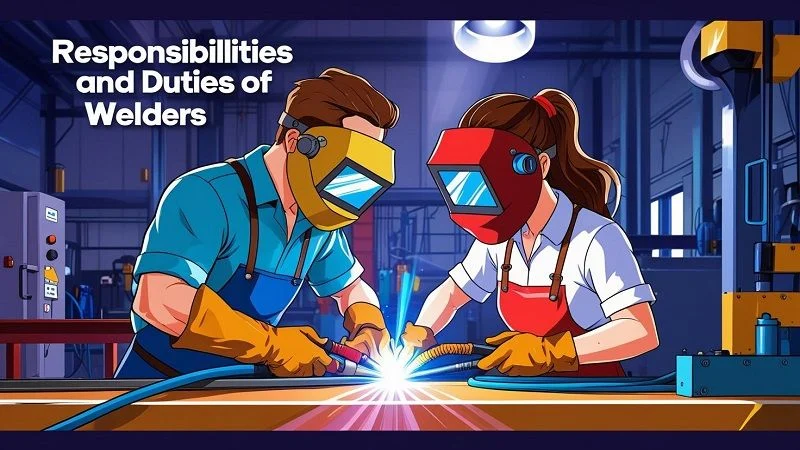
Welder job responsibilities include preparing materials, setting up equipment, joining metal safely, inspecting welds, and maintaining accurate production records.
Understanding welder job responsibilities requires more than listing weld metal on a job description A welder may read blueprints select a process calculate fit-up requirements prepare surfaces control.
A rushed career decision or hiring decision can overlook one easily missed detail welding is both a hands-on production job and a quality-control responsibility A person can produce.
This guide explains the core duties how responsibilities differ by workplace what employers commonly expect and which skills separate entry-level work from advanced assignments You will also learn how to evaluate a.
- ✓Welders prepare, fit, join, inspect, and document metal components—not simply operate a welding machine.
- ✓Responsibilities vary substantially among manufacturing, construction, maintenance, automotive, shipyard, and pipeline environments.
- ✓Safety, blueprint reading, measurement, and quality control are central duties because welding defects can affect performance and structural integrity.
- ✓Advanced roles add procedure compliance, inspection records, specialized processes, troubleshooting, and sometimes mentoring or supervision.
What Welder Job Responsibilities Usually Include
The core responsibilities begin before the arc starts. A welder reviews work instructions, drawings, weld symbols, material specifications, and the required joint design. The job may involve identifying the base metal, confirming thickness, checking dimensions, and determining whether the assignment calls for MIG, TIG, stick, flux-cored arc welding, submerged arc welding, or another process.
Preparation is often the difference between a reliable weld and a costly repair The welder cleans away rust paint oil moisture mill scale or other contaminants cuts or.
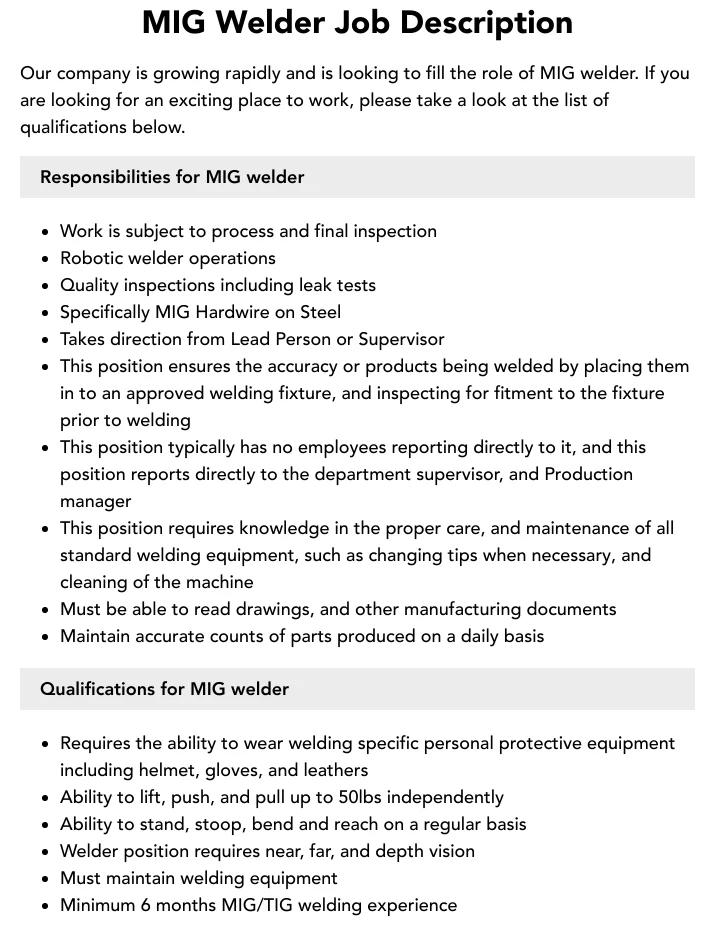
- Read the assignment: Confirm the drawing, weld symbols, dimensions, material, joint type, and acceptance requirements before setup.
- Prepare the joint: Clean, bevel, gap, align, and secure parts so the weld can achieve the intended strength and profile.
- Control the process: Use suitable amperage, voltage, wire speed, travel speed, electrode, gas flow, and technique for the work.
- Protect the result: Prevent contamination, excessive heat, distortion, spatter, and unsafe exposure during and after welding.
Preparing materials and work areas
Material preparation can include measuring and marking stock cutting with saws or oxyfuel equipment grinding edges drilling holes removing burrs and arranging parts for access Welders may use.
The work area also needs preparation Combustible materials should be removed or protected ventilation should be adequate welding screens may be required and leads and hoses should be.
Operating and adjusting welding equipment
Welders set up power sources torches guns regulators ground connections wire feeders electrode holders and shielding systems They choose consumables that match the procedure and replace worn contact.
The responsibility is not always to diagnose every electrical or mechanical problem. A welder should recognize unsafe or abnormal conditions—such as damaged insulation, gas leaks, unstable grounding, overheating, or irregular arc behavior—and stop or report them according to workplace procedure.
Inspecting and documenting finished work
Inspection may begin with a visual check for cracks undercut overlap porosity incomplete fusion excessive spatter poor bead shape crater defects and incorrect weld size The welder may.
More advanced inspection methods, including dye penetrant, magnetic-particle, ultrasonic, or radiographic testing, may be performed by qualified inspection personnel rather than the welder. Even so, the welder is responsible for producing work that can pass the applicable inspection and for correcting defects when authorized.
How Responsibilities Change by Welding Environment
The same basic process can look very different from one workplace to another A production welder may repeat a controlled joint hundreds of times per shift while a.
When comparing welder job responsibilities, look for the environment behind the title. “Welder” might describe a highly standardized operator, a structural fabricator, a repair specialist, a pipe welder, or a multi-process technician who works from complex drawings. Each role demands a different balance of speed, precision, independence, physical endurance, and documentation.
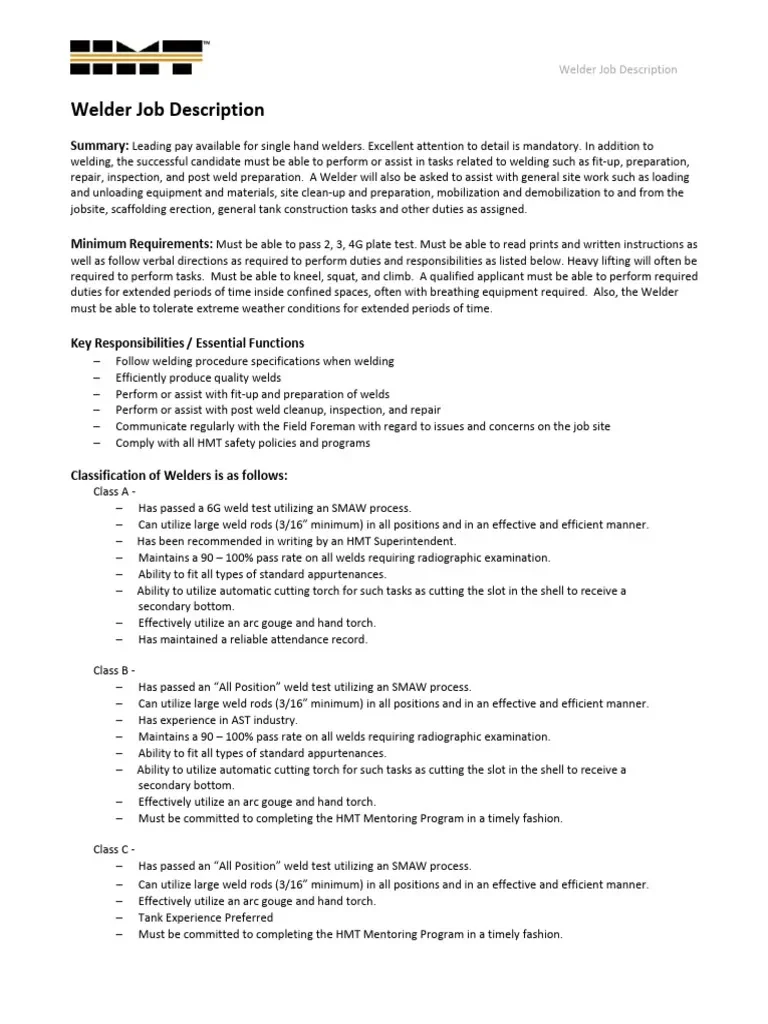
- Production manufacturing: Emphasizes repeatability, takt time, fixtures, production quotas, and consistent visual quality.
- Custom fabrication: Requires stronger blueprint reading, layout, fit-up judgment, dimensional control, and problem-solving.
- Construction and structural work: Adds field conditions, elevated work, weather exposure, staging, access, and strict safety coordination.
- Maintenance and repair: Focuses on diagnosis, safe isolation, variable materials, access limitations, and restoring serviceable equipment.
Manufacturing and production welding
Production welders commonly work from standardized work instructions and use fixtures that locate parts consistently. Responsibilities may include loading components, checking the first piece, completing repeated welds, removing spatter, inspecting the assembly, and moving finished work to the next station. Meeting output expectations matters, but speed cannot replace correct penetration, dimensions, or required inspection results.
Some facilities use robotic welding cells. In that setting, the welder may load and unload parts, verify fixture alignment, monitor wire and gas supplies, inspect sample welds, adjust approved parameters, and respond to alarms. Programming, teach pendant operation, or robot troubleshooting may be assigned to a welding technician or skilled operator, depending on the facility.
Structural, commercial, and field welding
Structural welders may join beams, columns, braces, stairs, platforms, tanks, or other large assemblies. They often work in awkward positions and must coordinate with fitters, ironworkers, riggers, supervisors, inspectors, and other trades. Wind, rain, temperature, elevated work, limited access, and changing site conditions can affect both safety and weld quality.
Field work also increases the importance of planning The welder may need to protect the weld area from wind arrange power and leads use temporary supports confirm preheat.
Pipe, pressure, and specialized welding
Pipe and pressure-related work generally places greater emphasis on joint preparation position root quality cleanliness procedure compliance and inspection Welders may work with carbon steel stainless steel nickel.
Specialized work may require current qualifications, documented procedure adherence, purge control, preheat or interpass temperature monitoring, and detailed traceability. The job posting should clarify whether the employer expects the worker to arrive with a particular qualification, complete testing after hire, or perform work under direct supervision.
Maintenance, repair, and repair judgment
Maintenance welders repair worn components, cracks, frames, guards, brackets, conveyors, heavy equipment, or production machinery. They must first understand why the part failed and whether welding is an approved repair. Welding over contamination, an unknown alloy, trapped pressure, or a fatigued structure can create a dangerous or temporary fix.
Repair work often involves disassembly, cleaning, preheating, controlled cooling, machining, grinding, or post-weld treatment. It may also require coordination with maintenance planners and operations staff so equipment is isolated, drained, de-energized, and safe to work on.
Safety Duties Are Part of the Job, Not an Add-On
Welding combines intense heat, ultraviolet radiation, fumes, compressed gases, electricity, sharp edges, heavy components, and fire hazards. A welder is expected to use required personal protective equipment, follow hot-work rules, keep the work area controlled, and report hazards before they become incidents. Safety duties remain important even when the task is familiar or repetitive.
Personal protective equipment may include a properly rated welding helmet, safety glasses, flame-resistant clothing, gloves, hearing protection, safety footwear, and respiratory protection when required by the hazard assessment. The correct protection depends on the process, material, ventilation, location, and employer program; a helmet alone does not protect against every hazard.
- Control ignition sources: Inspect the area for combustibles, flammable residues, openings, and hidden spaces where sparks can travel.
- Control fumes: Use local exhaust or other approved ventilation and follow the employer’s respiratory-protection requirements.
- Control energy: Verify that equipment, tanks, lines, and machinery are isolated or made safe before repair welding begins.
- Control access: Use screens, barriers, signs, and communication to protect nearby workers from arc flash, sparks, and hot metal.
Fume and exposure awareness
Welding fumes vary with the base metal, coating, filler, process, and work position. Painted, galvanized, stainless, or solvent-contaminated surfaces can create additional exposure concerns. A responsible welder does not assume that a familiar material is harmless; the worker follows the site assessment, safety data, ventilation plan, and training provided by the employer.
Respirators, when required, are part of a broader program involving selection, medical evaluation, fit testing, training, cleaning, and storage. A disposable mask is not automatically an adequate substitute for an approved respiratory-control program.
Fire, electrical, and compressed-gas hazards
Welding leads, electrode holders, torches, and power sources should be inspected before use. Wet conditions, damaged insulation, poor grounding, or improvised connections can increase shock risk. Gas cylinders must be secured, identified, protected from damage, and handled with the correct regulators and connections.
Fire prevention includes removing combustibles where possible, using fire-resistant covers, checking the opposite side of walls or floors, and maintaining the required fire watch. Sparks can travel farther than the visible work area, especially through cracks, ducts, openings, and lower levels.
Skills, Tools, and Qualifications Employers Look For
Employers commonly evaluate a combination of technical ability, judgment, reliability, and physical readiness. A person may learn basic torch or gun control quickly but still need substantial practice to read drawings, control distortion, weld out of position, or identify a defect before it becomes expensive rework.
Job descriptions often mention process experience, but the surrounding language reveals the real expectations. “Work from detailed drawings” signals a need for blueprint and weld-symbol literacy. “Meet production goals” signals pace and repeatability.
“Perform field installation” signals mobility, access, weather, and coordination demands.
- Technical foundation: Can you select a process, prepare a joint, control the arc, and recognize common discontinuities?
- Measurement ability: Can you use basic layout and inspection tools accurately rather than relying on visual estimates?
- Documentation: Can you complete travelers, inspection records, repair notes, or traceability paperwork?
- Work readiness: Can you safely lift, position, kneel, climb, work in restricted spaces, or tolerate heat and noise as the role requires?
Blueprints, symbols, and measurements
Welders need to interpret dimensions, tolerances, section views, material callouts, joint details, and welding symbols. A symbol may communicate the location, side, size, length, contour, finish, or type of weld. Misreading one element can produce a joint that looks acceptable but does not meet the design.
Measurement skills also support fit-up and final inspection. Welders may check root openings, bevel angles, offsets, squareness, alignment, weld size, and overall dimensions. These checks help identify a problem while correction is still practical.
Process knowledge and material control
Each welding process has different equipment, consumables, advantages, and limitations. MIG is often productive and accessible for many shop applications; TIG offers precise control and clean results; stick welding is useful in varied field conditions; flux-cored processes can provide high deposition and good outdoor capability when the procedure and shielding arrangement allow it.
Material control is equally important. Aluminum requires different preparation and handling from carbon steel, while stainless steel may require strict cleanliness to avoid contamination. Filler metal must be identified, stored, and used according to workplace and procedure requirements.
Soft skills and production judgment
Welders communicate with fitters, inspectors, engineers, supervisors, and other operators. They need to ask questions when a drawing conflicts with the physical assembly, a procedure does not fit the situation, or a defect appears outside their authority to repair. Quietly guessing can create more risk than pausing for clarification.
Dependability also matters. Arriving prepared, maintaining tools, following the sequence, recording problems, and leaving the station safe are routine behaviors that affect the entire production flow. Experienced workers often prevent problems by noticing poor fit-up, missing material identification, or a damaged fixture before welding begins.
Common Failure Points and How Welders Prevent Them
Many welding problems begin before the arc is struck. Incorrect joint preparation, contamination, wrong consumables, inadequate shielding, poor grounding, and unstable fit-up can all produce defects that cannot be fixed by moving the torch faster or increasing the power. Good welders connect the visible symptom to the likely cause.
When reviewing welder job responsibilities, quality language deserves close attention. Terms such as “first-piece inspection,” “non-destructive testing,” “weld procedure specification,” “rework,” “traceability,” and “dimensional inspection” indicate how much responsibility the worker has for preventing and documenting defects.
- Welding through contamination: Oil, paint, rust, moisture, and mill scale can cause porosity, inclusions, or unstable arc behavior.
- Ignoring fit-up: Excessive gaps, mismatch, or poor alignment can create burn-through, lack of fusion, distortion, or undersized welds.
- Changing settings casually: Unapproved changes may move the work outside the qualified procedure or create inconsistent results.
- Hiding rework: Failing to report a defect prevents root-cause correction and can compromise traceability or inspection.
Defects and likely causes
Porosity may result from moisture, contamination, inadequate shielding, drafts, leaks, or poor gas coverage. Undercut can be associated with excessive current, excessive travel speed, or poor manipulation. Incomplete fusion may reflect insufficient heat, an unfavorable angle, excessive travel speed, or an obstructed joint.
Distortion results from uneven heating and cooling. Welders reduce it through proper fit-up, balanced sequencing, appropriate tack placement, controlled heat input, fixtures, or planned restraint. Restraint can help maintain dimensions but may also increase residual stress, so it is not a universal solution.
Repair and escalation decisions
A welder may grind out a defect and reweld it when the procedure permits. Other situations require supervisor, quality, engineering, or inspection approval—especially when the defect is in a critical component, the base material is uncertain, repeated repairs occur, or the repair could reduce thickness or alter properties.
Stopping work is appropriate when conditions are unsafe, the drawing is unclear, the material is unidentified, the equipment is defective, or the requested result conflicts with the approved procedure. A productive employee is not the person who welds fastest at any cost; it is the person who protects quality and communicates early.
How to Read a Welder Job Description
A job posting should be evaluated as a description of working conditions, not only a list of skills. Look for the processes used, materials handled, work positions, shift schedule, overtime expectations, travel, indoor or outdoor location, lifting requirements, inspection standards, and whether the role is production, fabrication, installation, repair, or a mixture.
Pay attention to verbs. “Assist,” “learn,” and “work under supervision” usually suggest an entry-level path. “Interpret,” “fit,” “inspect,” “repair,” “qualify,” “troubleshoot,” and “lead” indicate increasing independence and accountability.
The word “all other duties” should not replace a clear explanation of the primary work.
- Process match: Does the employer require the processes and positions you already know, or provide training and qualification testing?
- Environment match: Are you comfortable with shop production, field conditions, confined spaces, elevated work, heat, noise, or travel?
- Quality match: Will you perform visual inspection only, or handle formal records and work subject to non-destructive testing?
- Schedule match: Do the shift, overtime, weekend, seasonal, or shutdown expectations fit your availability?
Entry-level versus experienced responsibilities
Entry-level welders may prepare materials, load fixtures, perform supervised welds, clean parts, identify obvious defects, and learn basic drawings and procedures. They are still responsible for PPE, safe behavior, careful preparation, and reporting problems, even when a senior worker makes final decisions.
Experienced welders are more likely to handle complex fit-up, multiple processes, out-of-position work, procedure-sensitive materials, repair decisions, troubleshooting, and mentoring. Some also help train coworkers, verify first-piece work, organize jobs, or coordinate with inspection personnel.
Questions worth asking before accepting
Useful questions focus on the actual assignment: Which processes and materials are used most often? Is the work primarily production, custom fabrication, installation, or repair? What inspections are required?
Are qualifications performed before hiring or after onboarding? How much blueprint reading and fitting is expected?
Also ask about ventilation, PPE, shift patterns, overtime, travel, lifting, work at height, confined-space exposure, and advancement. These details help distinguish a role that develops your preferred skills from one that merely uses a familiar job title.
FAQ About Welder Job Responsibilities
What are the main daily responsibilities of a welder?
A welder typically reviews drawings or instructions, prepares and aligns materials, sets up equipment, completes welds, checks the result, cleans the work area, and documents production or quality information. The exact duties depend on the process and industry.
Do welders have to inspect their own work?
Usually, yes. Welders commonly perform visual and dimensional checks and report defects, although formal inspection or non-destructive testing may be assigned to qualified inspectors. The welder remains responsible for following the procedure and correcting authorized problems.
Are welders responsible for blueprint reading?
Many are. Even production welders may need to interpret basic dimensions, weld symbols, joint details, and work instructions. Fabrication, structural, pipe, and repair roles usually demand more advanced drawing and layout skills.
What safety duties belong to a welder?
Safety duties include using required PPE, inspecting equipment, controlling sparks and hot metal, maintaining ventilation, protecting nearby workers, handling cylinders correctly, and following lockout, hot-work, confined-space, or respiratory-protection procedures when applicable.
Do welder responsibilities include fitting and cutting?
Often they do, particularly in fabrication and repair positions. A welder may measure, cut, bevel, grind, align, tack, and fixture components before completing the final weld. Some employers separate fitting into a dedicated role, so the job description should be checked carefully.
What is the difference between a welder and a welding operator?
A welder generally performs and controls manual or semi-automatic welding while using judgment about fit-up, technique, and quality. A welding operator may run a more standardized machine or automated cell, although many workplaces use the titles differently.
Can a welder refuse an unsafe task?
A worker should stop and report conditions that appear unsafe, outside training, or inconsistent with the approved procedure. The proper escalation path depends on the employer’s safety program, but continuing through an uncontrolled hazard can endanger the worker and others.
Conclusion
Welder job responsibilities cover preparation, equipment setup, welding technique, inspection, documentation, maintenance of a safe work area, and communication with the rest of the operation. The role becomes more demanding as materials, positions, inspection requirements, field conditions, and consequences of failure increase.
The major limitation is that no universal duty list fits every welding job. Always compare the posting with the actual process, material, work environment, qualification requirements, safety controls, and quality expectations before deciding whether the position is a good match.
Before applying or accepting an offer, mark every process, material, inspection, safety, schedule, and physical requirement in the job description and identify which ones need training or clarification.