Welder Helper Jobs: Complete Guide and Essential Information
Welder helper jobs are entry-level construction or industrial roles that support welders with materials, tools, preparation, safety, and job-site organization while building hands-on experience.
Welder helper jobs can be a practical entry point into welding fabrication shipbuilding pipeline work manufacturing and commercial construction A helper may spend the day moving and cleaning.
A common assumption is that a helper simply watches an experienced welder and waits for a chance to strike an arc In reality strong helpers learn how the.
- ✓Helpers support welding production through preparation, material handling, tool care, measurements, cleanup, and safety—not just observation.
- ✓Most employers value reliability, physical readiness, safe work habits, and willingness to learn as much as prior welding experience.
- ✓The job can lead to welding, fabrication, inspection, foreperson, or specialized industrial work, but progress usually requires deliberate skill development.
- ✓Pay and working conditions vary substantially by location, industry, shift, travel, union status, and hazard level.
What Welder Helper Jobs Actually Involve
The helper s main purpose is to keep the welder productive without compromising quality or safety Welding often involves several connected tasks before and after the arc is.
On a construction site, the helper may work outdoors, climb ladders, carry equipment, and coordinate with fitters, laborers, riggers, or pipe crews. In a shop, the work may be more repetitive and organized around drawings, fixtures, production targets, and material flow. Neither setting is automatically easier; each demands attention to different details.
- Support is technical: Correct measurements, clean joints, proper tool setup, and timely material delivery affect weld quality.
- Conditions vary: Shops may be controlled but repetitive, while field work may involve weather, travel, awkward positions, and changing priorities.
- Direction matters: A helper should follow the lead welder’s or supervisor’s instructions and ask when a task is unclear.
- Quality starts early: Contaminated metal, wrong material, poor fit-up, or damaged equipment can create problems before welding begins.
Typical daily duties
Job postings often use different titles for similar work, including welding assistant, welding laborer, fabrication helper, fitter helper, or entry-level welder. Read the duties rather than relying on the title, because some employers expect basic tack welding while others limit the role to preparation and support.
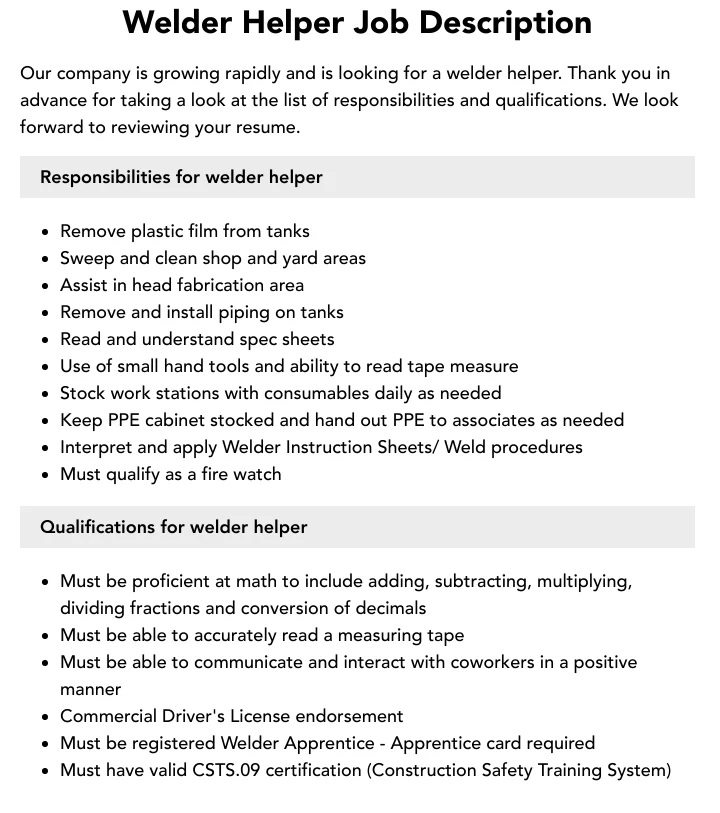
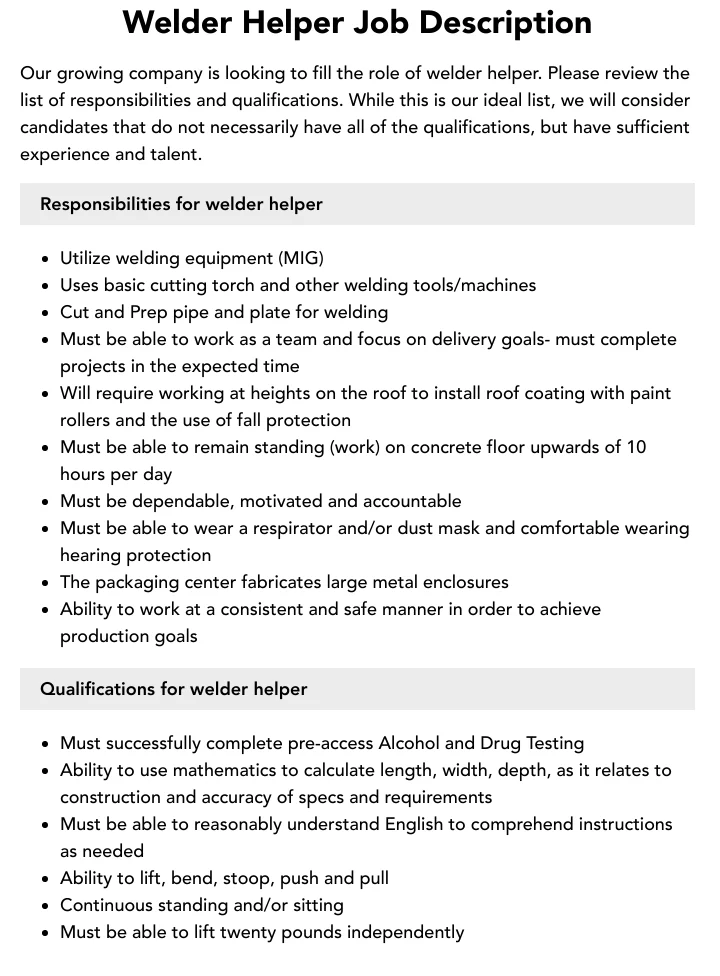
- Move, stage, and organize plate, pipe, structural members, fittings, and tools.
- Clean rust, paint, oil, mill scale, and debris from surfaces using approved methods.
- Measure, mark, align, clamp, and hold pieces according to drawings or instructions.
- Prepare welding machines, leads, ground clamps, hoses, screens, and ventilation equipment under supervision.
- Remove slag, spatter, and sharp edges after welding when the process requires it.
- Use grinders, wire brushes, drills, saws, clamps, magnets, and hand tools safely.
- Inspect cables, gas hoses, regulators, guards, and personal protective equipment before use.
- Maintain housekeeping and separate scrap, reusable material, and completed work.
- Record measurements, material movement, production information, or inspection notes when required.
What helpers usually do not decide
An entry-level helper normally does not independently select a welding procedure, change machine settings without authorization, approve a weld, interpret a code requirement, or repair energized equipment. Those decisions may belong to a qualified welder, welding supervisor, inspector, or maintenance specialist.
That limitation is not a dead end. It protects the employee and the project while the helper learns how procedures, drawings, and quality controls work. A good employer gives progressively harder assignments as the worker demonstrates competence.
Where These Jobs Are Found
Industry affects nearly every part of the position, including physical demands, schedule, travel, tools, training, and advancement. Before applying, identify what the company makes or builds and whether the work is shop-based, field-based, or a combination.
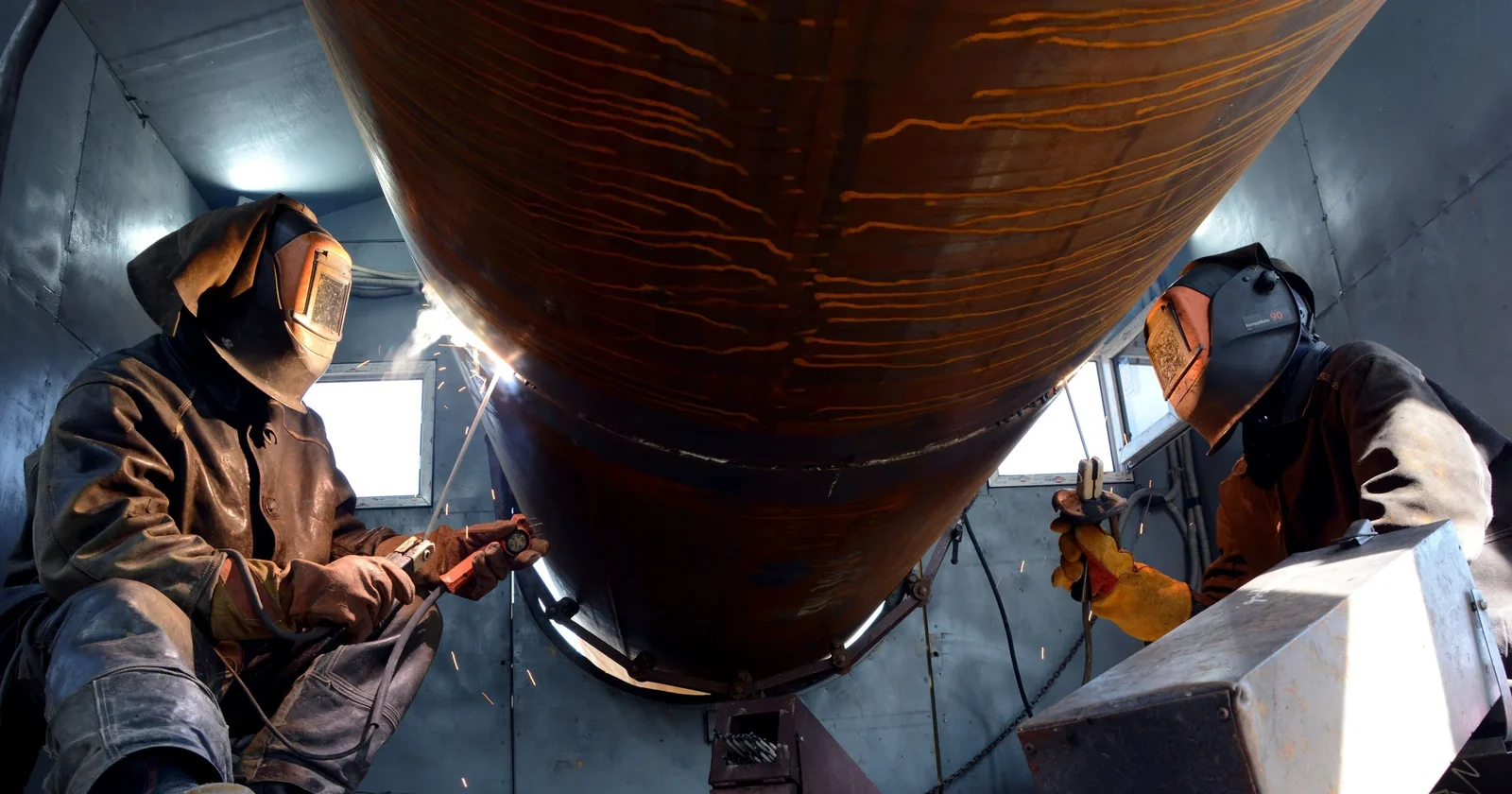
Manufacturing employers may assign helpers to repeatable production cells, while contractors may move crews between commercial sites, plants, bridges, utility projects, or industrial shutdowns. Shipyards and heavy fabrication facilities can involve large components, confined work areas, strict access rules, and multiple trades working nearby.
- Fabrication shop: A possible fit for people who prefer organized work, repeatable processes, drawings, and material handling.
- Construction: A possible fit for people comfortable with changing locations, weather, ladders, coordination, and deadlines.
- Industrial maintenance: Often involves troubleshooting, shutdown schedules, tight spaces, and strong permit and lockout procedures.
- Shipyard or heavy manufacturing: May require extensive PPE, large-part handling, confined-area awareness, and strict quality documentation.
| Work setting | Common demands | Questions to ask |
|---|---|---|
| Welding or fabrication shop | Standing, repetitive handling, measurements, production pace | How much lifting is required? Is training provided on drawings and tools? |
| Commercial construction | Outdoor work, elevation, travel between sites, coordination | What are the normal hours and travel expectations? |
| Industrial plant or maintenance | Permits, shutdowns, confined areas, changing hazards | What site qualifications and safety orientations are required? |
| Shipyard or heavy fabrication | Large components, noise, restricted spaces, detailed procedures | What PPE, physical tests, and schedule rotations apply? |
How to evaluate a job posting
Look for concrete information about the work location, shift, overtime, travel, lifting, required PPE, starting pay, training, and advancement. Vague promises such as “excellent earning potential” are less useful than a stated wage range and a clear explanation of how raises are earned.
Also distinguish employee positions from temporary assignments or contractor placements. Ask who supplies tools, who provides safety training, how payroll works, and whether the role is expected to become permanent. A legitimate employer should be able to explain the job without asking applicants to pay for a guaranteed position.
Qualifications, Skills, and Physical Demands
Many entry-level employers do not require a welding certificate for a helper position, but they do expect dependable attendance, basic workplace judgment, and the ability to learn. A high school diploma or equivalent may be preferred, and some jobs require a driver’s license, drug screening, background screening, or site-specific credentials.
The physical side deserves an honest evaluation. Helpers may stand for long periods, lift or carry materials, work in kneeling or crouched positions, reach overhead, climb, and tolerate heat, noise, dust, sparks, and uncomfortable weather. The exact requirements should be confirmed with the employer rather than guessed from the title.
- Reliability: Arriving on time matters because a missing helper can delay an entire crew.
- Safety judgment: Stop and ask when equipment, material, or instructions seem unsafe or unclear.
- Basic measurement: Comfort with a tape measure, fractions, markings, and simple arithmetic is useful.
- Tool care: Clean, organized, inspected tools reduce delays and prevent avoidable damage.
Useful skills before the first day
Experience with construction, mechanics, metalwork, warehouse work, farm equipment, automotive repair, or technical education can help, even if it did not involve welding. Employers often value evidence that an applicant can use hand tools, follow a process, protect equipment, and work respectfully around others.
Basic blueprint reading is an advantage. You do not need to claim expertise, but learning common views, dimensions, symbols, weld symbols, material callouts, and revision information can make instructions easier to follow. A community college, trade school, or workforce program may offer introductory welding and safety training.
Physical readiness without overpromising
Do not tell an employer that you can lift an unspecified weight or perform a task you have not safely practiced. Instead, ask for the essential functions and explain any limitation accurately. Some companies can accommodate a restriction; others may not be able to do so for a field position.
Wear practical clothing for an interview or orientation but do not arrive in unsafe loose clothing or open-toed shoes if a facility tour is possible Once hired use only the PPE specified by the employer and suited to the hazard casual sunglasses improvised guards or personal.
Safety Responsibilities and Common Hazards
Welding environments combine heat, electricity, compressed gases, ultraviolet radiation, fumes, sharp metal, noise, and moving equipment. A helper may face these hazards even when not welding, because the work area is shared and tasks occur close to active operations.
Training and site rules control the details, but personal awareness remains important. A helper should know where emergency exits, fire extinguishers, first-aid supplies, eyewash stations, and designated storage areas are located. Never assume that a familiar-looking task is safe under different site conditions.
- Eye and face protection: Use the protection required for the task and stay behind welding screens when an arc is active.
- Fire prevention: Keep combustibles away, control sparks, and follow hot-work watch and permit rules.
- Fume control: Use ventilation and respiratory protection only as directed by the site’s hazard assessment and training.
- Energy awareness: Treat electrical leads, gas cylinders, machinery, and suspended loads as serious hazards.
High-risk mistakes to avoid
Do not touch a recently welded part without confirming that it has cooled, even if it looks harmless. Do not move a gas cylinder by dragging it, stand under a suspended load, bypass a machine guard, or grind without the required eye and face protection.
Another frequent error is assuming that a welding helmet protects a helper who is standing outside the immediate weld zone. Arc flash can affect exposed eyes and skin, and screens must be positioned correctly. Follow the employer’s requirements for distance, barriers, and protective clothing.
When to stop and ask
Pause the task if you see damaged cables, leaking hoses, unstable material, missing guards, unexpected fumes, a blocked exit, or a load that is not properly secured. Report the condition to the supervisor rather than trying to fix equipment beyond your training. This is an important consideration for welder helper jobs.
Asking a concise question is a strength when it prevents rework or injury. A useful pattern is: “I understand the goal, but I’m not sure about this step. Which procedure should I follow?”
Pay, Scheduling, and Employment Trade-Offs
There is no single national wage that accurately describes all helper positions. Compensation is shaped by region, industry, experience, union coverage, shift, overtime, travel, project duration, and whether the employer provides benefits. A higher advertised rate may come with irregular hours, temporary work, difficult conditions, or significant travel.
Compare the complete offer rather than focusing only on hourly pay. Consider regular hours, overtime rules, paid holidays, health coverage, retirement contributions, tool allowances, per diem, transportation, training pay, and opportunities for wage progression.
- Guaranteed work: Ask whether the schedule is full-time, seasonal, project-based, or dependent on contracts.
- Total compensation: Check benefits, overtime treatment, travel pay, per diem, and unpaid orientation time.
- Work conditions: Clarify nights, weekends, heat, cold, confined spaces, noise, and lifting expectations.
- Advancement: Ask what skills or performance standards lead to higher-level assignments.
Why pay can differ widely
A shop helper near a large manufacturing center may have a different wage structure from a traveling industrial helper. Union contractors may use negotiated classifications and raises, while nonunion employers may set individual rates. Specialized environments can pay more because they require additional training, unusual schedules, or greater responsibility.
Overtime should also be understood carefully. Extra hours can increase earnings, but they may produce fatigue and reduce time available for training. Ask how often overtime occurs, whether it is mandatory, and how schedule changes are communicated.
How to Get Hired Without Extensive Experience
The strongest application connects your existing behavior to the job’s needs. Warehouse work can demonstrate safe material handling; automotive work can show tool familiarity; landscaping or construction can show outdoor endurance; school projects can show measurement and basic fabrication. Be specific about what you did instead of listing only broad traits.
Welder helper jobs are often filled through local contractors, fabrication shops, staffing agencies, workforce programs, trade schools, union apprenticeship channels, and employee referrals. Search related titles because a company may advertise “fabrication assistant” even when the daily work closely matches a helper role.
- Resume evidence: List tools, materials, measurements, safety training, equipment, and relevant work environments.
- Availability: State whether you can work shifts, overtime, travel, or outdoor assignments.
- References: Choose people who can discuss attendance, work habits, learning ability, or safe conduct.
- Questions: Prepare practical questions about training, PPE, duties, pay progression, and schedule.
Resume language that helps
Instead of writing “hard worker,” describe an action: “Handled metal components, maintained organized work areas, and followed daily safety procedures.” If you have used grinders, drills, clamps, saws, forklifts, tape measures, or material-handling equipment, list only tools you can discuss honestly.
Include certifications that are current and relevant, such as basic safety, forklift training, first aid, or introductory welding coursework. Do not present a classroom exercise as professional welding experience, and do not claim certification for a process you have not been tested or qualified to perform.
Interview questions to expect
An interviewer may ask why you want to enter welding, whether you can work in difficult conditions, how you respond to unclear instructions, and what tools you have used. They may also ask about attendance, teamwork, safety, transportation, and willingness to learn.
A strong answer is direct and realistic: explain what interests you, identify related experience, acknowledge what you still need to learn, and describe how you will follow procedures. If you lack welding experience, emphasize preparation and reliability rather than pretending to know more than you do.
Advancement From Helper to Skilled Worker
The helper position can become a foundation, but advancement is not automatic. Workers who progress usually seek feedback, learn the names and purposes of tools, understand drawings, practice measurement, and build a record of safe, dependable work. They also recognize that speed should follow accuracy, not replace it.
Possible next steps include entry-level welder, structural or pipe welder, fitter, fabricator, welding machine operator, quality-control assistant, welding inspector pathway, lead hand, or supervisor. The best route depends on the industry and the qualifications required for the work.
- Keep a learning log: Record processes, materials, tools, drawings, and feedback so you can identify gaps.
- Learn fit-up: Accurate alignment and joint preparation are valuable skills across many welding environments.
- Protect quality: Ask why a procedure matters instead of memorizing steps without understanding them.
- Plan training: Discuss realistic courses, qualifications, or tests with a supervisor before paying for them.
What to learn first
Start with safe tool use, material identification, measurement, joint preparation, and workplace communication. Then build familiarity with drawings, weld symbols, consumables, machine terminology, and the differences between common processes such as shielded metal arc, gas metal arc, flux-cored, and gas tungsten arc welding.
You do not need to master every process immediately. A focused plan aligned with your employer’s work is usually more useful than collecting unrelated certificates. Ask which skills are needed for the next position and practice under appropriate supervision.
Common Problems and How to Handle Them
New helpers sometimes struggle because the work moves quickly and instructions are delivered in shorthand. Mistakes often arise from guessing, rushing, or failing to confirm which piece, measurement, or procedure is being discussed.
Use repeat-back communication: restate the task, material, quantity, location, and deadline before starting. If priorities change, confirm which task comes first. This habit reduces both production errors and unnecessary conflict.
- Rushing setup: Skipping inspection or cleaning can create rework and expose the crew to hazards.
- Hiding confusion: Guessing about drawings, tools, or material identity is riskier than asking.
- Poor organization: Lost clamps, tangled leads, and mixed parts waste time and can cause damage.
- Ignoring fatigue: Tired workers may miss hot metal, pinch points, sparks, or changing site conditions.
When a job may be a poor fit
The position may not suit someone who cannot reliably reach the worksite, dislikes repetitive physical activity, cannot tolerate required PPE, or expects immediate independent welding. It may also be unsuitable if the employer cannot explain training, pay, supervision, or basic safety expectations.
That does not mean the person cannot build a career in the trades. A different shop, pre-apprenticeship program, technical course, or less physically demanding manufacturing role may provide a better starting point.
FAQ About Welder Helper Jobs
Do I need welding experience to become a helper?
Often, no. Many employers hire beginners who show reliability, safe work habits, physical readiness, and willingness to learn. Related experience with tools, construction, mechanics, manufacturing, or material handling can strengthen an application.
Can a welder helper weld?
Sometimes, but only when the employer authorizes it and the worker has the required training or qualification. Some helpers perform limited tack welding under supervision, while others do no welding until they progress to a different classification.
What should I wear to an interview?
Wear clean, practical clothing and sturdy closed-toe shoes. Avoid loose garments, jewelry, or anything that could be unsafe if the interview includes a facility tour. Follow any instructions the employer provides about PPE.
Are helper jobs physically demanding?
They can be. Duties may involve standing, lifting, carrying, climbing, bending, kneeling, reaching, and working around heat, noise, sparks, or weather. Ask for the essential physical requirements before accepting an offer.
How long does it take to move up?
There is no fixed timeline. Progress depends on attendance, demonstrated skills, available openings, training, company policy, and the type of welding work. Regular feedback and targeted training can make advancement more deliberate.
Should I buy my own welding helmet or tools?
Ask the employer first. Some companies provide required equipment, while others expect workers to supply basic hand tools or approved PPE. Do not purchase expensive equipment based on a verbal promise that work is guaranteed.
What questions should I ask before accepting?
Ask about daily duties, starting pay, benefits, schedule, overtime, travel, lifting, PPE, training, supervision, probation, and advancement. Also confirm whether the position is permanent, temporary, seasonal, or tied to one project.
Conclusion
Welder helper jobs are best understood as hands-on support roles that teach the workflow surrounding welding: preparation, fit-up, material handling, equipment care, quality awareness, and safe coordination. They can open a path into skilled welding or fabrication, but the work may be physically demanding and advancement requires consistent learning.
Evaluate the employer as carefully as the job title. Confirm duties, schedule, compensation, training, PPE, supervision, and progression before accepting, and never trade safety for speed or a promise of future work.
Choose one local helper posting, compare its duties and safety expectations with your current skills, then prepare a targeted resume and three practical interview questions.