How to Become a Welder: Clear Instructions and Common Mistakes
To become a welder, complete safety and skills training, practice a welding process, earn useful certifications, and gain supervised experience.
Most people begin making career decisions before they ever strike an arc A community college trade school union program employer apprenticeship or structured entry-level job can all lead.
Some beginners need only basic shop experience to qualify for a helper position while others need formal credentials for construction manufacturing pipelines shipyards or specialized fabrication This guide. This guide examines “how to become a welder” and explains the details that matter in practice.
- ✓Start with safety, welding fundamentals, and hands-on practice rather than buying advanced equipment immediately.
- ✓Choose training based on the work you want, because process, position, material, and employer requirements can differ substantially.
- ✓A certificate of course completion is not the same as a performance qualification for a specific welding job.
- ✓Entry-level experience, accurate paperwork, and a clean safety record can matter as much as speed.
How to Become a Welder
Welding joins metal by applying heat pressure or both often with a separate filler metal The finished work may involve structural steel automotive parts farm equipment pressure vessels.
A production welder may repeat a controlled weld while checking dimensions and tolerances A field welder may work outdoors climb position heavy materials read drawings and adapt to.
- Work environment: Decide whether you prefer a controlled shop, construction site, repair setting, shipyard, or field assignment.
- Physical demands: Expect protective clothing, awkward positions, standing, lifting, noise, heat, and extended concentration.
- Quality expectations: Welding can involve visual inspection, measurements, leak testing, destructive tests, or nondestructive examination.
- Schedule: Some jobs use regular shifts; others include overtime, travel, nights, or project-based employment.
Welding can provide a practical path into skilled work without requiring a four-year degree However it is not simply a matter of holding a torch and making a.
Choose a Welding Career Direction
Your target industry should influence your first training decisions Beginners often make the mistake of choosing a process because it looks interesting then discover that local employers mainly.
The most common processes for new welders are shielded metal arc welding, gas metal arc welding, flux-cored arc welding, and gas tungsten arc welding. Each has a useful place, and learning one does not prevent you from adding others later.
- SMAW or stick: Portable and useful for construction, maintenance, field work, and heavier steel, though it requires frequent electrode changes and careful arc control.
- GMAW or MIG: Productive and comparatively approachable for shop fabrication, automotive work, and thinner materials when the equipment and shielding gas are suitable.
- FCAW or flux-cored: Effective for production and outdoor work, with versions that use shielding gas and versions designed for self-shielding.
- GTAW or TIG: Offers precise control and clean results on suitable materials, but it usually requires more patience and coordination to learn.
Production and fabrication welding
Production jobs often emphasize repeatability pace measurement and following a qualified procedure You may weld the same joint many times use fixtures inspect parts and meet a specified.
Fabrication work is broader You may read drawings select material cut parts fit joints tack assemblies correct distortion.
Construction, repair, and field work
Field welding can offer variety but the conditions are less forgiving Wind can disturb shielding gas access may be limited surfaces may be dirty and the welder may.
Pipe pressure structural and critical-service work may have strict procedure and inspection requirements Do not assume that a.
Specialized paths
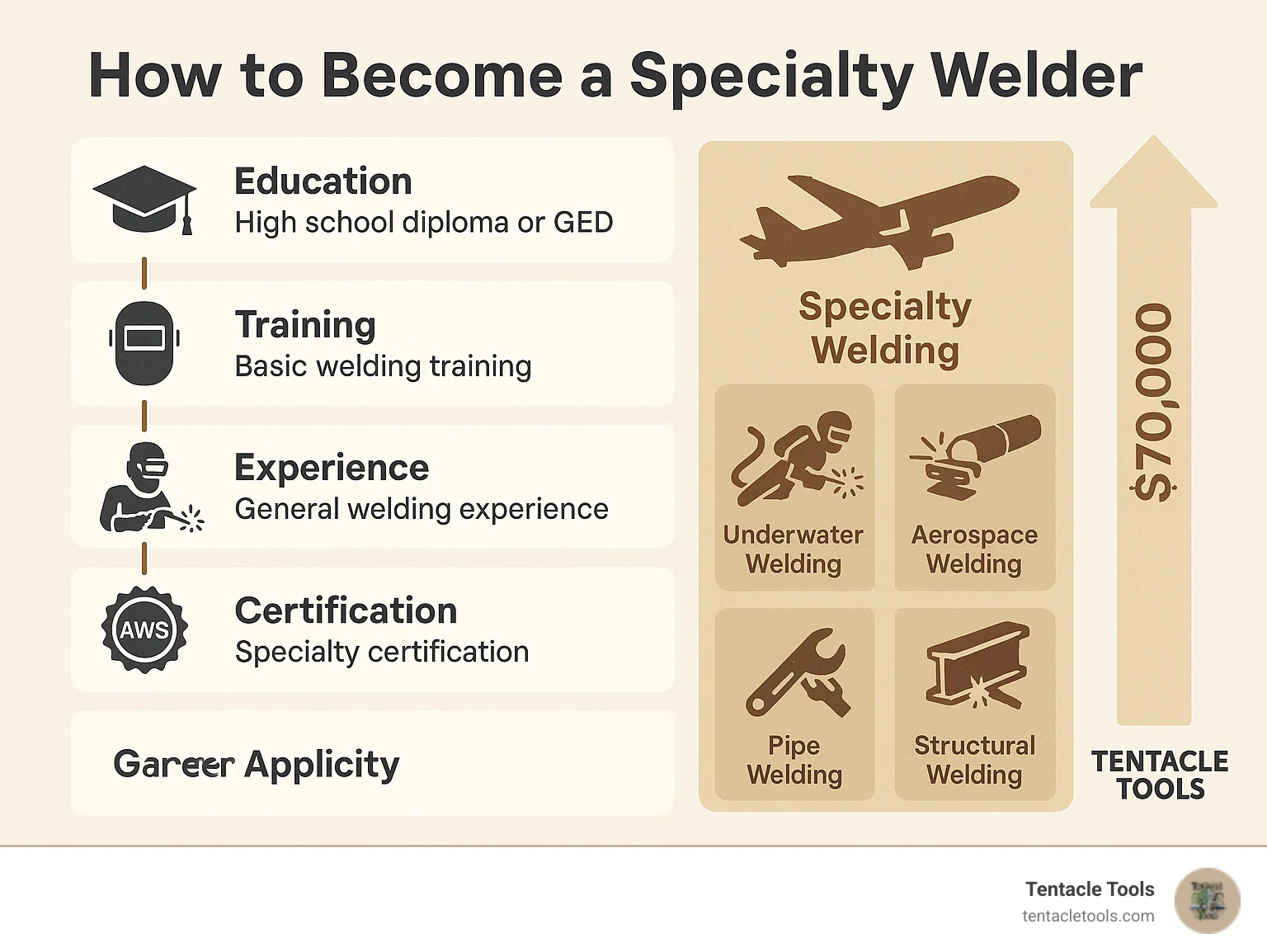
Some welders move into aerospace, underwater work, robotics, inspection, welding supervision, or welding engineering support. These paths typically require additional education, documented experience, specialized testing, or a strong understanding of codes and quality systems.
A useful early goal is not to choose a lifetime specialty. Instead, identify a realistic first job and the skills it demands, then build enough versatility to qualify for better opportunities later.
Complete the Right Training
Formal school is not the only way into welding, but structured instruction can shorten the learning curve and reduce unsafe habits. A good program combines classroom concepts with substantial booth time, supervised practice, equipment orientation, and feedback on weld quality.
When comparing programs look beyond the course title Ask how many hours are hands-on which processes and materials are available whether students practice multiple positions what safety equipment.

- Practical hours: Confirm that you will spend meaningful time welding rather than only watching demonstrations.
- Equipment access: Check whether the facility includes the processes, metals, positions, and joint types used by local employers.
- Instructor feedback: Look for direct correction of setup, body position, travel speed, bead profile, and discontinuities.
- Employment connection: Ask whether the program offers job referrals, employer visits, apprenticeships, or practice testing.
Trade school and community college
Trade schools often provide focused instruction in a relatively short period Community colleges may offer certificate programs evening classes broader fabrication coursework and credits that can support further.
Look for instruction in blueprint reading, measurement, joint preparation, welding symbols, metallurgy basics, workplace communication, and inspection. These subjects may seem less exciting than welding practice, but they directly affect whether you can work independently.
Apprenticeships and employer training
An apprenticeship or employer-sponsored program can combine paid work with progressive instruction It may be especially valuable when the employer performs the kind of welding you want to.
Some employers hire helpers or fitters and train promising workers internally This route can work well if you are dependable teachable safety-conscious and willing to begin with preparation.
Self-directed practice
Self-study can supplement formal instruction, but it should not replace competent safety guidance. Welding machines, compressed gases, fumes, electricity, fire hazards, and hot metal create risks that an online video cannot assess in your workspace.
If you practice independently use a properly ventilated area suitable fire protection correct electrical connections approved personal protective equipment and instruction from a qualified person Start with basic. This distinction matters when answering “how to become a welder”.
Build Core Welding Skills in the Correct Order
Beginners often focus on producing a visually attractive bead before learning how to prepare the joint or control the equipment. A sound learning sequence starts with safety and setup, then moves through fit-up, arc control, travel technique, inspection, and troubleshooting.
Before welding identify the base metal thickness joint type process electrode or wire polarity shielding requirements and expected.
- Setup: Learn machine controls, polarity, consumable selection, shielding, cables, clamps, and safe work area preparation.
- Joint preparation: Practice cleaning, fit-up, edge preparation, tack placement, alignment, and control of gaps.
- Arc control: Develop consistent arc length, travel angle, travel speed, and work angle.
- Inspection: Learn to recognize undercut, porosity, lack of fusion, overlap, cracks, excessive reinforcement, and distortion.
Read drawings and welding symbols
Blueprint reading helps you understand dimensions, material callouts, tolerances, joint details, and welding symbols. A symbol may communicate the weld location, size, length, contour, finish, and whether the weld continues around the joint.
Ask questions when a drawing conflicts with the physical assembly or when a dimension is unclear. Guessing can produce a strong-looking weld on the wrong joint, which is still a failure.
Control heat and distortion
Heat causes metal to expand and contract If heat is unevenly distributed an assembly can pull out of alignment or develop excessive distortion Tack sequence joint design clamping.
More heat is not automatically better. Excessive heat can burn through thin material, enlarge the heat-affected zone, increase distortion, and damage surrounding parts. Too little heat or overly fast travel can cause incomplete fusion or insufficient penetration.
Develop position skills
Flat welding is generally easier for beginners because gravity helps keep the molten puddle in place Horizontal vertical and overhead positions require different manipulation travel speed and puddle.
Practice positions progressively and ask an instructor to evaluate the result. Consistency matters more than producing one successful weld by accident.
Handle Safety, Health, and Workplace Requirements
Welding safety begins before the arc starts The work area must be evaluated for fire hazards combustible materials ventilation electrical risks compressed-gas concerns nearby workers and possible exposure.
Use task-appropriate eye and face protection flame-resistant clothing gloves hearing protection where needed and suitable respiratory controls Avoid synthetic clothing that can melt Keep skin covered from ultraviolet.
- Fumes: Use effective local exhaust or other appropriate controls, and never weld unknown coatings, galvanized materials, painted surfaces, or contaminated containers casually.
- Fire prevention: Remove combustibles, control sparks, inspect the opposite side of walls or floors, and follow required fire-watch practices.
- Electrical protection: Inspect leads, holders, plugs, work clamps, and machine settings; keep equipment dry and repair damaged parts.
- Gas cylinders: Secure cylinders upright, protect valves, use compatible regulators, and keep fuel and oxygen systems handled according to workplace rules.
Recognize hazardous materials
Metal coatings and residues can create dangerous fumes when heated Galvanized coatings paints degreasers lead-containing materials and sealed containers require special controls or professional evaluation Never weld on.
Good ventilation does not mean positioning your head in the plume. Keep your breathing zone away from smoke and use the control method specified for the task.
Expect physical and environmental demands
Welding can strain the eyes, neck, shoulders, back, knees, and hands. Practice stable positioning, use lifting assistance, adjust work height, and take sensible breaks. Job sites may expose you to heat, cold, wind, mud, elevated work, confined areas, and changing schedules.
Employers may also require drug screening, background checks, site orientations, respirator clearance, medical evaluations, or documentation of completed safety training. Requirements differ by employer and assignment, so confirm them before accepting work.
Understand Certifications and Qualification Tests
Certification language causes confusion because different documents prove different things. A school certificate may show that you completed training. An industry credential may demonstrate knowledge.
A performance qualification usually shows that you produced an acceptable weld under defined conditions.
For many welding jobs, the employer or contracting organization determines which test, code, procedure, or documentation applies. The exact qualification can be limited by process, position, material group, thickness range, joint type, backing, and other variables.
- Course completion: Confirms participation or successful completion of an educational program, but does not guarantee job qualification.
- Knowledge exam: Tests concepts such as safety, symbols, processes, and welding fundamentals.
- Performance test: Requires you to weld a specified sample that may be inspected or tested.
- Renewal or continuity: Some qualifications require records, periodic renewal, or evidence that you have continued using the process.
Prepare for a welding test
Ask what process, material, thickness, position, joint, electrode or wire, and inspection method will be used. Practice under similar conditions instead of relying on a different process or a comfortable flat-position coupon.
During the test, follow instructions exactly. Clean between passes when required, maintain the specified dimensions, avoid unauthorized repairs, and inspect your work honestly. Employers may evaluate not only the final sample but also setup, safety, interpretation of instructions, and housekeeping.
Keep accurate records
Maintain copies of training records, qualifications, safety courses, employer evaluations, and relevant work history. Record the process and type of work you have actually performed. Accurate documentation makes it easier to explain your experience without overstating it.
Keep these limitations in mind when considering “how to become a welder”.
Do not collect credentials that have no connection to your intended work simply because they sound impressive. A targeted qualification and verified hands-on experience are usually more useful than a long list of unrelated certificates.
Avoid Common Mistakes New Welders Make
Many early failures come from preventable habits rather than a lack of talent. A beginner may blame the machine when the real issue is dirty material, poor fit-up, incorrect polarity, unstable body position, or an inconsistent travel speed.
Use a troubleshooting mindset. Change one variable at a time, inspect the weld and the joint, and ask what evidence supports your conclusion. This method is more effective than turning several knobs at once and hoping the bead improves.
- Chasing appearance: A shiny, uniform bead can still have poor fusion, inadequate penetration, or hidden defects.
- Skipping preparation: Rust, oil, paint, mill scale, and poor alignment can undermine a correct machine setting.
- Using copied settings: Settings depend on process, material, thickness, position, joint design, and consumable.
- Ignoring cleanup: Slag, spatter, and sharp edges can hide defects or create hazards during later work.
Buying too much equipment too soon
A powerful machine does not replace instruction or practice. Before buying, determine which process and materials you need, whether your electrical service can support the equipment, how you will ventilate the space, and where consumables and cylinders can be stored safely.
Start with reliable essentials and spend more attention on fit-up tools, protective equipment, lighting, measurement, and practice material. Rent, share, or use a school shop when that is safer and more economical.
Learning only one position or process
Specialization can be valuable, but narrow experience may limit entry-level options. Even if your goal is TIG or pipe welding, basic familiarity with other processes, cutting, fitting, and shop equipment can improve your employability.
At the same time, avoid spreading practice so thinly that you never become consistent. Build competence in one foundational process, then add related skills based on actual job requirements.
Confusing speed with productivity
Fast welding that creates rework is not productive. Employers value sound work, correct dimensions, safe behavior, dependable attendance, and the ability to follow a procedure. Speed usually improves after technique becomes repeatable.
Find Your First Welding Job
Entry-level titles may include welding helper, junior welder, fabrication assistant, production welder, fitter-welder, maintenance helper, or structural welding trainee. Read the duties carefully because some jobs labeled “welder” involve substantial material handling, grinding, fitting, or machine operation.
Build a resume that states your training, processes practiced, materials, positions, blueprint skills, safety courses, and relevant mechanical experience. If you have completed a performance qualification, identify its scope accurately rather than describing yourself as qualified for every welding job.
- Show evidence: Bring training records, qualification documents, and a concise list of processes you can perform safely.
- Be precise: Say whether a skill is classroom practice, supervised work, or independent production experience.
- Prepare physically: Be ready to discuss lifting, standing, awkward positions, heat, shifts, and site conditions.
- Ask practical questions: Clarify pay progression, shift schedule, training, testing, tools, overtime, and advancement.
Build a useful portfolio
Photographs can show fit-up, joint preparation, finished assemblies, and the variety of work you have practiced, but photos do not prove internal weld quality. Use them as a supplement to documented training and honest explanations of your role.
A small portfolio can also demonstrate layout, cutting, fabrication, repair, and finishing skills. Label each example with the material, process, position, and whether it was supervised practice or paid work.
Use entry-level work strategically
Your first job does not need to be your final specialty A role that teaches measurement fabrication quality control and workplace discipline can prepare you for more advanced.
If a position offers only repetitive work, ask how cross-training works. If it offers broad exposure but unsafe practices, treat that as a serious warning rather than an opportunity worth accepting at any cost.
Plan Long-Term Progress
After gaining foundational experience, choose the next skill based on demand in your area and the direction you enjoy. Possible improvements include advanced positions, additional processes, aluminum or stainless steel work, pipe, structural applications, robotic welding support, inspection, estimating, or supervision.
Keep improving the skills that employers can observe: reading drawings, setting up accurately, producing repeatable welds, identifying defects, maintaining equipment, documenting work, and communicating clearly. Reliability is a career skill, not merely a personal trait.
- Track weak areas: Note which positions, materials, or joint types produce inconsistent results, then practice them deliberately.
- Learn quality language: Understand discontinuities, acceptance criteria, procedures, and inspection limits relevant to your work.
- Protect your health: Use exposure controls, ergonomic adjustments, hearing protection, and recovery time consistently.
- Reassess annually: Compare your current skills with local job requirements and choose one practical next qualification.
Some welders eventually pursue inspection or supervisory work which may require additional education and experience Others become versatile.
Frequently Asked Questions About How to Become a Welder
Do you need a college degree to become a welder?
No. Many welders enter through trade school, community college, apprenticeship, employer training, or supervised entry-level work. Some advanced roles may prefer additional education, but a four-year degree is not a universal requirement.
How long does it take to become a welder?
Basic training can take weeks or months, while job-ready consistency and specialized qualifications take longer. The timeline depends on practice hours, the process, the work type, and the employer’s testing requirements.
What welding process should a beginner learn first?
There is no universal first process. MIG may be approachable for some shop applications, while stick is valuable for portable or outdoor work. Choose a process that matches local entry-level jobs, then add others as your skills develop.
Can you become a welder with no experience?
Yes, but you may begin as a helper, trainee, or student rather than an independent production welder. Be honest about your experience and look for supervised practice that teaches setup, safety, fit-up, and inspection.
Is welding certification required for every welding job?
No. Requirements vary by employer, industry, contract, process, and job responsibility. Some positions provide testing after hiring, while others require documented qualifications before you start.
Is welding a physically demanding career?
Often, yes. Welders may stand, kneel, bend, lift, work in awkward positions, tolerate heat and noise, and wear protective equipment for long periods. Work environments differ, so review the physical demands of each job.
Can you learn welding at home?
You can practice some fundamentals at home if the workspace, ventilation, equipment, fire controls, and supervision are appropriate. Independent practice should supplement, not replace, competent instruction and safe procedures.
Conclusion
Learning how to become a welder starts with a realistic career target structured safety instruction and repeated hands-on practice Choose training that matches local work develop one process.
The major limitation is that welding conditions and employer requirements vary widely Never trade ventilation protective equipment fire prevention or honest skill assessment for speed With a careful.
Compare three local welding programs or entry-level job postings today, then list the process, safety training, and qualification each one requires.