MIG Welder Equipment: Essential Information and Useful Advice
MIG welder equipment includes the power source, gun, wire-feeding system, shielding gas setup, consumables, and protective gear needed for gas metal arc welding.
A rushed purchase often starts with the machine and ends with expensive compatibility problems. A welder may have enough advertised output yet perform poorly because the wire diameter, liner, contact tip, gas regulator, duty cycle, or electrical supply does not match the work.
That cause-and-effect chain matters the job determines the material and thickness those factors determine wire and current requirements and those requirements determine the power source accessories and safety.
- ✓Choose a welder by material thickness, electrical supply, duty cycle, and process capability rather than peak amperage alone.
- ✓A complete system includes compatible wire, gun parts, shielding gas equipment, grounding hardware, and personal protective equipment.
- ✓Flux-cored wire can improve outdoor flexibility, while solid MIG wire generally produces a cleaner arc when gas coverage is reliable.
- ✓Correct polarity, clean metal, steady wire feed, and proper gas flow solve many common weld defects.
What MIG Welder Equipment Includes
MIG or metal inert gas welding is commonly used to describe gas metal arc welding GMAW with a continuously fed wire electrode The wire melts into the joint.
The term equipment covers much more than the cabinet sitting on a shop floor A workable setup must deliver electrical power feed the correct consumable at a stable.
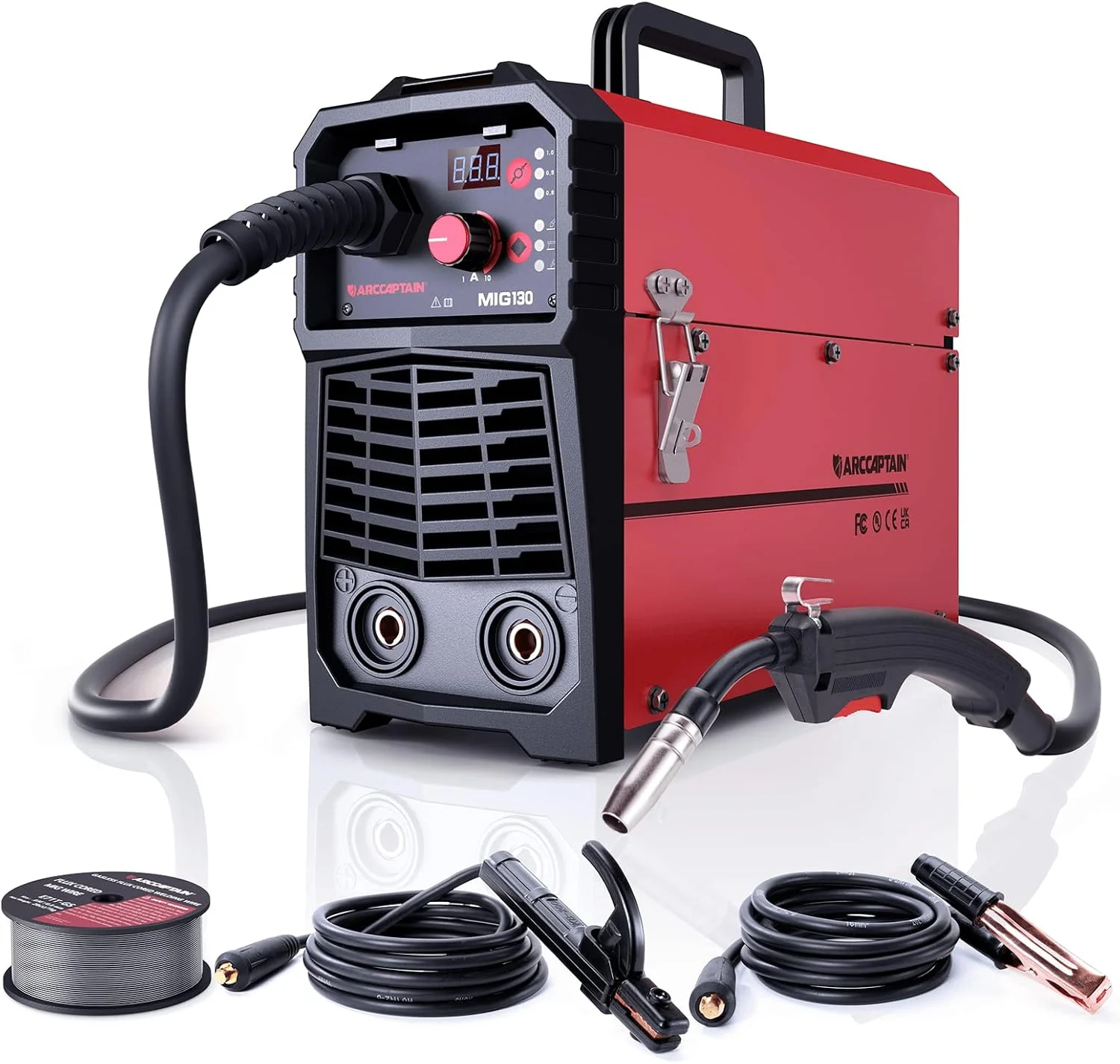
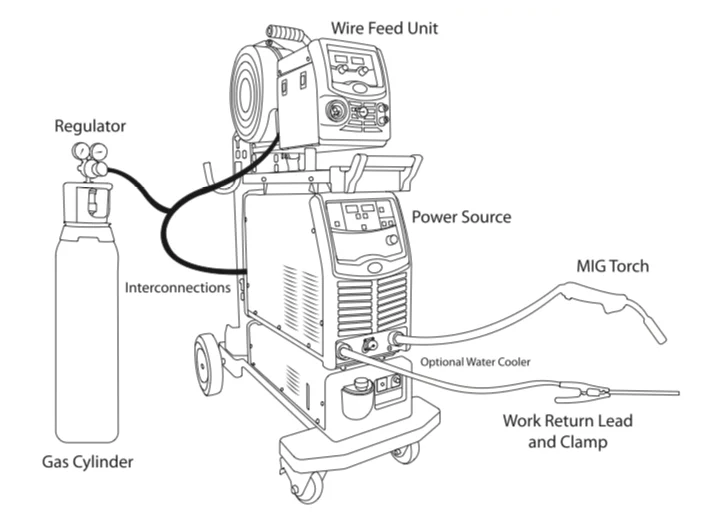
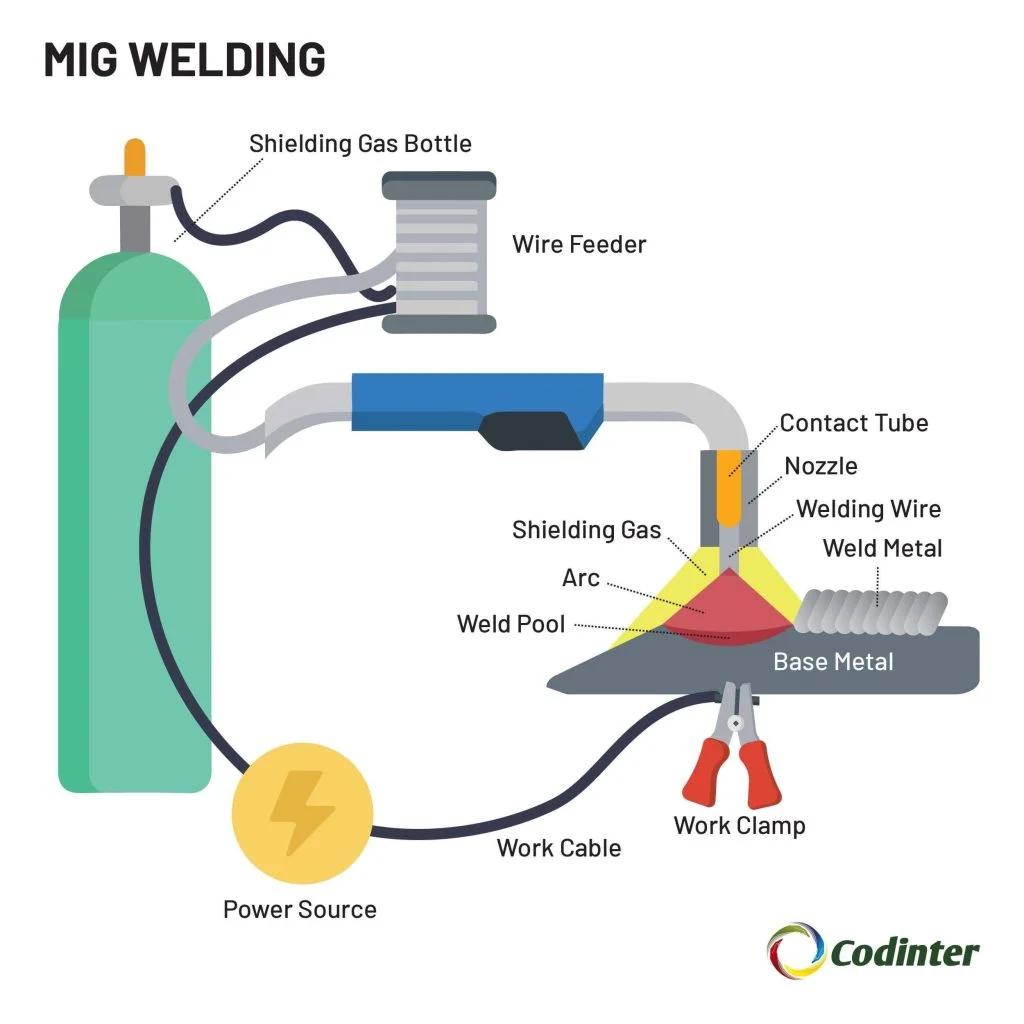
- Power source: Converts incoming electricity into the controlled welding current and voltage needed for the selected process.
- Wire feeder and gun: Pushes electrode wire through the liner and delivers current through the contact tip.
- Shielding system: Includes a gas cylinder, regulator, hose, and flow-control hardware when solid wire is used.
- Work circuit: Uses a work lead and clamp to complete the electrical path through the metal.
Power source
The power source controls the arc and usually provides settings for voltage, wire-feed speed, inductance, or an automated material program. Some machines use a conventional transformer design, while modern inverter welders are generally lighter and offer more precise electronic control.
Look beyond the maximum amperage A machine rated for a high peak output may not sustain that output long enough for repeated production work The duty cycle indicates.
Wire feeder, gun, and liner
The feeder uses drive rolls to move electrode wire from the spool to the gun Excessive drive-roll pressure can deform soft aluminum wire while insufficient pressure causes slipping.
The contact tip transfers current to the wire while allowing the wire to pass through It is a wear item not a permanent part A tip that is.
Shielding gas and work lead
Solid MIG wire depends on shielding gas to keep oxygen and nitrogen away from the weld pool A regulator reduces cylinder pressure and a flowmeter or calibrated outlet.
Some machines combine the feeder and power source in one cabinet while others use a separate feeder connected to a heavier power unit Integrated units are convenient for.
How to Choose MIG Welder Equipment for the Job
The correct choice begins with the workpiece, not the product label. Identify the metals you will weld, their thickness range, the joint types, the expected welding position, and whether the work occurs indoors, outdoors, or at changing locations.
Next confirm the available electrical service A compact machine designed for a household circuit may be practical for sheet metal and light fabrication while thicker material may require.
- Material range: Match the machine’s recommended operating range to the thinnest and thickest work you regularly expect.
- Input power: Verify voltage, circuit capacity, plug style, and whether the installation can support the machine safely.
- Duty cycle: Select enough sustained output for the length and frequency of your welds, especially in production work.
- Portability: Consider machine weight, cylinder handling, cable length, and access to power at the worksite.
Thickness and amperage
Amperage is related to penetration but it is not a universal thickness calculator Joint design fit-up travel speed wire type shielding welding position and the number of passes.
For thin sheet excessive heat can cause burn-through and distortion A machine with a stable low-output range fine control and the ability to use small-diameter wire may be.
Material and process capability
Steel is the most straightforward MIG application because solid steel wire and common shielding gas combinations are widely available Stainless steel can also be welded with suitable wire.
If aluminum is an occasional need a spool gun can shorten the path between the wire spool and the arc and reduce feeding problems For frequent aluminum work.
Single-process, multi-process, and dual-voltage machines
A dedicated MIG machine is often simple to learn and efficient when wire welding is the primary task A multi-process unit may add stick and TIG functions which.
Dual-voltage machines can operate from more than one input voltage when connected according to the manufacturer’s instructions. This flexibility helps mobile users, but output can differ between supplies. Never assume a machine produces its full rated performance on the lower input.
| Priority | Feature to emphasize | Why it matters |
|---|---|---|
| Home repair and light fabrication | Low-current control and simple setup | Reduces burn-through and makes short welds easier to manage. |
| Mobile repair | Portability, dual-voltage input, and spool-gun support | Improves access to different locations and materials. |
| Repeated shop production | Duty cycle, feeder durability, and serviceability | Limits downtime and supports longer welding intervals. |
| Mixed processes | Reliable process switching and suitable accessories | Provides flexibility without overlooking MIG-specific performance. |
Wire, Shielding Gas, and Consumable Compatibility
Consumables strongly influence arc behavior and weld quality. A welder can be correctly sized and electrically sound, yet produce porosity or feeding problems when the wire, gas, polarity, liner, and contact tip are mismatched.
Read the wire manufacturer s specifications and the machine instructions together The correct combination depends on the metal wire classification diameter transfer mode joint position and intended strength or appearance Treat a change in wire as a setup.
- Wire diameter: Confirm that drive rolls, liner, contact tip, and machine settings support the selected size.
- Polarity: Set the leads according to the wire manufacturer’s requirements; solid wire and many gas-shielded flux-cored wires commonly use electrode-positive polarity.
- Gas mixture: Use a gas appropriate for the wire and base metal; the wrong mixture can increase spatter or destabilize the arc.
- Storage: Keep wire clean and dry, and protect cylinders from damage, heat, and tipping.
Solid wire versus flux-cored wire
Solid wire requires external shielding gas and generally produces a clean bead with relatively little slag. It is a strong choice for indoor fabrication where wind is controlled and a neat appearance matters.
Flux-cored wire contains compounds that create shielding as the wire burns Some versions still require external gas while self-shielded flux-cored wire does not Self-shielded wire is useful outdoors.
Shielding gas selection and flow
Gas selection balances penetration arc smoothness spatter and bead profile Carbon dioxide can provide strong penetration at a lower gas cost while argon-rich blends commonly offer a smoother.
More gas is not always better Excessive flow can create turbulence that draws surrounding air into the shielding zone while too little flow leaves the weld vulnerable to.
Consumable wear parts
Keep spare contact tips nozzles liners drive rolls and diffusers available A nozzle packed with spatter can restrict gas coverage and a liner contaminated with dust or shavings.
Use anti-spatter products carefully and keep them away from surfaces that will later be painted or coated unless compatibility is known. Excessive buildup inside the nozzle can break loose and contaminate the weld or obstruct gas flow.
Gun Setup, Settings, and Welding Technique
Most MIG machines use a relationship between wire-feed speed and voltage Wire-feed speed largely influences amperage and deposition rate while voltage affects arc length and bead shape The.
Before welding clean the base metal secure the workpiece install the correct spool thread the wire and confirm the polarity A short test weld on similar scrap is. This is an important consideration for mig welder equipment.
- Prepare the joint: Remove oil, paint, rust, moisture, and heavy scale from the weld area.
- Install consumables: Match the spool, drive rolls, liner, contact tip, nozzle, and polarity to the wire.
- Check gas: Secure the cylinder, inspect connections, and set flow with the gun in the welding position.
- Test and observe: Make a short bead, then adjust settings in small changes rather than turning several controls at once.
Stickout, travel angle, and speed
Electrode stickout is the distance from the contact tip to the end of the wire Excessive stickout preheats the wire and can reduce effective penetration very short stickout.
A modest work angle helps the operator see the puddle and control the bead Travel too slowly can create a wide excessively hot weld while moving too quickly.
Short-circuit, spray, and pulsed transfer
Short-circuit transfer uses lower settings and is common for thinner steel and out-of-position work. It can produce more spatter and requires careful control of voltage and wire speed.
Spray transfer deposits metal in a smoother stream at higher energy levels and is generally suited to thicker material and favorable positions Pulsed systems alternate current levels to.
Safety Equipment and Work Area Controls
MIG welding produces intense ultraviolet and infrared radiation, hot metal, sparks, fumes, and electrical hazards. Personal protective equipment is essential, but it cannot compensate for poor ventilation, wet conditions, damaged leads, or combustible materials near the arc.
Use a properly rated welding helmet with the correct shade for the process and current range Wear flame-resistant clothing that covers exposed skin leather gloves suited to welding.
- Ventilation: Control fumes with general ventilation or local exhaust positioned to keep contaminants away from the breathing zone.
- Fire prevention: Remove combustibles, inspect nearby hidden spaces, and keep a suitable fire extinguisher accessible.
- Electrical condition: Inspect the power cord, gun cable, work lead, connections, and insulation before use.
- Cylinder handling: Keep gas cylinders upright, capped when not connected, and secured against falling or impact.
Fume and coating hazards
Paint plating galvanized coatings degreasers and residues can release hazardous substances when heated Do not weld unknown containers closed vessels or metal contaminated with flammable residue Cleaning the.
Some metals and coatings require more stringent controls than ordinary mild steel. If the work produces unusual fumes, the material is coated, or ventilation is uncertain, stop and obtain qualified industrial-hygiene or safety guidance before continuing.
Electrical and fire precautions
Keep the work lead connection secure and avoid welding in wet conditions. Do not use damaged extension cords or overload a circuit. Position cables to prevent vehicle traffic, sharp-edge damage, and trip hazards.
Inspect the area behind and beneath the joint because sparks can travel farther than expected. After welding, remain alert for smoldering materials and hot metal. A fire watch may be necessary when sparks can enter walls, floors, insulation, or machinery.
Common MIG Problems and What They Indicate
Weld appearance provides clues, but symptoms can have multiple causes. Change one variable at a time and make a short test bead so you know which adjustment produced the improvement.
The exact settings depend on the machine and consumables, yet the diagnostic relationships below apply broadly. Always distinguish a setting problem from a mechanical problem such as a slipping drive roll, blocked liner, poor ground, or empty gas cylinder.
- Porosity: Check gas supply, leaks, drafts, nozzle blockage, dirty metal, and moisture before changing voltage.
- Bird-nesting: Inspect liner friction, drive-roll pressure, spool tension, and the gun’s contact tip.
- Excessive spatter: Check voltage-to-wire-speed balance, polarity, gas choice, stickout, and surface cleanliness.
- Poor penetration: Review joint preparation, travel speed, heat input, arc placement, and work-circuit connection.
Porosity and contamination
Porosity appears as holes or pinholes in the bead and may become visible only after cleaning or cutting the weld. First verify that gas is reaching the nozzle. Check the cylinder valve, regulator, hose, fittings, solenoid operation, and nozzle condition.
If gas delivery is sound, inspect for wind and contamination. Oil, moisture, paint, rust, and excessive stickout can expose the puddle to atmospheric contamination. A clean test coupon in a sheltered area helps separate an equipment fault from a workpiece problem.
Inconsistent wire feeding
Wire feeding can become erratic when the spool brake is too tight the drive rolls are mismatched the liner is dirty or the gun cable is sharply bent.
Burnback, where the wire fuses to the contact tip, can result from excessive stickout, incorrect settings, a worn tip, or stopping the gun too close to the puddle. Replace the tip if it is damaged and confirm that the liner and wire size match.
Weak or unattractive welds
Low penetration may come from insufficient heat, excessive travel speed, poor fit-up, an incorrect joint angle, or a ground clamp attached to contaminated metal. Increasing power without correcting a gap or dirty surface can produce a larger but still unsound bead.
Undercut can occur when settings are too hot travel is too fast or the gun angle directs the arc toward the edge Excessively convex beads can indicate low.
Maintenance and Storage Practices
Routine maintenance keeps a feeder predictable and makes troubleshooting easier. Before servicing, turn off the power, disconnect the input supply when appropriate, close the gas cylinder valve, and follow the machine’s instructions for stored energy and internal access.
Keep the machine vents clear and protect it from metal dust, moisture, grinding debris, and excessive heat. Inspect cables and connectors regularly. Damage to insulation, loose terminals, or overheating marks should be addressed before the next weld.
- Every session: Clean spatter from the nozzle, inspect the tip, check the work clamp, and confirm the wire path is feeding smoothly.
- During spool changes: Check spool tension, drive-roll condition, liner entry, and wire cleanliness.
- Periodically: Inspect hoses, regulators, leads, plugs, fans, and ventilation openings for wear or obstruction.
- Before storage: Protect wire from humidity, secure cylinders properly, and cover the machine without trapping moisture inside.
Wire should be stored in a dry environment and discarded or tested carefully if it has developed heavy rust or contamination Moisture can contribute to feeding trouble porosity.
Gas regulators and cylinders deserve particular care Do not use oil or grease on oxygen-service components and do not modify fittings to force incompatible connections If a regulator.
Buying Decisions That Save Money
The least expensive machine is not necessarily the lowest-cost system. A unit with limited wire support may require specialized accessories, while a machine with an unsuitable duty cycle can slow production and increase downtime. Consumable availability and local service support also affect long-term value.
When comparing mig welder equipment calculate the complete setup machine gun work lead gas regulator cylinder wire spare tips liner drive rolls helmet gloves clothing ventilation provisions and.
- Included accessories: Confirm whether the package contains a regulator, gas hose, work clamp, spool adapter, and suitable consumables.
- Future materials: Check support for steel, stainless, aluminum, flux-cored wire, and the diameters you may use later.
- Repairability: Favor accessible wear parts, clear documentation, and a service path appropriate to the machine’s complexity.
- Electrical cost: Include outlets, breakers, cords, and safe installation in the budget.
A machine with automatic settings can shorten the learning curve, but presets are starting points rather than guarantees. Manual control remains valuable when joint fit-up, material condition, position, or wire type differs from the program assumptions.
Do not buy based on a single peak amperage claim. Compare operating output, duty cycle, low-end control, wire diameter range, input requirements, feeder design, and process limitations. Those specifications better predict whether the equipment will suit your actual work.
FAQ: MIG Welder Equipment
What is the minimum equipment needed for MIG welding?
You need a compatible power source and gun, wire-feeding components, a work lead and clamp, suitable wire, and either shielding gas equipment or self-shielded flux-cored wire. You also need a helmet, protective clothing, gloves, appropriate footwear, and a safe, ventilated work area.
Is shielding gas always required with MIG welder equipment?
No. Solid MIG wire requires shielding gas, but self-shielded flux-cored wire creates its own shielding and can be used without a gas cylinder. Confirm the wire type, polarity, and machine setup because gas-shielded and self-shielded wires do not use identical settings.
Can one MIG welder handle steel, stainless steel, and aluminum?
Some machines can handle all three with the correct wire, gas, liner, contact tip, and feeding arrangement. Aluminum is the most demanding because its soft wire may feed poorly through a standard gun. A spool gun or push-pull system can improve reliability.
How much duty cycle does a MIG welder need?
Choose a duty cycle that matches how long and how often you weld at the required output Short repair beads may not need the same capacity as repeated.
Why does my MIG welder produce excessive spatter?
Common causes include an incorrect voltage and wire-feed-speed relationship, wrong polarity, contaminated metal, poor shielding, excessive stickout, or an unsuitable gas mixture. Check the setup systematically and make a short test bead after each adjustment.
What wire size should I use?
Use a diameter suited to the material thickness welding position machine output and joint design Smaller wire generally provides better control on thin material while larger wire can.
Can a household outlet power MIG welder equipment?
Some compact welders are designed for a standard household circuit, while higher-output machines may require a different voltage or dedicated circuit. Check the machine’s input-current requirements and have electrical work performed safely; do not rely on an undersized circuit or unsuitable extension cord.
Conclusion
Choosing mig welder equipment is mainly an exercise in matching the complete system to the work. Evaluate material, thickness, wire, gas, duty cycle, input power, feeding hardware, consumable availability, and safety controls together rather than selecting a machine by peak amperage alone.
Correct setup and maintenance matter just as much as the purchase. Clean metal, compatible parts, sound gas coverage, secure electrical connections, and appropriate protective equipment reduce defects and help prevent avoidable injuries.
Write down your material types, thickness range, available voltage, and indoor or outdoor work conditions, then use that list to compare complete equipment packages and consumable compatibility.