Pipeline Welder Salary: Practical Guide and Important Details
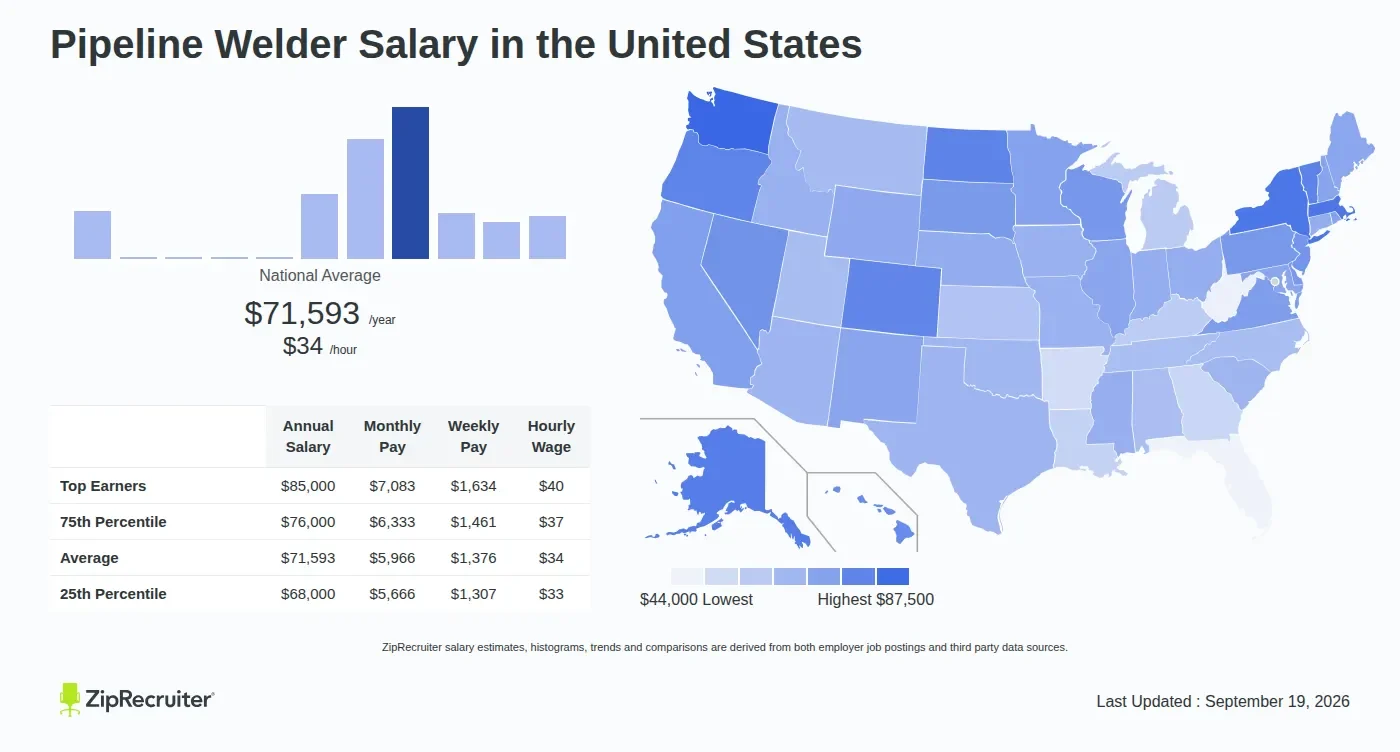
A U.S. pipeline welder commonly earns about $50,000 to $100,000 annually, while experienced traveling welders may exceed $120,000 with overtime and per diem.
Understanding pipeline welder salary starts with separating the advertised hourly rate from the amount that actually reaches a worker’s annual income. A contractor may quote an impressive wage, but total compensation can also depend on overtime, travel allowances, housing, project duration, union rules, certifications, and unpaid time between jobs.
Imagine you have a strong welding background and two offers one near home with a steady schedule and another several states away that pays more but requires weeks.
This guide explains how pipeline welding pay is structured which credentials and work conditions raise earning power how regional and project differences affect income and how to compare.
- ✓Annual earnings vary widely because overtime, travel, per diem, project length, and downtime can matter as much as the base wage.
- ✓Pipe-welding skill, code knowledge, procedure qualification, and a strong safety record generally improve access to higher-paying work.
- ✓Travel jobs can produce higher gross income but may involve irregular schedules, remote conditions, temporary housing, and personal costs.
- ✓The best offer is determined by total compensation and predictable work—not simply the highest posted hourly rate.
What Determines Pipeline Welder Salary?
Pipeline welders join sections of pipe used in oil and gas transmission water systems utilities industrial facilities and related infrastructure Their work can include fit-up root passes fill.
Pay reflects a combination of technical skill, production demands, risk, mobility, and accountability. A welder who can consistently produce sound welds in difficult field positions may be more valuable than someone who has a higher general welding title but limited pipe experience.
- Base rate: The hourly wage is the starting point, but it does not show overtime, allowances, benefits, or unpaid travel time.
- Work classification: Union, nonunion, employee, and independent-contractor arrangements can produce very different compensation packages.
- Project conditions: Remote locations, night shifts, extreme weather, shutdown schedules, and strict production targets may raise pay.
- Reliability: Consistent weld quality, attendance, documentation, and safe work habits help determine whether a welder is invited back to future projects.
Typical U.S. pay ranges
A broad planning range for pipeline welders is approximately $25 to $50 or more per hour, with annual gross earnings often landing between $50,000 and $100,000. Newer workers may fall below that range while building field experience, and highly experienced welders on demanding traveling projects may earn above it.
Those figures should be treated as decision-making ranges rather than guarantees A job paying 35 per hour for a predictable 40-hour week produces a different annual result from.
| Experience or assignment profile | Approximate gross earnings pattern | What usually affects the result |
|---|---|---|
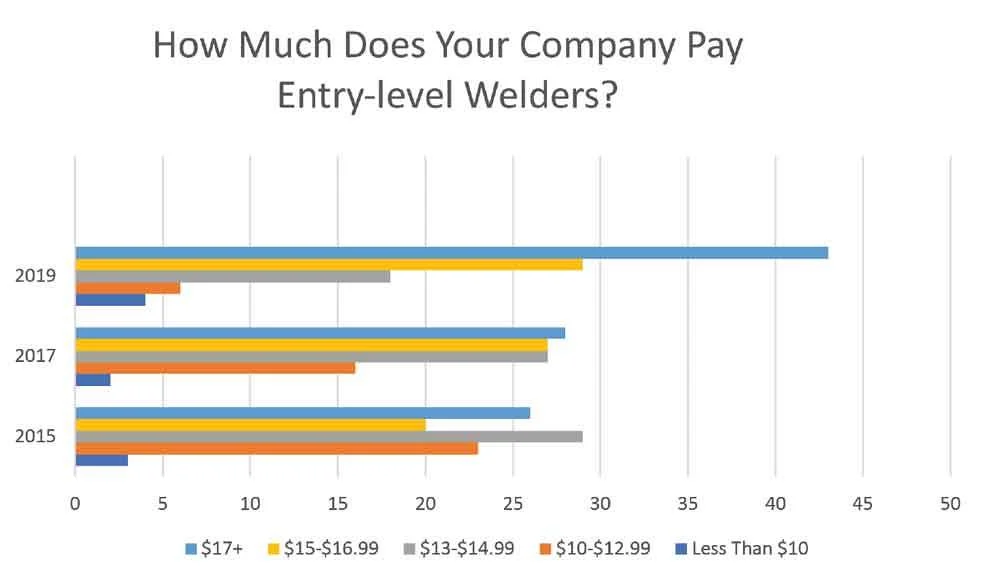
| Entry-level or developing pipe welder | Often below or around $50,000 annually | Limited qualifications, supervised work, fewer overtime opportunities |
| Experienced field pipe welder | Commonly about $60,000 to $100,000 | Production speed, travel, overtime, code qualifications, project availability |
| Specialized or high-demand traveling welder | May exceed $100,000 and sometimes $120,000 | Advanced qualifications, long shifts, per diem, remote projects, sustained demand |
Gross pay is not take-home pay. Payroll taxes, insurance premiums, retirement contributions, meals, vehicle costs, lodging, tools, and periods without a project can substantially change the amount available for household expenses.
How Experience and Welding Skill Change Earnings
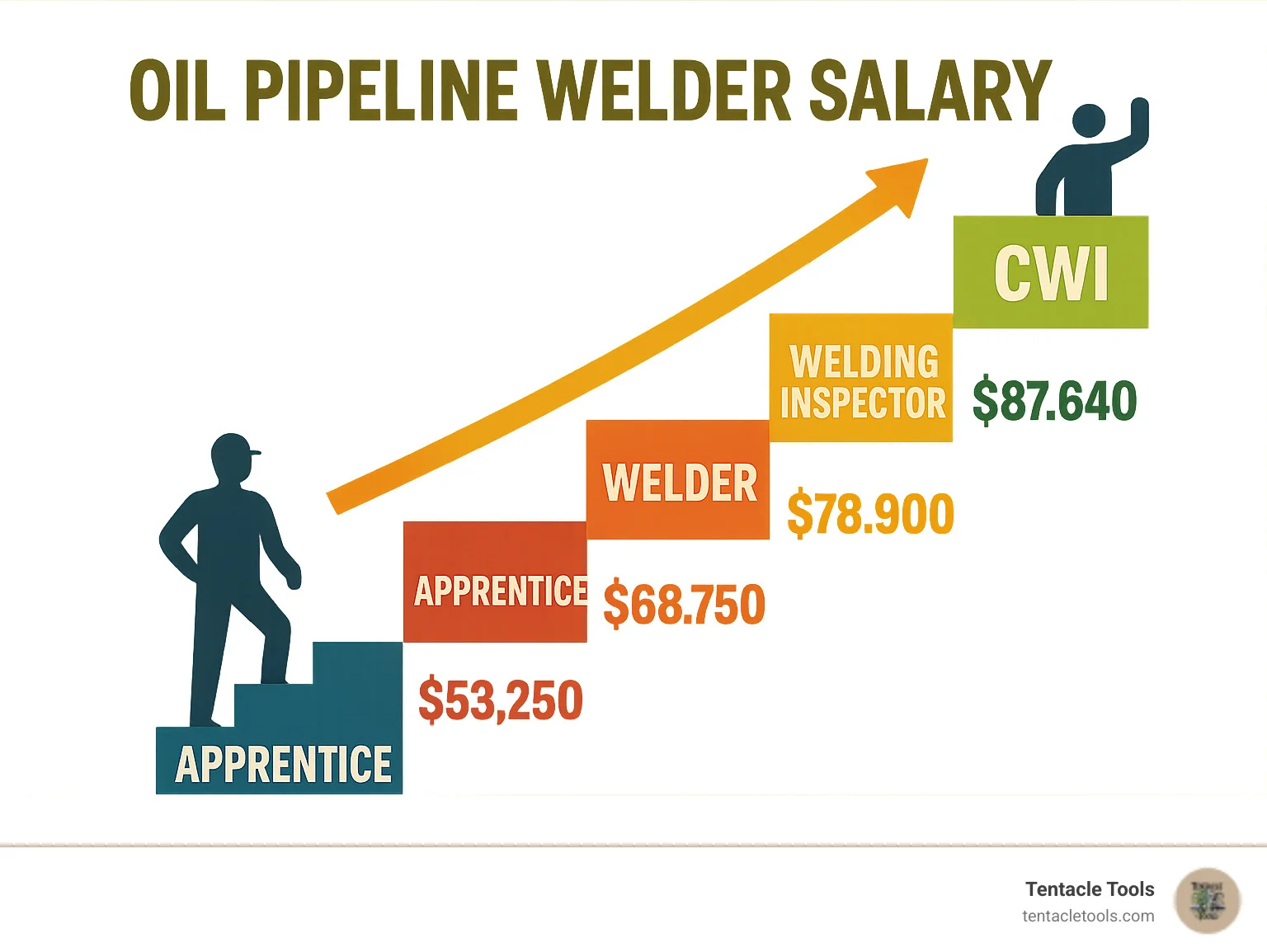
Pipeline welding rewards repeatable performance. Employers need welders who can read drawings and welding procedures, understand joint preparation, control heat input, maintain proper bead placement, and complete work that passes inspection. Experience matters because field conditions rarely match a controlled shop environment.
A newer welder may know the fundamentals but still need time to develop speed and judgment An experienced hand often recognizes fit-up problems early adjusts to changing weather.
- Pipe position: Experience with challenging positions, including fixed pipe work, can make a candidate more useful on field crews.
- Process range: Familiarity with relevant processes such as shielded metal arc welding, gas tungsten arc welding, or flux-cored work may expand job options.
- Inspection awareness: Understanding how visual inspection and nondestructive testing identify defects helps prevent costly rework.
- Production discipline: The ability to maintain quality while meeting a realistic schedule is more valuable than rushing and creating repairs.
Certifications and qualifications
There is no single credential that automatically guarantees a high wage. However, employers may prefer candidates whose qualifications match the project’s welding procedures, materials, pipe diameters, positions, and inspection requirements.
Commonly relevant qualifications can include employer or contractor performance tests, procedure-specific qualifications, safety training, and credentials recognized within a particular industrial segment. A qualification is useful only when it is current, properly documented, and relevant to the work being offered.
Ask whether the employer pays for testing, travel to a test facility, continuity documentation, or renewals. A job that requires the worker to absorb every qualification cost may be less attractive than a slightly lower wage with a stronger training and testing package.
Why repair rates affect career growth
Pipeline welding is closely tied to quality control. A failed weld can require removal, preparation, rewelding, and another inspection cycle. Repeated repairs can reduce production and damage a welder’s standing with contractors.
Low repair rates do not mean a welder works slowly. The strongest performance combines correct preparation, steady technique, sound judgment, and enough pace to meet the project’s requirements. Keeping personal records of completed qualifications, project types, and positive performance feedback can help support future negotiations.
Travel, Overtime, and Per Diem: The Biggest Pay Variables
Travel is one of the main reasons pipeline welding income can appear higher than local welding pay Projects may be built far from established labor markets and contractors.
Overtime can also transform annual income. A welder working 40 hours per week at $35 per hour earns a much different gross amount from one working 55 or 60 hours during an active construction phase. Yet long shifts increase fatigue, and fatigue can affect concentration, safety, quality, and personal well-being.
- Overtime basis: Confirm when overtime begins, whether the rate changes after a daily threshold, and how weekends or holidays are paid.
- Per diem: Determine the daily amount, eligibility rules, first and last travel days, and whether it is paid during days off.
- Travel time: Ask whether travel is paid, reimbursed, or treated as personal time.
- Lodging: Clarify whether the contractor provides housing, reimburses receipts, or expects the worker to arrange accommodation.
Gross pay versus usable income
Per diem is not the same as wages. It may help cover meals and incidental expenses, but its value depends on local prices and the employer’s policy. A worker who receives a daily allowance but must pay for an expensive hotel may have less practical benefit than expected.
Consider a simplified comparison Offer A pays 38 per hour for 40 hours near home with limited overtime and no travel costs Offer B pays 34 per hour.
When travel pay is worth it
Travel work may make financial sense when the project is long enough to provide steady hours housing is reasonable overtime is clearly defined and the worker can save.
Before accepting, estimate weekly net value rather than focusing on the hourly rate. Subtract transportation, lodging gaps, meals above the allowance, laundry, phone costs, equipment replacement, and the income you may lose while moving between projects.
Union and Nonunion Pipeline Welding Pay
Union and nonunion jobs can both provide strong careers, but compensation is often presented differently. A union package may separate the base wage from health coverage, pension or retirement contributions, training funds, and other benefits. A nonunion contractor may offer a higher direct wage but fewer employer-paid benefits.
This is an important consideration for pipeline welder salary.
Neither structure is automatically better for every worker. The right choice depends on the local agreement, hiring hall rules, travel requirements, work availability, initiation or membership costs, and the value of the benefits provided.
- Union package: Review total wage and benefit contributions rather than comparing only the taxable hourly wage.
- Nonunion offer: Ask how insurance, retirement savings, paid leave, testing, and training are funded.
- Mobility: Find out whether dispatch, referral, or seniority rules affect access to projects in other regions.
- Continuity: Compare how each arrangement handles gaps between assignments and access to the next job.
How to compare total compensation
Build a simple annual estimate using the same assumptions for every offer. Include expected regular hours, realistic overtime, paid holidays, per diem, travel reimbursement, insurance costs, retirement contributions, paid leave, and likely downtime.
Benefits deserve a dollar value, but avoid treating them as cash available for immediate bills. Health coverage may reduce financial risk without increasing a paycheck, while retirement contributions can be valuable over time but may have vesting rules or eligibility conditions.
| Compensation item | Question to ask | Why it matters |
|---|---|---|
| Hourly wage | What rate applies to regular, overtime, weekend, and holiday hours? | Small rate differences become significant over long assignments. |
| Benefits | Who pays for insurance, retirement, and leave? | A higher wage may not offset weak or expensive benefits. |
| Travel support | Are mileage, airfare, lodging, and meals reimbursed? | Unpaid project costs reduce effective earnings. |
| Downtime | How often do assignments end, pause, or move? | Annual income depends on the entire work calendar. |
Where Pipeline Welders Find Higher-Paying Opportunities
Location affects both wage levels and the availability of work. Regions with major energy, utility, industrial, or infrastructure projects may offer more opportunities, but a high nominal wage can be offset by housing costs, travel expenses, taxes, or competition for assignments.
Remote construction corridors and temporary project camps may pay more because employers need workers to accept difficult logistics Urban projects can also pay well especially when they involve.
- Demand: A shortage of qualified welders can improve bargaining power, especially during active construction periods.
- Cost of living: A larger paycheck may not produce more savings in an expensive metropolitan area.
- Project cycle: Construction booms, maintenance outages, and seasonal work can create uneven annual income.
- Distance from home: Frequent commuting can consume money and time even when the posted wage is attractive.
Energy, utility, and industrial work
Oil and gas transmission projects are commonly associated with pipeline welding, but related skills can transfer to water transmission, municipal utilities, power facilities, process plants, refineries, and industrial maintenance. Each sector may use different materials, procedures, inspection systems, and schedules.
Cross-training can protect a welder against slow periods in one market. A worker who understands several project environments may have more options than someone who relies on a single type of pipeline assignment. Still, transferring skills does not eliminate the need to meet each employer’s specific qualification requirements.
Costs, Risks, and Trade-Offs of the Career
A high pipeline welder salary can reflect real demands rather than easy money. Field welders may work outdoors in heat, cold, wind, rain, mud, dust, noise, and uneven terrain. They may climb, kneel, carry equipment, work in awkward positions, or maintain concentration during extended shifts.
Safety programs, personal protective equipment, hot-work controls, confined-space rules, respiratory protection, fall prevention, and hazard communication are essential parts of the job. No wage justifies ignoring a required control or performing work outside a worker’s training and authorization.
- Fatigue: Long overtime stretches can increase errors, so rest and honest fitness-for-duty decisions matter.
- Exposure: Welding fumes, ultraviolet radiation, noise, heat, and weather require appropriate controls and protective equipment.
- Site rules: Each project may have specific permits, orientations, lockout procedures, and emergency requirements.
- Quality pressure: Production targets should never replace proper fit-up, procedure compliance, inspection, or stop-work authority.
Personal costs people overlook
Travel workers often underestimate the cost of maintaining two locations. Vehicle repairs, tires, fuel, temporary storage, meals, work clothing, tool replacement, and missed family events can reduce the advantage of a higher wage.
Physical wear is another long-term consideration. Protecting hearing, lungs, eyes, joints, and skin can influence how long a person remains able to work at full capacity. Choosing employers that take safety, ventilation, ergonomics, and reasonable scheduling seriously is part of making a sustainable career decision.
How to Increase Your Earning Potential
The most dependable way to improve earnings is to become easier for a reputable contractor to place on difficult work. That means developing technical range while maintaining quality, reliability, safety, and professional documentation.
Start by identifying the assignments you want rather than collecting credentials without a target. Review job postings and speak with training providers or contractors to determine which pipe sizes, materials, processes, positions, and safety qualifications appear repeatedly in the market you are pursuing.
- Track qualifications: Keep organized records of tests, continuity, training, project dates, and processes used.
- Practice consistently: Improve fit-up, starts and stops, arc control, travel speed, and position changes under realistic conditions.
- Protect your reputation: Arrive prepared, communicate problems early, and treat quality documentation as part of the job.
- Build mobility carefully: Travel can expand opportunities, but calculate costs and personal obligations before committing.
Use negotiation intelligently
Negotiation is strongest when based on value and specifics. Be prepared to discuss relevant qualifications, prior project conditions, repair performance if documented, willingness to travel, schedule flexibility, and the type of work you can perform without extended supervision.
Ask for the complete offer in writing. Confirm the base wage, overtime rules, per diem, travel reimbursement, lodging, benefits, deductions, expected duration, schedule, testing requirements, and the conditions that could change the assignment. Clear questions do not guarantee a better offer, but they reduce avoidable surprises.
Choose training that improves employability
Useful training should connect directly to the work you want. Pipe welding practice, blueprint and isometric drawing interpretation, welding procedure awareness, inspection basics, rigging awareness, and site safety can all strengthen a candidate’s readiness.
A training certificate alone does not replace demonstrated ability. Employers may still require a practical performance test, and an expensive course may not be worthwhile if it teaches processes or materials rarely used in the target market.
How to Evaluate a Pipeline Welding Job Offer
Read an offer as a work-and-income forecast, not merely as a wage statement. The more variable the assignment, the more important it is to clarify assumptions before traveling or leaving another job.
- Calculate regular pay: Multiply the base rate by the number of realistic regular hours, not the maximum schedule mentioned casually.
- Estimate overtime: Use a conservative number of overtime hours and confirm how the premium is calculated.
- Add benefits and allowances: Separate taxable wages from per diem, reimbursements, insurance value, and retirement contributions.
- Subtract work costs: Include lodging gaps, travel, meals, fuel, equipment, taxes, and other assignment-related expenses.
- Model downtime: Estimate the days or weeks between projects, weather delays, shutdowns, or qualification periods.
- Review personal fit: Consider health, family, commute, schedule, housing, and whether the assignment can be performed safely.
Do not rely on verbal assurances about “plenty of hours” or “long-term work.” Projects can change because of permits, weather, material delivery, inspection findings, financing, land access, or schedule revisions. A cautious estimate is usually more useful than an optimistic promise.
- Comparing wage only: Ignoring benefits, housing, and unpaid travel can reverse the apparent ranking of two offers.
- Assuming overtime: A project may advertise long shifts but provide fewer hours after a phase is completed.
- Ignoring downtime: High weekly pay does not guarantee high annual income if assignments are short or irregular.
- Skipping documentation: A missing qualification record can delay mobilization or force another test.
FAQ About Pipeline Welder Salary
What is the average pipeline welder salary in the United States?
A practical broad estimate is roughly $50,000 to $100,000 in annual gross pay, with substantial variation. Entry-level workers may earn less, while experienced traveling welders with overtime and specialized qualifications may earn more than $100,000.
Can a pipeline welder make over $100,000 a year?
Yes, but it usually requires a combination of strong pipe-welding ability, steady project access, overtime, travel, difficult work conditions, and favorable compensation terms. The amount may not be repeatable every year if project availability changes.
Do pipeline welders get paid during travel?
It depends on the employer and agreement. Some jobs pay for certain travel time or reimburse transportation, while others provide per diem or lodging without paying every travel hour. Confirm the policy before accepting the assignment.
Does per diem count as part of a pipeline welder’s wages?
Per diem is generally an allowance intended to help cover eligible travel expenses, not the same thing as an hourly wage. Its practical value depends on the amount, eligibility rules, local costs, and whether housing is included or separate.
What certifications help increase pipeline welding pay?
Relevant pipe-welding performance qualifications, process experience, safety training, and procedure-specific credentials can improve access to better assignments. The most useful qualification is one that matches the project’s actual materials, positions, inspection requirements, and employer standards.
Is union pipeline welding pay higher than nonunion pay?
Not automatically. A union package may include valuable health, retirement, and training contributions that are not included in a nonunion hourly rate. Compare total compensation, work availability, travel rules, and downtime rather than looking at base wage alone.
How much experience is needed to become a pipeline welder?
Requirements vary by contractor and assignment. Some workers begin with foundational training and supervised experience, while higher-paying positions often expect proven pipe work, practical testing, field reliability, and the ability to meet the project’s welding procedure and inspection requirements.
Conclusion
Pipeline welder salary is best understood as a total compensation result shaped by skill, qualifications, overtime, travel, benefits, project duration, and time between assignments. Experienced welders can earn strong incomes, but the highest advertised number may come with demanding schedules, remote work, personal costs, and less predictable employment.
Compare offers using conservative annual estimates confirm every allowance and overtime rule in writing and treat safety and long-term physical health as essential parts of compensation The strongest career strategy is to build reliable pipe-welding ability maintain accurate qualification.
Before accepting your next offer, calculate expected annual pay after travel costs and downtime, then ask the employer to confirm the assumptions in writing.