Welder Resume Examples: Practical Guide and Important Details
Strong welder resumes match the target job, prove technical ability with specific results, and place certifications, safety knowledge, and processes where employers can find them quickly.
A rushed resume decision can hide the most valuable evidence A candidate may list MIG welding beside a long job history yet omit the material thicknesses positions drawings.
That is why welder resume examples are useful only when treated as models rather than forms to copy A structural welder pipe welder fabrication welder maintenance welder and.
- ✓Lead with the welding processes, materials, positions, and work environments that match the job.
- ✓Use measurable details such as production volume, rework reduction, project scale, or inspection results when they are accurate.
- ✓Separate certifications and qualifications from ordinary skills so recruiters can verify them quickly.
- ✓Customize the summary and experience bullets for each employer instead of sending one generic resume everywhere.
How to Build Effective Welder Resume Examples
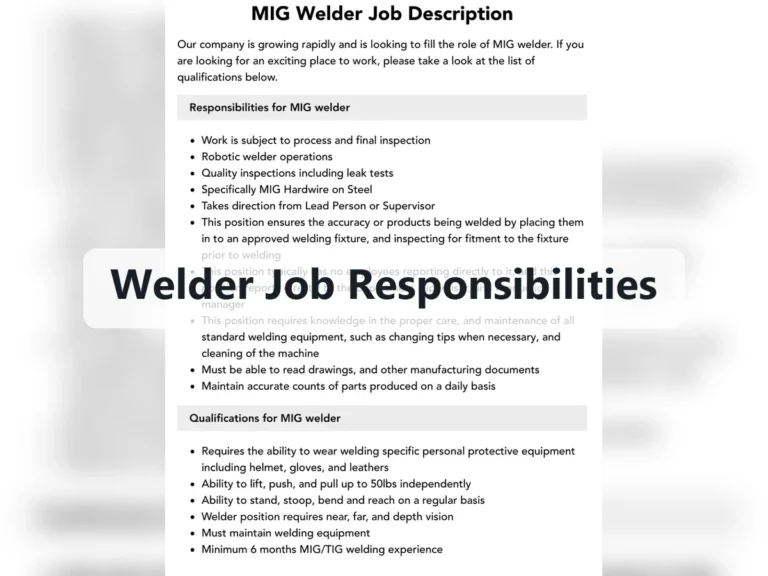
The best welder resume begins with the employer s needs not with a favorite template Read the job posting and identify its repeated requirements perhaps flux-cored arc welding.
Hiring teams often scan quickly for three things: whether you can perform the required work, whether you can do it safely and consistently, and whether your background fits the production environment. A clear resume answers those questions without making the reader search through dense paragraphs.
- Target role: Match your headline and summary to fabrication, construction, maintenance, production, or another specific welding setting.
- Technical scope: Identify processes, metals, thicknesses, joint types, positions, equipment, and drawings you genuinely use.
- Proof: Add accurate evidence such as throughput, first-pass quality, reduced rework, inspection performance, or project completion.
- Readability: Keep sections easy to scan, use consistent dates, and avoid decorative formatting that can confuse applicant-tracking software.
Choose a resume format that fits your experience
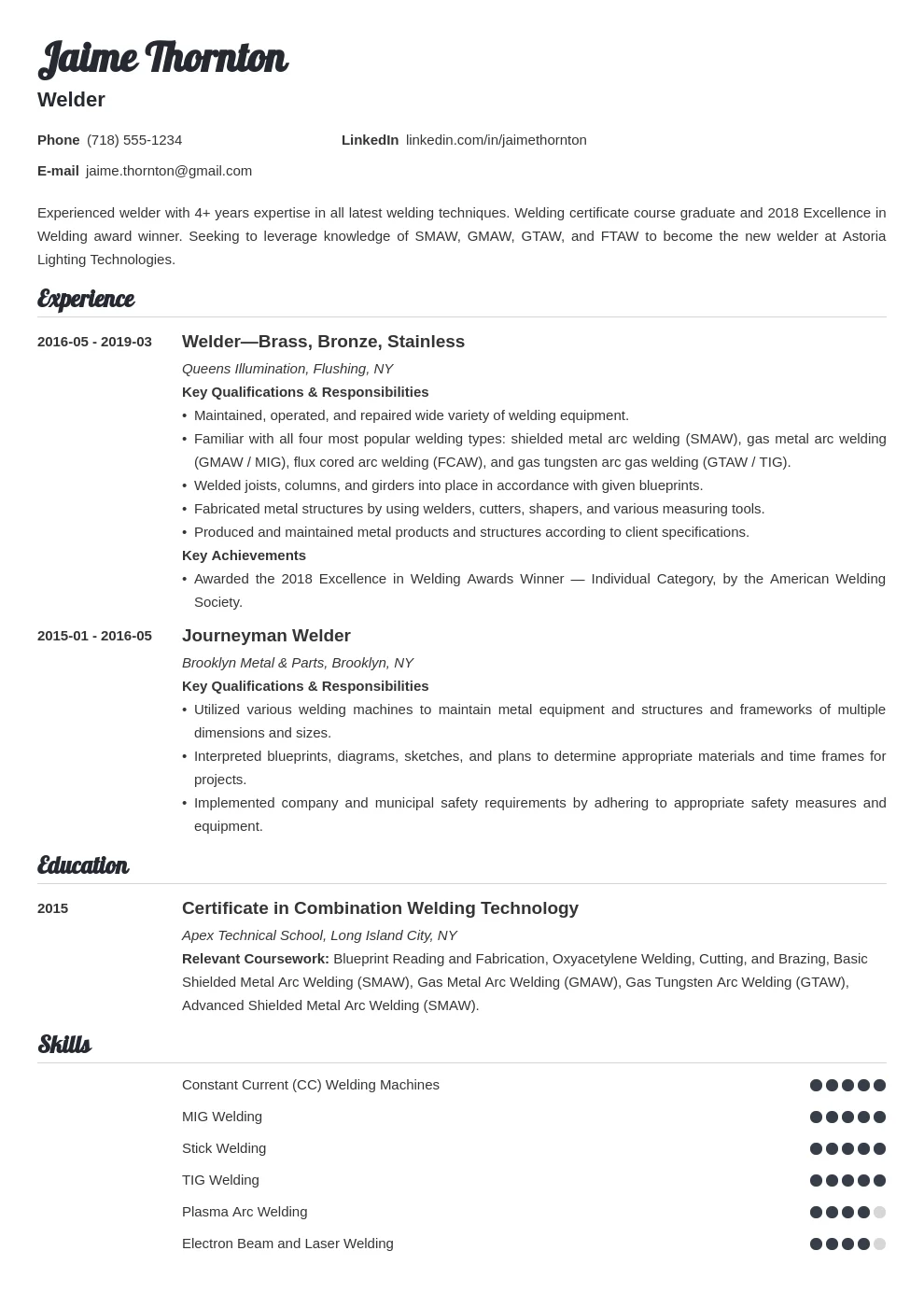
A reverse-chronological resume is usually the safest choice for an experienced welder with a steady employment record. It places recent work first and allows employers to see progression from helper or fitter to welder, lead welder, foreperson, or inspector.
A combination format works well when you have several relevant skills but your work history includes contract assignments, layoffs, seasonal construction, or a career change. It gives technical qualifications a visible opening section while still providing a complete employment timeline.
A purely functional resume organized mostly around skills can be less persuasive It may appear to conceal dates or limited experience and it makes it harder for an.
Use a professional header and headline
At the top, include your name, phone number, professional email address, city and state, and optionally a concise headline. A headline such as “Structural Welder | FCAW and Blueprint Reading” immediately communicates direction without claiming a qualification you do not have.
There is no need to include a full street address photograph age marital status or unrelated personal information If you are willing to relocate state that briefly Make.
Writing the Summary, Skills, and Qualifications Sections
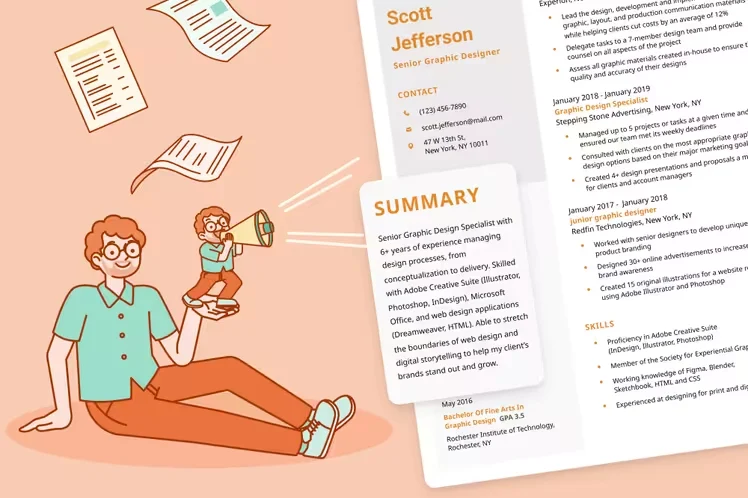
Your summary should be a compact argument for your candidacy In two or three sentences state your level of experience strongest relevant processes work setting and one or.
For an experienced candidate the summary can mention years in the trade materials positions and production or quality responsibilities For a new graduate it can emphasize formal training.
- Lead with fit: Name the processes and environment most closely connected to the vacancy.
- Show value: Mention reliable production, clean welds, accurate fit-up, reduced rework, or safe completion of demanding work when supportable.
- Keep it specific: Replace “knowledgeable welder” with details such as carbon steel fabrication, GTAW on stainless tubing, or FCAW structural assemblies.
- Adjust the emphasis: A production job may prioritize cycle time, while field work may prioritize mobility, drawings, safety, and changing conditions.
Welder resume summary examples
Experienced fabrication welder: “Fabrication welder with eight years of experience producing carbon-steel frames and assemblies in a high-volume shop. Skilled in GMAW and FCAW, blueprint interpretation, fit-up, visual inspection, and safe operation of overhead material-handling equipment.”
Pipe-focused candidate: “Pipe welder experienced with carbon-steel and stainless piping in industrial maintenance and fabrication settings. Proficient in GTAW root passes, SMAW fill and cap work, joint preparation, weld visual inspection, and following job-specific procedures.”
Entry-level candidate: “Recent welding program graduate with hands-on practice in SMAW, GMAW, FCAW, and GTAW on carbon steel and stainless steel. Trained in blueprint reading, shop safety, joint preparation, and basic weld inspection, with a strong interest in production fabrication.”
These examples are starting points, not universal claims. If you have not performed pipe welding in a commercial environment, describe school or personal-project practice accurately and label it as training or project experience. Credibility matters more than an impressive-sounding phrase.
Organize your technical skills
A long unstructured list can be difficult to interpret. Group skills into categories so the reader can distinguish processes from materials, tools, and supporting abilities. Include only skills you could discuss or demonstrate in an interview or practical test.
- Processes: SMAW, GMAW/MIG, FCAW, GTAW/TIG, oxyfuel cutting, plasma cutting, brazing, or spot welding.
- Materials: carbon steel, stainless steel, aluminum, galvanized steel, cast iron, or specific alloys you have handled.
- Work capabilities: flat, horizontal, vertical, and overhead positions; pipe work; structural assemblies; fit-up; tack welding; grinding; and repair.
- Technical tasks: blueprint and weld-symbol reading, measuring, joint preparation, fixture use, WPS compliance, visual inspection, and documentation.
- Workplace practices: lockout/tagout awareness, confined-space procedures, hot-work controls, PPE, housekeeping, and team communication.
Do not treat safety as a decorative keyword If the job posting emphasizes hot work respirator use fall protection confined spaces or site-specific orientations mention relevant training and.
Welder Resume Examples for Different Experience Levels
Experience changes what your resume should prove A senior welder should demonstrate scope reliability and leadership rather than merely repeat a list of processes A mid-career candidate should.
Before writing bullets ask what the employer would want to verify Can you read the drawing Can you prepare and fit the joint Can you maintain quality during.
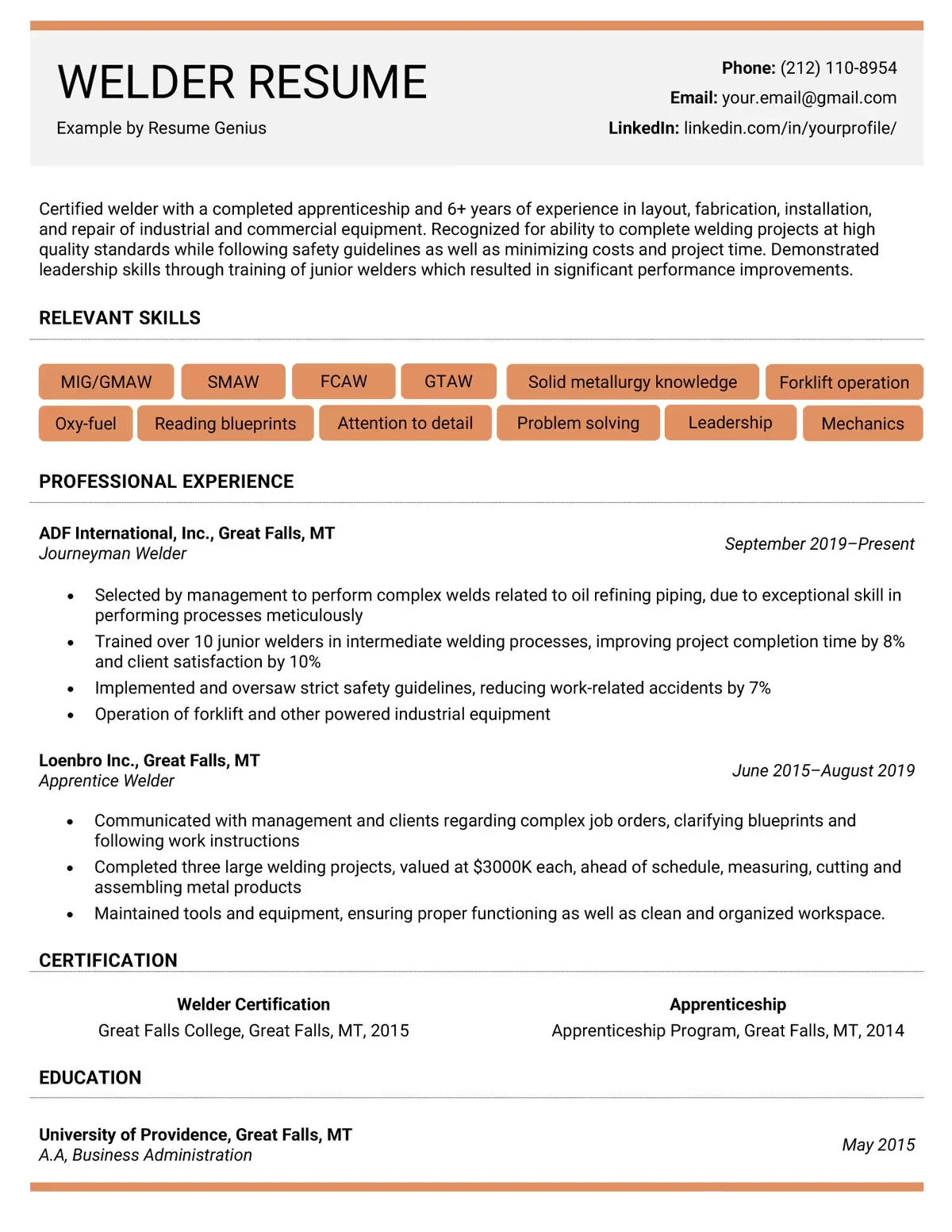
- Senior welder: Emphasize complex assemblies, procedure compliance, mentoring, troubleshooting, and inspection results.
- Mid-career welder: Balance processes and materials with production, quality, and equipment responsibilities.
- Entry-level welder: Use training projects, internships, shop work, and related employment to demonstrate readiness.
- Career changer: Translate mechanical, manufacturing, construction, or maintenance experience into relevant welding capabilities.
Experienced welder example
Senior Structural Welder, Regional Fabrication Company | 2019–Present
- Fabricate and weld carbon-steel frames, platforms, and supports from shop drawings using FCAW and GMAW in multiple positions.
- Complete fit-up, tack welding, weld cleanup, and visual checks before assemblies move to inspection.
- Coordinate with fitters and supervisors to resolve dimensional or access issues before final welding, limiting avoidable rework.
- Train newer welders on joint preparation, consumable handling, equipment checks, and safe work practices.
This example works because it describes the full workflow rather than claiming only that the worker “welded structures.” If you know accurate numbers—such as assemblies completed per shift or a documented reduction in rework—add them. Never invent metrics to make a bullet sound stronger.
Entry-level example
Welding Program Graduate | Community Technical College | 2025
- Completed supervised shop projects using SMAW, GMAW, FCAW, and GTAW on carbon steel and stainless steel.
- Read basic fabrication drawings and weld symbols, measured components, prepared joints, and completed welds in flat and horizontal positions.
- Applied PPE, ventilation, housekeeping, cylinder-handling, and equipment-inspection procedures during shop work.
- Documented project dimensions and reviewed finished welds for visible discontinuities under instructor guidance.
Related employment can strengthen this section. A machine operator may demonstrate production discipline and measurement accuracy; an auto technician may show mechanical troubleshooting; a construction laborer may show jobsite safety and tool familiarity. Explain the connection without pretending those jobs were welding positions.
Contract, temporary, and project work
Welders often work through staffing agencies, unions, shutdown contractors, or short-term project arrangements. Do not hide that pattern. Group assignments under a clear heading if doing so improves readability, or list each employer when the projects and responsibilities were substantially different.
This is an important consideration for welder resume examples.
Use location, project type, and dates to create context: “Shutdown Welder—industrial maintenance outage, May–July 2024.” If a project ended as scheduled, you can say so. That distinction helps employers understand that a short assignment was not necessarily a performance-related departure.
How to Describe Welding Experience With Strong Bullet Points
Job descriptions become persuasive when they show an action the technical setting and the result or purpose The strongest bullets do not need to be dramatic A precise.
Start with a strong verb such as fabricated, welded, fitted, repaired, inspected, interpreted, assembled, aligned, maintained, trained, or documented. Then add the process, material, component, environment, or standard that gives the action meaning.
- Action: Begin with what you personally did.
- Technical context: Name the process, material, equipment, drawing, position, or work environment.
- Purpose or result: Explain what the work supported, improved, completed, or protected.
- Evidence: Add a truthful number or quality indicator when available.
Weak versus stronger wording
| Weak wording | Stronger wording |
|---|---|
| Responsible for welding parts. | Weld carbon-steel brackets and frames with GMAW from fabrication drawings, completing fit-up and visual checks before shipment. |
| Used different machines. | Set up and adjusted GMAW and FCAW equipment for changing material thicknesses and joint configurations. |
| Worked safely. | Performed pre-use equipment checks, maintained hot-work housekeeping, and used required PPE in a busy fabrication area. |
| Fixed bad welds. | Removed and repaired weld discontinuities identified during visual inspection, then prepared assemblies for reinspection. |
Use numbers when they clarify scale: “completed 20 assemblies per shift,” “supported a three-person fabrication crew,” or “maintained records for daily production.” If you do not know the exact figure, use a defensible description such as “high-volume production” only when that accurately reflects the workplace.
Address quality without overclaiming
Welding quality can be described through inspection, rework, dimensional accuracy, procedure compliance, and customer or production requirements. Avoid claiming a perfect defect rate, universal code compliance, or formal inspection authority unless those statements are true and relevant to your role.
For example, “prepared welds for visual inspection and corrected identified discontinuities” is appropriate for many production roles. “Certified all welds to industry code” may be inaccurate if an inspector or engineer held that responsibility. Precise ownership protects your credibility.
Certifications, Training, and Credentials
Certifications deserve a prominent location because they may determine whether an employer can place you on a specific project. Create a separate section labeled “Certifications and Training” or “Credentials,” and list the credential name, issuing organization when relevant, date, and status if useful.
Include welding qualifications, OSHA-related training, forklift or aerial-lift training, confined-space training, respirator fit testing, rigging or signal-person training, and other credentials that matter to the target position. Do not list every course you have ever taken; prioritize current and relevant qualifications.
- Exact name: Use the credential’s real title instead of an informal abbreviation that could be misunderstood.
- Current status: Note expiration, renewal, or “in progress” when that information affects eligibility.
- Scope: Identify the process, material, position, or application covered when the credential has a defined range.
- Honesty: Do not present a school completion certificate as an employer qualification or claim a certification you cannot verify.
Where to place credentials
Put credentials near the top when the posting makes them a screening requirement For example a pipe-welding role may need to see process and position qualifications before reading.
Training that is expired can sometimes remain useful as background, but label it accurately. An expired qualification may show previous exposure without proving current eligibility. If renewal is scheduled, say “renewal in progress” only when that is true.
Tailoring a Welder Resume to the Job Posting
A generic resume can contain good information and still perform poorly because it does not prioritize the employer s needs Tailoring does not mean rewriting every sentence It means adjusting the headline summary skill order.
Compare the employer s wording with your own language If the posting says fabrication drawings do not rely only on blueprint reading If it requests flux-cored welding spell.
- Circle requirements: Mark every required process, material, credential, shift, tool, and work environment.
- Rank relevance: Move the closest matching qualifications toward the top of the document.
- Mirror accurately: Use the employer’s terminology when it truthfully describes your experience.
- Remove clutter: Reduce unrelated bullets that crowd out evidence for the target position.
For a field construction job, highlight site mobility, drawings, rigging awareness, weather or access challenges, and coordination with other trades. For a production shop, emphasize repeatability, fixtures, throughput, measurement, quality checks, and shift reliability. For maintenance, focus on troubleshooting, repair, equipment access, and minimizing downtime.
This is where welder resume examples can mislead applicants: a visually attractive sample may be written for a different specialization. Borrow the organization, not the claims. Your own resume should reflect the work you can perform in the environment you are seeking.
Common Resume Mistakes and How to Fix Them
Most weak welding resumes fail through omission or imprecision rather than poor grammar. They list tools without describing results, bury qualifications under unrelated history, or use broad statements that could describe almost anyone in the trade.
Review the document as a hiring manager would. Can the reader identify your target role, strongest processes, recent employers, relevant credentials, and level of independence within the first few seconds? If not, revise the hierarchy before polishing minor wording.
- Process-only lists: Add materials, positions, applications, and evidence instead of listing MIG, TIG, and stick welding alone.
- Unclear dates: Use consistent month-and-year formatting and explain project or seasonal work briefly.
- Unsupported claims: Replace “expert” or “perfect quality” with observable responsibilities and accurate outcomes.
- Overloaded design: Use readable headings and spacing rather than graphics, rating bars, or tiny text.
Do not confuse skills with qualifications
“Blueprint reading” is a skill. A documented welding qualification for a specific process and position is a credential. “Safety-conscious” is a trait; completed safety training or a demonstrated inspection procedure is evidence.
Separating these categories makes your resume easier to trust.
Keep the length proportional to the evidence
One page is often enough for an entry-level welder or someone with a short work history. Two pages may be appropriate for an experienced welder with multiple relevant employers, credentials, project types, and leadership responsibilities. Do not shrink the font to preserve every unrelated job.
Older experience can be summarized when it no longer adds useful detail. Keep positions that demonstrate the foundation of your trade, but give more space to recent and relevant work. A concise resume is not incomplete when it answers the employer’s practical questions.
Resume Formatting and Final Review
Use a simple layout with clear section headings, consistent bullet punctuation, and enough white space to separate jobs. Standard fonts and conventional headings generally make the document easier for both people and applicant-tracking systems to process.
Save the final file in the format requested by the employer Unless instructions say otherwise a PDF preserves the appearance while an editable document may be preferred by.
- Accuracy: Confirm employer names, dates, locations, process names, credential status, and contact details.
- Consistency: Check tense, capitalization, abbreviations, bullet style, and date format.
- Targeting: Make sure the summary and first experience section reflect the specific vacancy.
- Practical readiness: Prepare to explain every listed process, tool, credential, and accomplishment in an interview.
Read the resume aloud or ask someone unfamiliar with welding to identify the main message. If the reader cannot tell whether you are targeting structural fabrication, pipe work, production, or maintenance, your headline and summary need more direction.
FAQ About Welder Resume Examples
What should a welder put on a resume with no job experience?
Emphasize welding school, supervised shop projects, internships, personal projects, safety training, blueprint reading, measurements, and the processes you practiced. Add related employment that demonstrates production, mechanical, construction, or equipment experience.
Label training honestly. “Completed supervised GTAW practice on stainless steel” is stronger and more credible than implying commercial TIG experience you have not yet obtained.
How many welding processes should appear on a resume?
List every process you can genuinely discuss and perform at the level relevant to the job, but prioritize the requested processes. A focused list of four well-supported processes is more useful than a long inventory of occasional exposure.
Should welding certifications be listed before work experience?
Place certifications before work experience when they are a screening requirement or directly determine job eligibility. Otherwise, put them immediately after a strong summary and skills section so they remain easy to find.
How do you describe welding skills without exaggerating?
State the process, material, position, application, and level of responsibility you actually have. Distinguish classroom, supervised, independent, and inspection-related experience instead of using unsupported labels such as “master” or “expert.”
Should a welder include salary, references, or a photo?
Usually no. Do not include salary history, “references available upon request,” or a photo unless the employer specifically requests the information. Use that space for relevant processes, credentials, safety training, and measurable work evidence.
How can a welder explain short-term contract jobs?
Identify the contract, project type, employer or staffing agency, location when useful, and dates. A short assignment described as a scheduled shutdown or completed project is easier to understand than an unexplained series of brief jobs.
Can a welder use the same resume for every application?
Use one accurate master resume, but tailor the version you submit. Change the headline, summary, skill order, and selected bullets to match the employer’s process, materials, environment, shift, and credential requirements.
Conclusion
The strongest welder resume examples are useful because they show how to organize evidence not because they provide sentences to copy Build your resume around the target role.
Before submitting, verify every process and certification, remove unsupported claims, and make sure the first section answers why you fit that particular welding job. A clear resume cannot replace required qualifications or safe hands-on performance, but it can make your real capabilities easier to recognize.
Open the target job posting, mark its five most important requirements, and revise your summary and first experience bullets to address those requirements truthfully.