TIG Welder Salary: Everything You Need to Know and Understand
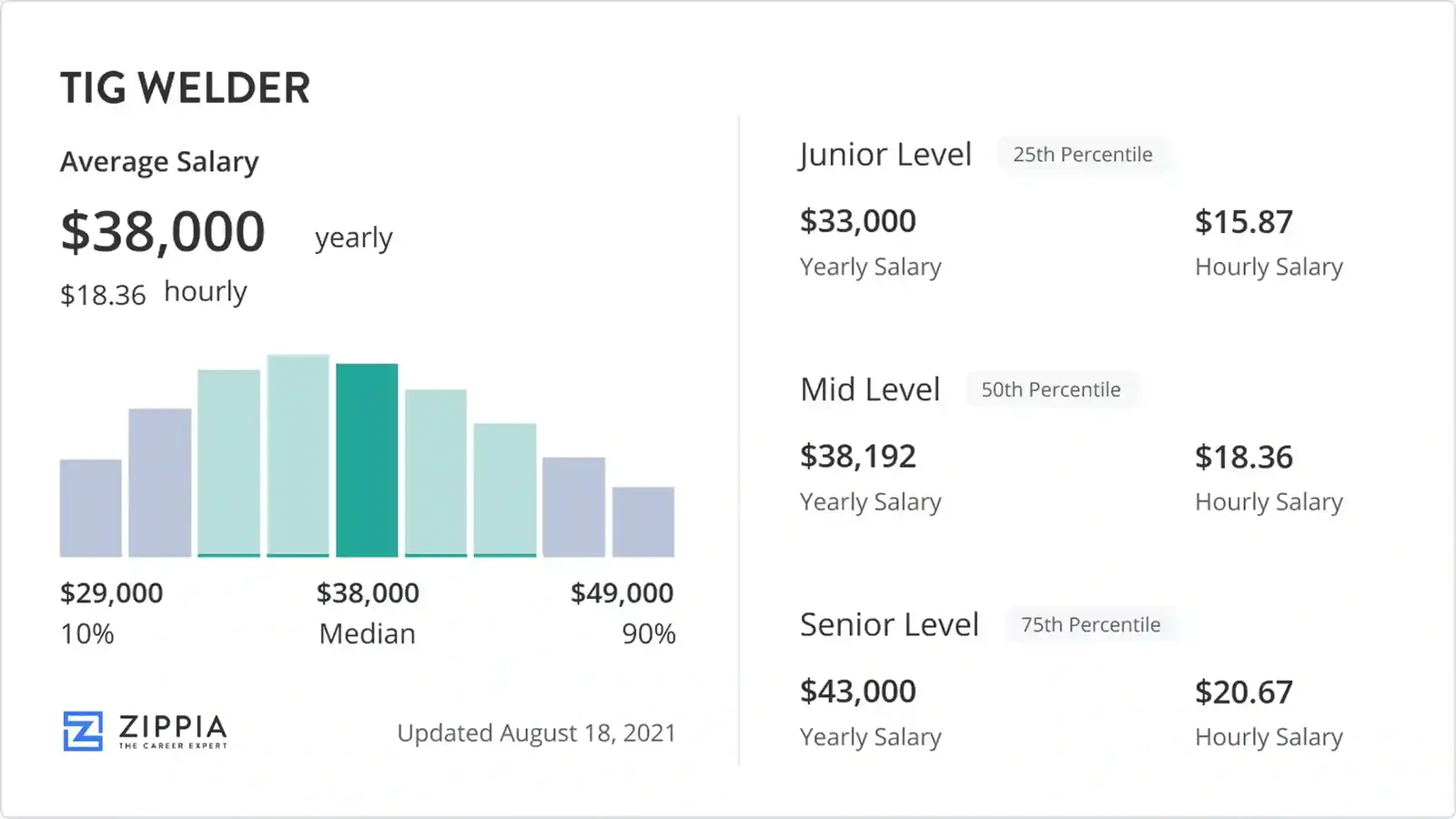
A TIG welder in the United States commonly earns about $20 to $35 per hour, while experienced specialists can earn $40 or more.
A higher TIG welder salary is not guaranteed simply because TIG welding is technically demanding. Counterintuitively, a worker who can produce beautiful welds may earn less than a versatile welder who also reads drawings, passes procedure tests, works efficiently, and handles difficult materials.
That difference is why a rushed career or job-offer decision can overlook the details that actually control pay industry location shift overtime travel certifications weld quality and whether.
- ✓TIG pay varies widely because “TIG welder” covers entry-level shop work, aerospace fabrication, pipe welding, sanitary work, and field assignments.
- ✓Hourly wage alone does not show total compensation; overtime, per diem, health insurance, retirement benefits, and travel premiums can materially change the result.
- ✓Precision, blueprint reading, inspection awareness, and multiple-process ability often increase earning power more than TIG experience alone.
- ✓Location and industry are major pay drivers, but high-paying jobs may involve stricter testing, unusual shifts, travel, or expensive local living costs.
TIG Welder Salary: What the Numbers Usually Mean
Salary estimates for TIG welders are best treated as ranges rather than promises. The occupation is commonly grouped with welders, cutters, solderers, and brazers in public labor data, while job boards and employers may use narrower titles such as TIG fabricator, pipe welder, orbital welder, stainless steel welder, or aerospace welder.
For a broad United States planning estimate entry-level TIG work often falls near 18 to 24 per hour A capable welder with several years of reliable production experience may see approximately 24 to 35 per hour while highly skilled pipe aerospace pharmaceutical nuclear or specialized fabrication roles can reach 35 to 50 or.
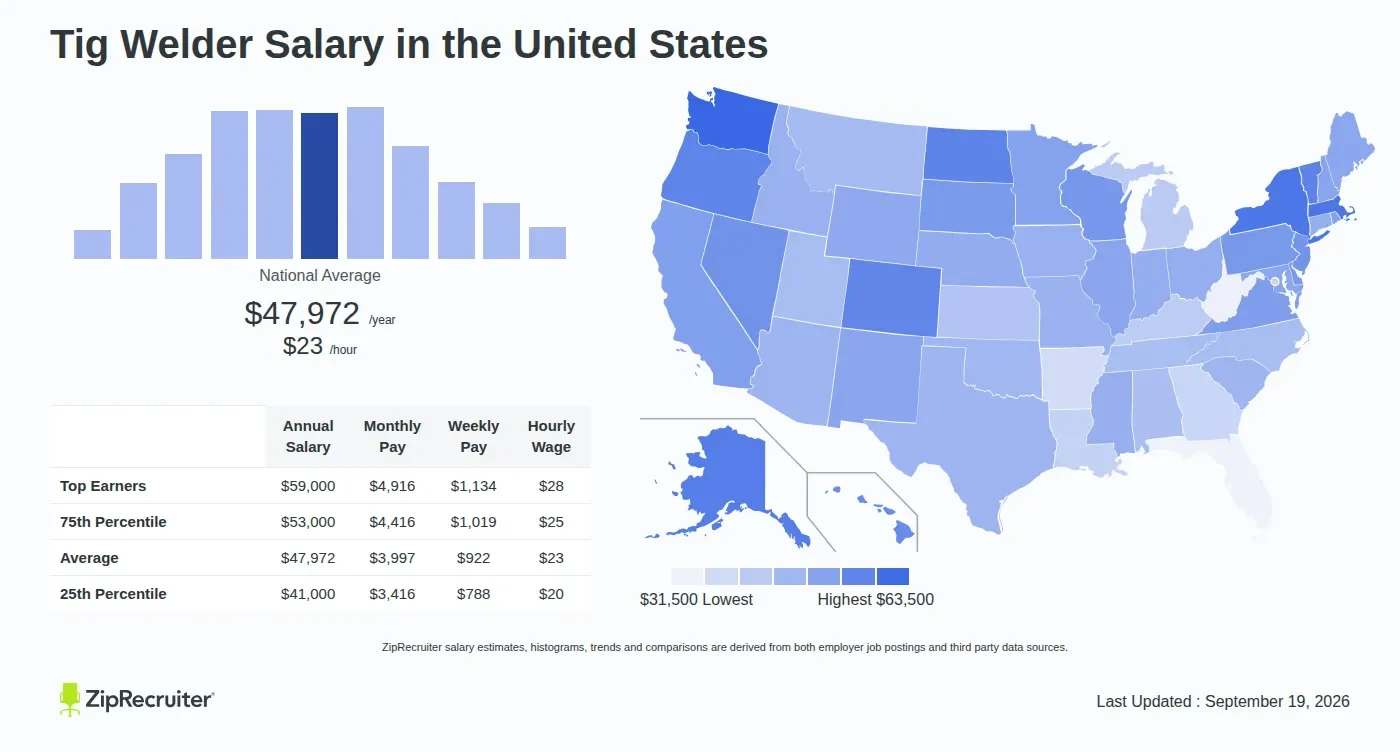
- Entry level: Roughly $18–$24 per hour, often involving supervised production, fit-up, basic stainless work, or general fabrication.
- Intermediate: About $24–$35 per hour for welders who consistently meet quality requirements and work from drawings.
- Specialized: Approximately $35–$50-plus per hour in demanding industries, union environments, travel work, or difficult-to-fill locations.
- Annual comparison: At 2,080 regular hours, $25 per hour equals $52,000 before taxes, while $35 per hour equals $72,800 before overtime or benefits.
Annual figures can be misleading because many industrial welders do not work exactly 2,080 paid hours. Seasonal slowdowns, temporary contracts, shutdowns, overtime, layoffs, travel rotations, and unpaid time between assignments can move actual earnings far from a simple hourly calculation.
Hourly pay versus annual income
To compare offers, multiply the guaranteed hourly rate by expected paid hours, then add realistic overtime and premiums. Do not count overtime that the employer cannot reasonably provide, and do not treat per diem as ordinary wages because it may reimburse travel expenses rather than increase taxable base pay.
| Hourly rate | Regular annual pay at 2,080 hours | What it may represent |
|---|---|---|
| $20 | $41,600 | Entry-level or lower-cost-market work |
| $25 | $52,000 | Developing production welder |
| $30 | $62,400 | Experienced shop or fabrication welder |
| $35 | $72,800 | Strong industrial or specialized worker |
| $45 | $93,600 | Highly specialized, union, travel, or demanding assignment |
For example, a $30-per-hour local job with health insurance and a predictable schedule may be financially stronger than a $38-per-hour contract that offers no benefits, inconsistent hours, and expensive travel. Compare the entire package, not just the number printed beside “pay rate.”
What Determines a TIG Welder’s Pay?
The process itself matters, but employers pay for the results and capabilities surrounding it. TIG welding can produce exceptionally clean, controlled welds, yet that advantage has commercial value only when the welder can maintain quality while meeting production, documentation, and safety expectations.
Material and joint difficulty are important. Thin aluminum, titanium, nickel alloys, stainless steel tubing, and critical pipe joints can require more control than basic mild-steel fabrication. A job involving strict visual standards, radiographic inspection, leak testing, or documented procedures generally carries more responsibility than one involving noncritical brackets or repair work.
- Quality consistency: Employers value repeatable penetration, clean starts and stops, controlled heat input, and minimal rework.
- Production value: A welder who works efficiently without sacrificing quality can justify a higher rate than someone who welds slowly or requires frequent correction.
- Technical range: TIG combined with MIG, flux-cored, stick, orbital, or automated welding can open more jobs than TIG alone.
- Documentation: Reading drawings, recording weld parameters, following procedures, and understanding inspection requirements increase workplace trust.
Experience and independence
Years in the trade help, but years alone do not determine advancement. Employers usually distinguish between someone who has spent five years repeating one simple weld and someone who has developed judgment across materials, positions, joint designs, and quality systems.
At the lower end, workers may tack parts, clean joints, follow close supervision, and perform repetitive welds. At higher levels, they may select tungsten and filler, adjust amperage and gas coverage, identify distortion risks, interpret weld symbols, troubleshoot porosity, and complete work with minimal oversight.
Industry and application
General fabrication can provide a useful entry point, but specialized sectors may pay more because the work is harder to staff or mistakes are more expensive. Aerospace and defense suppliers may emphasize traceability and procedure compliance. Pharmaceutical and food-processing fabrication may require sanitary welds and careful surface finishing.
Energy, shipbuilding, industrial maintenance, and construction can add premiums for field conditions, travel, or difficult schedules.
Pipe welding is often associated with higher wages, especially when the work requires demanding positions, code qualification, shutdown schedules, or travel. However, pipe work can involve irregular hours, uncomfortable environments, extensive testing, and periods between projects. The higher advertised rate is compensation for those demands, not free extra income.
Location and labor market
Wages tend to rise where manufacturing, construction, energy, shipbuilding, medical-device production, or aerospace activity creates strong demand. They may also rise in expensive metropolitan areas, although a larger paycheck does not automatically produce more purchasing power.
Compare pay with rent, commuting costs, taxes, insurance, and availability of steady work. A $32-per-hour position in a high-cost city may leave less disposable income than a $27-per-hour job in a smaller market with lower housing costs and a shorter commute.
How TIG Pay Compares With Other Welding Paths
TIG is frequently described as a premium process, but that does not mean every TIG job pays more than every MIG or stick position. Compensation reflects the complete assignment: material, position, inspection standard, production rate, environment, certification requirements, and labor shortage. This is an important consideration for tig welder salary.
A production MIG welder may earn more than a beginner TIG welder because the production worker is faster, more experienced, or responsible for a high-volume line. Conversely, an experienced TIG welder working on critical stainless or exotic-alloy assemblies may earn substantially more than a general fabricator.
- TIG: Offers precision and control, commonly used for stainless steel, aluminum, thin materials, tubing, and appearance-sensitive work.
- MIG: Often supports faster production and may offer abundant entry-level opportunities in manufacturing and fabrication.
- Stick: Remains valuable for outdoor, structural, repair, and field conditions where portability and tolerance for less-controlled environments matter.
- Pipe and orbital work: Can command strong compensation when testing, access, documentation, travel, or critical-service requirements are involved.
The best long-term strategy is often not to choose one process rigidly. A TIG specialist who can also fit, tack, read drawings, weld with another process, and support inspection has more ways to remain useful when one industry slows down.
Why precision does not always equal higher pay
TIG usually requires slower travel speeds and more attention to joint preparation than high-volume MIG work. If an employer sells simple fabricated products on narrow margins, the business may not be able to pay a premium for cosmetic precision that customers do not require.
In contrast, a leak-sensitive tube assembly, medical component, aircraft structure, or high-purity process line may depend on exact technique. There, a small defect can cause costly rework, contamination, failed inspection, or equipment downtime. The value of TIG rises when the customer pays for control and reliability.
Union, contract, and direct-hire differences
Union jobs may offer structured wage progression, overtime rules, health coverage, pension or retirement contributions, and formal classifications. Direct-hire shop positions may provide more stable year-round employment, but pay progression can depend heavily on individual negotiation and company policy.
Contract and traveling jobs sometimes advertise the highest hourly number. Before accepting, check the guaranteed hours, assignment length, lodging, mileage, per diem rules, travel time, testing costs, equipment requirements, and what happens if the project ends early.
Skills and Credentials That Can Raise Earnings
There is no single certificate that automatically produces a high wage. Credentials matter when they prove a capability the employer needs, and they matter even more when paired with clean work history and verifiable performance.
Many employers look for practical evidence: passed weld tests, documented experience with specific materials, familiarity with welding procedure specifications, and the ability to produce acceptable work under realistic conditions. A certificate may help you get considered, but the shop test often determines whether you receive the offer.
- Blueprint reading: Understand dimensions, tolerances, weld symbols, section views, and revision control.
- Fit-up and fabrication: Layout, tack, alignment, distortion control, and measurement skills make a welder more useful before the arc is started.
- Inspection awareness: Learn common causes of porosity, lack of fusion, undercut, cracks, contamination, and excessive oxidation.
- Process flexibility: Add MIG, stick, flux-cored, orbital, or automated-system experience when it supports your target industry.
Certifications and qualification tests
Welding qualification requirements vary by employer, project, material, position, and governing code. Some jobs expect recognized welder qualifications; others conduct their own bend tests, visual inspections, or production trials. Ask which qualifications are required before paying for training.
Useful credentials can include welding education, safety training, blueprint or fabrication coursework, and qualifications tied to the work you want. A credential with no connection to local openings may add less value than strong practice on the exact material and joint type employers are testing.
Soft skills that affect promotion
Reliable attendance, clear communication, careful housekeeping, and willingness to stop when a condition is unsafe often influence advancement. Supervisors need workers who can report a bad fit-up, ask for clarification, protect parts from contamination, and document problems instead of hiding them.
Leadership can also increase pay. Training newer welders, coordinating with fitters and inspectors, estimating labor, troubleshooting recurring defects, or helping improve a procedure can move a worker toward lead, foreperson, quality, or welding-supervisor roles.
How to Evaluate a TIG Welding Job Offer
A job offer should be analyzed as a working arrangement, not only as an hourly wage. Two employers may offer the same rate while providing very different amounts of paid time, overtime, equipment, stability, and advancement.
Ask specific questions before accepting. A vague description such as “TIG experience preferred” does not reveal whether you will weld thin sheet, repair tooling, fabricate tube, perform repetitive production, or split your time between fitting and cleanup. These practical limitations also matter for tig welder salary.
- Guaranteed hours: Confirm the normal schedule, seasonal fluctuations, overtime availability, and whether shutdowns are common.
- Actual duties: Ask what materials, thicknesses, positions, joint types, and inspection standards apply.
- Complete compensation: Compare health insurance costs, paid holidays, vacation, retirement contributions, bonuses, shift premiums, and raises.
- Testing and tools: Find out whether the company pays for qualification tests, consumables, protective equipment, and required training.
Questions worth asking the employer
- What percentage of the job is actual TIG welding?
- Which materials and joint configurations will I weld most often?
- Is the position production, fabrication, repair, field service, or a combination?
- How is quality measured, and what kinds of inspection are used?
- What is the normal shift, and how often is overtime available?
- What raises or wage reviews occur after training or qualification?
- Are travel, per diem, lodging, or shift differentials available?
These answers help distinguish a genuine development opportunity from a low-paid job using “TIG” as a recruiting label. If the role expects fitting, grinding, material handling, assembly, and welding, ask how those duties affect the classification and pay.
Negotiating without overreaching
Build your request around measurable value. Mention successful weld tests, specific materials, inspection experience, low rework, blueprint skills, or the ability to cover multiple processes. “I need more money” is weaker than “I can independently produce inspected stainless assemblies and also handle fit-up and final measurements.”
If the employer cannot raise the starting rate, negotiate a written review after a qualification period, paid training, a shift premium, tool reimbursement, additional vacation, or a clear progression to the next wage level. Get important promises in writing.
Ways to Increase Your Earnings Over Time
Higher pay usually follows a combination of technical depth, reliability, and access to better-paying markets. The goal is not to collect every possible skill; it is to build a profile that solves a costly problem for a particular type of employer.
Start by examining local job postings and identifying repeated requirements. If employers repeatedly request aluminum TIG, sanitary tubing, blueprint reading, pipe positions, or fabrication experience, direct your practice and training toward those needs rather than guessing.
- Keep a skills record: Track materials, thicknesses, positions, equipment, qualifications, and projects you can discuss accurately.
- Practice defect prevention: Study shielding gas coverage, cleanliness, tungsten preparation, heat control, joint fit-up, and contamination sources.
- Target a specialty: Choose a market where your preferred materials and working conditions match sustained employer demand.
- Review pay regularly: Compare your capabilities with current openings instead of waiting indefinitely for an informal raise.
Specialize without becoming fragile
Specialization can improve pay, but excessive narrowness can reduce job options. A welder who understands a specialized process while retaining basic fabrication and another welding process may be more resilient than someone who will accept only one exact task.
For example, sanitary stainless work may reward cleanliness and finishing, while structural or maintenance work may reward access, repair judgment, and field adaptability. Choose based on your tolerance for travel, physical conditions, schedule changes, and testing—not just the advertised wage.
Consider the total career path
Welding can lead into fitting, inspection, quality control, welding instruction, estimating, supervision, maintenance, or automation support. Some of these paths reduce time under the hood while increasing responsibility, documentation, or customer interaction.
Physical sustainability matters. Ergonomics, respiratory protection, hearing protection, eye protection, ventilation, and safe handling practices are not optional extras. A high hourly rate is not a good trade if the work environment exposes you to unmanaged hazards or causes an avoidable long-term injury.
Common Mistakes When Estimating TIG Income
Many salary comparisons fail because they combine different job types or treat exceptional assignments as normal. A travel shutdown rate, a union package, and a small local shop wage may all be labeled “TIG welder pay,” even though the schedules and benefits are entirely different.
Use ranges and verify assumptions. Search several local openings, ask employers about actual schedules, and separate base pay from overtime, reimbursements, bonuses, and benefits.
- Using a national average as a promise: Broad figures cannot account for your city, experience, industry, or work availability.
- Counting overtime as guaranteed: Overtime can disappear when projects, budgets, or seasons change.
- Ignoring unpaid time: Contract gaps, travel days, and shutdowns may reduce actual annual earnings.
- Comparing gross pay only: Insurance premiums, retirement contributions, commuting, and housing can change the better offer.
Another mistake is assuming more certifications automatically equal more money. Training has the strongest return when it helps you pass a test, qualify for a role, meet a code requirement, or perform a skill employers are actively purchasing.
FAQ About TIG Welder Salary
What is the average TIG welder salary in the United States?
There is no single reliable figure for every TIG welder because public wage categories often combine TIG with other welding occupations. A practical planning range is about $20 to $35 per hour, with specialized and travel roles sometimes exceeding that range.
Do TIG welders make more than MIG welders?
Not automatically. TIG can pay more when it involves difficult materials, strict inspection, thin-wall work, critical components, or specialized industries, but experienced MIG welders in high-volume or union environments may earn as much or more.
How much does an entry-level TIG welder make?
Entry-level pay often falls near $18 to $24 per hour, depending on location, education, shop duties, and whether the worker can already read drawings or perform basic fit-up. Initial pay can improve after passing an employer’s weld test and demonstrating consistent production quality.
Can TIG welding pay over $40 an hour?
Yes, but rates above $40 per hour are more common in specialized, union, travel, field, critical-service, or difficult-to-staff work than in ordinary entry-level shop positions. Confirm whether the rate includes unusual schedules, short contracts, unpaid travel, or limited benefits.
Does a welding certificate increase TIG pay?
It can, particularly when the credential matches an employer’s qualification requirements. A certificate is not a guarantee; practical performance, relevant materials, work history, inspection results, and the local labor market usually determine the final offer.
Which TIG specialties tend to pay the most?
Higher-paying opportunities may include pipe, aerospace, defense, pharmaceutical, sanitary process, high-purity tubing, power-generation, and specialized maintenance work. These roles commonly require stronger documentation, testing, precision, travel, or schedule flexibility.
Is TIG welding a good career financially?
It can be a solid career when you build dependable skills, protect your health, and target industries with sustained demand. Financial results depend on local costs, benefits, employment stability, overtime, and your willingness to qualify for more demanding work.
Conclusion
A competitive TIG welder salary depends on more than holding a torch. Experience with valuable materials, consistent quality, blueprint and fit-up ability, inspection awareness, process flexibility, and willingness to meet the realities of a specialized job all influence earning power.
Compare offers using total compensation, realistic annual hours, schedule, location, safety conditions, and advancement potential. Specialized or travel work may pay more, but it can also bring testing, physical demands, irregular schedules, and time away from home.
Review ten local TIG welding openings, record their repeated skill requirements and complete compensation, then choose one targeted skill or qualification to pursue next.