Rail Welding Training: Essential Information and Useful Advice
Many people assume rail welding training is mainly about learning how to strike an arc or control a torch. In practice, the difficult part is producing a rail joint that is safe, aligned, durable, inspectable, and acceptable under a railroad’s written procedure.
Rail welding training matters because railroad welding combines metallurgy, track geometry, equipment operation, heat control, inspection, and job-site safety. A technically attractive weld can still fail if the rail ends are poorly prepared, the temperature is wrong, the alignment is off, or the finished joint is not properly tested.
I wrote this guide to clarify what the training includes which welding methods are commonly taught how to choose a credible program what qualifications employers may expect and.
What Rail Welding Training Teaches
Rail welding training prepares a person to join rail sections while preserving the mechanical and geometric properties required for train traffic. The work is not limited to making two pieces of steel stick together. A rail weld must withstand repeated wheel loads, vibration, temperature changes, braking forces, and stresses caused by track movement.
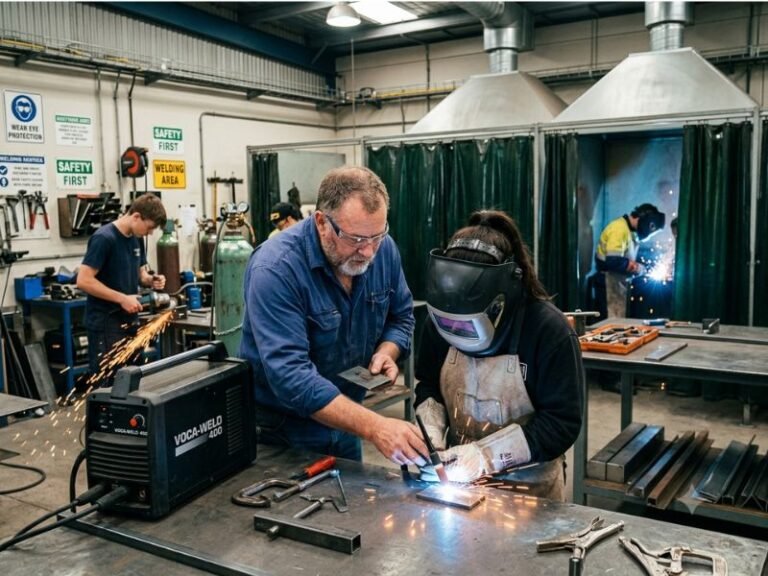
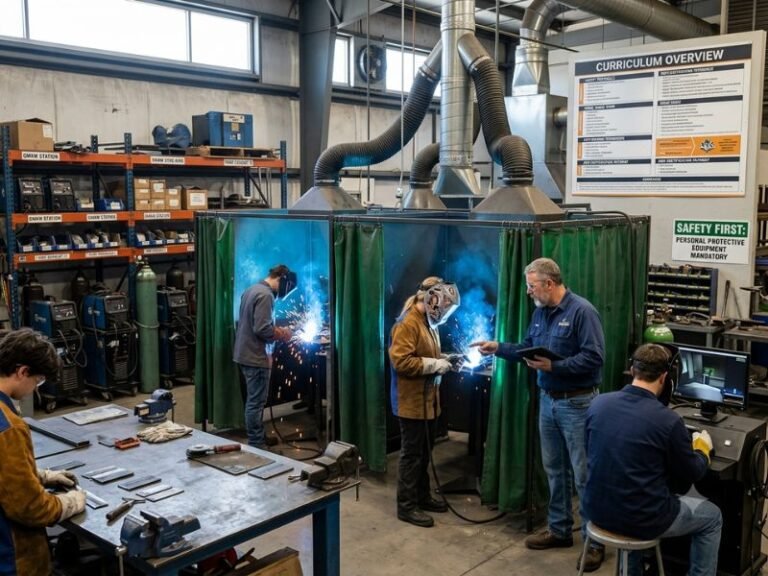
Most programs combine classroom instruction, demonstrations, supervised hands-on practice, and performance evaluation. The exact balance depends on the method. A course focused on thermite welding may spend substantial time on mold preparation, charge handling, preheating, and finishing. A flash-butt course may emphasize machine setup, electrical controls, rail positioning, upset measurement, and automated inspection.
Core instruction commonly covers:
- Rail steel identification and basic metallurgy
- Rail profile, joint design, and dimensional requirements
- Rail cutting, grinding, cleaning, and end preparation
- Welding equipment, tools, consumables, and calibration
- Preheating, heat control, cooling, and treatment of the heat-affected zone
- Rail alignment, longitudinal positioning, and track geometry
- Visual inspection and nondestructive testing
- Personal protective equipment and job-site hazard control
- Documentation, weld identification, and quality records
The best instruction connects each step to a failure mode. For example, a trainer should explain not only how to grind a rail head but also why an incorrect profile can create wheel impact, accelerated wear, or a defect that becomes difficult to detect.
Why Rail Weld Quality Matters
Welded rail reduces the number of mechanical joints in a track system and can contribute to smoother operation and lower maintenance demands. However, a welded joint becomes part of the continuous rail structure. That makes consistency especially important.
A defective weld may contain cracks, lack of fusion, porosity, inclusions, excessive hardness, soft areas, or dimensional irregularities. Some defects are visible. Others require ultrasonic, magnetic, or another approved nondestructive inspection method. A weld can also be internally sound but unacceptable because it has poor alignment or an incorrect rail-head profile.
Railroads manage these risks through written welding procedures qualified personnel inspection requirements equipment controls and records In the United States applicable Federal Railroad Administration rules railroad engineering standards contractor specifications and approved welding procedures may all affect the work A training certificate alone does.
I recommend treating quality documentation as part of the job rather than as paperwork added afterward. A clear record can show who performed the weld, which procedure and equipment were used, what inspection occurred, and whether the result met the required acceptance criteria.
Rail Welding Methods
Training should identify the welding process clearly because the equipment, hazards, skill requirements, and acceptance tests differ substantially. The main rail-welding methods used in North American railroad work include flash-butt welding and thermite, also called aluminothermic, welding. Some facilities or specialized applications may use other processes under controlled procedures.
Flash-butt welding
Flash-butt welding uses electrical resistance and controlled pressure to join prepared rail ends. The ends are brought close together so electrical current creates flashing and heat. The machine then forces the hot ends together, producing an upset that is later trimmed or finished according to the procedure.
It is commonly associated with production facilities, mobile welding machines, or highly controlled field operations. Training typically includes:
- Machine controls and setup
- Rail clamping and alignment
- Electrical and hydraulic safety
- Flash and upset parameters
- Measurement of the finished upset
- Grinding and profile restoration
- Inspection and rejection criteria
Flash-butt work demands disciplined machine operation. The operator must understand how rail temperature, end condition, alignment, machine settings, and the welding cycle affect the finished joint. A program that only demonstrates the machine without teaching parameter control is incomplete.
Thermite or aluminothermic welding
Thermite welding uses a chemical reaction to produce molten metal that fills a prepared joint between rail ends. The process normally involves cutting or squaring the rail, setting the correct gap, installing a mold, sealing the mold, preheating, igniting the charge, pouring the metal, removing the mold, and finishing the weld.
Because the reaction produces extremely high heat and molten metal, the work requires strict control of fire, burn, explosion, ventilation, and material-handling hazards. Training should cover the specific product instructions and approved procedure rather than relying on general welding knowledge.
Thermite weld quality depends heavily on preparation. Problems can result from contamination, an incorrect rail gap, poor mold fit, inadequate preheating, moisture, improper timing, or insufficient finishing. The process can look straightforward from a distance, but small preparation errors have serious consequences.
Other welding skills
Some railroad welding roles include maintenance or repair work involving arc welding, hardfacing, or buildup of rail components. These tasks are not automatically interchangeable with rail joining. The welding process, base metal, filler material, preheat requirement, and inspection method must match the approved procedure.
For that reason, I would not choose a course simply because it advertises “rail welding” without naming the processes covered. Ask whether the course prepares students for flash-butt welding, thermite welding, repair welding, or a combination of these activities.
What a Typical Training Process Looks Like
A credible program usually moves from fundamentals to controlled practice and then to qualification or evaluation. The sequence may differ, but the learning logic should remain clear.
1. Classroom fundamentals
Instruction begins with rail construction, steel behavior, weld terminology, drawings, procedures, and safety. Students should learn how rail sections are identified and how rail-head, web, and base geometry influence preparation and finishing.
Metallurgy does not need to become an advanced engineering course, but trainees should understand heat-affected zones, hardness, cooling behavior, residual stress, and why overheating or uncontrolled cooling can weaken a joint. That knowledge helps a welder recognize when a field condition is outside the procedure.
2. Tool and equipment familiarization
Students then learn to inspect and operate equipment. Depending on the method, this may include rail saws, grinders, alignment tools, molds, crucibles, preheaters, welding machines, measurement tools, ventilation equipment, and inspection instruments.
Equipment checks should be practical. A trainee should know how to identify damaged leads, worn grinding wheels, blocked fuel lines, defective clamps, expired consumables, poor ventilation, and inaccurate measuring devices. Continuing with questionable equipment is a quality and safety decision, not merely an efficiency issue.
3. Supervised joint preparation
Preparation is often where experienced welders distinguish themselves. Students practice making clean, square rail ends; removing contaminants; setting the correct gap; checking alignment; and securing the work. They also learn how to manage weather, moisture, access limitations, and nearby track operations.
Training should include deliberate fault scenarios. A good instructor can show what happens when a rail end is not square, a mold does not seal, a preheater is misplaced, or a rail shifts before solidification. Seeing the connection between the error and the defect makes the procedure easier to remember.
4. Weld execution and finishing
During the weld, students follow a defined sequence and observe the critical controls. Afterward, they remove excess material, restore the rail profile, inspect the surface, and verify alignment. Finishing is not cosmetic. A high spot, low spot, sharp transition, or incorrect gauge-face profile can affect wheel-rail contact.
5. Inspection and evaluation
Training concludes with inspection, documentation, and an assessment of the trainee’s performance. Some programs issue a completion certificate, while others prepare students for an employer qualification or a process-specific performance test.
I would ask in advance exactly what “certified” means. It may indicate course attendance, successful completion of a practical test, qualification under a particular procedure, or eligibility for an employer’s next evaluation. Those descriptions are not equivalent.
Prerequisites and Personal Skills
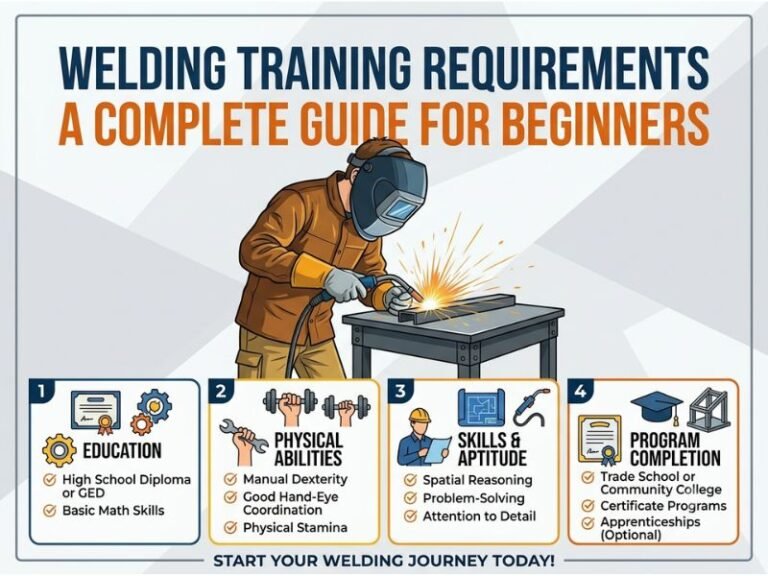
Entry requirements vary. Some employers hire trainees with no railroad background and teach the basic track environment on the job. Others prefer applicants with welding experience, mechanical experience, track maintenance experience, or a commercial driver’s license for mobile operations.
Common expectations may include:
- Ability to read safety instructions and technical procedures
- Basic mechanical and measurement skills
- Comfort working outdoors and around heavy equipment
- Ability to lift, position, or handle tools and materials safely
- Reliable attendance and willingness to follow a precise sequence
- Ability to work irregular hours, nights, weekends, or travel assignments
- Good visual awareness and attention to small changes in rail condition
General welding experience helps, but it does not replace railroad-specific instruction. Conversely, a person without extensive welding experience can become capable through structured practice, careful supervision, and consistent adherence to procedure.
Communication is another important skill. Rail welding often takes place within a larger track crew. A welder may need to coordinate with a foreman, track inspector, machine operator, flagger, dispatcher, or signal employee. Clear communication about track protection and changing conditions is essential.
How to Choose a Training Program
Course length alone does not reveal training quality. I would evaluate a program by asking what a student will actually do, who provides the instruction, and what qualification the student can realistically obtain afterward.
Questions to ask before enrolling
- Which rail welding processes are taught?
- How much time is spent in supervised hands-on practice?
- Does the course use full-size rail and industry-relevant equipment?
- Are rail alignment, finishing, inspection, and documentation included?
- What safety training is included for hot work, track access, and equipment?
- What written procedure or standard guides the practical exercises?
- Is the final credential a certificate of attendance or a performance qualification?
- Do employers or contractors recognize the program?
- Are tools, consumables, protective equipment, and testing fees included?
- What support is available after the course?
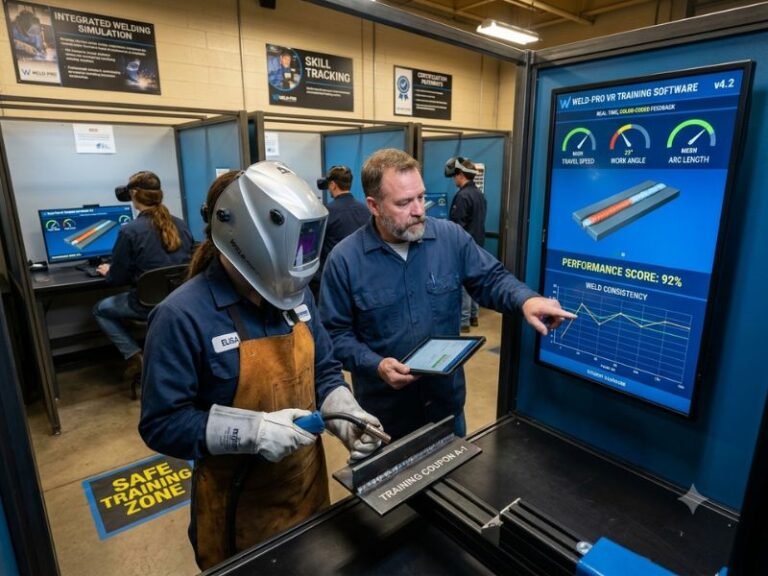
A program that promises fast certification but provides little supervised practice deserves caution. Rail welding is a hands-on skill, and video instruction alone cannot teach the feel of alignment, the behavior of equipment, or the discipline required around molten metal and active track.
Employer-sponsored and union-affiliated programs may offer a direct path into railroad work, while community colleges or private technical schools may provide broader welding fundamentals. Neither format is automatically better. The right choice depends on the process, the local labor market, the employer’s qualification system, and the type of work a trainee wants.
Safety Requirements and Job-Site Awareness
Rail welding contains several overlapping hazards: high temperatures, molten metal, fire, fumes, compressed gases, electrical energy, moving equipment, noise, sparks, grinding debris, uneven ground, and live or nearby track. A training program must address the entire work environment, not only the weld itself.
Personal protective equipment may include a welding helmet or face protection, safety glasses, flame-resistant clothing, gloves suited to the task, hearing protection, safety footwear, and respiratory protection when required by the hazard assessment. The correct equipment depends on the process and the employer’s rules.
Track protection deserves special emphasis. A skilled weld performed without proper authority, communication, or protection can still expose people to unacceptable risk. Trainees should learn who controls access to the track, how work limits are established, how equipment is secured, and what actions are required when conditions change.
Hot-work controls are equally important. Combustible material may be present in vegetation, ties, ballast, vehicles, or nearby structures. Fire prevention, extinguishing equipment, post-work monitoring, and local requirements should be part of the procedure.
I consider stop-work judgment a core qualification. A trainee should be able to pause when rail movement is unexpected, equipment malfunctions, visibility is poor, the mold is damaged, the preheat cannot be verified, or the procedure no longer matches the conditions. Confidence is useful; pressing ahead without control is not.
Inspection, Testing, and Acceptance
Inspection confirms whether the weld meets the applicable requirements. Visual inspection is an important first step, but it does not reveal every internal or metallurgical problem.
Depending on the railroad and procedure, inspection may address:
- Surface cracks, inclusions, laps, undercut, and visible irregularities
- Rail-head and gauge-face profile
- Vertical and lateral alignment
- Weld dimensions and upset or finishing limits
- Hardness or other metallurgical characteristics
- Internal discontinuities detected through nondestructive testing
- Temperature, preheat, or process records
Ultrasonic testing is commonly associated with finding internal flaws in rail, while other methods may be used for specific materials, surfaces, or components. The inspector or qualified technician must use the approved instrument, procedure, and acceptance criteria. A trainee should not interpret an informal check as a substitute for required testing.
Quality control also includes traceability. A weld identification system can connect the joint to the date, crew, process, materials, equipment, and inspection result. That information supports maintenance decisions and helps identify patterns if a problem occurs later.
Common Mistakes to Avoid
Confusing general welding with rail welding
Experience with structural steel or pipe welding is valuable, but rail has distinct geometry, loading, procedures, and inspection requirements. Assuming that one qualification transfers automatically can create both technical and compliance problems.
Rushing preparation
Most visible process steps happen quickly, but preparation controls the foundation of the joint. Dirty rail ends, incorrect gaps, poor alignment, moisture, and damaged molds should be corrected before the weld begins.
Ignoring temperature control
Preheat and cooling requirements exist for a reason. Guessing at temperature, using an unsuitable heating method, or allowing the joint to cool unpredictably can affect fusion and material properties. A trainee should use the required measurement method instead of relying on color or touch.
Over-grinding or under-finishing
Removing too much material can change the rail profile and weaken the section. Leaving excess material can create wheel impact and an unacceptable running surface. Finishing should follow measured limits and profile requirements.
Skipping records
A missing record can make a compliant weld difficult to verify. Training should reinforce the habit of documenting the process immediately and accurately.
Assuming the certificate is permanent
Some qualifications are process-specific, employer-specific, time-limited, or subject to periodic performance checks. A welder may need refresher training, requalification, or approval before working under a different railroad’s procedure.
Career Paths After Training
Rail welding can lead to several types of work. A person may join a railroad maintenance department, a track construction contractor, a specialized welding company, a rail transit agency, or a rail-welding production facility. Duties can range from shop-based flash-butt work to mobile field welding and track repair.
Entry-level roles may involve assisting qualified welders, preparing rail, operating tools under supervision, handling materials, recording information, and learning inspection requirements. Progression commonly depends on demonstrated performance, safety behavior, additional qualifications, and the availability of work.
Travel and schedule expectations should be considered before choosing this field. Some jobs require overnight shifts, emergency response, extended assignments, or work in severe weather. The physical environment can be demanding, and hearing, vision, respiratory, and heat-related hazards require serious attention.
Pay, benefits, and advancement vary widely by employer, region, union status, process, and experience. I would compare actual job postings and speak with employers before treating a course promise as a career guarantee.
Rail Welding Training FAQ
How long does rail welding training take?
There is no single standard duration. A short introductory course may cover basic process awareness, while a full program with hands-on practice, inspection, safety, and performance evaluation takes longer. Employer qualification and supervised field experience may continue after classroom training.
Do I need previous welding experience?
Not always. Some employers accept beginners, particularly for trainee or helper roles. Previous welding, mechanical, or track experience can improve employment prospects, but railroad-specific procedures still must be learned. Ask the provider whether the course is entry-level or intended for already experienced welders.
Which rail welding method should I learn first?
The best starting method depends on local demand and the jobs available to you. Thermite welding is often associated with field work, while flash-butt welding is strongly associated with production and specialized mobile equipment. Reviewing regional job postings and asking target employers which qualifications they require is more useful than choosing based on general popularity.
Does a rail welding certificate qualify me to weld anywhere?
No. A certificate may document course completion or qualification under one procedure, employer, product, or welding process. Each railroad or contractor may impose separate requirements for safety orientation, track protection, equipment, testing, and requalification.
Is rail welding dangerous?
It can be hazardous because it combines hot work, heavy equipment, electrical or chemical energy, fumes, grinding, and railroad operations. Proper training, protective equipment, track protection, equipment inspection, ventilation, and strict procedure control reduce risk. A person should never perform unsupervised work beyond the qualification received.
What should I bring to a training program?
Follow the provider’s instructions. Common requirements may include safety footwear, work clothing, eye protection, identification, and paperwork for enrollment. Some programs supply specialized helmets, gloves, tools, or consumables; others expect students to provide some equipment. Confirm the list before attending.
Can online training replace hands-on rail welding practice?
Online instruction can explain terminology, safety concepts, and process theory, but it cannot replace supervised practice with rail, equipment, alignment, finishing, and inspection. For a practical qualification, hands-on evaluation is essential.
What is the most important quality habit for a new rail welder?
Follow the approved procedure without guessing, and stop when a required condition cannot be verified. Careful preparation, accurate measurements, controlled heat, correct finishing, inspection, and complete records are more valuable than trying to work quickly.
Conclusion
Rail welding training is a specialized entry point into railroad construction maintenance and production work The strongest programs teach more than weld formation they develop judgment in preparation.