Welding Video Training: Essential Information and Useful Advice
Can a welder really learn from a screen, or does proper training require standing beside an instructor in a shop? The answer depends on what the video teaches, how clearly it demonstrates each step, and how the learner practices afterward.
Welding video training can explain processes, show correct technique, and help beginners prepare for hands-on work. It can also help experienced welders review settings, troubleshoot defects, or learn an unfamiliar process. However, a video cannot feel arc length, correct body position, or verify that a weld is safe under real working conditions.
I find the most useful approach is to treat video instruction as one part of a larger learning system. The sections below explain what this training includes, how to choose quality lessons, how to practice safely, which limitations matter, and how to turn online viewing into measurable welding progress.
What Welding Video Training Includes
Welding video training is instruction delivered through recorded demonstrations, narrated lessons, animations, close-up footage, diagrams, or live virtual classes. It may focus on one process, such as gas metal arc welding, or cover a broader path from shop safety to welding inspection.
Strong training usually connects three types of knowledge:
- Process knowledge: how an arc, shielding gas, electrode, power source, and base metal interact.
- Technique knowledge: how to hold the torch or electrode, control travel speed, maintain work angle, and manage the puddle.
- Decision-making: how to select settings, prepare a joint, recognize defects, and adjust technique.
A video may demonstrate shielded metal arc welding (SMAW), gas metal arc welding (GMAW or MIG), gas tungsten arc welding (GTAW or TIG), flux-cored arc welding (FCAW), oxyfuel cutting, or related shop skills. Some courses are designed for complete beginners. Others assume that the viewer already understands welding symbols, joint design, machine controls, or material preparation.
The format matters less than the instructional detail. A polished video with dramatic sparks is not automatically useful. A useful lesson explains why the operator makes each move and shows enough of the weld pool, joint, controls, and finished bead for the learner to connect cause and effect.
Why Use Video for Welding Instruction?
Video is especially effective for visual and procedural skills. A learner can pause a demonstration, replay a difficult movement, slow the playback, and compare several examples. That flexibility is valuable because welding involves many small actions occurring at the same time.
Visual access to hidden details
A close camera angle can show torch travel, electrode angle, puddle behavior, arc characteristics, and the appearance of a finished bead. Diagrams can clarify joint geometry that is difficult to understand from text alone. A good instructor may also show an incorrect example and explain the resulting defect.
Flexible review
Recorded lessons fit around work, school, and shop access. I can revisit a machine setup lesson before practicing instead of trying to remember every detail from one classroom demonstration. This is useful for terminology, safety procedures, and process comparisons.
Consistent explanations
A structured course presents the same foundational material to every learner. It can establish a logical sequence: safety, equipment, material preparation, settings, basic beads, joints, inspection, and troubleshooting. That sequence is easier to follow than unrelated short clips selected at random.
Preparation before hands-on practice
Video can make the first shop session more productive. A learner who already recognizes a welding gun, ground clamp, regulator, electrode holder, and basic control panel can spend more practice time developing coordination rather than trying to identify every component.
Still, video is not a substitute for supervised practice. Welding skill depends on physical control, visual judgment, and safe responses to changing conditions. A screen can demonstrate those actions, but it cannot confirm that a learner is performing them correctly.
How to Choose a Quality Course
I would judge a course by its instructional structure rather than its production value. Clear audio and good lighting help, but the curriculum must answer practical questions and show the work at a useful scale.
Check the learning objectives
Before enrolling or watching a series, look for specific outcomes. “Learn to weld” is too vague. More useful objectives identify a process, material, joint type, or task, such as setting up a GMAW machine, making fillet welds on mild steel, or identifying common porosity causes.
A course should make clear what the learner will be able to do after each module. It should distinguish knowledge that can be learned online from skills that require shop practice or instructor evaluation.
Look for complete demonstrations
Useful demonstrations show more than the moment the arc starts. I look for lessons that include:
- Personal protective equipment and workspace preparation.
- Machine connections and control settings.
- Joint cleaning, fit-up, and positioning.
- Body position, hand position, and travel direction.
- The actual weld from start to finish.
- Post-weld inspection and discussion of the result.
Close-up footage should remain understandable without hiding the larger context. If a camera only shows bright arc footage, the viewer may miss the operator’s angle, movement, and relationship to the joint.
Evaluate the instructor and technical language
The instructor should explain terms accurately and identify the conditions behind a recommendation. Settings are not universal; they depend on equipment, material, thickness, wire or electrode, joint design, shielding, and position. Be cautious of lessons that present one number as correct for every situation.
Quality instruction also distinguishes personal preference from a safety requirement, manufacturer guidance, code requirement, or accepted shop practice. That distinction helps learners make sound decisions instead of memorizing rules without context.
Prefer courses with practice and feedback
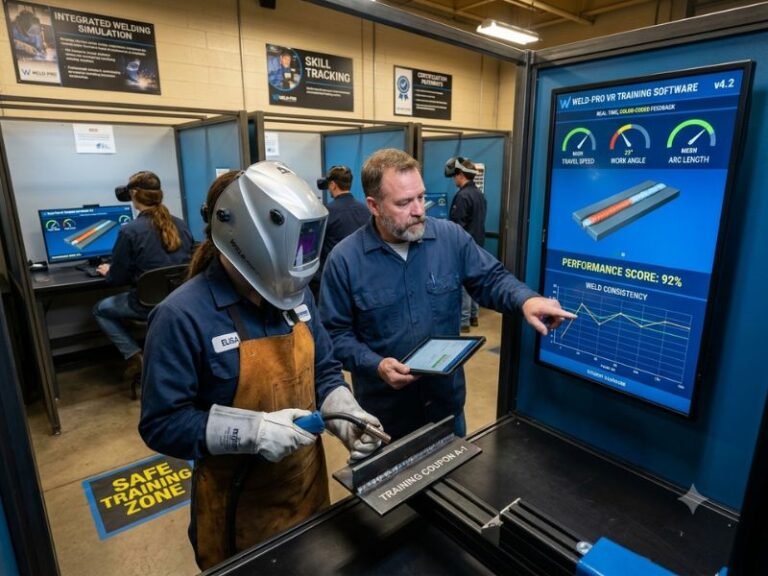
Quizzes can check terminology, but practical assignments are more valuable. A strong course may ask the learner to produce practice beads, photograph results, record settings, keep a weld log, or submit work for instructor review. Feedback is important because a learner may repeat the same incorrect motion for many hours without recognizing it.
Core Safety Information
Safety should appear at the beginning of a welding course and remain part of every practical lesson. Welding creates several hazards at once: arc radiation, hot metal, fire, fumes, compressed gases, electrical energy, noise, and physical injury from tools or workpieces.
Use appropriate personal protection
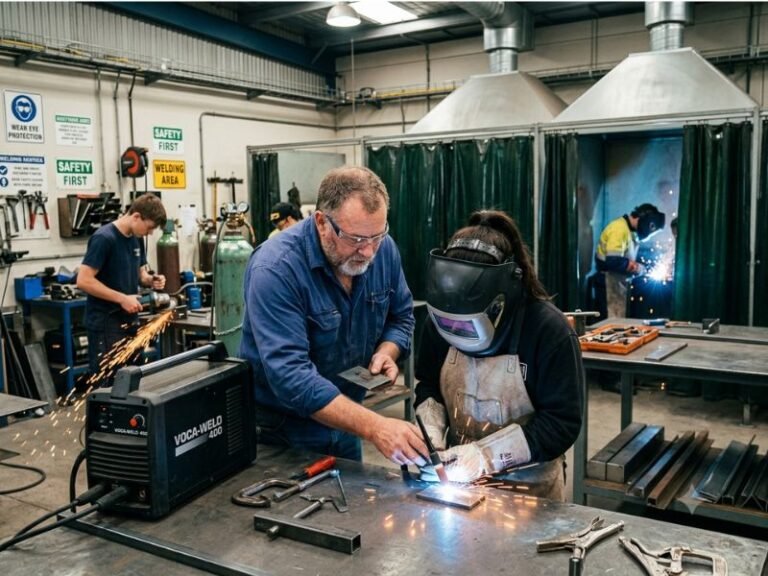
Required protection depends on the process and workplace, but welding commonly involves a properly selected welding helmet, safety glasses, flame-resistant clothing, welding gloves, protective footwear, and hearing protection when conditions require it. Clothing should cover exposed skin and avoid materials that can melt or ignite easily.
A helmet shade must be suitable for the operation. Learners should follow equipment instructions and applicable workplace or safety guidance rather than choosing protection based only on comfort or appearance.
Control the workspace
Remove or shield combustible materials, secure the workpiece, inspect leads and hoses, and keep walkways clear. Fire prevention is not limited to the immediate area because sparks and hot metal can travel or remain hot after welding stops. A suitable fire extinguisher and a clear emergency plan should be available.
Ventilation and fume control are equally important. A fan that simply moves contaminated air around the room may not provide adequate protection. The material, coating, process, and duration of welding affect exposure. Painted, plated, galvanized, or contaminated surfaces require special caution and appropriate controls.
Handle cylinders and electricity carefully
Compressed gas cylinders must be secured, protected from damage, and used with compatible regulators and hoses. Valves, connections, and leak checks should follow equipment instructions. Electrical connections, work clamps, and machine leads should be inspected before use, especially in damp or damaged conditions.
Video can introduce these procedures, but a qualified instructor or responsible supervisor should verify a learner’s setup before welding begins. If a lesson ignores safety or treats it as a brief disclaimer, I would choose another resource.
Building a Practical Learning Path
Randomly watching welding clips can create gaps. A planned sequence produces better results because each lesson supports the next one.
Start with fundamentals
Begin with terminology, equipment identification, shop safety, material preparation, and the purpose of the selected process. Learn what the arc is doing, how shielding works, and why contamination affects weld quality.
Practice control before complex joints
Early practice should focus on steady hand movement and puddle control. Straight beads on suitable practice material can help a learner observe travel speed, bead width, penetration indicators, and consistency. The goal is not merely to create a bead; it is to connect a visible result with a specific technique.
Progress to joints and positions
After basic control improves, move through common joint types such as butt, lap, corner, and fillet joints. Position changes introduce gravity, access, and visibility challenges. A course should explain how settings and movement may need adjustment rather than implying that one technique works in every position.
Add inspection and troubleshooting
Learning to identify defects is as important as learning to produce a bead. Lessons should address discontinuities such as undercut, overlap, porosity, lack of fusion, incomplete penetration, cracking, excessive spatter, and inconsistent profile. A visible defect does not always reveal one simple cause, so troubleshooting should consider settings, fit-up, cleanliness, shielding, technique, and material.
Document the practice
I recommend keeping a simple weld log. Record the process, material, thickness, consumable, polarity when applicable, shielding gas, settings, joint type, position, and result. Add a short note about what changed between attempts. This turns practice into a comparison instead of a series of guesses.
Matching Training to the Welding Process
Choosing a course by process prevents wasted time. The best training for a hobbyist repairing mild steel may not suit someone preparing for production work or pipe welding.
MIG and flux-cored welding
MIG training commonly covers wire selection, shielding gas, gun angle, stickout, travel speed, polarity, and machine setup. Flux-cored lessons may address self-shielded and gas-shielded variations, slag removal, outdoor considerations, and the differences between wire types.
Because these processes can appear easy at first, beginners should pay close attention to joint preparation, travel direction, wire placement, and the causes of porosity or lack of fusion.
Stick welding
SMAW training should explain electrode selection, storage and handling, arc length, striking and restarting, rod angle, travel speed, slag removal, and polarity. Learners also need to understand why different electrodes suit different materials, positions, and applications.
TIG welding
TIG lessons usually require more detailed coordination. They may cover tungsten preparation, torch control, shielding gas, filler rod timing, foot-pedal or hand-control use, and cleanliness. Videos should show both hands and the puddle clearly because the process depends on precise coordination.
Pipe, structural, and code-focused work
Pipe welding, structural welding, pressure-related work, and regulated fabrication demand more than general online instruction. They may involve qualified procedures, specific positions, inspection methods, and employer or industry requirements. Video can support preparation, but it should not be treated as proof of qualification.
What Video Cannot Teach by Itself
Some elements of welding are difficult to learn without direct observation and correction. A viewer may understand the ideal torch angle but still hold the torch too far away, move unevenly, or lose the joint while watching the puddle.
Videos also simplify conditions. Real work may involve awkward access, imperfect fit-up, wind, variable material thickness, limited visibility, and equipment differences. A demonstration performed on clean flat plate does not automatically prepare someone for a repair in a confined or elevated position.
Another limitation is feedback. A video cannot reliably tell a learner that a helmet is positioned incorrectly, a work clamp is unsafe, a cylinder is unsecured, or a bead has insufficient fusion. An instructor can observe behavior before an accident or bad habit develops.
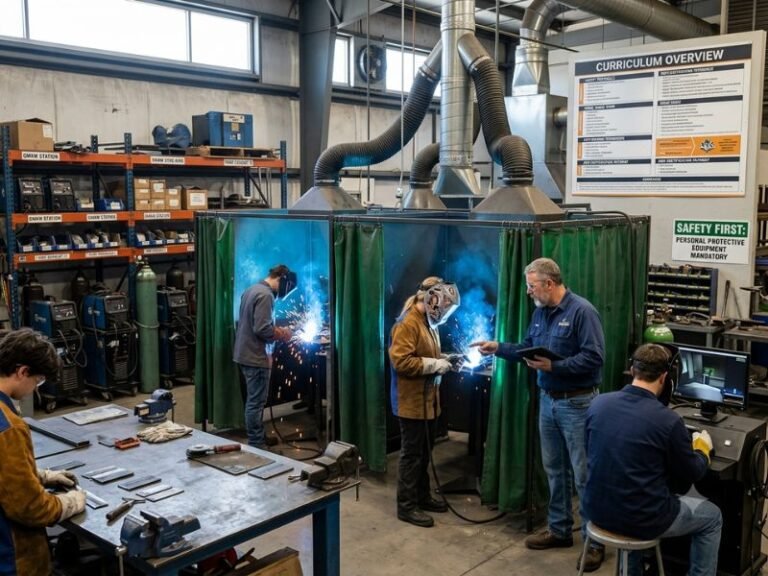
For that reason, I would combine online lessons with supervised shop sessions, a community college or trade program, an employer training system, or a qualified mentor. Hands-on evaluation becomes especially important when the work affects structural integrity, pressure containment, transportation equipment, or public safety.
Common Mistakes to Avoid
- Watching without practicing: Recognition feels like competence, but welding requires physical repetition and correction.
- Copying settings blindly: A setting shown in one lesson may not match another machine, wire, electrode, material, or joint.
- Ignoring preparation: Dirty, oily, painted, or poorly fitted material can defeat an otherwise reasonable technique.
- Focusing only on appearance: A smooth bead can still have inadequate fusion, penetration, or other unacceptable characteristics.
- Skipping safety because the task is small: A short weld can still create fumes, fire, burns, eye injury, or electrical hazards.
- Using random short clips as a complete curriculum: Fragmented content often leaves gaps in setup, inspection, and troubleshooting.
- Practicing bad technique repeatedly: Repetition helps only when the learner receives feedback and corrects errors.
- Assuming a certificate proves ability: Course completion may show participation or knowledge, but it does not automatically establish practical qualification.
Assessing Progress
Progress should be measured with evidence rather than viewing time. A learner can track consistency, control, safety habits, and the ability to explain decisions.
Useful checkpoints include setting up equipment correctly, identifying hazards, preparing a joint, producing repeatable practice beads, explaining visible defects, and adjusting one variable at a time. Photographs can document bead appearance, but they cannot prove internal weld quality. Visual inspection has limits, and formal testing may be required for critical work.
Instructor feedback is most helpful when it is specific. “Improve the weld” gives little direction. Comments about arc length, travel speed, work angle, puddle control, start and stop technique, or cleaning provide a clear next action.
As skills improve, the learner should be able to explain not only what setting was used, but why it was selected and what evidence would justify changing it. That reasoning is more transferable than memorizing a chart.
Frequently Asked Questions
Is Welding Video Training enough to become a welder?
No. Video can teach concepts and demonstrate technique, but becoming competent requires hands-on practice, safety supervision, and feedback. Work that requires formal qualification also involves applicable testing or employer requirements.
What should beginners learn first in Welding Video Training?
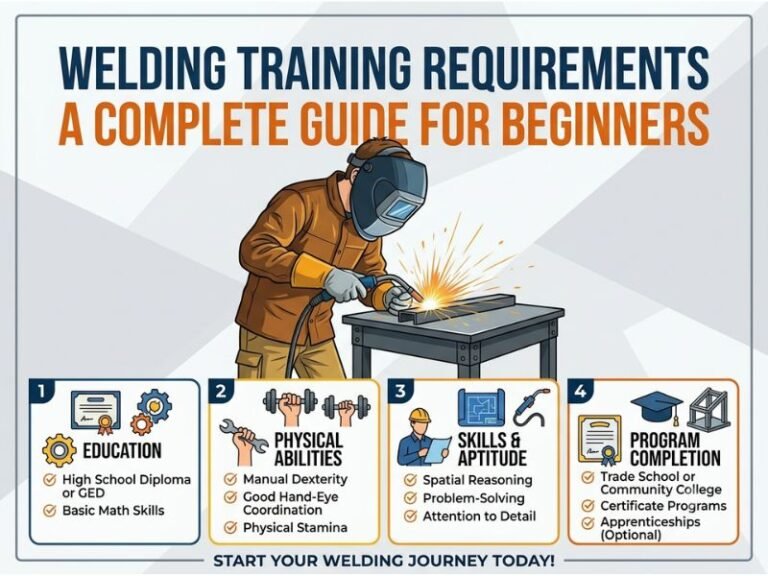
Beginners should start with shop safety, personal protection, equipment identification, basic process differences, material preparation, and machine setup. After that foundation, they can practice simple beads before moving to joints and more difficult positions.
Can Welding Video Training teach MIG, TIG, and stick welding?
Yes, a course can introduce all three processes, but each requires different equipment, consumables, settings, and hand coordination. A focused course for the process used most often usually provides more useful practice than a brief overview of every process.
How can I tell if a welding video course is reliable?
Look for clear objectives, accurate terminology, complete demonstrations, safety instruction, explanations of settings, defect analysis, and opportunities for feedback. Be cautious of courses that promise instant mastery or present universal settings without discussing equipment and material differences.
Do online welding courses provide certification?
Some courses provide a certificate of completion, but that document does not necessarily certify welding performance or qualify a person for regulated work. Confirm what the certificate means and compare it with the requirements of the employer, training program, code, or testing organization involved.
How should I practice after watching a welding video?
Use suitable equipment and supervision, repeat the demonstrated task on practice material, record the setup and result, and change one variable at a time. Inspect the bead, compare it with the lesson, and obtain qualified feedback before moving to more demanding work.
Can welding videos replace a welding school?
They can supplement a school, apprenticeship, employer program, or supervised shop class, but they rarely replace the instructor access, equipment time, structured evaluation, and workplace practice that those programs provide. Video works best as preparation, review, and targeted skill support.
Conclusion
Welding video training is most valuable when it combines clear demonstrations with safe hands-on practice, feedback, and realistic expectations. I would choose lessons that explain decisions, show complete procedures, address defects, and identify the limits of online learning. Used that way, video can shorten the path from unfamiliar equipment to informed practice without pretending that watching alone creates reliable welding skill.