Sub Arc Welding Training: Skills, Process, Safety & Job Basics
Sub Arc Welding training teaches welders and welding operators how to control the Submerged Arc Welding (SAW) process, from equipment and consumable selection to welding parameters, joint preparation, safety, and weld-quality evaluation. The goal is not simply to operate an automated welding machine, but to understand why the process produces a particular weld and how to recognize problems before they affect production.
Unlike manual processes where the welder continuously watches an exposed arc, Submerged Arc Welding operates beneath a blanket of granular flux. AWS describes SAW as an arc welding process in which one or more bare metal electrodes form an arc with the workpiece while the arc and molten metal remain submerged beneath granular fusible flux.
Because SAW is commonly mechanized or automated, training places considerable emphasis on machine setup, process variables, joint tracking, consumable management, and interpreting the finished weld. Those skills are particularly relevant in heavy fabrication, where SAW is used for long welds, thick materials, and production work that benefits from high deposition rates and repeatability.
What Is Sub Arc Welding Training?
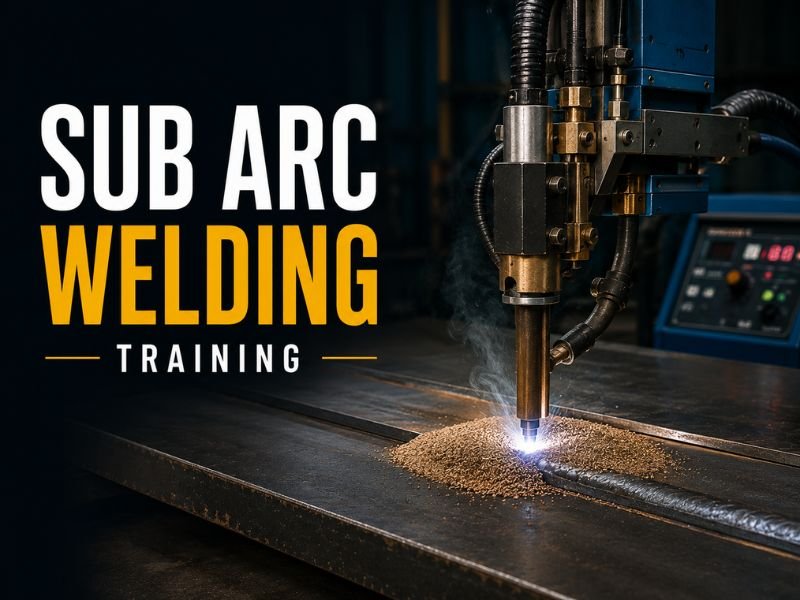
Sub Arc Welding training is specialized instruction in the theory and practical operation of Submerged Arc Welding equipment.
Training may be offered as part of a broader welding program, as employer-specific instruction, or as a dedicated course for people who already understand welding fundamentals. Lincoln Electric’s current SAW201 course, for example, covers SAW fundamentals, arc-welding safety, single- and twin-wire equipment, wire and flux applications, polarity, equipment operation, and weld-defect troubleshooting.
A good SAW course should develop three abilities:
- Understand what is happening beneath the flux
- Control the equipment and welding variables
- Evaluate whether the resulting weld meets the required quality
The operator may not manipulate the electrode by hand throughout the weld, but that does not reduce the need for welding knowledge. Mechanization shifts much of the skill from hand movement to preparation, parameter control, monitoring, and troubleshooting.
What Is Submerged Arc Welding?
In SAW, a continuous electrode wire feeds toward the workpiece while granular flux is deposited around the welding zone. The electrical arc forms beneath that flux, melting the electrode and base metal to create the weld pool.
Part of the flux melts and contributes to the protective slag covering the weld. The remaining flux shields the welding zone, and suitable unused flux can be recovered in properly controlled systems.
The hidden arc is one of the process’s defining characteristics.
For a trainee, that means learning to rely on machine readings, electrode alignment, travel behavior, flux coverage, and the finished weld instead of continuously watching the molten pool as with an exposed-arc process.
Who Should Take Sub Arc Welding Training?
SAW training can be useful for people working or preparing to work in industrial fabrication, including:
- Welders
- Welding operators
- Fabrication technicians
- Production personnel
- Welding supervisors
- Maintenance technicians
- Inspectors who need SAW process knowledge
Specialized SAW courses are also available for welding personnel who already have general welding experience and want process-specific training.
Do You Need Previous Welding Experience?
Not every training program has the same prerequisites.
However, understanding basic welding concepts makes SAW considerably easier to learn. A trainee benefits from already knowing terms such as current, voltage, polarity, penetration, fusion, joint design, filler metal, and welding procedure.
Someone without prior welding experience can learn these fundamentals within a comprehensive welding program. An experienced welder can usually concentrate more quickly on the variables that make SAW different from SMAW, GMAW, FCAW, or GTAW.
What Do You Learn in Sub Arc Welding Training?
A well-rounded course should cover the complete welding system rather than treating the welding machine as a collection of controls.
Typical areas include:
- SAW process fundamentals
- Welding power sources
- Wire feeding
- Flux handling
- Welding parameters
- Joint preparation
- Mechanized travel equipment
- Weld defects
- Safety
- Welding procedures
- Practical machine operation
Current specialized U.S. training reflects this approach, combining process fundamentals with consumables, polarity, equipment systems, safety, and troubleshooting.
Sub Arc Welding Equipment
Understanding each component makes troubleshooting much easier because SAW performance depends on the entire system working together.
Welding Power Source
The power source provides the electrical energy required to establish and maintain the arc.
SAW systems can use DC, AC, and more advanced AC/DC configurations depending on the equipment and application. AWS notes DC as common while AC and variable-polarity arrangements are also used for particular applications, and current specialized training includes AC/DC SAW equipment.
A trainee should understand that power-source selection and polarity can influence arc behavior and weld characteristics.
Wire Feeder
The wire feeder supplies electrode continuously to the welding head.
Feed stability matters because electrode delivery is closely connected to current and deposition behavior. A feeding problem can therefore appear in the weld even if the programmed settings have not changed.
Welding Head and Contact Tip
The welding head positions the electrode over the joint.
The contact tip transfers welding current into the wire. Its relationship to the workpiece also determines electrode extension, an important SAW variable.
Accurate positioning is particularly important on long welds. A wire that gradually moves away from the intended joint centerline can produce poor bead placement or incomplete fusion while the machine continues welding normally.
Flux Hopper and Delivery System
The flux-delivery system places granular flux over the welding zone before and during welding.
AWS identifies flux delivery as one of the essential components of a SAW system and notes that advanced production arrangements may incorporate flux recovery.
An operator therefore needs to understand flux flow as well as wire flow.
Welding Tractor, Carriage, and Positioning Equipment
SAW frequently uses mechanical travel rather than the welder moving the electrode manually.
Equipment may include:
- Welding tractors
- Travel carriages
- Gantries
- Column-and-boom manipulators
- Rotators
- Positioners
The travel system directly affects weld consistency because travel speed is a major process variable.
Wire and Flux Selection in SAW Training
The wire and flux should be considered a welding consumable system rather than two unrelated products.
AWS A5.17/A5.17M:2025 contains classification requirements for carbon-steel electrodes and fluxes used in submerged arc welding. The specification classifies electrodes and evaluates flux in relation to weld-metal properties produced with an electrode.
Electrode Wire
Training should introduce the factors that affect wire selection, including:
- Electrode classification
- Wire diameter
- Chemical composition
- Base-metal requirements
- Welding procedure
- Storage and handling
Wire diameter also relates to the operating range and deposition requirements of the process.
Welding Flux
Granular flux does more than cover the arc.
It protects the welding zone from atmospheric contamination, helps stabilize the arc, forms slag, and can influence the metallurgical characteristics of the completed joint.
That is why flux selection and condition matter.
A trainee should understand that contaminated, incorrectly stored, or inappropriate flux can affect the weld even when the electrical settings are correct.
Welding Parameters Covered in Training
Process variables are where operator knowledge becomes especially important.
SAW equipment can repeat settings very consistently, but repeating the wrong settings only produces the wrong weld more consistently.
Welding Current
Current strongly influences electrode melting, deposition, and penetration.
Increasing amperage is therefore not simply a way to make the process weld faster. A current level that does not match the joint, electrode, travel speed, and procedure can produce an unsuitable weld profile.
Arc Voltage
Voltage affects the behavior of the arc and the shape of the bead.
Operators should learn to interpret voltage together with current and travel speed rather than diagnosing a weld from one number alone.
Travel Speed
Travel speed controls how quickly the arc progresses along the joint.
Changing travel speed changes the amount of heat and deposited metal applied per unit length. In long mechanized welds, consistent travel is especially important because an incorrect speed can reproduce the same defect over a considerable distance.
Wire Feed Speed
Wire feed determines how rapidly electrode enters the welding zone.
The relationship between wire-feed speed and welding current is an important part of understanding many SAW systems. Operators need to know what a wire-feed adjustment will do before changing it.
Electrode Extension
Electrode extension is the length of wire between the contact tip and the arc.
Electrical resistance heats the electrode before it reaches the arc, so changes in extension can influence deposition behavior. Consistency is important when a welding procedure specifies the intended setup.
Flux Depth
The arc requires adequate flux coverage.
Too little flux may leave the welding zone inadequately covered, while excessive flux can also affect process behavior. The operator needs enough coverage for stable operation without treating “more flux” as automatically better.
Joint Design and Fit-Up
A mechanized process cannot correct poor joint preparation on its own.
SAW training should therefore include practical understanding of:
- Groove angle
- Root opening
- Root face
- Joint alignment
- Backing
- Tack welds
- Surface condition
A joint that changes dimension along its length can produce changing penetration or bead geometry even when the welding machine maintains exactly the same settings.
This is an important production lesson: consistency begins with fit-up, not with the start button.
Welding Positions Used in Sub Arc Welding
SAW is best suited to applications where granular flux can remain over the welding zone.
AWS identifies flat and horizontal work as typical SAW applications and notes the process’s limited positional flexibility as one of its practical restrictions.
Manufacturers often solve this limitation by repositioning the work rather than trying to force the process into an unsuitable position.
For cylindrical components, rotators can keep the active welding area in a favorable orientation while the workpiece turns.
This arrangement is particularly useful for tanks, vessels, pipe, and other large cylindrical fabrications.
Hands-On Skills Developed During SAW Training
Theory explains what each variable does. Practical training teaches the operator to recognize those effects on actual equipment.
Machine Setup and Control
A trainee should become comfortable identifying and monitoring:
- Current
- Voltage
- Wire feed
- Travel speed
- Electrode position
- Flux delivery
- Travel direction
The goal is not memorizing one set of numbers but understanding the relationship among them.
Joint Tracking
Long seams demand accurate electrode tracking.
If the wire drifts from the intended location, the process may continue depositing metal while producing a weld that is no longer properly positioned in the joint.
The operator therefore monitors alignment even when travel is automated.
Evaluating the Finished Weld
After the slag is removed, the weld tells the operator a great deal about process stability.
Training should develop the ability to evaluate:
- Bead width
- Reinforcement
- Toe shape
- Undercut
- Surface porosity
- Consistency
- Weld location
The more valuable skill is connecting an observed condition to likely causes instead of making random machine adjustments.
Common Sub Arc Welding Defects
Current specialized SAW training specifically includes weld-defect troubleshooting because identifying the cause of a poor weld is a core operator responsibility.
Porosity
Porosity can be associated with contamination, consumable condition, joint cleanliness, or inadequate protection of the welding zone.
It should be investigated systematically rather than treated as proof that one particular component has failed.
Slag Inclusion
Slag may become trapped between passes or within an unfavorable joint profile.
Interpass cleaning, bead placement, joint geometry, and process conditions all deserve consideration.
Undercut
Undercut forms along the edge of the weld when the base metal is melted but not adequately filled.
Travel speed, voltage, current, electrode position, and joint geometry can all affect the condition.
Lack of Fusion
Lack of fusion indicates that weld metal did not adequately fuse with the base material or a previous weld pass.
Possible contributors include unsuitable parameters, excessive travel speed, poor wire position, or joint-preparation problems.
Single-Wire and Multi-Wire SAW
Single-wire SAW provides the clearest starting point for learning the relationship among the major process variables.
Industrial systems can use additional electrodes to increase deposition and productivity.
Lincoln Electric’s current SAW training includes both single- and twin-wire systems, while AWS also recognizes process variations such as series submerged arc welding.
Multi-electrode systems introduce additional considerations such as electrode spacing, polarity, arc interaction, and balanced deposition.
That makes them more appropriate after the operator understands basic single-wire behavior.
Mechanized vs. Automated Sub Arc Welding
SAW is frequently described as automated, but not every system operates at the same level of automation.
Mechanized SAW
A mechanized system uses machinery to control movement while an operator remains responsible for setup and monitoring.
The operator may still control:
- Welding parameters
- Wire position
- Flux
- Start and stop points
- Joint tracking
- Weld inspection
Automated SAW
More advanced systems can integrate programmable parameters, travel, seam tracking, and workpiece positioning.
AWS notes that advanced SAW systems can use programmable controls for current, voltage, wire feed, and travel speed to improve repeatability.
Automation does not remove the need for welding knowledge. A machine can maintain a parameter accurately without knowing whether that parameter is appropriate for the joint.
Sub Arc Welding Safety Training
A hidden arc should never be confused with a hazard-free process.
OSHA identifies welding hazards that include metal fumes, burns, eye damage, electrical shock, and other physical hazards. OSHA also maintains specific welding, cutting, and brazing standards for general industry, construction, and maritime workplaces.
Fumes and Ventilation
Submerging the arc under flux does not eliminate welding fumes.
Ventilation and exposure controls still need to match the material, consumables, and work environment.
Electrical Hazards
SAW systems can operate at substantial welding currents.
Training should address cables, electrical connections, equipment condition, grounding/work connections, and safe maintenance practices.
Hot Metal and Slag
Flux-covered welds can remain extremely hot even when there is no visible arc.
Slag, welded plate, fixtures, and nearby material should be treated as hot until their condition is known.
Moving Machinery
Mechanized SAW adds hazards from tractors, carriages, rotators, positioners, and automated equipment.
Pinch, crush, and entanglement hazards therefore belong in SAW safety training alongside conventional welding hazards. OSHA specifically includes physical injuries such as crushed fingers and toes among welding-related hazards.
Learning to Read a Welding Procedure Specification
A capable SAW operator should understand the Welding Procedure Specification, or WPS, being used for production.
Depending on the job, a WPS may control variables such as:
- Base metal
- Electrode
- Flux
- Current
- Voltage
- Polarity
- Travel speed
- Joint design
- Position
- Preheat
- Interpass temperature
The operator’s job is to reproduce the specified welding conditions, not substitute personal settings simply because another combination appears faster.
Training and Qualification Are Not the Same
Completing Sub Arc Welding training develops knowledge and practical ability, but it does not automatically qualify a person to perform every SAW production weld.
Formal welding or welding-operator qualification depends on the applicable code, procedure, employer, material, and project requirements.
That distinction matters because a training certificate demonstrates completion of education, while a production qualification demonstrates capability under defined requirements.
A competent operator needs to understand both.
Where Are Sub Arc Welding Skills Used?
SAW is especially valuable where long seams, thick materials, high deposition, and repeatable mechanized welding are important.
AWS identifies applications including structural steel fabrication, shipbuilding, pressure vessels, storage tanks, pipe mills, and other heavy industrial work.
Common areas include:
- Structural fabrication
- Pressure vessels
- Storage tanks
- Pipe manufacturing
- Shipbuilding
- Offshore fabrication
- Heavy equipment
- Large cylindrical structures
The process is less attractive for short, highly irregular welds where setup time and flux handling outweigh its production advantages.
Advantages and Limitations of SAW Training
A strong training program should teach where the process performs well and where another welding method may be more suitable.
Main Advantages of SAW
Important process strengths include:
- High deposition capability
- High productivity on long seams
- Consistent mechanized travel
- Low visible spatter
- Suitability for thick materials
- Repeatable production
- Reduced continuous manual manipulation
AWS highlights high deposition, productivity, consistency, and suitability for heavy fabrication among the major reasons SAW remains widely used.
Main Limitations of SAW
Operators also need to understand its restrictions:
- Limited positional flexibility
- Flux handling and storage
- Slag removal
- Larger equipment requirements
- More setup for short welds
- Limited access in confined joint configurations
- Dependence on accurate tracking and fit-up
Knowing when SAW is the wrong process is part of knowing the process well.
How Long Does Sub Arc Welding Training Take?
There is no universal training length.
SAW can be introduced within a comprehensive welding program, taught as employer-specific machine training, or studied through a dedicated advanced course.
Lincoln Electric currently offers SAW201 as a specialized Submerged Arc Welding course, demonstrating that SAW can be taught separately to welding personnel rather than only inside a general beginner program.
The better measure of training quality is therefore what the trainee can understand and demonstrate afterward, not simply the number of classroom hours.
What Skills Should You Have After Sub Arc Welding Training?
After effective introductory training, a developing operator should be able to:
- Identify the main SAW system components
- Explain how granular flux functions
- Understand electrode and flux compatibility
- Recognize the effects of current and voltage
- Understand travel-speed changes
- Maintain suitable electrode position
- Follow a WPS
- Recognize common weld defects
- Monitor mechanized travel
- Evaluate completed welds
- Apply appropriate welding safety practices
Advanced operators may also develop skills in multi-wire systems, AC/DC control, automated equipment, procedure development, and production troubleshooting.
Frequently Asked Questions
What Is Sub Arc Welding Training?
Sub Arc Welding training teaches the theory and practical operation of Submerged Arc Welding. Typical subjects include equipment, safety, wire and flux, polarity, welding parameters, joint preparation, machine operation, and weld-defect troubleshooting.
Is Sub Arc Welding Hard to Learn?
The basic process is straightforward to understand, but competent operation requires learning how current, voltage, travel speed, wire feed, electrode position, flux, and joint preparation interact. Mechanization reduces manual torch movement but increases the importance of setup and process control.
Do You Need Welding Experience Before SAW Training?
Not always. Entry requirements vary by program. However, previous knowledge of welding terminology, electrical principles, joint design, and weld defects makes specialized SAW training easier to absorb.
How Long Does Sub Arc Welding Training Take?
There is no standard duration. SAW may be taught within a general welding program, a dedicated specialist course, or employer-specific equipment training. Current U.S. welding-school offerings include dedicated SAW courses.
Is Sub Arc Welding Automatic?
SAW is commonly mechanized or automated, but an operator is still often responsible for equipment setup, parameters, flux, wire positioning, joint tracking, and weld evaluation.
What Equipment Is Used in Sub Arc Welding?
A typical system includes a welding power source, wire feeder, continuous electrode, welding head, flux-delivery system, controls, work connection, and mechanized travel equipment such as a tractor or carriage.
What Welding Position Is Best for SAW?
Flat and suitable horizontal applications are most common because granular flux needs to remain over the welding zone. Industrial positioners and rotators can move the workpiece to keep the active weld in a favorable orientation.
Can You Get Qualified in Sub Arc Welding?
Yes, but training and qualification are separate concepts. A welder or welding operator may need to meet specific procedure, code, employer, or project requirements before performing production SAW work.
What Industries Use Sub Arc Welding?
SAW is used in structural steel fabrication, shipbuilding, pressure vessels, storage tanks, pipe manufacturing, offshore fabrication, and other heavy industrial applications where long welds and high deposition rates are useful.
Is Sub Arc Welding Training Good for Industrial Welding Jobs?
It can be valuable for jobs involving mechanized heavy fabrication because SAW remains relevant to industries that need long, repeatable welds on substantial material. The usefulness of the training depends on the processes and equipment used by the employer.
Conclusion
Sub Arc Welding training should teach an operator to understand the welding process, not simply operate the controls. The core skills include equipment knowledge, wire and flux selection, current and voltage control, travel speed, electrode positioning, joint preparation, defect recognition, WPS awareness, and safe operation.
The most capable SAW operators understand cause and effect. If bead shape changes, tracking drifts, penetration becomes inconsistent, or a defect appears, they know which process variables and setup conditions deserve attention rather than making random adjustments.
For structural fabrication, pressure vessels, tanks, pipe production, shipbuilding, and other heavy industrial applications, that combination of welding knowledge and mechanized-process control is what makes Sub Arc Welding training useful.