Submerged Arc Welding Training: Skills, Process, and Safety
Submerged Arc Welding training teaches welders and welding operators how to control a high-deposition arc welding process in which the arc and molten weld area are covered by granular flux. Training typically combines process theory with equipment setup, consumable selection, parameter control, weld-quality evaluation, safety, and practical machine operation.
For someone moving from manual welding into heavy fabrication, Submerged Arc Welding training involves more than learning to run a welding tractor. A competent SAW operator needs to understand what current, voltage, wire feed speed, travel speed, electrode extension, flux depth, joint preparation, and polarity are doing to a weld even though the arc itself is normally hidden under flux.
That ability to interpret the process is particularly important because SAW is widely associated with long seams, thick material, high deposition rates, and mechanized production. A small setup error can continue for a considerable distance before it becomes obvious in the finished weld.
What Is Submerged Arc Welding Training?
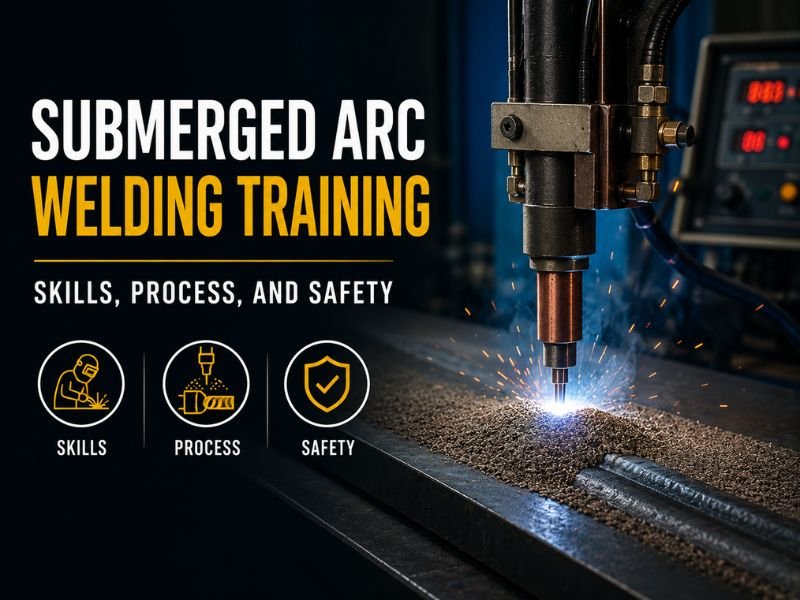
Submerged Arc Welding training is specialized instruction focused on the SAW process, its equipment, consumables, operating variables, and production applications.
The American Welding Society defines submerged arc welding as an arc welding process in which coalescence is produced by an arc or arcs between one or more bare metal electrodes and the workpiece, with the welding zone protected beneath granular fusible flux.
Unlike processes where the welder directly watches and manually controls an exposed arc, SAW is commonly mechanized. A welding head feeds the electrode continuously while a carriage, tractor, manipulator, or work-positioning system controls movement.
As a result, SAW training places considerable emphasis on process control.
A trainee is expected to understand not only whether a weld looks acceptable afterward, but why a particular combination of settings produced that result.
What Happens During the SAW Process?
During submerged arc welding, a continuously fed electrode is directed toward the joint. An arc forms between the electrode and workpiece.
Granular flux is deposited around and ahead of the welding zone. The arc operates beneath that flux layer rather than remaining visibly exposed.
Heat from the arc melts:
- The electrode
- Part of the base metal
- A portion of the surrounding flux
The molten electrode and base metal form the weld pool. Molten flux forms slag over the weld as it solidifies.
Unused flux may be recovered in appropriately designed production systems.
This arrangement is one reason SAW performs well on long, repetitive welds where high productivity and consistent process control matter.
Who Should Take Submerged Arc Welding Training?
SAW training is relevant to several types of welding personnel.
It can benefit:
- Welders moving into heavy fabrication
- Welding-machine operators
- Fabrication technicians
- Production welding personnel
- Welding supervisors
- Maintenance personnel
- Welding inspectors who need process knowledge
- Students preparing for industrial welding work
Someone experienced with SMAW, GMAW, or FCAW may already understand welding fundamentals, but SAW requires a different operating mindset.
The operator does not manipulate an exposed arc by hand in the same way as a stick or MIG welder.
Instead, much of the skill lies in preparation, machine positioning, parameter selection, monitoring, and recognizing whether the process remains stable.
Do You Need Welding Experience Before SAW Training?
Requirements depend on the school, employer, or training program.
Basic welding knowledge is highly useful because SAW training assumes an understanding of subjects such as:
- Welding current
- Arc voltage
- Polarity
- Joint design
- Base metals
- Weld terminology
- Welding symbols
- Weld defects
- Safe shop practices
A beginner can learn these concepts as part of a broader welding program, while experienced welders may take SAW as a specialized process course.
Lincoln Electric, for example, currently lists dedicated AC/DC Submerged Arc Welding training within its welding education offerings, showing how SAW may be taught as a specialized course rather than only as part of an entry-level welding curriculum.
What Do You Learn in Submerged Arc Welding Training?
A useful SAW course should build an understanding of the entire welding system rather than focusing on one control panel.
The major subject areas normally include:
- Process fundamentals
- Equipment identification
- Power-source characteristics
- Wire and flux selection
- Welding parameters
- Joint preparation
- Machine positioning
- Weld-defect recognition
- Procedure requirements
- Safety
- Practical welding operation
The exact depth depends on whether the training is intended for a beginning operator, experienced welder, welding technician, or procedure-development personnel.
SAW Equipment and Components
A trainee should be able to identify the major parts of a submerged arc welding system and understand what each one controls.
Welding Power Source
The power source supplies the electrical energy necessary to establish and maintain the arc.
Training may cover DC, AC, or AC/DC submerged arc systems depending on the equipment and application.
Power-source characteristics become particularly important in advanced SAW work involving multiple electrodes, polarity changes, or applications where penetration and arc interaction must be carefully controlled.
Wire Feeder
The wire feeder continuously delivers electrode wire to the welding head.
Unlike SMAW, where electrodes must repeatedly be replaced, submerged arc welding can use continuous electrode supplied from a coil, drum, or other package.
Stable wire feeding is necessary for consistent welding current and deposition.
Welding Head and Contact Tip
The welding head guides the electrode toward the joint.
The contact tip transfers welding current to the electrode.
Its location relative to the workpiece influences electrode extension, which can affect deposition behavior and process performance.
Flux Hopper and Delivery System
The flux system deposits granular flux around the welding zone.
The operator needs enough coverage to protect the arc and molten weld pool while avoiding poor flux distribution or unnecessary waste.
Industrial systems may also use flux recovery equipment to collect suitable unused flux.
Travel Equipment
Mechanized SAW can use:
- Welding tractors
- Carriages
- Gantries
- Column-and-boom manipulators
- Rotators
- Positioners
Sometimes the welding head moves.
In other applications, the welding head remains relatively fixed while the workpiece rotates or travels beneath it.
Understanding which component controls travel is important because travel speed is one of the major welding variables.
Submerged Arc Welding Wire and Flux Training
SAW consumables deserve significant attention in training because the electrode and flux work as a system.
Electrode Wire
Electrode selection depends on the base metal, required mechanical properties, procedure specification, and flux combination.
Training may cover characteristics such as:
- Electrode classification
- Wire diameter
- Chemical composition
- Wire feed speed
- Storage and handling
- Compatibility with flux
Larger or smaller electrode diameters may suit different current ranges and production requirements.
The correct choice cannot be based solely on which spool physically fits the feeder.
Welding Flux
Flux performs several jobs during SAW.
It protects the welding zone, contributes to slag formation, affects weld-metal chemistry, and influences the operating characteristics of the process.
Training may introduce different flux manufacturing types, including fused and bonded or agglomerated products.
Flux condition also matters. Contamination or improper handling can contribute to welding problems, so storage and recovery practices are part of professional SAW operation.
Why the Wire and Flux Combination Matters
An electrode and flux should not be treated as unrelated consumables.
Their combination can affect:
- Weld-metal composition
- Mechanical properties
- Bead characteristics
- Usable welding parameters
- Procedure compliance
AWS filler-metal specifications include classification requirements for electrodes and flux-electrode combinations used for submerged arc welding, reinforcing the importance of considering the consumables as a matched system.
Welding Parameters Covered in SAW Training
One of the most important parts of Submerged Arc Welding training is learning how process variables interact.
Changing one setting can affect several characteristics of the weld.
Welding Current
Current has a strong relationship with melting rate, deposition, and penetration.
Insufficient current can produce inadequate fusion or an unsuitable bead profile.
Excessive current can create excessive penetration, an oversized weld, or other undesirable conditions depending on joint design and travel speed.
The correct current is therefore determined from the welding procedure rather than simply turning the machine up for faster production.
Arc Voltage
Voltage influences arc characteristics and weld-bead shape.
Changes in voltage can affect bead width, flux consumption, and overall weld profile.
A trained operator learns to view voltage together with current and travel speed rather than as an isolated number.
Travel Speed
Travel speed determines how quickly the welding arc moves along the joint.
If travel is too slow, excessive weld metal and heat may be concentrated in an area.
If travel is too fast, the weld may become narrow, underfilled, or lack adequate fusion depending on the other parameters.
Because SAW often produces long welds, accurate travel control is especially important.
Wire Feed Speed
Wire feed speed determines how rapidly electrode enters the welding zone and is closely related to welding current in many SAW systems.
A change in wire feed can affect:
- Current
- Deposition rate
- Weld size
- Process stability
Operators therefore need to understand the relationship between the wire-feed control and the power source being used.
Electrode Extension
Electrode extension is the distance between the point where welding current enters the wire at the contact tip and the point where the electrode enters the arc.
Increasing electrode extension increases electrical resistance heating in the wire.
In certain SAW applications, this effect can be used to influence deposition rate, but excessive or uncontrolled extension can create process problems.
The operator needs to maintain the extension specified by the procedure.
Flux Depth
The arc must remain properly covered by flux.
Too little coverage may expose the welding zone or provide inadequate process protection.
Excessive flux depth can also interfere with desirable process behavior or make operation unnecessarily inefficient.
Training therefore includes recognizing suitable flux coverage rather than assuming that more flux is always better.
Joint Design and Preparation
A high-quality SAW weld begins before the arc starts.
Training should cover joint geometry, alignment, fit-up, and cleanliness because mechanized welding cannot compensate for a poorly prepared joint.
Common SAW joints can include:
- Butt joints
- Groove joints
- Fillet joints
- Certain lap-joint applications
Groove Preparation
For groove welds, trainees may need to understand:
- Groove angle
- Root opening
- Root face
- Joint alignment
- Backing
- Required penetration
These dimensions affect how the arc reaches the joint and how much weld metal is necessary.
Poor fit-up can produce inconsistent penetration even when machine settings remain unchanged.
Welding Positions Used for SAW
Submerged arc welding is strongly associated with flat and horizontal welding because loose granular flux must remain over the welding zone.
This makes SAW less flexible for out-of-position welding than processes such as SMAW or FCAW.
Manufacturing operations often solve this limitation by positioning the work.
A cylindrical component, for example, may rotate under a stationary welding head so that the weld stays in a favorable position.
That is why SAW training may include familiarity with:
- Rotators
- Turning rolls
- Positioners
- Manipulators
The ability to control the position of the joint is often part of controlling the welding process itself.
Hands-On Skills in Submerged Arc Welding Training
Practical training should teach an operator to recognize what the machine is doing rather than simply start and stop the equipment.
Electrode Alignment
The electrode needs to track the intended joint.
Even a good procedure can produce poor fusion or uneven bead placement if the wire is positioned incorrectly.
On long welds, a small tracking error can become significant.
Welding-Head Position
The welding head must maintain the appropriate relationship to the joint.
Operators learn to monitor:
- Electrode position
- Contact-tip distance
- Wire alignment
- Travel direction
- Flux placement
Reading the Finished Weld
Because the arc is hidden during normal SAW operation, post-weld inspection becomes particularly important.
After slag removal, the operator evaluates characteristics such as:
- Bead width
- Reinforcement
- Toe shape
- Undercut
- Surface porosity
- Uniformity
- Position relative to the joint
The goal is not merely to decide that a weld “looks good.” Training should connect the finished bead to the welding variables that produced it.
Common SAW Weld Defects Covered in Training
Understanding defects is essential because troubleshooting is part of competent process operation.
Porosity
Porosity can be associated with contamination, improper consumable handling, joint condition, or inadequate process protection.
The correct response is to identify the cause rather than simply increase current or add more flux.
Slag Inclusions
Slag can become trapped inside a weld, particularly in multipass welding if previous slag is not adequately removed or joint geometry prevents proper fusion.
Undercut
Undercut appears as a groove melted along the weld toe that is not adequately filled with weld metal.
Voltage, travel speed, current, electrode placement, and joint geometry can all influence the condition.
Lack of Fusion
Lack of fusion occurs when weld metal does not properly fuse with the base metal or previous weld layer.
Possible contributing factors include unsuitable heat input, poor electrode placement, joint geometry, or excessive travel speed.
Excessive Penetration
Too much penetration may result from an inappropriate combination of current, travel speed, joint design, and root conditions.
Training teaches operators to evaluate the entire parameter set rather than blaming one setting automatically.
Single-Wire and Multi-Wire Submerged Arc Welding
Basic SAW training commonly begins with a single electrode.
That makes the relationship among current, voltage, travel speed, wire feed, and weld shape easier to understand.
Industrial SAW can become considerably more complex.
Multiple-wire systems may be used when very high deposition rates and production speeds are required.
These configurations can include:
- Tandem electrodes
- Multiple electrodes
- Multiple arcs
- Specialized AC/DC arrangements
AWS also recognizes series submerged arc welding as a process variation.
Advanced training may therefore include arc interaction, electrode spacing, multiple power sources, and more sophisticated parameter control.
Mechanized vs. Automated Submerged Arc Welding
SAW is often described as an automatic welding process, but that description can oversimplify how industrial systems operate.
Mechanized SAW
In mechanized welding, equipment performs the physical motion while an operator controls or monitors the operation.
The operator may be responsible for:
- Setting parameters
- Positioning the welding head
- Starting and stopping the weld
- Monitoring joint tracking
- Managing flux
- Inspecting results
Automated SAW
Automated systems may integrate more of the process into production machinery.
They can incorporate:
- Automated travel
- Seam tracking
- Programmable parameters
- Workpiece positioning
- Process monitoring
- Production controls
Even highly automated equipment still requires people who understand the welding process.
Automation can repeat a setting very consistently, but it cannot make an incorrect welding procedure correct.
Submerged Arc Welding Safety Training
SAW hides the arc beneath flux, but it should never be interpreted as a hazard-free welding process.
OSHA identifies welding hazards that include exposure to metal fumes and other physical hazards, and federal workplace rules address ventilation, fire prevention, electrical equipment, and protection associated with welding operations.
Welding Fumes
Flux coverage can reduce direct arc visibility, but submerged arc welding still generates welding fumes.
Ventilation and exposure controls must be appropriate for the material, consumables, workplace, and applicable regulations.
Electrical Hazards
SAW equipment can operate at substantial welding currents.
Operators need training in:
- Equipment condition
- Cable integrity
- Connections
- Grounding/work connections
- Safe maintenance practices
Power should be controlled according to equipment procedures before servicing components.
Hot Slag, Flux, and Metal
A weld that looks dark after the arc passes can still contain enough heat to cause serious burns.
Slag, surrounding flux, workpieces, fixtures, and recently welded components should all be treated as potentially hot.
Moving Machinery
Mechanized SAW adds hazards that a manual welder may encounter less often.
Travel carriages, rotators, positioners, wire-feed systems, and automated equipment can create pinch, crush, and entanglement hazards.
Training should therefore cover machine movement as well as welding hazards.
Reading a WPS During SAW Training
A professional SAW operator needs to understand a Welding Procedure Specification (WPS).
The WPS defines the conditions under which the weld is intended to be produced.
Depending on the application, it can specify variables such as:
- Base metal
- Electrode
- Flux
- Current
- Voltage
- Polarity
- Travel speed
- Joint design
- Position
- Preheat
- Interpass temperature
The operator’s job is not to replace those values with personal preferences simply because another setting appears to weld faster.
Following the applicable WPS is a core production skill.
Training Is Not the Same as Welding Qualification
Completing an SAW course and being qualified to perform a particular production weld are not automatically the same thing.
Training develops knowledge and practical skill.
Qualification demonstrates ability under the requirements of a particular code, standard, procedure, employer, or project.
AWS B2.1/B2.1M:2026 provides requirements for welding procedure and performance qualification and includes submerged arc welding within its scope.
Other industries may use different governing codes or specifications.
A welder or welding operator may therefore need a specific qualification even after completing excellent SAW training.
Why This Difference Matters
A person can understand submerged arc welding very well and still not be qualified for every possible SAW application.
Qualification can depend on variables such as:
- Welding process
- Material
- Thickness
- Position
- Procedure
- Applicable code
Employers and project documents determine which qualification requirements apply.
Where Is Submerged Arc Welding Used?
SAW is particularly valuable where long welds, substantial material thickness, high deposition, and repeatable production are important.
Common applications include:
Structural Fabrication
Large structural assemblies can contain long groove and fillet welds where mechanized welding improves productivity and consistency.
Pressure Vessels and Tanks
Large cylindrical products often provide favorable conditions for mechanized longitudinal or circumferential seams.
Pipe Manufacturing
Submerged arc welding can be used in manufacturing applications involving longitudinal or spiral pipe seams.
Shipbuilding
Large plate structures and long weld joints make SAW useful for appropriate shipbuilding operations.
Heavy Equipment
Heavy fabrication can involve thick sections and repeated production joints where high deposition is valuable.
Wind Towers and Cylindrical Structures
Large cylindrical sections can be positioned or rotated to keep long weld seams in favorable welding positions.
AWS continues to describe SAW as a significant process for applications where productivity, weld quality, and consistency are priorities.
Advantages Covered in SAW Training
Students should understand why an employer chooses SAW rather than simply how to operate it.
Important advantages include:
- High deposition capability
- High production potential
- Consistent mechanized travel
- Good suitability for long seams
- Capability for thick-section welding
- Limited visible arc during normal operation
- Efficient use in repetitive fabrication
These strengths explain why SAW remains important even though processes such as GMAW and FCAW may offer greater positional flexibility.
Limitations of Submerged Arc Welding
Training also needs to address situations where SAW is not the best process.
Important limitations include:
- Restricted welding positions
- Need to retain granular flux over the arc
- Slag removal requirements
- Flux handling and storage
- Larger equipment footprint
- More preparation for short welds
- Limited practicality in tight or irregular locations
- Dependence on reliable joint tracking
A process can have excellent productivity and still be a poor choice for a particular joint.
Recognizing that distinction is part of welding expertise.
How Long Does Submerged Arc Welding Training Take?
There is no universal training duration.
SAW may be taught as:
- One part of a broader welding program
- A dedicated specialized course
- Employer-provided operator training
- Equipment-specific training
- Advanced procedure-development instruction
An experienced welder learning a specific production SAW system may need a very different training path from a student learning welding fundamentals for the first time.
Current U.S. training offerings include dedicated SAW courses, confirming that the process can be studied separately after foundational welding knowledge has already been developed.
The quality of training should therefore be judged by the skills covered and demonstrated rather than by course length alone.
What Skills Should You Have After SAW Training?
A well-trained beginner or developing SAW operator should be able to explain and demonstrate the fundamentals of the process.
That includes the ability to:
- Identify major SAW equipment
- Explain how flux protects the welding zone
- Understand the role of electrode wire
- Recognize the effects of current and voltage
- Understand travel speed
- Maintain proper electrode positioning
- Recognize common weld defects
- Interpret basic WPS information
- Understand the importance of wire/flux compatibility
- Follow workplace welding safety requirements
- Evaluate the appearance and consistency of completed welds
Advanced operators may also need knowledge of multi-wire systems, AC/DC process control, automated equipment, procedure development, and production troubleshooting.
Frequently Asked Questions
Is Submerged Arc Welding Difficult to Learn?
The basic SAW process is straightforward to understand, but becoming a capable operator requires learning how multiple welding variables interact. The hidden arc and mechanized nature of the process make parameter control, joint tracking, consumable selection, and weld evaluation especially important.
Do You Need Welding Experience Before SAW Training?
Not always, but previous knowledge of welding fundamentals is helpful. Experienced welders already understand concepts such as current, voltage, joint design, polarity, weld defects, and WPS requirements, allowing specialized SAW instruction to progress more quickly.
How Long Does Submerged Arc Welding Training Take?
There is no standard duration. SAW may be covered within a longer welding program or taught through a dedicated process course. Training length depends on prior experience, equipment complexity, and whether the goal is basic operation or advanced procedure and production knowledge.
Is Submerged Arc Welding Automatic?
It can be mechanized or automated, but not every SAW operation is fully automatic. Many systems rely on an operator to set parameters, position equipment, manage flux, monitor joint tracking, and inspect the completed weld.
What Equipment Is Used for Submerged Arc Welding Training?
Typical equipment includes a welding power source, continuous wire feeder, welding head, contact tip, flux hopper, electrode wire, travel carriage or tractor, and work connection. Advanced systems may also use manipulators, rotators, flux recovery units, and automated controls.
What Welding Position Is Most Common for SAW?
SAW is most commonly associated with flat and horizontal welding because granular flux must remain over the arc and molten weld zone. Industrial equipment may rotate or reposition a workpiece to maintain a favorable welding position.
Can You Get Qualified in Submerged Arc Welding?
Yes, welders or welding operators can be qualified for SAW work under applicable codes, standards, procedures, or employer requirements. Completing a training course by itself does not automatically qualify someone for every production welding application. AWS B2.1/B2.1M includes requirements related to welding procedure and performance qualification.
Is SAW Training Useful for Industrial Welding Jobs?
Yes. SAW skills are relevant to heavy fabrication operations involving structural components, tanks, pressure vessels, pipe manufacturing, heavy equipment, large cylindrical structures, and other applications where long welds and high deposition rates are valuable.
Conclusion
Submerged Arc Welding training should teach far more than how to start a machine and feed wire into a joint. Effective training develops an understanding of SAW equipment, flux and electrode combinations, current, voltage, travel speed, electrode extension, joint preparation, weld defects, safety, and the Welding Procedure Specification that controls production work.
The strongest SAW operators understand the relationship between machine settings and the finished weld. They can recognize when a weld is changing, determine which variables deserve attention, and operate mechanized equipment without treating automation as a substitute for welding knowledge.
Training provides that foundation, while formal qualification demonstrates that a welder or welding operator meets the requirements for a specific application. For industrial fabrication where long seams, thick material, repeatability, and high deposition matter, those SAW skills remain highly relevant.