Laser Welding Training: Practical Guide and Important Details
A new operator can produce a bright, clean-looking weld within minutes of turning on a laser welder. The difficult part often appears later: inconsistent penetration, porosity, distortion, damaged optics, or an unsafe work area. Fast equipment does not remove the need for sound welding judgment.
I see Laser welding training as a combination of welding fundamentals, machine operation, process control, and laser safety. A useful program should teach more than which buttons to press. It should help a learner recognize a stable weld, correct a developing defect, and stop work before a small problem becomes an expensive or dangerous one.
This guide explains what the training covers, how hands-on instruction normally works, how to compare providers, which safety topics deserve close attention, and what a beginner should expect before operating production equipment.
What Laser Welding Training Teaches
Laser welding uses a concentrated beam of light to melt and join metal. The beam can deliver energy to a small area, which often allows narrow welds, low heat input, and limited distortion compared with some conventional welding methods. The result depends on much more than laser power. Material type, joint design, fit-up, shielding gas, travel speed, focus position, and surface condition all affect the weld.
A complete course normally teaches a learner to connect those variables. The operator should understand what a setting changes, what a weld defect indicates, and how a machine’s controls interact. Training may focus on fiber laser welding, handheld laser welding, automated systems, or a combination of processes.
Laser welding is not a replacement for every other welding method. It works especially well for suitable materials and repeatable joints, but thick sections, poor fit-up, reflective metals, complex access, and repair work may require another process or a hybrid approach.
Core skills covered
- Identifying common metals and recognizing how each responds to laser energy.
- Preparing surfaces, edges, fixtures, and joint gaps before welding.
- Understanding laser power, pulse or continuous-wave operation, travel speed, focal position, beam mode, and wobble settings where available.
- Selecting and checking shielding gas, nozzle position, gas flow, and consumable wire when filler is used.
- Setting up workholding so parts remain aligned during welding.
- Starting, stopping, and monitoring a weld safely.
- Inspecting weld appearance and identifying defects such as undercut, lack of fusion, porosity, burn-through, cracking, spatter, and excessive width.
- Cleaning, maintaining, and documenting the equipment according to manufacturer instructions.
The best instruction connects theory to a visible result. For example, a student might change travel speed while holding other variables steady, then compare penetration, bead shape, and heat effects. That type of controlled practice builds judgment more effectively than memorizing a preset.
Why Proper Training Matters
Laser welding machines can make a good joint quickly, but they can also make a bad joint quickly. A smooth surface bead may hide incomplete fusion below the surface. A joint can look acceptable while failing dimensional, strength, leak, or cosmetic requirements. Training teaches the operator not to judge quality from appearance alone.
Safety is equally important. Many industrial laser welders are Class 4 laser systems, and direct or reflected exposure can cause severe eye or skin injury. Handheld equipment may also create hazards from fumes, hot metal, sparks, compressed gas, electrical energy, and unintended beam exposure. A trained operator learns how the enclosure, interlocks, beam delivery system, protective eyewear, warning controls, and work area fit together.
Training also reduces avoidable equipment damage. Incorrect focus, contaminated protective windows, poor gas coverage, an unsuitable nozzle, or an unstable part can damage optics and create poor welds. Repeated trial and error can consume material and downtime. I would rather see a learner spend time understanding the process window before attempting production work.
What a Typical Course Includes
Welding fundamentals
Laser instruction is more effective when the learner already understands basic welding concepts, but a strong introductory course can teach the essential foundation. Topics may include heat input, fusion, penetration, metallurgy, joint types, weld symbols, distortion, and the relationship between speed and energy.
The course should also explain the difference between a conduction-mode weld and a keyhole-mode weld. Conduction mode produces a broader, shallower melt area. Keyhole mode uses higher energy density to create deeper penetration. The transition depends on material, beam conditions, power density, speed, and focus. A learner does not need to calculate every value manually, but the relationship helps explain why a setting change can alter the weld dramatically.
Machine setup and controls
Setup training usually begins with a pre-operation inspection. The operator checks the power source, cooling system, cables, fiber or delivery head, nozzle, protective window, shielding gas, emergency stop, work surface, and guarding. Manufacturer procedures should control the exact inspection sequence.
Students then learn the purpose of common controls. Depending on the system, these may include laser power, frequency, pulse duration, duty cycle, wire feed speed, wobble width, wobble frequency, focal position, travel speed, and gas settings. Not every machine has every control, and similar labels do not guarantee identical behavior between brands.
Training should emphasize controlled adjustments. Changing several settings at once makes it difficult to know which change helped or caused a defect. I recommend keeping a simple process record that identifies the material, thickness, joint type, settings, shielding gas, wire, result, and inspection notes.
Material and joint preparation
Clean preparation is one of the most important parts of the process. Oil, paint, oxide, moisture, plating, fingerprints, and other contaminants can contribute to porosity, spatter, instability, or poor fusion. Training should cover approved cleaning methods and the need to avoid introducing new contamination through unsuitable rags, solvents, or handling.
Joint fit-up also matters. A laser beam can be narrow, so a large or inconsistent gap may exceed the process capability. The operator needs to understand how edge condition, alignment, clamping, and joint access affect the weld. A filler wire can sometimes bridge a gap, but filler is not a universal solution for poor preparation.
Shielding gas and filler metal
Shielding gas protects the molten pool from atmospheric contamination. The correct gas and flow arrangement depend on the material, laser process, nozzle, and application. Too little coverage may cause oxidation or porosity. Excessive flow can create turbulence and draw air into the weld area.
Some laser welding applications use filler wire to improve joint shape, bridge a controlled gap, or meet a design requirement. The wire must match the material and application, and the feeding angle and timing must be consistent. A course should show the operator how to recognize an unstable wire feed instead of treating every problem as a power-setting problem.
Inspection and quality control
Visual inspection is a starting point, not always the final acceptance method. Training may cover bead width, surface profile, discoloration, undercut, overlap, cracks, spatter, and signs of porosity. Depending on the product, additional methods can include cross-sectioning, leak testing, dye penetrant testing, dimensional checks, or other non-destructive examination.
Acceptance criteria should come from the applicable drawing, specification, welding procedure, customer requirement, or quality system. A training instructor can teach general defect recognition, but the production standard determines whether a weld passes.
Laser Safety and Work Area Requirements
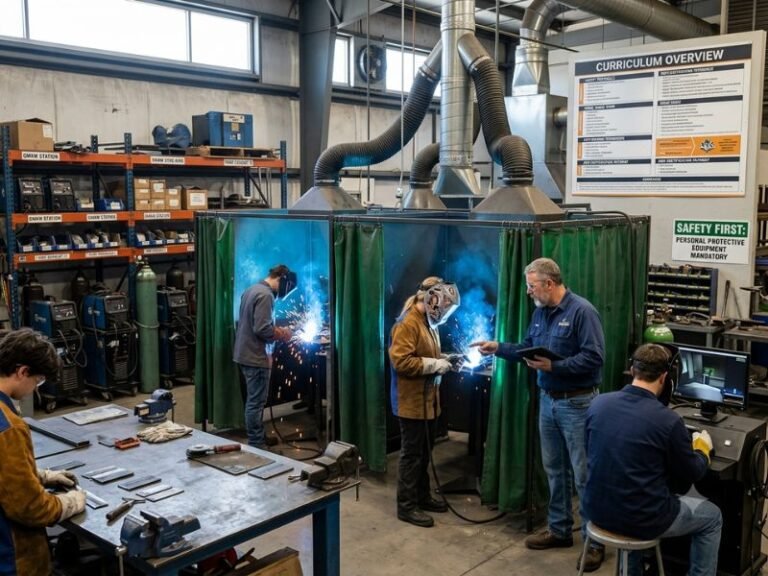
Laser safety should be treated as a core operating skill rather than a short orientation before hands-on practice. A facility should perform a hazard evaluation and establish controls appropriate to the specific machine and work area. The machine manual, employer procedures, and applicable regulations and standards should guide the program.
Key safety controls
- Engineering controls: Enclosures, guarding, beam stops, interlocks, protective viewing windows, and controlled access can prevent exposure.
- Administrative controls: Written procedures, training records, warning signs, authorized-user rules, inspections, and maintenance instructions support safe operation.
- Personal protective equipment: Laser-rated eyewear, welding helmets or face protection, gloves, protective clothing, and other PPE must match the hazards.
- Fume control: Local exhaust ventilation or an appropriate extraction system may be necessary for metal fumes, coatings, and process byproducts.
- Fire prevention: Combustible materials, reflective surfaces, hot parts, sparks, and nearby gas supplies require careful control.
Laser eyewear is not interchangeable. The protective rating must be suitable for the laser wavelength, operating conditions, and exposure risk. Ordinary safety glasses or a general welding lens should not be treated as automatic protection from a laser beam.
Reflective metals create additional concerns because a beam can reflect from the workpiece or nearby surfaces. Operators should never improvise with reflective shielding, bypass an interlock, defeat a warning device, or place an unapproved reflective object near the beam path. Only authorized personnel should service equipment or enter a controlled area during applicable operations.
Fume hazards deserve separate attention. Stainless steel, galvanized material, painted parts, coatings, and unknown residues can produce hazardous emissions when heated. Cleaning a surface does not eliminate every risk. A safety-focused course explains ventilation, respiratory protection policies, and the need to identify the material before welding.
Hands-On Learning Process
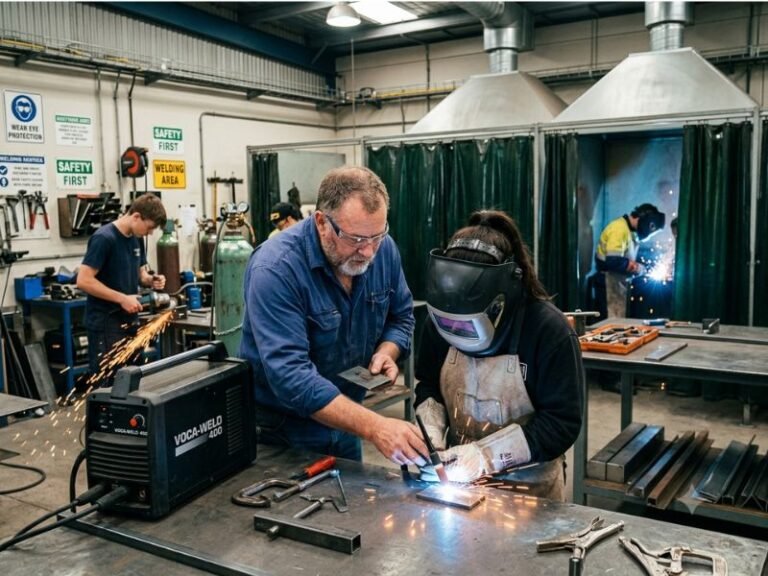
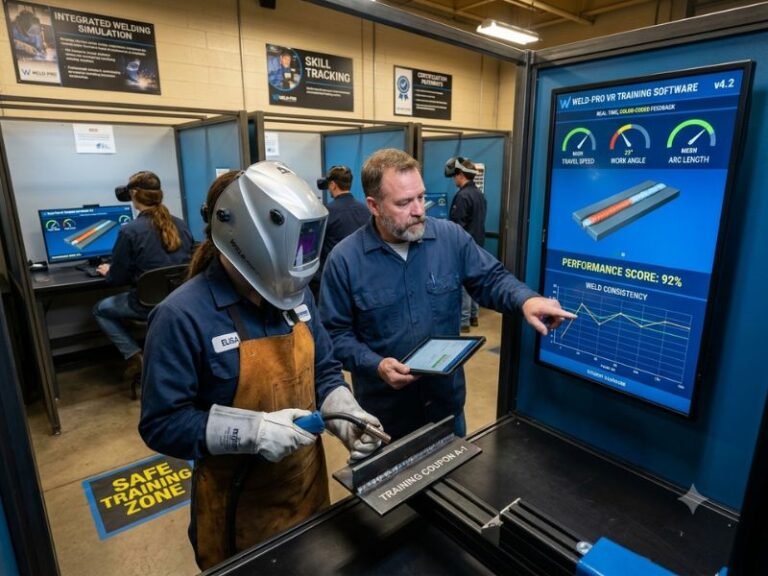
Classroom explanation alone is not enough for most operators. Laser welding has a visual and physical feedback loop: the sound, melt pool, bead shape, penetration, discoloration, and response to movement all matter. Practical training lets a learner connect a control change with an actual weld result.
- Orientation: The instructor identifies machine components, controls, hazards, emergency procedures, and the boundaries of authorized operation.
- Demonstration: The instructor shows preparation, setup, beam alignment or aiming procedures, welding technique, and shutdown.
- Practice on simple joints: The learner begins with suitable scrap or training coupons and focuses on posture, travel speed, torch angle, and consistent movement.
- Parameter exercises: The learner changes one variable at a time and records the effect on penetration, bead shape, and distortion.
- Defect correction: The instructor introduces common problems and asks the learner to diagnose the likely cause before changing settings.
- Inspection and review: Welds are examined against the relevant criteria, and the learner documents the result.
- Supervised assessment: The learner demonstrates safe setup, operation, shutdown, and basic process control.
Technique is important, but consistency is the real target. A production operator should be able to hold a stable torch angle, maintain a repeatable travel speed, position the focal point correctly, and follow a documented procedure. Skill improves when practice is deliberate rather than based on random adjustments.
Choosing a Laser Welding Training Program
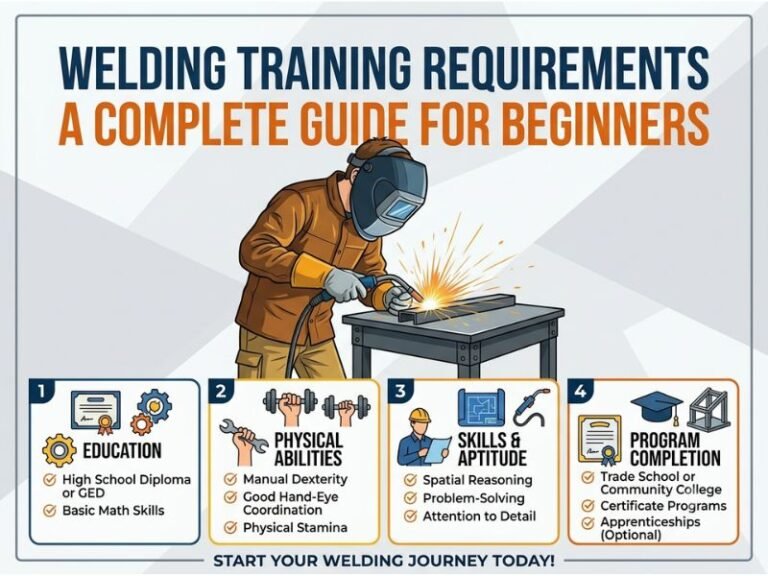
The right program depends on the learner’s role and the equipment involved. A maintenance technician may need machine safety, setup, and troubleshooting. A welding operator may need more time on joint preparation and manual technique. An engineer or supervisor may need process development, parameter documentation, and quality controls.
Questions to ask a provider
- Does the course include supervised hands-on welding?
- Which laser types, delivery heads, and materials are covered?
- Does the training use equipment similar to the machine at the workplace?
- How much time is devoted to laser safety and hazard controls?
- Are inspection methods and weld defects included?
- Does the provider explain machine-specific procedures instead of presenting generic settings?
- What documentation is provided after completion?
- Are class size and instructor access suitable for the amount of practice required?
- Does the course address filler wire, shielding gas, cleaning, and maintenance where relevant?
A certificate can document attendance or completion, but it does not automatically qualify a person for every laser system or every welding application. The employer may still need to conduct a site-specific evaluation, authorize the operator, verify competency, and provide additional training for its equipment and procedures.
I would compare programs by practical depth, instructor qualifications, safety controls, and relevance to the intended application rather than by certificate wording alone. A course that promises mastery in a very short time may be useful for orientation, but complex production work generally requires supervised practice and follow-up.
How Long Does Training Take?
Course length varies because the starting skill level and equipment differ. A basic awareness session may introduce hazards and machine components. An operator course may require additional time for welding practice, setup, inspection, and troubleshooting. Advanced process-development instruction can take longer because it involves procedure qualification, parameter studies, and application-specific testing.
Prior experience with TIG, MIG, or other welding methods can help with torch control, joint preparation, and weld inspection. It does not replace laser-specific safety or machine instruction. A skilled welder still needs to learn beam hazards, optical components, interlocks, focal control, shielding requirements, and the behavior of the particular system.
Training should end with a clear next step. That may be supervised production, a skills evaluation, a documented work instruction, or additional practice on specific materials. A learner should not be placed alone on unfamiliar equipment simply because a short course has been completed.
Common Mistakes to Avoid
Treating presets as universal
Factory presets can be a starting point, but they are not automatically correct for every thickness, joint, material condition, or machine configuration. The same nominal power can produce different results when focus, speed, gas, or beam delivery changes.
Ignoring fit-up and cleanliness
Operators sometimes increase power to compensate for a gap, contamination, or poor alignment. That can create excessive heat without solving the underlying problem. Correct preparation should come before aggressive parameter changes.
Changing too many variables
If power, speed, gas flow, wobble, and focus are all changed together, the cause of improvement or failure remains unclear. A controlled process record makes troubleshooting faster and supports repeatability.
Judging quality by appearance alone
A shiny bead is not proof of complete fusion, acceptable penetration, or adequate strength. The inspection method must match the product requirement. Destructive testing and non-destructive testing may reveal problems that visual inspection cannot.
Overlooking optics and maintenance
A dirty protective window, damaged nozzle, unstable cooling system, or misaligned delivery head can affect the beam and weld quality. Maintenance should follow the manufacturer’s instructions, and personnel should not open or service laser equipment without proper authorization and training.
Bypassing safety features
Interlocks and guards exist to control exposure. Bypassing them to save time creates a serious hazard and can invalidate the intended safety design. If a machine cannot operate as designed, the correct response is to stop and report the problem.
Career and Workplace Applications
Laser welding skills are used in manufacturing environments that value precise, repeatable joining. Applications may include sheet metal assemblies, automotive components, medical or laboratory products, electronics-related parts, tool and die work, appliances, and general fabrication. The exact opportunity depends on the material, product requirements, automation level, and employer qualification system.
Manual handheld laser welding and automated laser welding require different strengths. Manual work emphasizes torch control, visual feedback, ergonomic technique, and adaptation to part variation. Automated work emphasizes fixturing, programming, sensors, repeatability, maintenance, and process verification. Training for one path may not fully prepare a person for the other.
Employers often value a combination of welding fundamentals, blueprint reading, measurement, quality awareness, machine troubleshooting, and safe work habits. I would treat laser welding as an added specialization rather than a substitute for those broader manufacturing skills.
Frequently Asked Questions About Laser Welding Training
Who should take laser welding training?
Operators, welders, maintenance personnel, engineers, supervisors, and quality staff can benefit. Anyone who will operate, set up, maintain, specify, inspect, or supervise a laser welding process needs training appropriate to that responsibility.
Can a beginner learn laser welding?
Yes. A beginner can learn the process through structured instruction and supervised practice. Basic welding knowledge helps, but the learner still needs laser safety, equipment orientation, material preparation, process control, and inspection training before independent operation.
Is laser welding training the same as TIG or MIG training?
No. Some welding principles overlap, but laser welding introduces different beam hazards, optical components, energy delivery, focal control, shielding behavior, and equipment safeguards. Experience with TIG or MIG is useful preparation, not a replacement for laser-specific training.
Does a course certificate qualify someone to operate any laser welder?
Usually not. A certificate may show that a person completed a particular course. The employer still needs to confirm competence on the specific machine, materials, procedures, and safety controls used at the workplace.
What safety topics should a course include?
It should address laser classifications and exposure, controlled areas, guarding, interlocks, approved eyewear, reflected beams, emergency procedures, fumes, fire prevention, hot work, compressed gases, electrical hazards, and machine-specific operating rules.
Does training include parameter development?
Some operator courses focus on using established procedures, while advanced courses cover parameter development and process optimization. A learner should ask the provider directly about material thickness, joint design, testing, documentation, and the extent of hands-on development work.
How can I practice after completing a course?
Practice under an authorized supervisor using approved materials and documented procedures. Record settings and results, inspect the welds, and change one variable at a time. Independent experimentation should never involve bypassing guards or using an unapproved machine configuration.
Conclusion
Effective Laser welding training builds more than machine familiarity. It develops safe habits, controlled technique, material awareness, defect recognition, and the judgment to know when a weld or setup is not acceptable. I would choose instruction with meaningful hands-on practice, clear safety controls, equipment-specific guidance, and a path for supervised workplace qualification. That foundation gives a new operator a safer and more reliable start with laser welding.