TIG Welding Training: Courses, Certification, Costs, and Careers
TIG welding training teaches you how to produce clean, controlled welds using a nonconsumable tungsten electrode, shielding gas, and, when needed, a separate filler rod. It is suitable for beginners, experienced welders, fabricators, and career changers who want to develop precision welding skills.
In this guide, I will explain what TIG courses cover, how long training may take, what costs to expect, and how a course certificate differs from a performance-based welding qualification. I will also cover the main training options available in the United States.
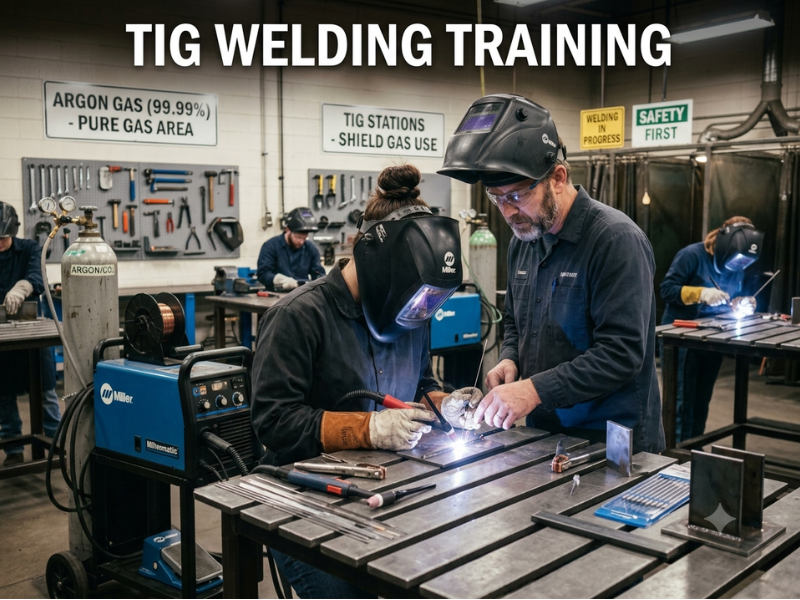
What Is TIG Welding Training?
TIG welding training is structured instruction in Gas Tungsten Arc Welding (GTAW). The process creates an arc between a nonconsumable tungsten electrode and the workpiece. An inert shielding gas protects the molten weld pool from atmospheric contamination.
Unlike MIG welding, TIG does not continuously feed electrode wire through the torch. The welder controls the torch with one hand and may add filler rod with the other. Many machines also use a foot pedal or fingertip control to adjust amperage.
TIG provides excellent control, but it requires coordination, careful preparation, and steady practice.
What Do You Learn in a TIG Welding Course?
A useful course should combine safety, equipment setup, metal preparation, torch control, filler-metal technique, joint practice, and weld inspection.
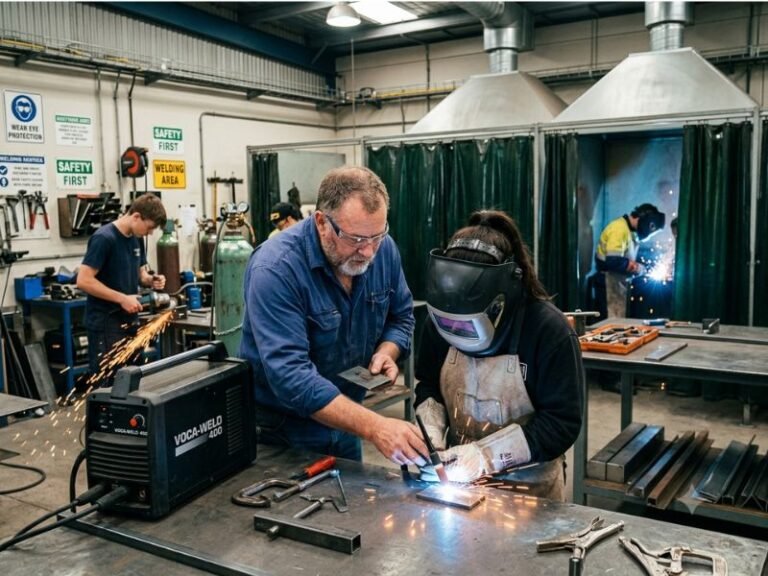
Welding Safety and PPE
Students should learn how to manage ultraviolet radiation, hot metal, sparks, fumes, electrical hazards, and compressed gas cylinders.
Common protective equipment includes:
- A properly rated welding helmet
- Safety glasses
- TIG welding gloves
- Flame-resistant clothing
- Leather work boots
- Hearing or respiratory protection when required
The training area should have proper ventilation, fire controls, and safe cylinder storage. Painted, coated, oily, or unidentified materials may create additional hazards and require careful assessment.
Machine Setup and Controls
Students normally learn how to set up the power source, TIG torch, work clamp, gas cylinder, flowmeter, tungsten electrode, ceramic cup, filler rod, and remote amperage control.
Training may also cover:
- DC electrode negative
- Alternating current
- Gas flow and cup size
- Tungsten type and diameter
- Amperage
- Preflow and postflow
- Pulse settings
- AC balance
Steel and stainless steel are commonly welded with direct current, while aluminum is often welded with alternating current. The correct setup depends on the material, machine, joint, thickness, and procedure.
Torch and Filler-Rod Control
TIG welding requires the student to coordinate several movements. Important skills include:
- Maintaining a short, stable arc
- Holding a consistent torch angle
- Controlling travel speed
- Feeding filler rod smoothly
- Keeping the filler inside the gas coverage
- Preventing tungsten contamination
- Filling the crater before stopping
Touching the tungsten to the weld pool or filler rod can contaminate it. The electrode may then need to be removed and prepared again.
Metal Preparation and Joint Practice
TIG is sensitive to contamination. Students should learn to remove oil, paint, rust, oxide, moisture, and dirt before welding.
Practice commonly includes butt joints, lap joints, T-joints, corner joints, fillet welds, groove welds, sheet metal, tube, or pipe. Accurate joint fit-up helps control penetration, bead consistency, and distortion.
Common TIG Welding Problems
| Problem | Common Cause | Possible Correction |
| Porosity | Contamination or poor gas coverage | Clean the metal and inspect the gas system |
| Tungsten contamination | Electrode touched the pool or filler | Regrind or replace the tungsten |
| Lack of fusion | Low heat, fast travel, or poor arc placement | Adjust heat input and torch position |
| Burn-through | Excessive amperage or a large joint gap | Reduce heat and improve fit-up |
| Oxidized weld | Inadequate shielding | Check gas flow and coverage |
TIG Welding Training Options in the United States
Students can learn through trade schools, community colleges, short workshops, employer programs, apprenticeships, and hybrid courses.
Trade Schools and Community Colleges
Career programs often combine TIG with MIG, stick, flux-cored welding, cutting, blueprint reading, and fabrication. They may award a certificate, diploma, or associate degree.
This option is suitable for students who want structured instruction, regular shop access, and broader preparation for welding work.
Short TIG Courses
A short course may focus on basic GTAW, stainless steel, aluminum, pipe, or a particular application. It can benefit beginners, hobbyists, maintenance workers, and welders adding TIG skills.
The main limitation is practice time. A short class can introduce correct technique, but proficiency requires repeated supervised practice.
Apprenticeships and Employer Training
Apprenticeships and employer programs combine practical work with instruction. They may allow students to earn income while learning production standards and workplace procedures.
Employer training may focus on a limited range of materials or joints, so ask whether the skills and qualifications are recognized elsewhere.
Online and Hybrid Courses
Online courses can teach theory, safety, machine controls, and troubleshooting. They cannot replace physical coaching, supervised arc time, or independent weld evaluation.
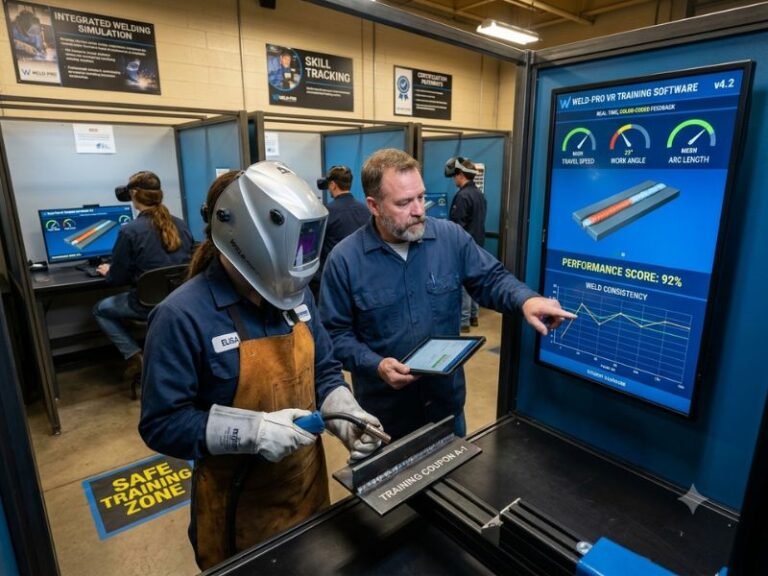
A hybrid course is more useful when it includes scheduled shop practice and direct instructor feedback.
How Long Does TIG Training Take?
A beginner workshop may last one or two days. A process-specific course may run for several weeks, while a comprehensive welding program may take several months.
Course length depends on your previous experience, practice frequency, material, joint type, welding position, and required quality level. Learning basic torch control is only the first stage.
I recommend comparing programs by supervised lab hours and demonstrated competencies rather than course length alone.
How Much Does TIG Training Cost?
Costs vary across the United States. A short workshop usually costs less than a trade-school or college program, but advertised tuition may not include every expense.
Possible costs include:
- Tuition and lab fees
- Books or online materials
- Tungsten, filler rod, gas, and practice metal
- Helmet, gloves, clothing, and hand tools
- Qualification testing and retesting
- Transportation
Before enrolling, request a written cost breakdown. Ask whether consumables, equipment, and practical testing are included.
TIG Welding Certification and Course Certificates
A course completion certificate confirms that you completed training. It does not automatically qualify you for every TIG welding job.
A welder performance qualification shows that you produced an acceptable test weld under defined conditions. The qualification may be limited by the process, material, thickness, joint, position, procedure, or code.
The American Welding Society provides performance-based certification pathways, while many employers conduct their own welding tests. Before paying for a test, ask potential employers which qualification they require.
A training provider should clearly explain the credential, test procedure, covered materials and positions, retesting fees, and any continuity requirements.
How to Choose a TIG Welding Program
Use these factors when comparing programs:
- Define your goal. Decide whether you are learning for a hobby, career, employer test, or specific material.
- Review the curriculum. Look for safety, setup, torch control, filler technique, joints, inspection, and troubleshooting.
- Compare lab hours. Practical welding time matters more than a long list of classroom topics.
- Check instructor access. Direct feedback helps correct bad habits early.
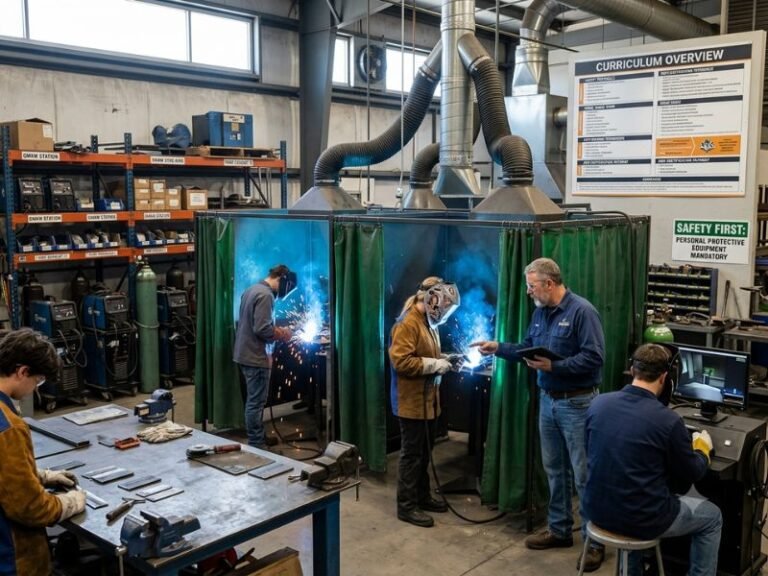
- Tour the facility. Inspect ventilation, equipment, booth availability, and fire controls.
- Verify the credential. Confirm whether you receive a completion certificate or performance qualification.
- Calculate the full cost. Include PPE, consumables, testing, and transportation.
- Evaluate career claims carefully. No responsible program can guarantee a job or salary.
I recommend visiting the lab and speaking with an instructor before enrolling.
A Simple Beginner Practice Plan
A structured sequence helps students build control safely:
- Learn PPE, ventilation, electrical safety, and cylinder handling.
- Identify the machine and torch components.
- Practice preparing and installing tungsten.
- Run straight beads without filler.
- Add filler while maintaining a stable arc.
- Practice butt, lap, and T-joints.
- Record the material, amperage, gas, filler, and results.
- Ask an instructor to identify defects.
- Practice the exact procedure before a qualification test.
Never practice on tanks, closed containers, coated metals, or unidentified materials. They can create fire, explosion, or toxic-exposure hazards.
TIG Welding Career Opportunities
TIG skills are used where precision, appearance, and heat control are important. Potential fields include aerospace, stainless steel fabrication, pipe and tube welding, food-processing equipment, motorsports, automotive fabrication, marine work, and custom metal fabrication.
Common job titles include TIG welder, combination welder, pipe welder, fabrication welder, production welder, and welder-fitter.
Career options may improve when TIG skills are combined with blueprint reading, fitting, pipe welding, MIG, stick, inspection, and fabrication.
Frequently Asked Questions
Is TIG welding difficult to learn?
TIG is coordination-intensive because the welder must control the torch, filler rod, arc length, travel speed, and sometimes amperage at the same time. Structured practice makes these movements more consistent.
Can I learn TIG welding online?
You can learn theory and setup online, but hands-on practice is necessary to develop physical control and produce welds that can be evaluated properly.
What metal should a beginner practice on?
Many courses begin with clean carbon steel because it is generally more forgiving than thin stainless steel or aluminum. The best material depends on the equipment and course objective.
Do I need my own TIG welder?
Most in-person schools provide welding machines. Confirm whether you must supply a helmet, gloves, protective clothing, tungsten, filler rod, or hand tools.
Does completing a TIG course make me certified?
Not automatically. A completion certificate documents training, while a performance qualification requires passing a defined practical test.
Is TIG welding a useful career skill?
Yes. It can be valuable in industries requiring precise, high-quality welds. Opportunities depend on location, industry, experience, qualifications, and related fabrication skills.
Conclusion
TIG welding training can help you develop the coordination, safety awareness, and technical knowledge required for high-quality GTAW work. The best program should provide sufficient lab time, qualified feedback, safe facilities, relevant practice materials, and a clearly defined credential.
I recommend comparing several programs, reviewing the complete cost, and confirming exactly what practical testing is included. A careful choice can give you a stronger foundation for building reliable welding skills and pursuing relevant opportunities in the United States.