Gas Welding Training: Skills, Costs, Courses, and Careers
Gas welding training teaches students how to join and cut metals using heat produced by a fuel gas flame, most commonly oxygen and acetylene. Although modern industries often use advanced welding processes such as MIG, TIG, and flux-cored welding, gas welding remains an important foundational skill for fabrication, repair work, maintenance, and metalworking applications.
Also known as oxy-fuel welding or oxy-acetylene welding, this process helps students understand fundamental welding concepts such as heat control, flame adjustment, metal behavior, joint preparation, and safe equipment handling.
In this guide, I will explain what gas welding training includes, how the process works, what skills students learn, how much courses cost, certification options, and how to choose a suitable training program in the United States.
Whether you are a beginner entering the welding field, a mechanic wanting repair skills, or a professional looking to expand your abilities, understanding gas welding fundamentals can provide a strong foundation for metalworking careers.
What Is Gas Welding Training?
Gas welding training is structured instruction in oxy-fuel welding, a process that uses a fuel gas flame to heat and melt metals together.
The most common gas welding method uses oxygen and acetylene because the combination produces a high-temperature flame suitable for welding steel and other metals.
During the process, the welder controls the torch flame, heats the joint area until a molten weld pool forms, and adds filler metal when required. Unlike arc welding processes that rely on electricity, gas welding uses controlled combustion to create the necessary heat.
A complete gas welding program teaches students:
- Safe torch operation
- Gas-cylinder handling
- Flame adjustment
- Metal preparation
- Joint design
- Filler rod selection
- Welding techniques
- Cutting operations
- Weld inspection
Although gas welding equipment is relatively simple compared with many modern welding systems, developing proper technique requires practice and a strong understanding of heat control.
Why Learn Gas Welding?
Gas welding remains valuable because it teaches essential principles that apply across many welding processes.
One major advantage is understanding heat management. A gas welder learns how metals respond to temperature changes, how heat affects distortion, and how to control a weld pool manually.
These skills are useful when learning other processes such as GMAW (MIG welding), GTAW (TIG welding), and SMAW (stick welding).
Gas welding is also useful because the equipment is portable and does not require an electrical power source. This makes it practical for field repairs, maintenance work, and situations where electrical welding equipment may not be available.
Common applications include:
- Metal repair
- Automotive restoration
- Fabrication work
- Pipe repair
- Heating and bending operations
- Cutting and preparation work
While many large manufacturing facilities use automated or semi-automated welding systems, gas welding knowledge remains valuable for technicians, fabricators, and maintenance professionals.
What Do You Learn in Gas Welding Training?
A quality gas welding course focuses on safety, equipment operation, torch control, metal preparation, and practical welding skills.
Students learn not only how to create a weld but also how to understand why different techniques produce different results.
Gas Welding Safety and Equipment Handling
Safety is one of the most important parts of gas welding training because the process involves high-pressure gases, extreme heat, flames, and combustible materials.
Students learn how to safely handle oxygen and fuel gas cylinders, inspect equipment, prevent leaks, and maintain a controlled work environment.
Proper personal protective equipment usually includes:
- Welding goggles or helmet with appropriate shade
- Safety glasses
- Welding gloves
- Flame-resistant clothing
- Protective footwear
Training also covers ventilation, fire prevention, flashback protection, safe cylinder storage, and emergency procedures.
Gas cylinders must be handled carefully because they contain gases stored under high pressure. Incorrect storage, transportation, or connection procedures can create serious hazards.
Understanding Gas Welding Equipment
A major part of gas welding training involves learning the purpose of each equipment component.
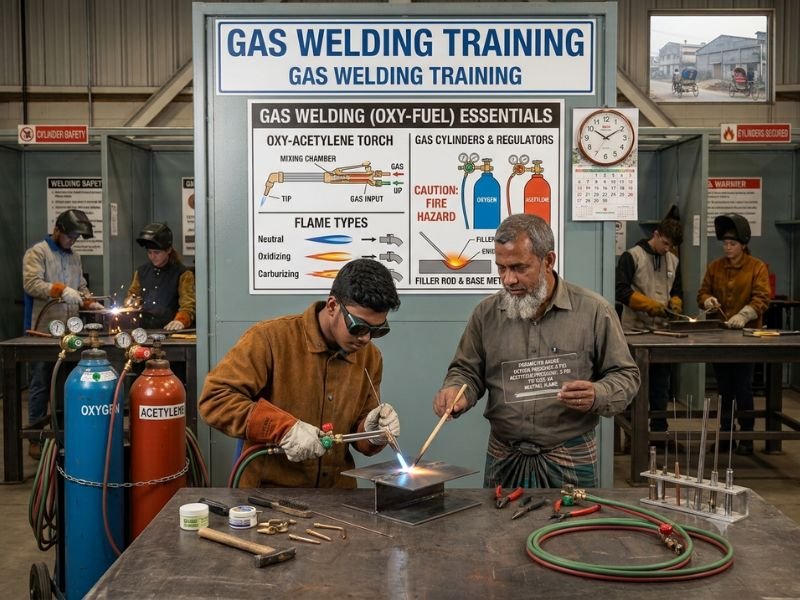
A typical oxy-acetylene setup includes:
- Oxygen cylinder
- Acetylene cylinder
- Regulators
- Hoses
- Torch handle
- Torch tips
- Check valves
- Flashback arrestors
- Filler rods
Students learn how to inspect equipment before use and recognize problems such as damaged hoses, incorrect connections, leaks, or regulator issues.
The regulator controls gas pressure from the cylinder and allows the welder to adjust the working pressure required for the application.
The torch mixes oxygen and fuel gas to create the flame used for welding or cutting.
Understanding equipment setup is essential because incorrect gas pressure or poor maintenance can affect both safety and weld quality.
Flame Types in Gas Welding
Learning flame control is one of the most important skills in gas welding training.
The three main flame types are:
Neutral Flame
A neutral flame contains balanced oxygen and acetylene. It is commonly used for welding steel because it provides a stable flame without adding excessive carbon or oxygen to the weld area.
Carburizing Flame
A carburizing flame contains excess acetylene. It can add carbon to the weld area and may be useful for certain applications, although it is not commonly used for general steel welding.
Oxidizing Flame
An oxidizing flame contains excess oxygen. It produces a hotter flame but can cause oxidation and unwanted changes in metal properties.
Students learn how to identify flame characteristics visually and adjust the torch correctly for different materials and applications.
Torch Control and Welding Technique
Gas welding requires careful control of torch movement, heat input, and filler metal.
Students learn how torch angle affects the weld pool, how travel speed influences penetration, and how to maintain consistent heating.
Important skills include:
- Controlling flame position
- Maintaining proper distance from the workpiece
- Creating a stable weld pool
- Adding filler rod correctly
- Avoiding overheating
- Managing distortion
Unlike automated welding systems, gas welding depends heavily on the welder’s ability to judge heat and metal behavior.
Metal Preparation and Joint Design
Proper preparation is essential for producing quality welds.
Students learn how to clean metal surfaces, remove contamination, prepare edges, and select suitable joint designs.
Common joints include:
- Butt joints
- Lap joints
- Fillet joints
- Corner joints
Surface contamination from oil, paint, rust, dirt, or coatings can reduce weld quality and create defects.
Good preparation improves penetration, appearance, and overall weld strength.
Gas Cutting Training
Many gas welding programs also include oxy-fuel cutting, which uses the same basic equipment principles.
Students learn how to cut steel safely using oxygen and fuel gas.
Training may include:
- Torch setup
- Tip selection
- Flame adjustment
- Piercing techniques
- Cutting speed control
- Edge quality
- Safety procedures
Gas cutting remains useful in fabrication shops, repair operations, construction, and metal recycling applications.
Common Gas Welding Defects and Troubleshooting
Understanding defects helps students improve their welding skills.
Porosity occurs when gases become trapped inside the weld. Contamination, incorrect flame adjustment, or poor technique can contribute to this problem.
Lack of fusion happens when the melted metal does not properly combine with the base material. Insufficient heat or incorrect torch movement may cause this issue.
Excessive penetration can occur when too much heat is applied, especially on thin materials.
Distortion happens when uneven heating causes the metal to change shape. Proper sequence planning and heat control help reduce distortion.
Cracking may result from incorrect procedures, unsuitable materials, or excessive stress.
Professional training teaches students how to identify the cause of defects rather than simply repairing the visible problem.
Gas Welding Training Options in the United States
Students can choose different learning paths depending on their career goals and experience level.
Trade Schools and Technical Institutes
Trade schools often provide career-focused welding programs that include gas welding fundamentals along with other welding processes.
Programs may cover:
- Gas welding
- Gas cutting
- MIG welding
- TIG welding
- Stick welding
- Blueprint reading
- Fabrication
- Welding safety
This option is suitable for students seeking structured training and direct preparation for skilled trade careers.
Community College Welding Programs
Community colleges frequently offer welding certificates and technical programs.
These programs may provide:
- Experienced instructors
- Modern facilities
- Flexible scheduling
- Financial aid opportunities
Students may also learn fabrication, inspection, and manufacturing skills alongside welding.
Short-Term Gas Welding Courses
Short courses are useful for beginners, hobbyists, and workers who need basic repair skills.
They typically focus on:
- Equipment safety
- Torch operation
- Flame adjustment
- Basic joints
- Cutting techniques
However, professional-level welding ability requires more extensive practice.
Apprenticeships and Employer Training
Apprenticeships allow students to develop skills while working under experienced professionals.
Employer training can also be valuable because it teaches workplace-specific procedures, equipment, and quality requirements.
Online Gas Welding Training
Online courses can help students understand:
- Welding theory
- Equipment components
- Safety principles
- Flame characteristics
- Troubleshooting concepts
However, gas welding requires physical practice. Students need hands-on experience to develop torch control, heat management, and practical judgment.
How Long Does Gas Welding Training Take?
The time required depends on the student’s goals and the depth of the program.
A beginner course may introduce basic torch operation and simple welds. Career-focused welding programs usually require more time and include multiple processes, fabrication skills, and practical testing.
Learning speed depends on:
- Practice frequency
- Instructor feedback
- Previous mechanical experience
- Material type
- Joint complexity
- Required quality standards
I recommend comparing programs based on practical training hours rather than only completion time.
How Much Does Gas Welding Training Cost?
Training costs vary depending on the school, location, course length, and included materials.
Students should consider expenses such as:
- Tuition
- Lab fees
- Safety equipment
- Welding tools
- Gas usage
- Practice materials
- Testing fees
Before enrolling, ask whether the program provides equipment, consumables, and certification preparation.
A lower-cost program may not always provide the best value if it offers limited practice time or outdated equipment.
Gas Welding Certification and Qualifications
Completing a gas welding course does not automatically qualify someone for every welding position.
A training certificate shows that a student completed instruction, while a welding qualification demonstrates that a person successfully passed a practical test under specific conditions.
Qualification requirements may depend on:
- Material type
- Thickness
- Welding position
- Joint design
- Employer requirements
- Applicable standards
The American Welding Society (AWS) provides welding certification pathways, and many employers conduct their own skill evaluations.
For some jobs, employers may prioritize practical ability and experience over a general course certificate.
How to Choose a Gas Welding Training Program
Choosing the right program requires careful evaluation.
First, review the curriculum. A strong program should include safety, equipment setup, flame control, welding technique, cutting, inspection, and practical projects.
Next, compare hands-on hours. Gas welding is a skill that improves through repetition.
Instructor experience is also important. Good instructors can identify mistakes and explain how to correct them.
I recommend visiting the training facility before enrolling. Check the equipment, ventilation, safety procedures, and available practice areas.
Finally, understand the complete cost and the credential provided after completion.
Gas Welding Career Opportunities
Gas welding skills can support careers in fabrication, repair, maintenance, and metalworking.
Possible job roles include:
- Welder
- Fabrication technician
- Maintenance welder
- Repair technician
- Metalworker
- Welding assistant
Industries that may use gas welding skills include:
- Manufacturing
- Automotive restoration
- Construction
- Equipment repair
- Shipyards
- Industrial maintenance
Additional skills such as MIG welding, TIG welding, blueprint reading, fabrication, and inspection can improve career opportunities.
Advantages and Challenges of Gas Welding Careers
Gas welding offers several advantages.
It teaches fundamental welding principles, requires relatively portable equipment, and remains useful for repair and maintenance applications.
However, it also has challenges.
Modern industries often rely more heavily on arc welding processes for production because they are faster and easier to automate. Gas welding professionals may need additional skills to remain competitive.
The work can also involve heat exposure, fumes, physical demands, and strict safety requirements.
Long-term success depends on technical ability, adaptability, and continuous skill development.
Common Gas Welding Training Mistakes
One common mistake is focusing only on creating a visible weld instead of understanding heat control and metal behavior.
Another mistake is ignoring equipment safety. Gas cylinders, regulators, hoses, and torches require proper inspection and handling.
Some beginners also practice without enough feedback. Incorrect torch angle, flame adjustment, or travel speed can become difficult habits to correct.
Finally, learning only one process may limit career opportunities. Combining gas welding knowledge with MIG, TIG, or fabrication skills can create a stronger professional profile.
Frequently Asked Questions
Is gas welding difficult to learn?
Gas welding can be challenging because the welder controls heat, torch movement, and filler metal manually. Proper training and practice make the process easier to master.
Is gas welding still used today?
Yes. Gas welding remains useful for repair work, fabrication, maintenance, cutting, and specialized applications.
How long does gas welding training take?
Basic skills can be introduced quickly, but professional-level ability requires continued practice and experience.
Do I need welding school to learn gas welding?
Not always. Some people learn through apprenticeships or workplace training, but formal courses provide structured instruction and safer learning.
Can I learn gas welding online?
Online resources can explain theory, but hands-on practice is necessary to develop torch control and welding ability.
What certification is best for gas welding?
The appropriate qualification depends on the industry, employer, material, and job requirements.
Conclusion
Gas welding training provides a strong foundation for understanding heat control, metal behavior, torch operation, and welding fundamentals.
Although many industries now use advanced arc welding technologies, gas welding remains valuable for repair work, fabrication, maintenance, and as a foundation for learning other welding processes.
I recommend choosing a program that provides strong hands-on practice, experienced instructors, safe equipment, and a curriculum that matches your career goals.
With proper training and continued practice, gas welding can become a useful skill that supports opportunities across the welding and metalworking industries.