Fabrication Welding Training: Key Facts and Helpful Guidance
Many people assume a welding career starts with learning how to make a clean bead. In fabrication, that is only part of the job. A successful welder must also read drawings, prepare materials, control distortion, select the correct process, inspect finished work, and follow strict safety requirements.
Fabrication welding training can provide that broader preparation The right program helps a beginner build shop skills while showing an experienced worker how to qualify for more demanding.
The best choice depends on a person’s starting skill level, target industry, schedule, budget, and desired credential. A short course may be enough for an entry-level position, while structural, pipe, pressure-vessel, or high-specification work usually requires additional practice, testing, and documentation.
What Is Fabrication Welding Training?
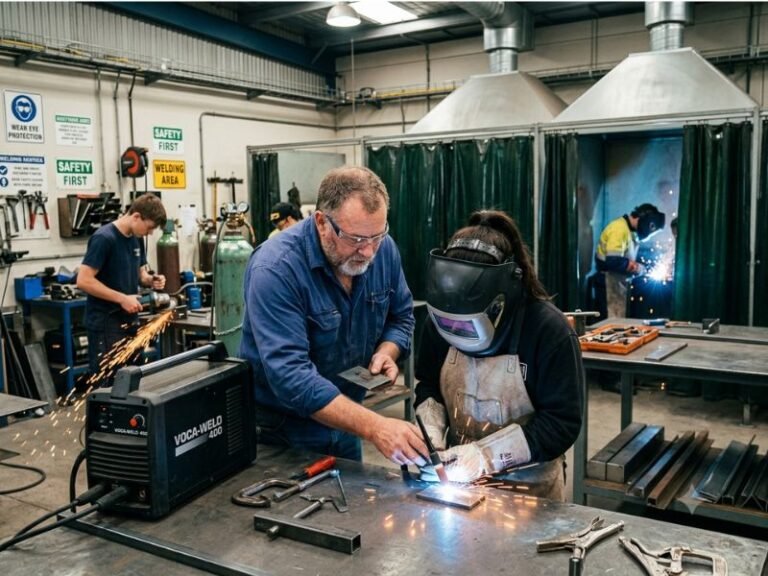
Fabrication welding training teaches people to manufacture, assemble, repair, and modify metal components by joining materials with heat, pressure, or both. The work may involve frames, platforms, stairs, railings, machinery parts, tanks, ductwork, agricultural equipment, trailers, or custom production assemblies.
Unlike a class focused only on welding technique, fabrication training connects welding to the complete production process. Students commonly learn how to:
- Read blueprints, shop drawings, symbols, dimensions, and weld callouts.
- Measure, mark, cut, drill, bend, fit, and tack metal parts.
- Choose suitable electrodes, filler metals, shielding gases, and welding processes.
- Set machine controls and adjust amperage, voltage, wire speed, travel speed, and gas flow.
- Control alignment, sequence, heat input, shrinkage, and distortion.
- Use grinders, saws, plasma cutters, oxyfuel equipment, drills, presses, and hand tools.
- Inspect welds and correct common defects before a part moves to the next operation.
- Apply shop safety procedures, including ventilation, fire prevention, and personal protective equipment.
A fabrication welder may work from a drawing rather than a verbal instruction That means accuracy matters as much as appearance A weld can look acceptable and still.
What Students Learn
Welding processes
Most programs introduce several welding processes before emphasizing the methods most common in local industry. The main processes include:
- Shielded metal arc welding (SMAW): Often called stick welding, this process uses a flux-covered electrode. It is useful outdoors and on heavier steel, but it demands control of arc length, electrode angle, and slag removal.
- Gas metal arc welding (GMAW): Commonly called MIG welding, GMAW uses a continuously fed wire and shielding gas. It is productive for many steel, stainless steel, and aluminum applications.
- Flux-cored arc welding (FCAW): FCAW uses tubular wire and may be self-shielded or gas-shielded. It is widely used for structural and heavy fabrication because of its deposition rate and flexibility.
- Gas tungsten arc welding (GTAW): Also called TIG welding, GTAW provides precise control and clean welds. It usually takes longer to master and is especially valuable for stainless steel, aluminum, thin material, and critical joints.
- Oxyfuel cutting and heating: These skills help a fabricator cut, bevel, heat, and sometimes shape metal. They also reinforce torch safety and flame control.
- Plasma cutting: Plasma equipment can cut conductive metal quickly, although training must address electrical safety, compressed gas, fumes, and edge quality.
A beginning program does not need to teach every process to the same depth. I would look for a curriculum that builds reliable fundamentals first, then matches advanced practice to the jobs available in the intended region.
Blueprints and fabrication math
Blueprint reading is a core fabrication skill, not an optional classroom subject. Students learn orthographic views, section views, dimensions, tolerances, material callouts, weld symbols, revision blocks, and assembly details. They may also interpret cut lists and bills of material.
Fabrication math usually includes fractions, decimals, unit conversion, angles, geometry, measuring, and basic trigonometry. These skills help a worker calculate lengths, locate holes, determine bevels, and verify whether a finished assembly meets the drawing.
Some employers also expect familiarity with computer-aided design files, digital measuring tools, or production tracking systems. Entry-level training may not make a student a designer, but it should create comfort with the documents used on a modern shop floor.
Fit-up and joint preparation
Many welding problems begin before the arc starts. Training should cover joint types such as butt, lap, corner, edge, and T-joints, along with root openings, land thickness, bevel angles, joint cleanliness, tack welds, and clamping.
Good fit-up reduces excessive grinding, prevents gaps from changing during welding, and makes penetration more predictable. Students should practice using squares, levels, clamps, fixtures, tape measures, calipers, and layout tools. They should also learn how to verify dimensions after tack welding and during final inspection.
Metallurgy and distortion control
Basic metallurgy explains how heat affects carbon steel, stainless steel, aluminum, and other alloys. A program may discuss heat-affected zones, hardening, cracking, contamination, preheating, interpass temperature, and cooling behavior.
Welding creates contraction as molten metal cools. That contraction can pull an assembly out of square or change its dimensions. Fabricators manage the problem through joint design, clamping, tack placement, weld sequence, balanced welding, controlled heat input, and planned allowances.
Safety Requirements in a Welding Program
Welding combines intense heat, electricity, compressed gases, metal fumes, ultraviolet radiation, noise, sharp edges, and heavy materials. Safety instruction should begin before hands-on practice and continue throughout the program.
Important subjects include:
- Proper selection and use of helmets, lenses, gloves, flame-resistant clothing, boots, hearing protection, and eye protection.
- Ventilation and exposure control for welding fumes, gases, coatings, and contaminated metals.
- Fire prevention, combustible-material control, fire-watch procedures, and hot-work permits where applicable.
- Safe handling, storage, transport, and connection of compressed-gas cylinders.
- Electrical grounding, cable inspection, machine setup, and protection from shock.
- Safe use of grinders, cutoff wheels, saws, drills, presses, and lifting equipment.
- Lockout/tagout awareness and procedures for equipment maintenance.
- Emergency response for burns, eye injuries, fires, gas leaks, and other shop incidents.
In the United States training providers should align shop practices with applicable Occupational Safety and Health Administration requirements equipment instructions fire codes and employer procedures A school should.
Respiratory protection deserves particular attention. A respirator is not a substitute for effective ventilation, and some types require medical evaluation, fit testing, and a formal respiratory protection program. Students should also learn why painted, galvanized, stainless, or solvent-contaminated metal can create additional hazards.
Common Training Pathways
Community college or technical college
Community and technical colleges often provide structured welding certificates, associate degree options, and evening classes. These programs may offer multiple processes, fabrication equipment, blueprint instruction, and general education support.
This path can suit a person who wants a broad foundation, access to instructors, and a credential that may transfer into further education. The tradeoff is that admission schedules, semester calendars, and required courses can make the path less flexible than a private short-term school.
Trade school or private welding school
Private schools may focus heavily on shop time and job-ready skills. Some offer accelerated schedules, small cohorts, career services, or specialized preparation for structural, pipe, or industrial work.
Before enrolling, I would ask how many hours are spent welding compared with watching demonstrations, whether consumables and protective equipment are included, how often each student has access to a machine, and whether the advertised completion time is realistic for a beginner.
Apprenticeship
An apprenticeship combines supervised employment with related technical instruction. It can provide a practical route into construction, manufacturing, maintenance, or structural fabrication. Apprentices learn production expectations while earning income, although entry requirements and availability vary by employer, union, region, and occupation.
This option may be especially useful for someone who values paid workplace experience. It can also be competitive, so applicants should prepare a clear resume, reliable transportation plan, safety mindset, and evidence of basic mechanical ability.
Employer-based training
Some manufacturers hire entry-level workers and teach specific procedures internally. This route may be efficient when the employer has a strong training system, qualified supervisors, and a clear progression plan.
The limitation is specialization. A worker may become proficient with one product, position, or process without receiving broad blueprint, metallurgy, or multi-process instruction. Asking about advancement and outside credentials can clarify whether the position supports long-term growth.
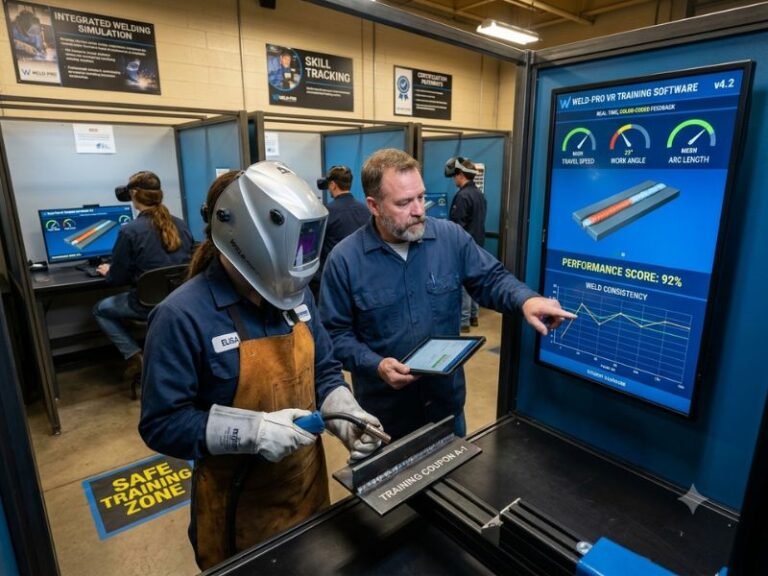
Online and hybrid learning
Online lessons can explain terminology blueprint symbols metallurgy safety and process theory They cannot replace supervised arc time hands-on fit-up or practical testing A hybrid program can work.
How to Choose a Quality Program
Program names and marketing claims do not tell the complete story. I recommend comparing the actual curriculum, equipment, instructors, assessment process, and graduate outcomes.
Review the hands-on structure
Ask for a detailed schedule showing shop hours class size machine availability and practice time A student who shares one machine with many classmates may receive far less arc time than the brochure.
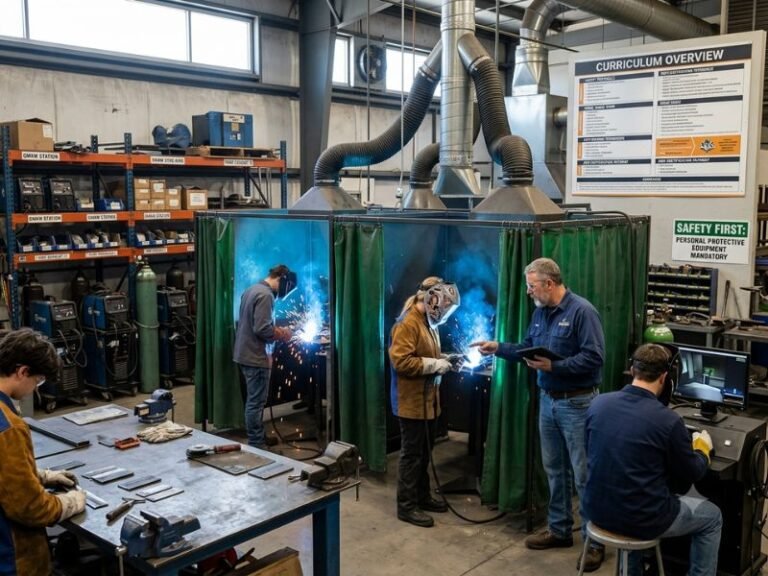
Inspect the shop if possible. It should be orderly, well ventilated, adequately lit, and equipped with working machines. Look for space to practice fit-up and assembly rather than only individual weld coupons. Fabrication work requires access to saws, grinders, layout tools, fixtures, and material-handling equipment.
Evaluate instructors and curriculum
Instructors should be able to explain both welding technique and production practice. Relevant industry experience is valuable, but teaching ability matters too. A strong instructor demonstrates a task, observes student work, identifies the cause of a problem, and explains a repeatable correction.
The curriculum should progress from safety and machine setup to flat-position practice, additional positions, joint preparation, fabrication assemblies, inspection, and troubleshooting. It should also explain welding procedure specifications, or WPSs, when the target industry uses them.
Check credentials and employer connections
Some programs prepare students for American Welding Society performance qualification tests or other employer and code-related examinations A training certificate is not automatically the same as a welder.
Ask exactly which credentials are included who administers testing whether testing fees are separate and how results are documented Also ask whether the school works with local fabricators.
Compare total cost and schedule
Tuition is only one expense. The total may include helmet, jacket, gloves, boots, tools, books, testing fees, transportation, parking, and missed work. A less expensive program can cost more if it offers limited shop access or requires later retraining.
Compare the schedule with personal obligations. Consistent attendance matters because welding skills depend on repetition. A shorter program is not automatically better if the pace leaves too little time to correct technique and build muscle memory.
Credentials, Testing, and Career Preparation
Employers may use different terms for training certificates, certifications, qualifications, licenses, and endorsements. The meaning depends on the issuing organization and the work involved.
A welding certification commonly refers to a credential from an organization or school A welder performance qualification confirms that a specific welder passed a test under defined variables.
Codes and standards may control work in structural steel, pressure vessels, pipelines, transportation, or other regulated sectors. Employers may ask for tests connected to standards such as AWS, ASME, or API, but the relevant requirement depends on the job. A general course cannot promise qualification for every industry.
Job preparation should include a resume that lists processes, materials, positions, equipment, blueprint skills, safety training, and completed tests. A small portfolio of permitted work photos can show fit-up, clean layout, and finished assemblies. Applicants should never display confidential drawings or claim qualifications that have not been earned.
Skills That Improve Employability
Technical welding is central, but fabrication employers also value habits that protect quality and production schedules.
- Measurement accuracy: Verify dimensions instead of relying on visual judgment.
- Drawing literacy: Ask about unclear symbols, revisions, tolerances, or material specifications before cutting.
- Workmanship: Keep surfaces clean, starts and stops controlled, and grinding limited to what the job permits.
- Reliability: Arrive prepared, maintain equipment, and complete assigned work safely.
- Problem solving: Identify whether a defect comes from contamination, settings, fit-up, technique, shielding, or material.
- Communication: Report damaged tools, unsafe conditions, missing information, and quality concerns promptly.
- Adaptability: Move between welding, layout, cutting, assembly, inspection, and rework as production requires.
Basic computer skills are increasingly useful. Digital work orders, inventory systems, inspection records, and CNC cutting equipment are common in many shops. A worker who understands both manual fabrication and production documentation can qualify for more responsibilities over time.
Common Beginner Mistakes
Chasing appearance instead of function
A shiny, uniform bead is not proof of a sound weld. Beginners often focus on surface appearance while overlooking penetration, fusion, undercut, porosity, cracks, joint cleanliness, and dimensional accuracy. Visual inspection is important, but it has limits. Some defects require destructive or nondestructive testing to identify.
Skipping fit-up and preparation
Welding over mill scale, rust, oil, paint, moisture, or improper gaps creates avoidable problems. Poor tacks can pull parts out of alignment, and rushed bevel preparation can make penetration inconsistent. Preparation may feel slower, but it usually reduces rework.
Changing several variables at once
If a weld is too cold, too hot, porous, or irregular, changing amperage, travel speed, wire speed, gas flow, and angle simultaneously makes troubleshooting difficult. A better method is to review the procedure, verify equipment setup, change one relevant variable, and observe the result.
Ignoring distortion
Long continuous welds can warp a frame or panel. Beginners may discover the problem only after the assembly is complete. Planning weld sequence, using balanced passes, alternating sides, and checking dimensions during fabrication can prevent expensive correction.
Assuming one process fits every job
MIG, stick, flux-cored, and TIG each have strengths and limitations. Material thickness, alloy, position, environment, production rate, appearance, and code requirements influence process selection. Training should teach the reasoning behind the choice rather than presenting one process as universally superior.
Confusing school completion with job readiness
Finishing a course is an important milestone, but skill develops through repetition under supervision. A new graduate may still need practice with vertical and overhead positions, larger assemblies, production pace, or employer-specific procedures. Honest self-assessment supports safer applications and better career decisions.
A Practical Training Plan
A useful plan starts with a target job rather than a generic desire to weld. Review local job postings and note the processes, materials, thicknesses, positions, drawings, shifts, and credentials employers request. This information can reveal whether a broad entry-level program or a specialized course is more appropriate.
- Set a target: Choose a first objective, such as entry-level shop fabrication, structural work, maintenance, or production welding.
- Build safety habits: Learn ventilation, PPE, fire prevention, cylinder handling, electrical safety, and equipment inspection before increasing speed.
- Learn measurement and drawings: Practice reading dimensions, symbols, tolerances, and cut lists alongside shop work.
- Develop process fundamentals: Establish consistent machine setup, arc control, travel speed, joint preparation, and cleaning.
- Practice fabrication assemblies: Move from coupons to brackets, frames, fixtures, or other projects that require layout, fit-up, sequencing, and inspection.
- Use feedback: Have an instructor or qualified supervisor identify defects and record the correction.
- Prepare for testing: Confirm the exact process and variables used by the intended employer before paying for a performance qualification test.
- Document progress: Keep a record of processes practiced, materials, positions, completed projects, and credentials.
This sequence creates a more reliable bridge from classroom practice to employment. It also prevents a common waste of money: taking an advanced test before basic fit-up, position, or process control is consistent.
Frequently Asked Questions
How long does fabrication welding training take?
It can range from a short introductory course to a multi-semester certificate, apprenticeship, or associate degree. The appropriate length depends on the target work, prior experience, shop hours, and number of processes covered. A student should judge a program by supervised practice and demonstrated competence, not calendar length alone.
Is fabrication welding training suitable for beginners?
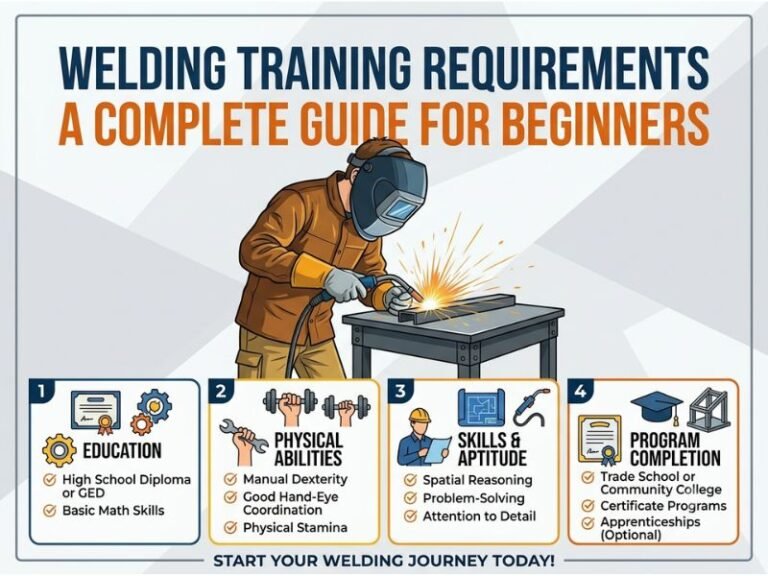
Yes, if the program starts with safety, equipment operation, basic joints, measurement, and blueprint reading. Beginners should avoid programs that assume prior shop experience without providing adequate orientation and instructor supervision.
What is the difference between welding school and fabrication training?
Welding school may emphasize producing welds in different positions and processes. Fabrication training includes those skills but also covers layout, cutting, fit-up, assembly, drawings, distortion control, tools, and inspection. A person seeking general shop employment often benefits from the broader fabrication curriculum.
Do I need a college degree to become a fabrication welder?
No. Employers may accept trade school training, an apprenticeship, a community college certificate, employer instruction, or relevant experience. Some advanced roles prefer additional education, but a four-year degree is not generally required for entry-level fabrication welding.
Will a training certificate qualify me for every welding job?
No. A certificate documents course completion, while a welder qualification applies to specified test conditions. Employers and governing codes can require particular processes, positions, materials, thickness ranges, or procedures. Confirm the exact requirement before selecting a program or test.
Which welding process should a beginner learn first?
There is no single answer for every career goal. GMAW is common in many production shops, while SMAW and FCAW are important in structural and heavy work, and GTAW is valuable for precision applications. A broad introductory program can help a beginner compare processes before specializing.
Can online classes replace hands-on welding training?
No. Online instruction can support theory, safety, blueprint reading, and terminology, but it cannot replace supervised arc time, material preparation, fit-up, equipment setup, or practical testing. Hands-on access is essential for safe skill development.
What should I bring to a fabrication welding program?
Follow the school’s equipment list. Common items include an approved welding helmet, safety glasses, flame-resistant clothing, gloves, hearing protection, work boots, a tape measure, and basic hand tools. Confirm lens requirements, clothing rules, and whether the school supplies consumables before purchasing equipment.
What jobs can follow fabrication welding training?
Possible entry-level roles include welder, welding fabricator, fitter-welder, production welder, structural welder, repair welder, welding machine operator, and fabrication helper. Advancement may lead to layout work, inspection, quality control, welding supervision, estimating, or specialized code work after additional experience and qualification.
Conclusion
Fabrication welding training is most valuable when it combines welding processes with blueprint reading measurement fit-up cutting safety inspection and practical assembly work I would compare programs by.