Can You TIG Weld with a Stick Welder: Clear Answers and Key Facts
Many people assume a stick welder and a TIG welder are completely interchangeable because both can produce an arc. The practical answer is more specific: some stick welding power sources can perform basic DC TIG welding, but a standard stick welder cannot automatically provide the complete TIG process.
If you are asking, can you tig weld with a stick welder, the answer depends on the machine’s output, controls, connections, and accessories. A compatible DC stick welder may work for scratch-start TIG on suitable metals, while aluminum TIG and precise, production-quality TIG usually require a dedicated TIG-capable machine.
Can You TIG Weld With a Stick Welder?
Yes, you can sometimes TIG weld with a stick welder, but only under the right conditions. The stick welder must provide a suitable constant-current DC output, and you need a TIG torch, shielding gas, a regulator, and the correct work-lead and torch connections.
In this setup the power source supplies welding current but it does not necessarily control every part of the TIG process A basic stick machine may allow only.
A stick welder with a built-in TIG mode is different. Some multiprocess welders are designed to run TIG with the proper torch and gas equipment. The manufacturer’s manual should specifically identify TIG capability rather than merely stating that the machine produces DC power.
Why a Stick Welder Can Sometimes Run TIG
Stick welding, also called SMAW, and TIG welding, also called GTAW, use different electrodes and shielding methods. However, both processes can use a constant-current power source. This shared electrical characteristic is why certain DC stick welders can supply current for basic TIG work.
In stick welding, a flux-coated consumable electrode creates the arc and provides filler metal and shielding as it burns. In TIG welding, a nonconsumable tungsten electrode creates the arc, while an external supply of argon shields the molten weld pool. Filler metal is added separately when needed.
The power source therefore handles only part of the TIG process The torch holds the tungsten and directs shielding gas The gas regulator controls flow from the cylinder.
What Equipment Do You Need?
For basic DC TIG operation from a compatible stick welder, the required equipment typically includes:
- A DC-capable stick welding power source
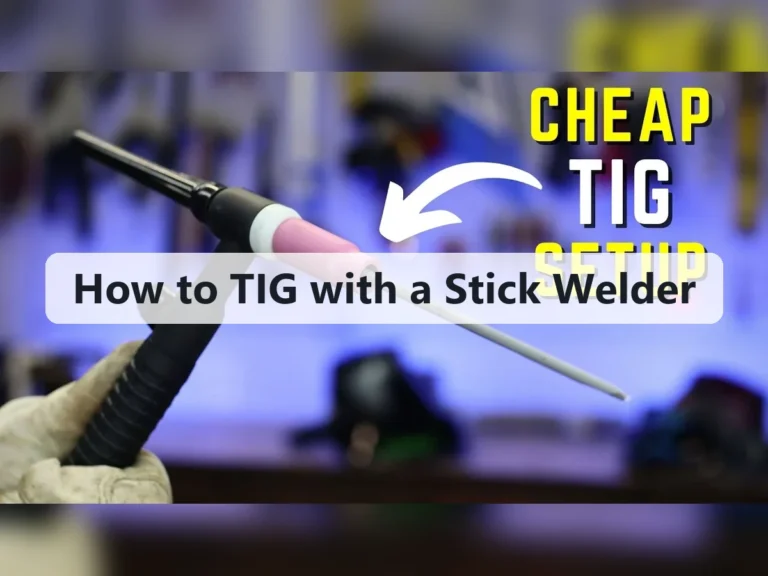
- A TIG torch that matches the current range and connection type
- A tungsten electrode and suitable collet, cup, and back cap
- An argon cylinder, regulator, and gas hose
- A work clamp and correctly connected welding leads
- Appropriate filler rod when the joint requires added metal
- Personal protective equipment, including a welding helmet, gloves, and protective clothing
The torch must be connected with the correct polarity and current capacity Many scratch-start arrangements use a torch without a trigger or gas valve so the operator opens.
Some TIG torches are water-cooled and require a cooler. For low-amperage work, an air-cooled torch is often more practical. The machine manual and torch specifications should determine which arrangement is appropriate. Improvised connections can cause poor performance, damaged equipment, or an electrical safety hazard.
What Type of TIG Welding Is Possible?
A compatible DC stick welder is most suitable for simple DC TIG welding. DC TIG is commonly used for materials such as mild steel, stainless steel, and some other ferrous or conductive metals that can be welded with direct current and argon shielding.
Scratch-start TIG can produce clean, controlled welds when the operator has good technique. It may be useful for repairs, light fabrication, or occasional work where purchasing a dedicated TIG machine is not justified. It can also help an operator avoid the slag and spatter associated with stick electrodes.
However, the process is less convenient and less controllable than TIG on a purpose-built machine. Starting the arc by touching the tungsten to the workpiece can contaminate the electrode. If that contaminated tungsten is not cleaned and reshaped, the arc may wander and the weld may become less consistent.
Why Aluminum Is Usually a Problem
Most basic stick welders do not provide the AC output required for conventional aluminum TIG welding. Aluminum TIG commonly uses alternating current to help manage the oxide layer on the metal while maintaining an effective arc. A DC-only stick welder generally cannot provide that function.
Some specialized procedures can weld aluminum with DC under carefully controlled conditions, but that is not a practical substitute for an AC TIG machine in ordinary shop work. If aluminum is the main material, the machine must specifically support AC TIG and the necessary controls.
Important Limitations
The main limitation is arc starting. A standard stick welder normally has no high-frequency start or built-in lift-arc control. Scratch starting is possible, but it requires more care and can leave tungsten particles in the weld.
Another limitation is current control. A dedicated TIG machine may provide a foot pedal or fingertip control, allowing the operator to adjust amperage while welding. A basic stick machine generally provides only a manually adjusted current setting. That makes it harder to respond to heat buildup, joint changes, or thin material.
Gas control may also be manual. If the machine does not control shielding gas, the torch must have a valve or the gas must be managed separately. The gas should flow before the arc starts and continue briefly after the arc stops so the hot tungsten and weld area remain shielded.
Many stick welders also lack TIG-specific features such as pre-flow, post-flow, adjustable starting current, crater control, pulse settings, and downslope. These features are not always necessary for a basic weld, but they improve arc reliability, weld appearance, and control.
Duty cycle is another consideration. TIG can require a steady arc for longer periods than some stick welding tasks. Confirm that the welder and torch can handle the intended amperage and duration. Exceeding the rated duty cycle can cause thermal shutdown or equipment damage.
How to Set Up a Stick Welder for Basic TIG
Always follow the specific manufacturer’s instructions first. If the manual does not approve TIG use, do not assume that the machine is safe simply because it produces DC current.
- Confirm compatibility. Check that the machine supports DC output and that the manufacturer permits TIG operation. Verify the required current range, polarity, lead connections, and duty cycle.
- Prepare the gas system. Secure an argon cylinder upright, attach a compatible regulator, and connect the gas hose to the torch or gas inlet. Check the connections for leaks.
- Install the tungsten. Select a tungsten size appropriate for the planned current. Grind the electrode as required for DC TIG and keep the tip clean.
- Connect the leads correctly. Use the polarity specified by the machine or torch manufacturer. Attach the work clamp directly to clean metal or to a suitable welding table connection.
- Clean the joint. Remove oil, paint, rust, scale, and other contamination. TIG welding exposes surface contamination more readily than many stick welding procedures.
- Set the gas flow and amperage. Use settings appropriate for the torch, cup, tungsten, material, and joint. Avoid treating a general setting as universal because gas flow and current depend on the application.
- Start the arc carefully. With scratch-start TIG, briefly touch the tungsten to the workpiece and lift it to establish the arc. Do not drag the tungsten through the weld pool.
- Maintain shielding. Keep the torch angle and travel speed consistent, and allow post-flow if the torch or gas system provides it. Protect the weld from drafts that can disturb argon shielding.
Before welding the actual part, practice on clean scrap of the same or similar material. This helps confirm polarity, gas flow, amperage, arc behavior, and torch setup without risking the finished component.
When a Dedicated TIG Welder Is Better
A dedicated TIG welder is the better choice when weld quality, repeatability, or operator control matters. It is especially useful for thin sheet metal, visible stainless steel work, precision repairs, and joints that require controlled heat input.
A purpose-built machine commonly offers high-frequency or reliable lift-arc starting, a torch trigger, gas solenoid control, post-flow, and more refined current adjustment. Many models also support a foot pedal or remote amperage control. These functions make it easier to start and stop cleanly without contaminating the tungsten.
For aluminum, an AC TIG machine is normally the appropriate option. AC balance and frequency controls can further improve arc performance, although the exact controls vary by machine. A DC stick welder cannot be converted into a full AC TIG system by adding a torch and argon cylinder.
Using a dedicated machine also reduces uncertainty about lead connections and internal protection. A welder designed and rated for TIG has the correct electrical behavior and accessories for that process. This does not guarantee a perfect weld, but it makes the setup more predictable and easier to operate.
Safety and Setup Cautions
Do not connect a bare tungsten electrode to a stick electrode holder and assume that the arrangement is equivalent to TIG. A stick holder is designed for coated electrodes and does not provide shielding gas, torch handling, or reliable tungsten positioning. Use a properly rated TIG torch and accessories.
Shielding gas cylinders must be secured and handled according to supplier and workplace safety instructions. Argon can displace oxygen in enclosed spaces, so ventilation is essential. Never weld on containers or materials that may contain flammable residues without proper preparation and authorization.
Inspect cables, connectors, torch insulation, and the work clamp before use. Keep the tungsten and filler rod clean, and avoid touching the electrode to the weld pool or contaminated surfaces. Wear suitable eye, hand, body, and respiratory protection for the material and welding environment.
If the machine manual is unclear about TIG connections, polarity, or gas control, consult the manufacturer or a qualified welding professional before powering the setup. An incorrect connection can create more than a poor weld; it can damage the power source or expose the operator to electrical danger.
FAQ
Can any stick welder be used for TIG?
No. The stick welder must be compatible with DC TIG operation, and it must work with the required torch, polarity, current range, and gas arrangement. A machine that only lists SMAW or stick welding should not automatically be treated as TIG-capable.
Can you TIG weld with a stick welder without gas?
No. TIG welding requires shielding gas, normally argon, to protect the tungsten and molten weld pool from atmospheric contamination. A flux-coated stick electrode cannot provide that shielding for a TIG torch.
Can a stick welder TIG weld stainless steel?
Often, yes, if the machine supports DC TIG and the torch and argon system are correctly installed. Stainless steel requires careful cleaning and gas shielding because contamination can reduce weld quality and appearance.
Can you TIG weld aluminum with a DC stick welder?
Usually not in the conventional sense. Most aluminum TIG work requires AC, while a basic stick welder provides DC only. Use a machine specifically rated for AC TIG when aluminum welding is required.
Is scratch-start TIG as good as regular TIG?
Scratch-start TIG can make sound welds, but it offers less control than a dedicated TIG system. The tungsten can become contaminated during arc starting, and the operator usually cannot adjust amperage while welding with a foot pedal or remote control.
Do you need a TIG torch for a stick welder?
Yes. A TIG torch holds the tungsten and directs shielding gas. You also need the correct collet components, gas supply, work connection, and compatible leads. A stick electrode holder is not a substitute for a TIG torch.
Conclusion
So can you tig weld with a stick welder Yes when the machine supports suitable DC output and you add a compatible TIG torch argon shielding and correct connections Expect basic scratch-start TIG rather than the full control of.