Aerospace Welder Salary: Essential Information and Useful Advice
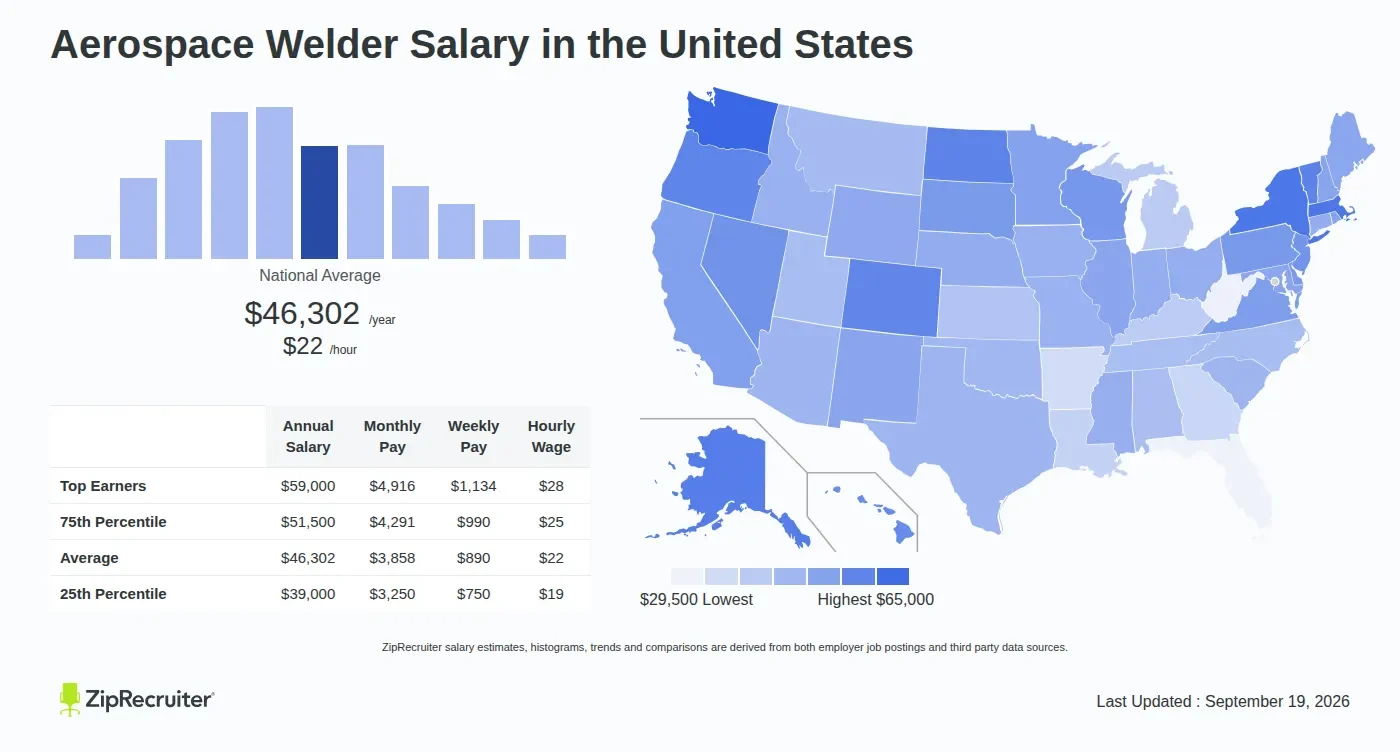
An aerospace welder in the United States commonly earns about $45,000 to $80,000 per year, with experienced specialists and high-cost markets sometimes exceeding $90,000.
The phrase aerospace welder salary does not describe one fixed paycheck Pay changes substantially with experience welding process clearance requirements location shift overtime employer type and the precision.
One easily overlooked detail is that aerospace welding is often paid for quality responsibility not merely arc time A job may require documentation traceability inspection cooperation specialized materials.
- ✓Most U.S. aerospace welders fall into a broad middle range, but specialized experience can push total compensation much higher.
- ✓Process capability, material experience, inspection knowledge, and documented quality performance often matter more than job title alone.
- ✓Hourly pay can outperform a lower salaried offer when overtime, shift premiums, and differentials are consistent.
- ✓Location, security requirements, union status, benefits, and contract stability can change the value of an offer significantly.
Aerospace Welder Salary
Salary estimates for aerospace welders should be treated as planning ranges rather than promises In broad U S terms entry-level workers may start near the upper 30 000s.
Those figures can represent different things One employer may advertise base wages only while another may describe expected annual earnings after overtime shift premiums bonuses or incentive pay.
- Entry level: Often lower pay while the welder builds production speed, process qualifications, and familiarity with aerospace documentation.
- Mid-career: Usually reflects independent work, multiple processes, difficult alloys, and consistent inspection results.
- Advanced specialist: May include precision tube work, repair welding, welding procedure support, lead duties, or security-sensitive production.
- Total compensation: Includes base pay plus overtime, differentials, bonuses, retirement contributions, insurance value, and paid leave.
Hourly pay versus annual salary
Aerospace welding jobs are frequently paid hourly because production schedules overtime and shift assignments can change An hourly rate of 28 equals roughly 58 240 in straight-time annual.
A salaried role may provide steadier budgeting but the title alone does not guarantee better pay A salaried manufacturing technician who regularly works extended hours could earn less.
Why online salary figures disagree
Salary websites may group aerospace welders with broader categories such as welders cutters solderers or metal workers Employer postings can also use different titles for nearly identical work.
Another source of variation is the difference between base wages and total annual earnings A job paying 30 per hour with regular overtime may produce more cash than.
What Drives an Aerospace Welder’s Earnings?
The strongest pay differences usually come from the difficulty and consequences of the work Aerospace welds may involve thin materials tight fit-up limited access heat-sensitive alloys or components.
Employers also pay for the ability to work inside a controlled system. Reading drawings, following weld procedure specifications, recording lot information, protecting material identity, and responding correctly to a nonconformance can distinguish an aerospace-capable welder from a general fabrication welder.
- Process range: TIG, gas tungsten arc welding, resistance welding, laser-related processes, and specialized joining experience may open different pay levels.
- Material difficulty: Aluminum, titanium, nickel alloys, stainless steel, and thin-gauge materials demand different control and preparation.
- Quality record: Low reject rates, reliable documentation, and successful inspection results strengthen a compensation case.
- Business impact: Work on scarce parts, repair programs, prototypes, or production bottlenecks can command a premium.
Experience is more than years on the job
Five years of repetitive production work is not automatically more valuable than three years involving multiple aerospace materials and demanding weld positions. Hiring managers often look for evidence of increasing responsibility: qualifying on additional procedures, handling more difficult assemblies, troubleshooting defects, or training newer employees.
Keep a private record of the capabilities you have developed, subject to employer confidentiality rules. Useful categories include processes, material families, position qualifications, inspection methods understood, equipment operated, documentation systems used, and measurable improvements such as reduced rework or faster setup.
Process and material specialization
TIG welding is commonly associated with precision aerospace work because it offers careful control over heat and filler addition That does not mean every TIG position pays exceptionally.
Resistance welding electron beam support laser welding brazing and automated-cell operation can also lead to specialized opportunities In some roles the welder is expected to set up equipment and interpret process data rather than simply manipulate a torch The broader your useful capability the.
Inspection and documentation skills
Many aerospace employers need welders who understand how their work will be evaluated. Familiarity with visual inspection criteria, dimensional checks, leak testing, dye penetrant concepts, radiographic limitations, and procedure compliance can improve communication with quality personnel. It does not make the welder an inspector, but it helps prevent avoidable defects.
Documentation discipline is equally important. A missing record, incorrect material identification, or undocumented repair can delay an entire work order. Welders who consistently complete travelers, inspection records, and traceability entries accurately may be trusted with higher-consequence assignments.
How Location, Industry, and Employer Type Change Pay
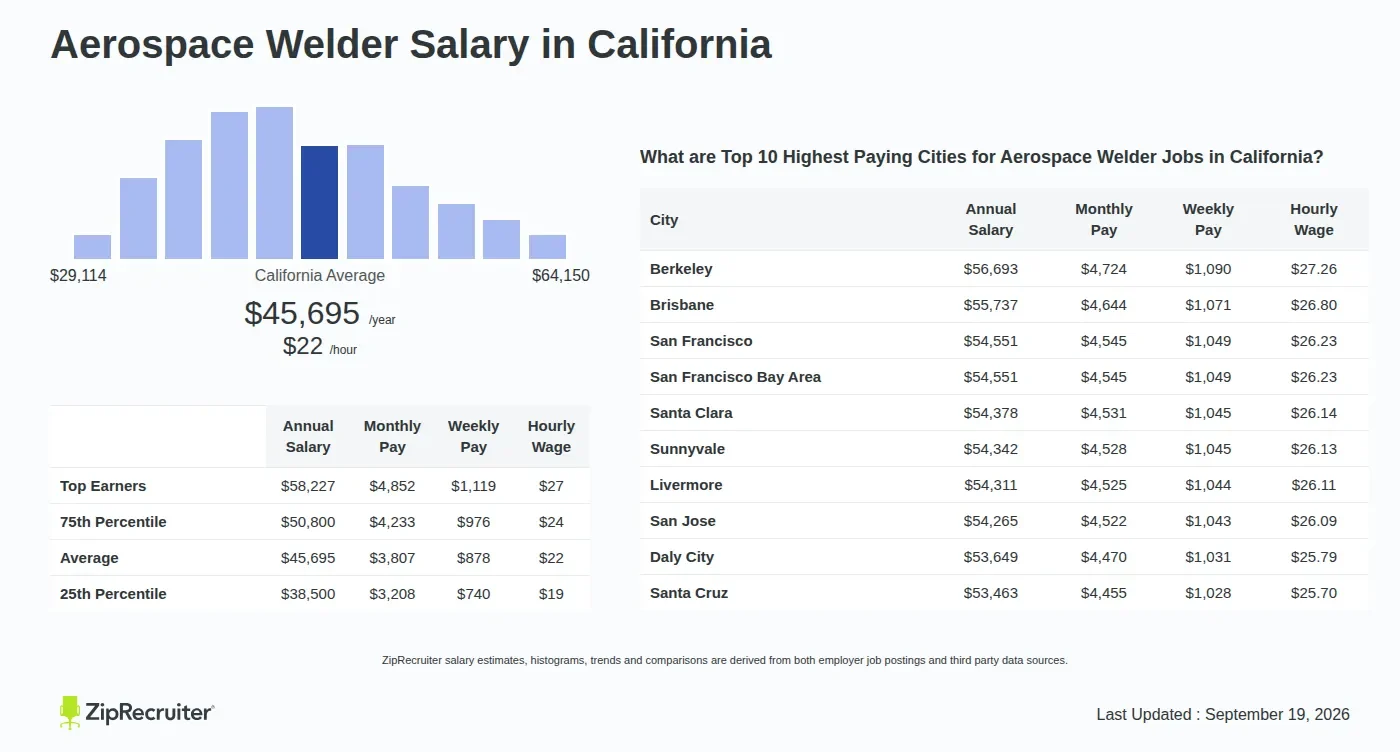
Geography affects wages because aerospace employers compete within local labor markets. Areas with aircraft manufacturing, defense production, space companies, engine plants, or major maintenance operations may offer more specialized positions. They may also have higher housing and transportation costs, so a larger paycheck does not automatically provide better purchasing power.
Employer type matters as well A large aerospace manufacturer may provide structured progression strong benefits and training but use formal pay bands A small precision shop may pay.

- Compare purchasing power: Look at rent, commuting costs, taxes, and insurance expenses—not salary alone.
- Ask about pay bands: A posted range may depend on an assessment, prior qualifications, or a formal skills matrix.
- Check stability: Contract-funded work can be lucrative but may depend on program awards, extensions, or customer demand.
- Identify the premium: Determine whether a higher rate reflects a permanent skill premium, a temporary shift, or difficult recruiting conditions.
Defense and security-sensitive work
Defense-related aerospace work can pay competitively because it may involve controlled information strict configuration management or a need for workers who can satisfy additional screening requirements A clearance.
Do not assume that a job requiring a clearance will automatically compensate you for the time or restrictions involved. Ask whether the company sponsors the process, whether the position is contingent on approval, and whether the quoted wage begins before or after access is granted.
Union, nonunion, and contractor differences
Union environments may use transparent wage steps defined classifications shift rules and negotiated benefits A nonunion employer may have more discretion to reward individual skills but raises and.
Contract or temporary jobs can be useful for gaining aerospace experience, especially when they lead to direct employment. Before accepting one, confirm the assignment length, overtime rules, holiday treatment, insurance eligibility, conversion terms, and whether time worked counts toward seniority or pay progression.
Skills and Credentials That Can Raise Your Pay
There is no single credential that guarantees a high aerospace welder salary. Employers usually value a combination of demonstrated welding ability, relevant qualifications, production reliability, and the capacity to follow controlled procedures. A certificate helps most when it matches the work the company actually needs.
Training decisions should therefore begin with the target job not with a long list of credentials Review local postings and identify repeated requirements If employers consistently request thin-gauge.
- Master one valuable specialty: Become reliably employable in a demanding process before collecting unrelated introductory qualifications.
- Expand deliberately: Add materials, positions, or equipment that appear repeatedly in target aerospace postings.
- Learn the quality system: Drawing interpretation, traceability, controlled documentation, and defect prevention can separate applicants.
- Protect qualification status: Follow employer rules for continuity, retesting, and maintaining process authorization.
Certifications and qualification records
Welding certifications and employer-specific qualifications are not interchangeable. A general credential may show technical preparation, while an employer qualification confirms that you can meet a particular procedure under defined conditions. Some aerospace work also requires qualification testing tied to a procedure, material, thickness, position, or equipment setup.
This is an important consideration for aerospace welder salary.
Keep copies of credentials and qualification information that you are legally allowed to retain. Record the issuing organization, process, material, position, date, and any limitations. Never misrepresent a qualification or take confidential procedure information from a former employer.
Blueprints, GD&T, and digital production systems
Welders who can read engineering drawings and understand basic geometric dimensioning and tolerancing often communicate more effectively with engineering and inspection teams. They can recognize critical dimensions, datum references, weld symbols, and notes that affect sequence or preparation.
Digital travelers, manufacturing execution systems, barcode scanning, and electronic inspection records are increasingly common. Comfort with these systems can reduce errors and make it easier to move into senior technician, lead, or quality-support work.
What does not always pay off
Collecting credentials without practical application can produce a weak return. A course may be valuable for safety, fundamentals, or access to an entry-level role, but it will not replace the hand skills and defect-control experience required for difficult production work.
Likewise, chasing every process can dilute your profile. A focused combination—such as precision TIG plus difficult alloys, drawing interpretation, and inspection awareness—may be more persuasive than a résumé listing many processes with little depth.
Benefits, Overtime, and the Real Value of an Offer
Base pay is only one part of compensation. Health insurance premiums, deductibles, retirement contributions, paid holidays, vacation accrual, tuition assistance, tool allowances, bonuses, and employer-paid training can change the practical value of two offers with similar hourly rates.
Overtime deserves special attention because it can either improve earnings or disguise an understaffed operation Occasional overtime may be a useful opportunity mandatory extended shifts every week may.
- Base compensation: Confirm the hourly rate or salary, pay frequency, review schedule, and starting step.
- Premium pay: Ask about second- and third-shift differentials, weekend rates, holidays, call-in pay, and overtime calculation.
- Benefits cost: Compare employee premiums, deductibles, employer retirement contributions, and waiting periods.
- Schedule reality: Determine normal hours, mandatory overtime, shutdowns, and how often shifts change.
A simple comparison method
Start with guaranteed annual base pay. Then estimate realistic overtime separately rather than treating it as guaranteed income. Add the employer’s retirement contribution and a reasonable value for paid leave, but avoid assigning full value to benefits you would not use.
For example an hourly job may have a lower base but strong health coverage and consistent overtime A salaried job may offer more predictable hours and paid time.
Warning signs in compensation discussions
Be cautious when an employer emphasizes an impressive “potential” income without explaining the base rate, overtime assumptions, or eligibility rules. Also ask why the position is open, how long employees typically stay, and whether the wage is tied to a temporary customer program.
Another warning sign is a promise that pay will rise quickly after hiring without a written review process. A clear skills matrix, qualification schedule, or probationary wage agreement is easier to evaluate than an informal assurance.
How to Improve Your Earning Potential
The most effective strategy is to connect your next skill to a real labor-market need. If your current employer has a shortage of qualified TIG welders, difficult-material experience, or trained leads, volunteering for relevant work may create a stronger path than pursuing a credential unrelated to available assignments.
Use performance evidence when discussing advancement. A manager may not remember every difficult assembly you completed, but a concise record of qualifications, training contributions, reduced rework, or dependable attendance gives the discussion something concrete to address.
- Ask for a skills map: Learn exactly what separates each pay grade and which qualifications are recognized.
- Choose visible assignments: Seek work that demonstrates precision, problem-solving, or cross-functional value.
- Build inspection trust: Preventing repeat defects can be more valuable than simply welding faster.
- Review annually: Compare your current capabilities with local job postings and update your target accordingly.
Negotiating a first offer
Research comparable local positions, then explain why your experience fits the upper part of the employer’s range. Mention specific processes, materials, positions, documentation systems, and production responsibilities rather than making a general claim that you deserve more.
If the base rate cannot move, negotiate other terms where possible: a higher starting step after qualification, a scheduled wage review, a shift premium, paid training, relocation assistance, or additional leave. Get important commitments in writing before relying on them.
Moving from welder to lead or technician
Career growth may involve becoming a lead welder, welding technician, inspector, trainer, manufacturing technician, or supervisor. These roles can increase pay, but they may reduce hands-on welding and add responsibility for schedules, documentation, troubleshooting, or personnel.
Before pursuing promotion, decide whether you want technical depth or people leadership. A senior specialist may earn well by remaining highly skilled, while a supervisor may gain broader authority but spend less time at the workstation. The better route depends on your strengths and preferred workday.
Common Mistakes When Estimating Aerospace Welder Salary
Job seekers often compare their current wage with a national average and assume the difference represents a realistic raise. That approach ignores local housing costs, the employer’s process mix, shift requirements, and whether the new job expects qualifications the applicant does not yet have.
Another mistake is treating a job title as proof of technical level. “Aerospace welder” can describe an entry-level production position, a highly specialized repair role, or a hybrid job involving setup and inspection support. Read the duties and qualification requirements carefully.
- Counting overtime as guaranteed: Base your essential budget on dependable wages, not the employer’s best-case projection.
- Ignoring commute costs: A higher rate can disappear through fuel, parking, relocation, or unpaid travel time.
- Overvaluing a title: Compare process, material, responsibility, and pay grade instead of labels.
- Forgetting fatigue: A demanding schedule may affect health, attendance, and long-term employability.
How to read a job posting critically
Look for verbs that reveal the real job: weld, fit, set up, inspect, document, troubleshoot, train, repair, or program. A posting requiring several of these may justify a higher target than one limited to repetitive welding, but only if the employer’s pay structure recognizes the broader duties.
Check whether required experience is firm or preferred. If the company lists a difficult process as preferred rather than required, you may still be competitive by showing adjacent skills and a credible training plan.
FAQ: Aerospace Welder Salary Questions
What is a good starting salary for an aerospace welder?
A reasonable starting target may fall around the upper $30,000s to low $50,000s, depending on location, previous welding experience, process ability, and the employer’s training structure. A candidate with strong TIG fundamentals or relevant production experience may start higher.
Evaluate the complete package, especially paid training, qualification increases, benefits, and overtime rules. A slightly lower starting rate can be worthwhile if the employer provides a clear path to higher pay.
Can an aerospace welder make over $80,000?
Yes. Experienced specialists may exceed $80,000 through a strong base rate, overtime, shift premiums, difficult-material work, lead responsibilities, or a high-cost labor market. However, the amount may represent total annual earnings rather than guaranteed base pay.
Ask how many hours are required to reach the advertised figure. A high total built on extensive overtime should not be compared directly with a similar base salary earned on a standard schedule.
Does TIG welding lead to a higher aerospace welder salary?
TIG can support higher pay when it is used for demanding aerospace work involving thin materials, tubing, difficult alloys, tight tolerances, or complex repairs. TIG alone is not a guarantee because pay also depends on quality, production needs, inspection requirements, and location.
The strongest profile combines controlled TIG technique with drawing literacy, material knowledge, documentation accuracy, and the ability to pass employer-specific qualifications.
Do aerospace welders get paid hourly or by salary?
Both arrangements exist, although hourly pay is common in production environments because overtime and shift premiums are easier to apply. Salaried roles may be more common for technicians, leads, supervisors, or positions with broader process responsibilities.
Compare the effective hourly value of each offer. Include normal work hours, expected overtime, paid leave, benefits, and whether the role receives additional compensation for extended schedules.
Does location make a major difference in pay?
Yes. Regions with concentrated aircraft, defense, space, engine, or maintenance operations may have more specialized jobs and stronger competition for qualified workers. They may also have higher living costs.
Compare local offers using purchasing power rather than the wage alone. A lower nominal salary in an affordable area can provide more usable income than a higher salary in an expensive market.
Are certifications required for aerospace welding jobs?
Requirements vary by employer, process, material, and product. Some companies hire entry-level workers and qualify them internally, while others require prior certifications or documented experience before allowing production work.
Ask which qualifications are required at hiring, which are completed after hire, who pays for testing, and whether failed or expired qualifications affect pay or continued employment.
What should I ask before accepting an aerospace welding offer?
Ask about base pay, shift, overtime, mandatory hours, pay reviews, qualification increases, benefits, schedule stability, layoff risk, and the exact processes and materials involved. Also confirm whether the position is direct hire, contract, temporary-to-hire, or tied to a particular program.
These questions reveal whether the advertised compensation reflects dependable income or a best-case scenario. They also help you compare the offer with your long-term skill and career goals.
Conclusion
A realistic aerospace welder salary depends on more than a national average Process specialization difficult materials quality performance documentation location schedule employer type and benefits all shape the.
Use published ranges as a starting point, then evaluate the actual job through guaranteed base pay, likely overtime, qualifications, living costs, and career progression. Do not overlook fatigue, safety practices, or the possibility that a high advertised total depends on unsustainable hours.
Before your next interview, write down your qualified processes, materials, inspection-related skills, target base rate, and minimum acceptable schedule so you can compare offers on evidence rather than title alone.