Industrial Pipe Welder Salary: Key Facts and Helpful Guidance
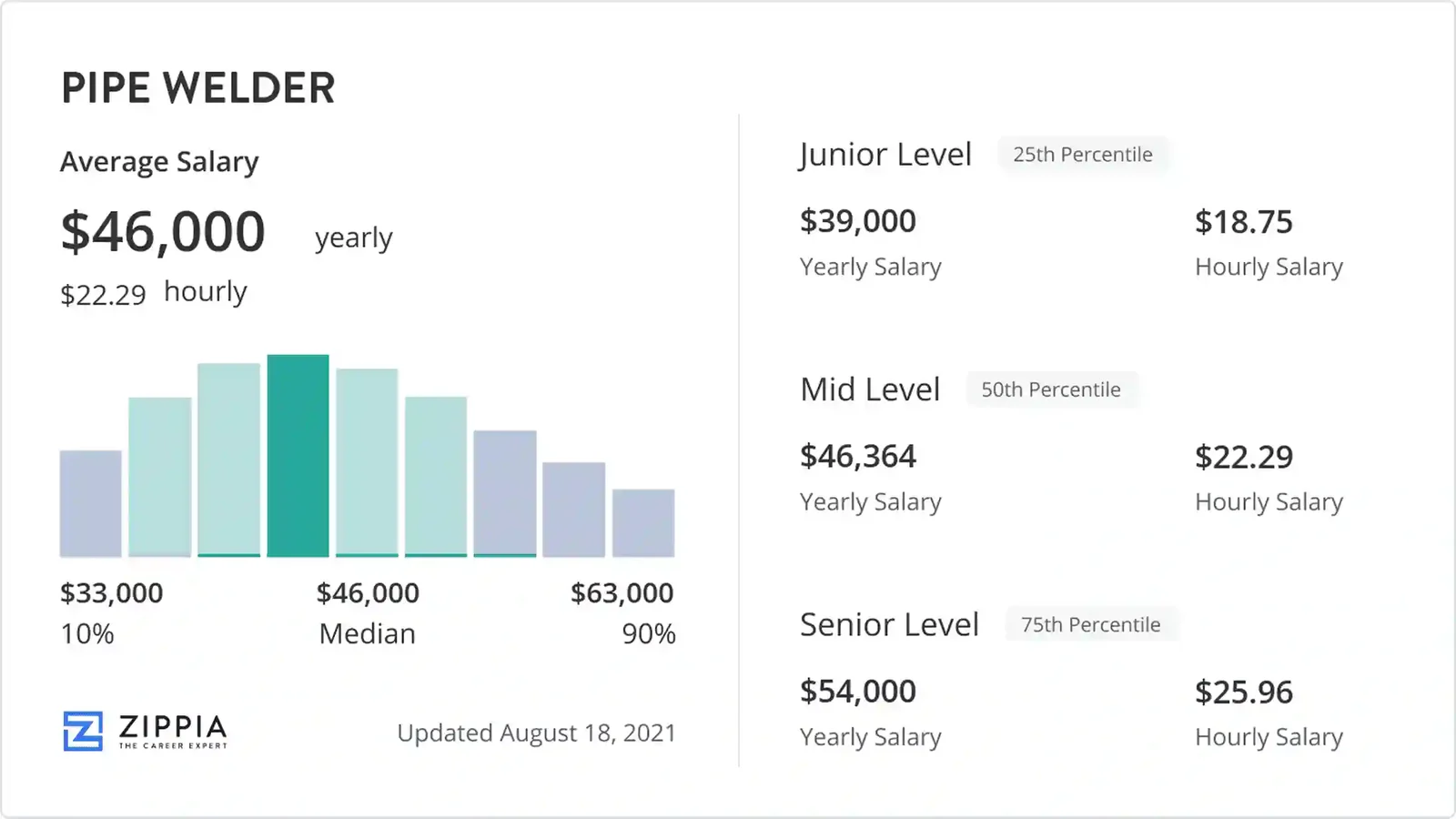
Industrial pipe welders commonly earn about $45,000 to $90,000 annually, while highly skilled, traveling, or union welders may earn more.
Industrial pipe welding can pay substantially more than entry-level welding because the work demands precise joints difficult positions code compliance and dependable performance around high-pressure systems A new.
Several factors separate a normal paycheck from a genuinely attractive offer Location overtime per diem union status process certifications shutdown work travel benefits and whether the posted figure. This guide explains industrial pipe welder salary, including the practical details and important limitations.
This guide explains the industrial pipe welder salary range how employers calculate total compensation which skills raise earning power and how to evaluate job advertisements without being misled.
- ✓Pay is driven by experience, pipe size and material, welding process, certifications, location, and job conditions.
- ✓Overtime, per diem, travel allowances, and benefits can make total compensation very different from base wages.
- ✓Proven ability to pass a practical weld test often matters more than a long list of general certificates.
- ✓Shutdown and traveling work may pay more, but the schedule, continuity, and personal costs require careful review.
What an Industrial Pipe Welder Salary Usually Looks
There is no single national wage for industrial pipe welding. Employers may advertise an hourly rate, an annual estimate, a project rate, or a package that combines wages with overtime and allowances. Those figures are not interchangeable, so the first task is identifying what the number actually represents.
In broad terms entry-level workers and recently qualified welders may earn around the general welding market s lower-to-middle range Experienced pipe welders who can work independently often move.
- Starting level: Helpers, apprentices, and welders building pipe experience usually earn less while they develop fit-up, blueprint, and testing skills.
- Working journeyman: A welder who passes common pipe tests and works independently generally has stronger bargaining power.
- Premium assignments: Travel, night shifts, shutdowns, hazardous environments, and difficult alloys can increase gross earnings.
- Annual uncertainty: A high hourly rate does not guarantee a high yearly income if projects are short or gaps between jobs are common.
Hourly pay and annual pay are different measurements
Suppose a company offers $35 per hour. At 40 hours per week for 52 weeks, the simple gross calculation is $72,800 before taxes. That calculation assumes steady work and excludes overtime, unpaid travel, holidays, layoffs, and time between projects.
Construction and maintenance jobs frequently do not follow that ideal schedule.
Overtime can change the result quickly. Ten extra hours each week at time-and-a-half can add a substantial amount over a long project, but it also means more fatigue and less recovery time. Annualizing overtime that an employer describes as “available” rather than guaranteed is a common mistake.
Why advertised ranges can be difficult to compare
One posting may list base wage only, while another includes a completion bonus, per diem, lodging, or expected overtime. A union package may show a wage rate separately from health coverage, pension contributions, and other benefits. Comparing only the largest number can produce a misleading conclusion.
For a useful comparison, record the base hourly wage, expected weekly hours, overtime rule, duration of the project, paid travel time, per diem terms, benefits, and likely downtime. Then estimate gross pay under a normal week rather than relying on the best-case schedule.
How Experience and Welding Skill Increase Pay
Pipe welding is not simply a matter of producing a visually acceptable bead The welder must understand joint preparation fit-up root control heat input distortion purge requirements inspection expectations and the consequences of defects inside a pressurized system As those abilities become reliable an employer usually needs less supervision and faces.
That progression explains why the industrial pipe welder salary can rise sharply after a worker proves consistent performance. Employers pay for reduced risk, production speed, fewer repairs, and the ability to handle difficult assignments—not merely for years since the worker first held a torch.
- Independent fit-up: Reading drawings and correcting alignment problems makes a welder more useful before the arc even starts.
- Root-pass control: Reliable penetration and internal profile are essential where radiographic or ultrasonic inspection is required.
- Material knowledge: Carbon steel, stainless steel, chrome-moly, nickel alloys, and other materials demand different procedures and discipline.
- Low repair rates: Passing tests and producing sound welds repeatedly can support a higher rate than a broad but unproven résumé.
Entry-level, intermediate, and senior expectations
An entry-level worker may assist with staging, cleaning, grinding, and basic welds under close direction. The next stage usually involves passing one or more practical tests, interpreting welding procedures, and completing routine joints without constant correction.
A senior pipe welder is often expected to manage awkward positions, tight access, changing site conditions, and demanding inspection requirements. Some also help with fitters, identify problems before welding, coach less experienced workers, and communicate effectively with inspectors and supervisors.
Processes and positions that can affect compensation
Employers commonly value combinations of GTAW/TIG for precise roots and stainless or alloy work, along with SMAW/stick or other processes for fill and cap passes. The valuable combination depends on the facility, procedure, material, and production method.
Position qualification matters too. A worker who can weld pipe in difficult fixed positions has a broader job market than someone limited to easy shop work. However, a certificate by itself is not proof of current ability; many employers still require a site-specific test before hiring.
Certifications, Weld Tests, and Qualifications
Pipe welding credentials can improve access to work, but their value depends on whether they match the jobs available in the target region. A qualification connected to a recognized welding procedure may help an applicant reach the interview stage, while a successful practical test often determines whether the employer makes an offer.
Requirements vary by employer, contractor, project specification, and governing code. Some jobs emphasize a particular process and material combination, while others require safety training, documented experience, blueprint reading, or the ability to work under a qualified welding procedure.
- Match the process: Confirm whether the job needs TIG, stick, flux-cored, submerged arc, or a specific combination.
- Match the material: A carbon-steel qualification may not demonstrate ability with stainless, chrome-moly, or nickel alloys.
- Check continuity: Ask how the employer documents ongoing work so a qualification remains useful.
- Prepare for testing: Practice the actual position, joint design, purge method, and acceptance expectations when possible.
Why a weld test may matter more than a certificate
A practical test gives the employer direct evidence of technique. It may reveal whether the applicant controls the root, maintains travel speed, avoids contamination, handles restarts, and produces a joint that can pass inspection.
This is also why two welders with similar résumés may receive different offers. One may have current experience on the exact material and position, while the other has more general experience but needs retraining for the project’s procedure.
Training investments that can pay off
Training is most valuable when it solves a specific hiring barrier. If local contractors need TIG pipe welders, a focused course and repeated practice may be more useful than collecting unrelated certificates. If the goal is industrial maintenance, blueprint reading, confined-space awareness, rigging knowledge, and inspection familiarity may broaden job options.
Before paying for a program, review local postings and call contractors about their tests. Compare tuition with likely wage improvement, the time away from paid work, consumable costs, and whether the training provides meaningful practice rather than only classroom instruction.
Location, Industry, and Work Setting
Geography strongly affects wages because employers must compete for labor, projects may have different technical demands, and living costs vary. Major industrial corridors, energy centers, shipyards, refineries, power facilities, and large construction markets may offer more opportunities than areas with little heavy industry.
Higher pay does not automatically mean higher purchasing power. Housing, transportation, food, taxes, and time away from home can consume much of a travel premium. A local job with steady hours and strong benefits may produce a better practical outcome than a distant assignment with a larger hourly figure.
- Local shop or plant: Often provides more predictable routines and lower travel costs, though the hourly rate may be moderate.
- Major construction project: May offer overtime and a defined completion period, with possible gaps afterward.
- Shutdown or turnaround: Can produce intense short-term earnings but commonly involves long days and uncertain future dates.
- Travel assignment: May include per diem and lodging, but the value depends on eligibility rules and actual out-of-pocket costs.
Industries that commonly hire pipe welders
Industrial pipe welders may work in chemical processing, petroleum refining, power generation, food and beverage plants, water treatment, manufacturing, shipbuilding, commercial mechanical construction, and industrial maintenance. Each sector has different materials, inspection practices, hazards, and schedules.
Power and process facilities may place heavy emphasis on procedure compliance and inspection documentation. Mechanical contractors may value productivity across varied job sites. Maintenance work can reward troubleshooting and quick adaptation because existing systems rarely provide ideal access.
This is an important consideration for industrial pipe welder salary.
Union and nonunion compensation
Union jobs may present compensation as a combination of wage and employer-paid benefits. Health coverage, retirement contributions, training resources, and standardized progression can be valuable even when the listed cash wage is not the highest available.
Nonunion employers may offer more flexibility, direct negotiation, bonuses, or rapid advancement. They may also differ widely in benefits and overtime practices. Evaluate the complete package rather than assuming either structure is always better.
Overtime, Travel, Per Diem, and Total Compensation
The most important question about a job offer is often not “What is the hourly rate?” but “What will I realistically receive for the time and costs involved?” Total compensation includes direct wages, overtime, bonuses, paid leave, insurance, retirement contributions, travel treatment, lodging, and allowances.
Per diem is generally intended to cover eligible travel-related expenses, not to function as ordinary wages. Its tax treatment and eligibility can depend on the arrangement and the worker’s circumstances, so do not treat every allowance as guaranteed take-home pay.
- Base rate: Confirm the ordinary hourly wage and whether it changes by shift, location, or classification.
- Overtime: Ask when premium pay begins and whether weekends, holidays, or sixth and seventh days are treated differently.
- Travel terms: Clarify mileage, flights, lodging, mobilization, demobilization, and paid or unpaid travel hours.
- Benefits: Assign a realistic value to insurance, retirement, paid time off, tool allowances, and training.
A simple way to compare two offers
Start with expected gross base wages for a normal week. Add only overtime that the project manager can reasonably support, then add guaranteed bonuses and employer-paid benefits. Keep per diem separate because it may offset living costs rather than increase disposable income.
For example, an offer with a lower wage but year-round work may outperform a high-rate shutdown job if the shutdown lasts only six weeks and requires several unpaid weeks afterward. Conversely, a worker with low living costs and a planned rotation may reasonably value the short-term premium more highly.
Questions that reveal the real schedule
Ask how many hours were worked by people in the same role during the previous comparable project. Find out whether the project has a firm end date, whether extensions are common, and how workers are selected for the next assignment.
Also ask about breaks, shift length, weather delays, site access, drug-screen requirements, tools, transportation, and the time between hiring and the first paid shift. These details can materially change the value of an offer.
Risks, Working Conditions, and Career Sustainability
Industrial pipe welding can involve heat, fumes, noise, awkward posture, heavy components, elevated work, confined spaces, energized equipment, and exposure to hazardous industrial environments. A higher wage may reflect greater responsibility or unpleasant conditions, but money does not remove the need for proper controls and training.
Workers should understand the site’s safety program, required protective equipment, ventilation, respiratory protection rules, lockout procedures, fall protection, and emergency arrangements before beginning. Never improvise around a pressurized, energized, or contaminated system.
- Red flag: A recruiter pressures you to begin without clear site orientation, required protective equipment, or a defined safety process.
- Normal variation: Hot work, shift rotations, testing, and protective equipment requirements are common in industrial settings when properly managed.
- Health protection: Follow ventilation, exposure-control, hearing, eye, respiratory, and hygiene requirements for the specific work.
- Fatigue control: Long overtime stretches can increase mistakes, so ask how rest and shift changes are handled.
Physical demands and long-term planning
Pipe welding often requires kneeling, crouching, reaching, climbing, lifting, and holding controlled positions for extended periods. Conditioning, proper lifting technique, sensible recovery, and attention to early discomfort can help support a longer career.
Career sustainability also includes financial planning. Project work may produce excellent months followed by slower periods, so budgeting around guaranteed income rather than peak overtime can reduce pressure to accept unsafe or unsuitable assignments.
How to Increase Your Earning Potential
The strongest pay strategy is usually a combination of technical reliability and professional dependability. Employers want welders who pass tests, protect quality, arrive prepared, follow procedures, and communicate problems before they become expensive repairs.
Build a record of the materials, processes, positions, pipe sizes, and environments you have actually worked on. Specific documentation is more persuasive than vague claims such as “experienced in all welding.”
- Track your work: Keep lawful, accurate records of procedures, materials, positions, project types, and completed training.
- Practice deliberately: Spend time on the root and difficult positions that employers use in qualification tests.
- Protect quality: Cleanliness, fit-up awareness, correct settings, and controlled technique reduce costly repairs.
- Develop adjacent skills: Blueprint reading, layout, rigging awareness, inspection basics, and leadership can expand your options.
Choose specialization strategically
Specialization can improve pay when it aligns with real demand. Stainless and alloy work, high-purity piping, power work, critical-service welding, and difficult field repairs may offer premiums, but they also require stricter procedure control and testing.
Do not pursue a specialty solely because it sounds prestigious. Confirm that employers in your preferred location hire for it, that training facilities can provide relevant practice, and that you are prepared for the associated schedule and safety requirements.
Build a reputation employers remember
Reliability is a technical advantage in project work. Showing up prepared, maintaining tools, following the qualified procedure, recording concerns, and treating fitters, inspectors, and other trades professionally can lead to referrals and repeat assignments.
Negotiation is easier when you can explain the value you bring. Instead of asking only for more money, connect your request to current qualifications, difficult materials, low repair performance, leadership duties, travel flexibility, or the ability to start quickly.
Common Mistakes When Evaluating Pay
Many workers compare wage numbers without checking the assumptions behind them. This can lead to accepting a job that pays less than expected or declining a package that is stronger after benefits and reliable hours are included.
The best comparison is specific, written, and based on a realistic schedule. If a recruiter cannot clearly explain pay, overtime, project duration, or travel terms, treat that uncertainty as part of the risk.
- Annualizing maximum overtime: Use a normal expected schedule first, then model overtime as a separate scenario.
- Ignoring downtime: Include likely gaps between projects when estimating yearly income.
- Counting per diem as profit: Subtract the legitimate travel costs it is meant to cover.
- Overvaluing certificates: A current, relevant test result may matter more than unrelated credentials.
FAQ About Industrial Pipe Welder Salary
What is a good industrial pipe welder salary?
A good salary depends on the area, schedule, benefits, and skill level. For many workers, a strong offer combines a competitive base rate with steady hours, fair overtime, useful benefits, and reasonable travel terms rather than simply advertising the highest hourly number.
Can an industrial pipe welder make six figures?
Yes, some experienced welders reach six-figure gross earnings during strong years, especially with substantial overtime, travel, shutdowns, specialized work, or union packages. It is not guaranteed, and the total may depend on long hours, temporary projects, and time away from home.
Does TIG pipe welding pay more than general welding?
It can, particularly when TIG work involves stainless steel, alloys, high-purity systems, critical-service joints, or demanding qualification tests. The premium depends on verified skill and local demand; simply listing TIG on a résumé does not guarantee higher pay.
Do certifications guarantee a higher wage?
No. Certifications can help qualify you for interviews and specific jobs, but employers also consider current experience, practical test results, productivity, inspection performance, and reliability. A relevant qualification is generally more useful than a long list of unrelated certificates.
Is travel work worth it for a pipe welder?
Travel work may be worthwhile when the wage, overtime, lodging, per diem, project duration, and rotation make sense for your circumstances. Compare the after-expense result with a local job and ask what happens when the project ends.
How much experience is needed to earn top pay?
There is no universal year threshold. Employers usually pay more when a welder can independently pass the required test, work difficult positions and materials, maintain quality under production pressure, and handle site expectations with limited supervision.
Should I accept a job with a high hourly rate but no benefits?
Only after assigning a realistic cost to health insurance, retirement savings, unpaid leave, tools, travel, and downtime. A higher cash rate may be attractive, but it should compensate for the benefits and stability you would otherwise receive.
Conclusion
Industrial pipe welder salary levels vary because the work itself varies. Experience, weld-test performance, process and material knowledge, location, overtime, travel, union structure, benefits, and project continuity all influence the final result. The safest comparison separates guaranteed base pay from uncertain overtime and allowances.
Higher-paying assignments can be worthwhile, but they should still provide clear safety expectations, lawful working conditions, and enough information to judge the real annual value. Use the offer details—not the headline number—to decide whether the opportunity supports your income, skills, and long-term career.
Write down the base rate, expected hours, overtime terms, benefits, travel costs, and project duration for every offer, then compare realistic yearly totals before negotiating.