Best Welding Training: Top Options and Practical Buying Advice
A new welder can spend hours practicing a bead that looks acceptable on the surface but has poor penetration inconsistent travel speed or hidden porosity That gap between.
The Best welding training depends on the process, material, job goal, schedule, and amount of supervised practice available. A hobbyist learning basic repairs needs a different path from someone preparing for a structural, pipe, manufacturing, or maintenance career.
I’ll compare the main training options, explain what a strong program should teach, show how to evaluate schools and online courses, and identify the mistakes that can waste money or delay certification.
What Makes Welding Training the Best Choice?
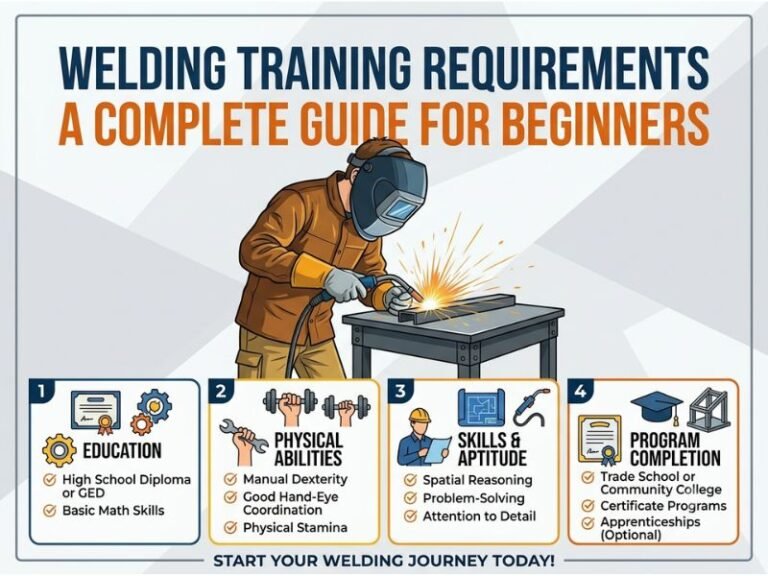
The best program is not necessarily the most expensive school or the course with the most impressive marketing. It is the option that gives you appropriate hands-on practice, qualified instruction, useful feedback, and a realistic path toward your intended work.
A high-quality welding program usually includes these elements:
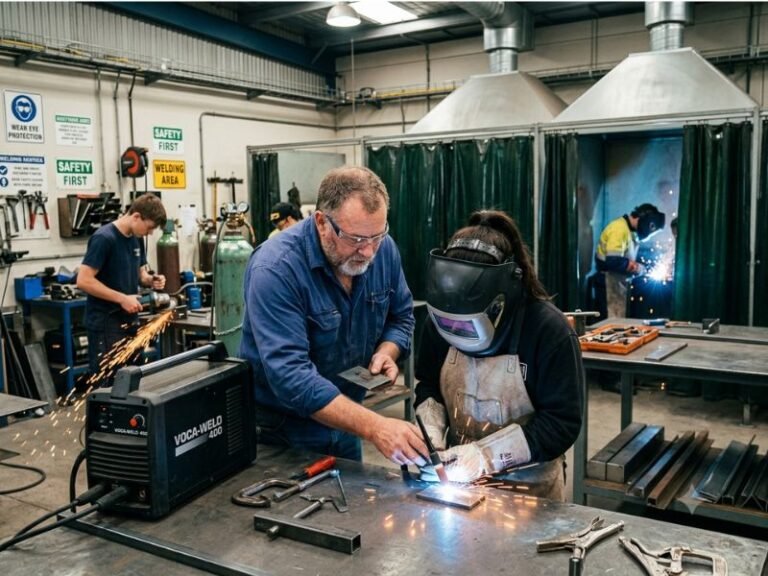
- Hands-on arc time: You need repeated practice with a real welding machine, workpieces, consumables, and position changes.
- Instructor correction: A skilled instructor should identify problems with angle, travel speed, amperage, fit-up, and preparation before poor habits become automatic.
- Process coverage: Training should match the processes used in your target work, such as SMAW, GMAW, GTAW, or FCAW.
- Safety instruction: Ventilation, fire prevention, electrical safety, compressed-gas handling, eye protection, and respiratory risks deserve more than a brief orientation.
- Inspection and measurement: Students should learn how weld quality is evaluated, not just how to make a bead look attractive.
- A clear outcome: The course should state whether it prepares students for entry-level employment, a performance qualification test, continuing education, or personal projects.
I would judge a program by the quality of its practice and feedback before judging it by its certificate A printed completion certificate may show attendance while a recognized.
Choose Training Based on Your Welding Goal
Before comparing schools, define the work you want to perform. Welding is a broad trade, and the right starting point varies significantly by application.
Hobby and home-shop welding
For occasional repairs, artwork, brackets, gates, or equipment projects, a short supervised class can be a sensible starting point. Look for basic instruction in machine setup, joint preparation, material identification, weld defects, and safe shop practices.
A beginner does not need to master every process immediately An introductory course may focus on stick welding or MIG welding depending on the local school s equipment.
Entry-level welding employment
Someone seeking a first welding job should look for a program with substantial shop time and exposure to multiple joint types and positions. Employers may value practical ability, reliability, blueprint comprehension, measurement skills, and safety awareness alongside a certificate.
Career-focused programs may also include fabrication math, symbols, shop communication, material handling, basic cutting, grinding, and workplace expectations. Ask whether the program has relationships with local employers or provides realistic job-placement information. Placement claims should be specific and verifiable rather than vague promises.
Structural steel and fabrication
Structural work often requires accurate fit-up, position welding, process control, and familiarity with applicable codes and inspection practices. Training should include fillet and groove welds, distortion control, joint preparation, preheat concepts when relevant, and reading fabrication drawings.
A general beginner class can provide a foundation, but it may not prepare a student for a particular employer’s qualification test or structural standard. Confirm the exact requirements before assuming a course leads directly to a job qualification.
Pipe welding
Pipe welding demands more specialized practice because joint geometry, access, position, and consistency create challenges that flat-plate practice cannot fully reproduce. A serious pipe course should provide practice on the pipe diameters, wall thicknesses, positions, and processes relevant to the intended work.
Pipe training is usually more effective after a student has basic control of the selected process. A rushed transition into advanced pipe positions can produce frustration and expensive practice time without solving fundamental technique problems.
Maintenance and field repair
Maintenance welders often work with unknown materials, awkward access, contamination, time pressure, and equipment that cannot easily be moved into a controlled shop. Training should therefore include preparation, troubleshooting, repair planning, safe isolation of equipment, and techniques for dealing with variable conditions.
Compare the Main Welding Training Formats
Community college programs
Community colleges commonly offer introductory classes, certificate programs, and longer technical pathways. Their advantages can include structured curricula, welding booths, multiple processes, safety systems, and access to instructors with industry experience.
The main limitation is scheduling A semester-based program may be too slow for a worker who needs a specific skill quickly while a short class may not provide.
Trade schools and private welding schools
Private trade schools may offer intensive schedules and a direct career focus. Some are designed for students who want concentrated practice in a short period. Others combine welding with fabrication, industrial maintenance, or construction skills.
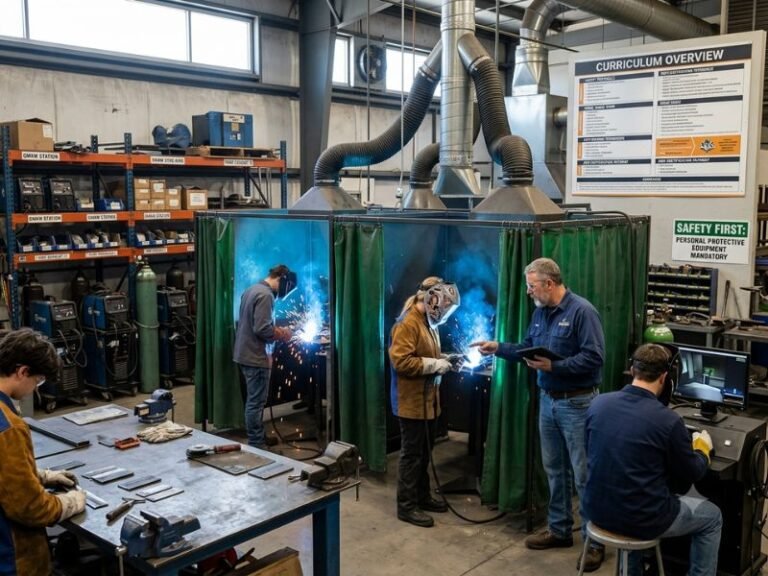
Compare total tuition, tool costs, protective equipment, consumables, testing fees, and any additional charges. I would also ask how many students share each booth, how often machines are available, and how much time instructors spend observing individual work.
Apprenticeships and employer training
An apprenticeship or employer-sponsored pathway can combine paid work with classroom instruction. This format is valuable because students learn production expectations, jobsite conduct, material handling, and the realities of a welding workplace.
Availability varies by region and industry. Some opportunities may focus on a narrow process or employer-specific procedure, so confirm whether the experience transfers to the type of work you eventually want.
Short workshops and continuing education
Short courses work well for targeted skills, such as introductory TIG, aluminum welding, blueprint reading, or preparation for a specific test. They are less suitable when a complete beginner expects to become job-ready after only a few sessions.
A workshop can be an efficient supplement to previous training. It is rarely a substitute for repeated practice when the student has never safely set up and operated the equipment.
Online welding courses
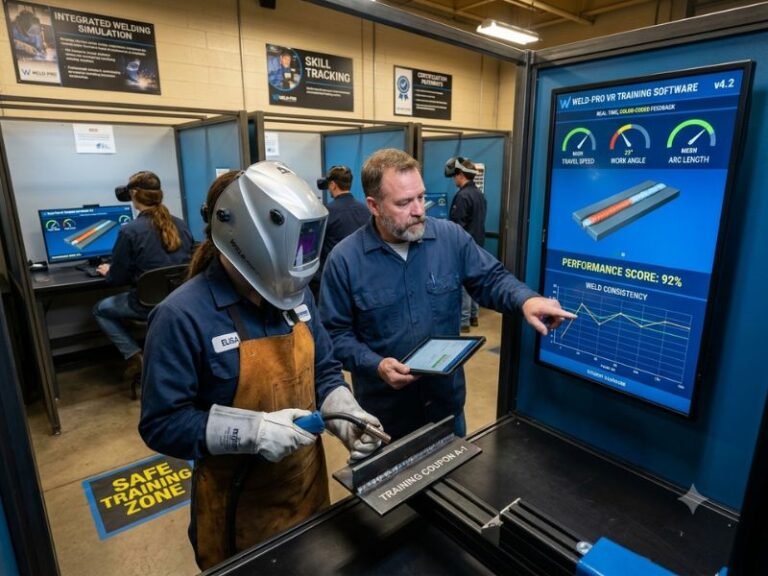
Online instruction can explain terminology, joint design, welding symbols, machine controls, metallurgy, safety, and defect identification. Video demonstrations are also useful for showing torch movement and process fundamentals.
The limitation is direct: an online course cannot physically correct your hand position, arc length, travel speed, or work angle. It also cannot verify that your weld meets a visual or performance standard unless an appropriate in-person assessment is included.
I recommend using online training for theory, review, or preparation, then adding supervised lab practice. Be cautious when a course implies that watching videos alone qualifies someone for industrial welding work.
Understand the Core Welding Processes
Training should explain not only how a process works, but also where it is useful and what trade-offs it creates.
SMAW or stick welding
Shielded metal arc welding (SMAW) uses a flux-coated electrode and is valued for portability and versatility. It can be useful outdoors and on heavier materials, but beginners must learn electrode selection, arc length, rod angle, slag removal, and control of starts and stops.
Stick welding produces slag that must be removed between passes. Poor cleaning can hide defects or contaminate later welds. A course should teach students to inspect the joint after cleaning instead of assuming a covered bead is sound.
GMAW or MIG welding
Gas metal arc welding (GMAW), commonly called MIG, uses a continuously fed wire and shielding gas or a related flux-cored setup. It is widely used in fabrication and can be approachable for beginners because there is no electrode stub to manage.
Training should cover wire size, voltage, wire-feed speed, gas flow, polarity, gun angle, stickout, contact-tip condition, and adjustment for material thickness. A machine with incorrect settings can produce an attractive but weak weld, so students need to learn how to connect appearance with process control.
GTAW or TIG welding
Gas tungsten arc welding (GTAW), commonly called TIG, offers precise control and clean welds but requires coordination between the torch, filler metal, travel speed, and sometimes a foot pedal. It is used on materials and applications where control and appearance matter.
TIG training generally requires patience. A short introductory session may demonstrate the process, but consistent skill usually requires substantial practice in cleanliness, arc length, tungsten preparation, shielding, and heat management.
FCAW and specialized processes
Flux-cored arc welding (FCAW) can be productive for fabrication and certain field applications. Different wire types and shielding arrangements create different operating requirements, so the course should make those distinctions clear.
Plasma cutting, oxyfuel cutting, brazing, and welding automation may be useful related skills. They should support the student’s main objective rather than distract from basic welding control.
What a Strong Curriculum Should Include
A useful curriculum balances practical operation with the knowledge needed to make safe and repeatable decisions.
Safety and shop practice
Students should learn how welding fumes, ultraviolet radiation, hot metal, sparks, noise, cylinders, electricity, and fire hazards are controlled. Proper clothing, a suitable helmet, gloves, eye protection, hearing protection, ventilation, and safe work positioning should be routine rather than optional reminders.
Training should also address coated, painted, galvanized, oily, or previously used materials. Welding on containers or equipment that held flammable substances can create severe hazards. A responsible instructor should teach students to stop and verify conditions rather than improvise.
Joint preparation and fit-up
Many welding problems begin before the arc starts. Students should practice cleaning, cutting, beveling, aligning, tacking, controlling root openings, and checking dimensions. Poor fit-up can force excessive heat, create incomplete fusion, increase distortion, or make a sound weld impossible.
Settings and technique
Students should learn how to select process parameters from reliable procedures and then recognize when conditions require adjustment. Technique includes travel speed, work angle, travel angle, arc length, electrode manipulation, interpass cleaning, and sequence.
A good instructor explains the reason behind each adjustment. “Turn the machine up” is less useful than explaining how insufficient heat, excessive travel speed, or a poor joint design affects fusion and bead shape.
Inspection and defects
Training should cover common defects such as porosity, undercut, overlap, cracks, lack of fusion, incomplete penetration, excessive reinforcement, and inclusions. Students need to understand likely causes and corrective actions.
Visual inspection is important, but it has limits. A weld can look smooth and still contain internal problems. Depending on the job, quality may be evaluated through bend testing, fillet-break testing, radiographic testing, ultrasonic testing, or other methods performed under appropriate procedures.
Blueprints and welding symbols
Entry-level welders benefit from learning dimensions, tolerances, views, material callouts, joint details, and common welding symbols. Blueprint literacy helps a welder understand what must be made, where the weld goes, and which details require clarification before fabrication begins.
Credentials, Certifications, and Qualification Tests
These terms are often used loosely but they describe different outcomes A school certificate may confirm completion of a course A certification may refer to a credential issued.
In the United States, employers may reference standards and programs associated with organizations such as the American Welding Society, but requirements differ by employer, industry, project, and governing code. A general training certificate does not automatically qualify someone for every welding job.
Ask these questions before enrolling:
- Which credential or test does the program actually provide?
- Who administers the test and evaluates the results?
- What process, position, material, thickness, and joint type does the test cover?
- Are testing fees included in tuition?
- Does the credential have renewal, continuity, or employer-specific requirements?
- Do local employers recognize the outcome?
I would avoid treating a logo, badge, or “certified welder” phrase as proof of broad ability. The value of a credential depends on its issuing body, scope, documentation, and relevance to the job being pursued.
How to Evaluate a Welding School
A tour or phone call can reveal more than a polished website. Ask to see the lab, equipment, student work areas, safety controls, and current course schedule if the school permits visitors.
Questions about practice time
- How many lab hours are included?
- How many students share each welding booth?
- Can students practice outside scheduled class time?
- Are machines available for the process I need?
- Who pays for metal, wire, electrodes, gas, and test coupons?
Questions about instruction
- What industry and teaching experience do instructors have?
- How is student work evaluated?
- How quickly do students receive corrections?
- Does the instructor demonstrate multiple ways to solve a problem?
- What happens if a student struggles with a particular process?
Questions about outcomes
- What jobs do graduates commonly pursue?
- Can the school provide current completion and placement information?
- Are interviews, internships, or employer introductions available?
- Does the curriculum match local hiring requirements?
- What additional training do graduates usually need?
Watch for vague answers, overcrowded labs, broken equipment, limited consumables, and pressure to sign a contract immediately. A strong school should be able to explain its curriculum and costs without guaranteeing a specific salary or job.
Budget for the Full Cost of Training
Tuition is only one part of the budget. Depending on the program, additional expenses may include a welding helmet, jacket, gloves, boots, safety glasses, hearing protection, respirator-related equipment where appropriate, hand tools, textbooks, transportation, and testing.
Some schools provide shared equipment while others expect students to bring personal tools. Ask whether equipment remains available after class and whether consumables are included or billed separately. A low advertised price may not be low after fees and required purchases are added.
Time is another cost. An intensive program may reduce the time available for work, while evening classes may extend the training period. I would compare the total cost against the specific skill or credential gained, not against the sticker price alone.
Common Mistakes to Avoid
Choosing a course by title alone
“Professional welding,” “advanced fabrication,” and similar labels do not reveal the amount of lab time or the processes taught. Read the syllabus and ask for a weekly breakdown.
Ignoring the target employer
A course can be excellent and still be a poor fit for a particular job. Before enrolling, review local job listings and note requested processes, materials, shifts, drawings, certifications, and physical requirements.
Expecting one process to cover every job
MIG, stick, TIG, and flux-cored welding have different strengths. A student who learns only one process may be employable in some settings but unprepared for others. Start with the process most relevant to the goal, then expand strategically.
Practicing without feedback
Repetition helps only when the technique is reasonably correct. Practicing the same travel error for weeks can make correction harder. Even occasional expert feedback can prevent wasted material and time.
Focusing on appearance alone
A neat, shiny bead is not automatically a strong weld. Preparation, penetration, fusion, dimensions, procedure compliance, and inspection all matter. Training should teach students to evaluate the complete joint.
Buying equipment too early
New welders sometimes purchase a machine before understanding the process, power supply, duty cycle, material range, or accessories required. Renting shop time or using school equipment first can make later purchases more informed.
A Practical Decision Process
I suggest using this sequence to narrow the options:
- Define the outcome. Decide whether you want a hobby skill, entry-level job, employer qualification, process upgrade, or preparation for a specific test.
- Identify the required process. Review target job postings and ask employers which processes and materials matter most.
- Set a realistic schedule. Choose among evening, weekend, semester, intensive, apprenticeship, or online-plus-lab formats.
- Compare supervised lab time. Count actual practice hours, not total program hours that may include lectures or general education.
- Verify the credential. Confirm who issues it, what it covers, and whether employers recognize it.
- Calculate total costs. Include tools, protective equipment, consumables, travel, testing, and missed work.
- Inspect the learning environment. Look for safe ventilation, functioning equipment, adequate booth space, and accessible instructors.
- Choose the narrowest useful starting point. A focused course aligned with a real goal is often better than a broad program with little practice in the needed process.
FAQ About Best Welding Training
What is the best welding training for a complete beginner?
The best starting point is usually a supervised introductory course that teaches safety machine setup joint preparation basic positions and one or two relevant processes The course should.
Is a welding certificate worth it?
It can be worthwhile if the certificate represents meaningful instruction or supports a specific employer requirement Its value depends on the issuing organization course content hands-on hours and.
Can online welding training prepare me for a welding job?
Online training can prepare you for theory, terminology, safety concepts, symbols, and process knowledge. It cannot replace supervised practice or reliably prove that you can produce acceptable welds. For job preparation, combine online study with in-person lab work and an appropriate assessment.
Should I learn MIG, TIG, or stick welding first?
Choose based on your intended work MIG may provide a practical introduction to wire-feed fabrication stick can be useful for portable and heavier-work applications and TIG offers precise.
How much hands-on practice should welding training include?
There is no universal hour requirement that guarantees competence. More important factors include booth access, useful repetitions, instructor feedback, process relevance, and testing or inspection. Compare the actual lab schedule and student-to-machine ratio rather than relying on a course’s total advertised length.
Does welding school guarantee a job?
No responsible program can guarantee a specific job. A school may offer placement support, employer connections, interviews, or an apprenticeship pathway, but hiring depends on skill, attendance, location, transportation, work authorization, physical demands, interview performance, and employer needs.
What equipment should a beginner buy for welding training?
Start with the personal protective equipment required by the class such as a suitable helmet gloves protective clothing boots and safety glasses Delay buying a machine until you.
Conclusion
The Best welding training is the program that matches your intended work and provides safe supervised practice with measurable feedback Compare processes lab access instructors credentials total costs.