Basic Welding Training Courses: Key Facts and Helpful Guidance
Many people assume welding training is mainly about learning to hold a torch or electrode at the right angle. In practice, the hardest part is building safe habits, understanding how heat affects metal, and producing joints that meet a clear standard.
Basic welding training courses can provide that foundation, but course quality, welding process, equipment access, and instructor feedback matter more than a course title alone. A short class may introduce the trade, while a stronger entry-level program can prepare a student for supervised shop work, further technical training, or a certification test.
I will explain what these courses usually cover, how the main options differ, how to choose a suitable program, what beginners should expect, and which mistakes can limit progress. The goal is to help you compare programs realistically rather than choosing based only on price or duration.
What Basic Welding Training Courses Actually Teach
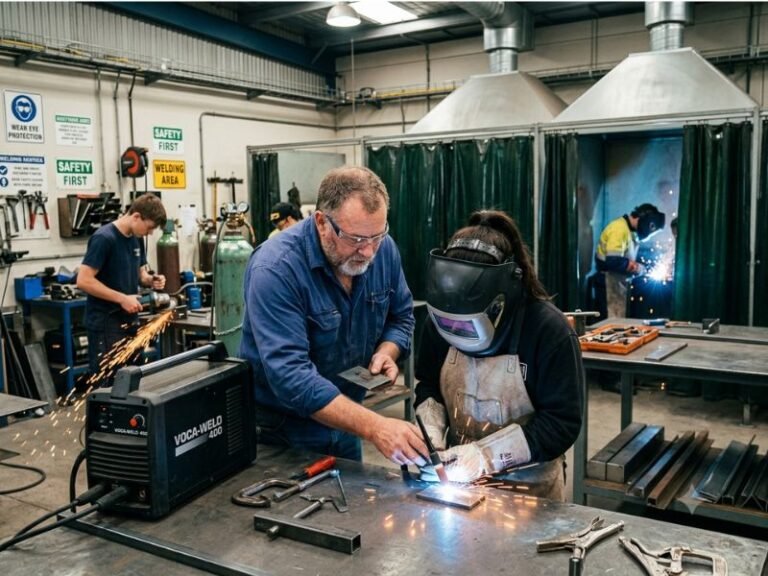
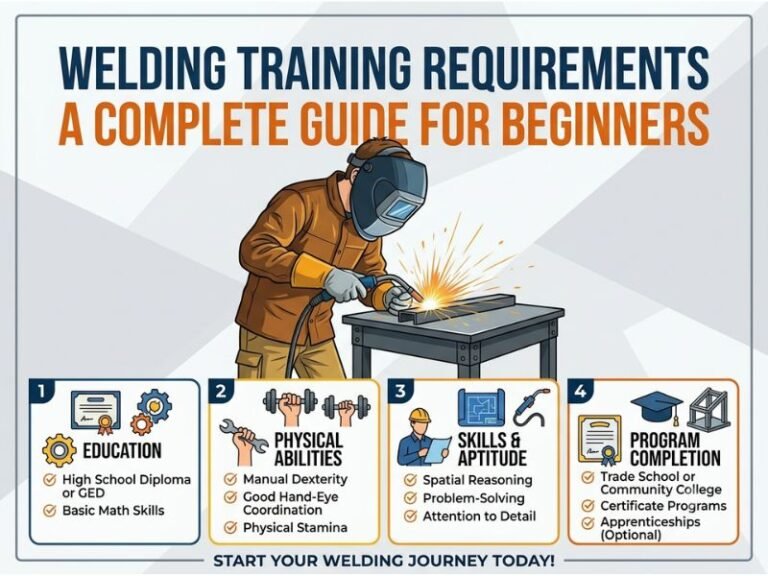
A basic welding course introduces the knowledge and physical skills needed to join metal safely. Most programs begin with shop safety, equipment identification, joint preparation, and basic welding terminology. Students then practice producing welds on sample pieces under instructor supervision.
Entry-level instruction commonly includes:
- Personal protective equipment and welding shop safety
- Fire prevention, ventilation, electrical safety, and compressed-gas handling
- Welding machines, leads, torches, clamps, and common accessories
- Metal identification and basic material preparation
- Joint types, welding positions, and common weld symbols
- Machine settings such as amperage, voltage, polarity, wire speed, or gas flow
- Arc or flame control, travel speed, work angle, and travel angle
- Cleaning, inspection, defect recognition, and basic repair
The course should connect every setting to a practical result. For example, excessive heat can burn through thin material, while insufficient heat may produce a weak or poorly fused joint. A beginner needs more than a list of machine settings; I would look for instruction that explains how to observe the weld and make controlled adjustments.
Common Welding Processes for Beginners
Different processes use different equipment, consumables, and techniques. A course does not need to teach every process, but it should clearly state which processes are included and what level of practice each one provides.
Shielded Metal Arc Welding
Shielded metal arc welding, often called stick welding or SMAW, uses a flux-coated electrode. The coating helps shield the molten weld pool, and the electrode is replaced as it is consumed.
Stick welding equipment can be practical for outdoor work and heavier steel. It also teaches arc length, electrode control, slag removal, and puddle observation. Beginners may find it demanding because the electrode gets shorter during the weld and the arc must be restarted correctly.
Gas Metal Arc Welding
Gas metal arc welding, commonly called MIG or GMAW, feeds a continuous wire through a welding gun while shielding gas protects the arc. Many introductory courses use MIG because it is comparatively easy to start and works well for common shop projects.
MIG students still need to learn wire-feed settings, gas selection, contact-tip distance, gun angle, travel speed, and how to prevent contamination. Easy arc initiation does not automatically produce strong welds.
Flux-Cored Arc Welding
Flux-cored arc welding, or FCAW, uses a continuously fed tubular wire. Some flux-cored wires use shielding gas, while self-shielded wire does not require an external gas supply.
This process can be useful for thicker steel and certain outdoor applications. It also creates slag that must be removed between passes. A beginner course should explain the difference between gas-shielded and self-shielded flux-cored welding instead of treating all flux-cored work as identical.
Gas Tungsten Arc Welding
Gas tungsten arc welding, commonly called TIG or GTAW, uses a nonconsumable tungsten electrode and usually requires a separate filler rod. TIG offers precise control and can produce clean welds on materials such as steel, stainless steel, and aluminum.
It demands careful coordination of arc length, torch movement, filler addition, shielding gas, and cleanliness. TIG is valuable for students interested in precision fabrication, but it may take longer to develop than basic MIG skills. A program advertising TIG should specify whether students practice only introductory beads or complete joints on several materials.
Oxyfuel Welding and Cutting
Oxyfuel equipment uses fuel gas and oxygen to create a flame for heating, cutting, brazing, or welding. Although many modern shops rely heavily on arc welding, oxyfuel fundamentals can help students understand flame adjustment, heat control, cylinder safety, and thermal cutting.
Because gas cylinders and hoses create specific hazards, this training should be conducted with proper ventilation, flashback protection, storage procedures, and instructor oversight.
Safety Is the First Learning Outcome
A responsible course treats safety as a working skill rather than a one-time lecture. Welding can expose students to ultraviolet radiation, fumes, hot metal, sparks, electrical hazards, compressed gases, noise, and fire risks. Safe behavior must become automatic before production speed becomes a priority.
Important safety topics include:
- Correct shade-rated welding helmets and eye protection
- Flame-resistant clothing, gloves, boots, and hearing protection
- Ventilation and appropriate respiratory protection procedures
- Fire-watch practices and removal of combustible materials
- Safe grounding, cable inspection, and electrical connections
- Handling, securing, and transporting compressed-gas cylinders
- Safe use of grinders, wire brushes, clamps, and cutting equipment
- Emergency procedures for burns, fires, eye injuries, and equipment problems
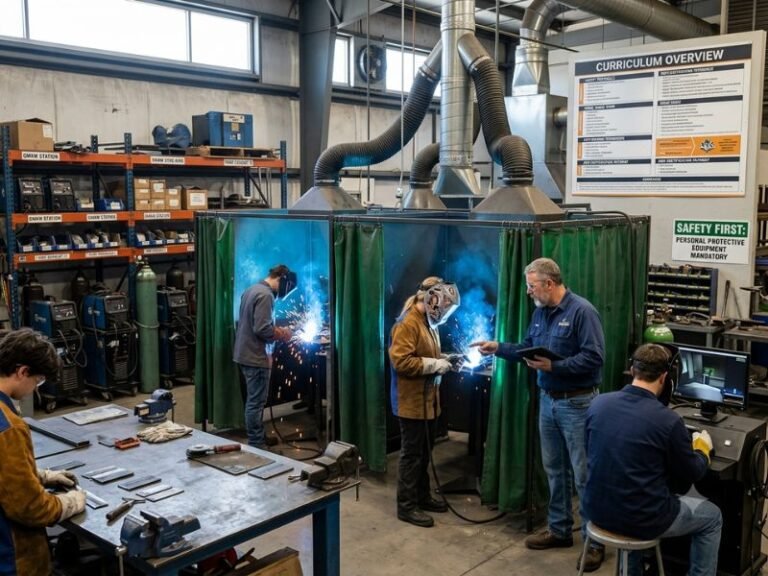
I would avoid any program that allows beginners to weld with inadequate personal protective equipment or without close supervision. A clean classroom is helpful, but the more important question is whether the shop has functioning ventilation, maintained machines, clear walkways, fire-control equipment, and enforceable safety rules.
How a Typical Beginner Course Works
Most introductory programs combine classroom explanation with substantial shop practice. The sequence may vary, but a sensible learning progression moves from observation to simple practice and then to increasingly controlled joints.
- Orientation: Students learn shop rules, hazards, protective equipment, and emergency procedures.
- Equipment setup: The instructor identifies the machine, cables, torch or gun, consumables, work clamp, and controls.
- Preparation: Students clean, measure, cut, fit, and clamp sample pieces.
- Practice beads: Students lay beads on plate to develop arc control, puddle awareness, and travel consistency.
- Basic joints: Students practice butt, lap, tee, and corner joints in selected positions.
- Inspection: The instructor reviews appearance, continuity, profile, penetration indicators, and visible defects.
- Correction: Students adjust technique or settings and repeat the exercise.
The correction stage is especially important. A beginner learns faster when an instructor can identify whether a problem comes from travel speed, arc length, angle, contamination, joint fit-up, or machine settings. A course that consists mostly of unsupervised booth time may offer practice, but it may not offer enough learning.
Hands-On Practice Versus Online Instruction
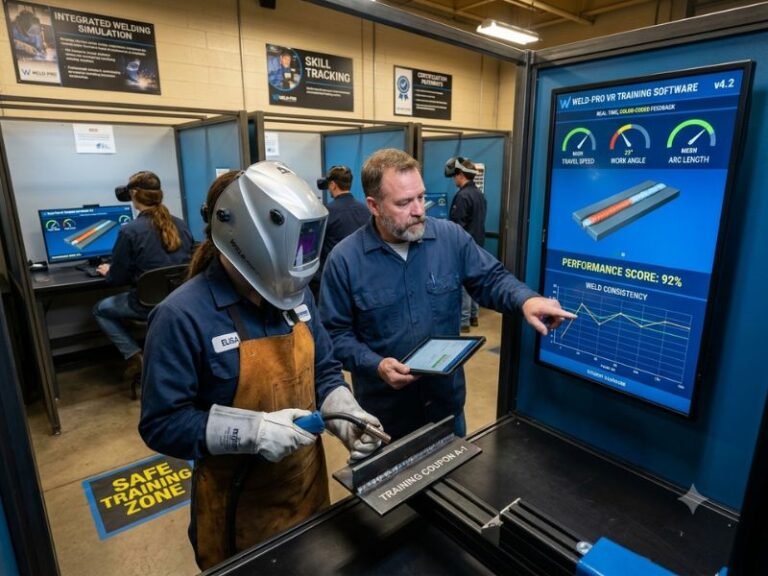
Online lessons can explain terminology, safety concepts, process differences, welding symbols, and basic machine controls. They can be useful before entering a shop or reviewing material after class.
However, welding is a physical skill. Video cannot reliably show whether a student is holding the correct arc length, moving too quickly, contaminating the tungsten, or controlling the puddle effectively. I would treat online-only instruction as preparation or supplemental education, not a complete substitute for supervised practice.
A strong blended program may include:
- Online theory and safety modules
- Demonstration videos that show correct technique
- Scheduled lab sessions with real equipment
- Instructor feedback on completed welds
- Written or practical assessments
Before enrolling, confirm how many in-person lab hours are included, how many students share each machine, which processes are available, and whether materials and consumables are included.
Course Length, Format, and Student Commitment
Basic training is offered through community colleges, technical schools, trade schools, workforce programs, private training centers, unions, and some adult education providers. Formats may include evening classes, weekend workshops, accelerated programs, or semester-based instruction.
Course length alone does not reveal quality. A short orientation may be appropriate for someone exploring welding, but it will not provide the same repetition as a longer lab-based program. I would compare the following details:
| Program feature | Why it matters |
|---|---|
| Lab hours | Shows how much time is available to build physical skill. |
| Class size | Affects access to equipment and individual feedback. |
| Processes taught | Indicates whether the course matches the student’s intended work. |
| Material range | Shows whether practice includes only mild steel or additional metals. |
| Assessment method | Clarifies whether progress is checked through demonstrations, tests, or weld samples. |
| Equipment access | Determines whether each student can practice enough during scheduled sessions. |
Students should also ask about attendance requirements, makeup labs, required tools, protective equipment, age restrictions, physical demands, and whether prior experience is expected. These details can prevent surprises after registration.
How to Choose the Right Training Level
The best course depends on the intended outcome. A hobbyist, career changer, maintenance worker, and aspiring pipe welder may all need different starting points.
For exploration or home projects
A short introductory class may be enough to learn basic shop safety, equipment operation, and simple practice welds. Students should still understand that classroom success does not automatically qualify them to fabricate load-bearing structures, repair pressure equipment, or work on safety-critical components.
For entry-level shop employment
Look for a program with repeated hands-on practice, multiple joint types, basic blueprint or weld-symbol reading, measurement, cutting, grinding, and inspection. Employers may value dependable shop behavior, safe equipment use, accurate fit-up, and willingness to learn as much as a certificate from a beginner course.
For an established trade pathway
A more structured technical program may be appropriate. It may introduce several welding processes, positions, materials, fabrication math, print reading, quality control, and preparation for later performance testing. A basic course can be the first step, but advanced occupational goals often require additional training and supervised experience.
I recommend choosing based on the next realistic goal rather than paying for every available process immediately. A student who wants to fabricate mild-steel projects may not need advanced TIG instruction at the beginning. A student targeting thin stainless or aluminum work may need TIG practice much earlier.
Certificates, Qualifications, and Performance Tests
A course completion certificate usually confirms that a student attended or completed the provider’s curriculum. It is not automatically the same as an industry certification, employer qualification, or code-based performance credential.
Before enrolling, ask:
- What document does the student receive at completion?
- Is the assessment written, practical, or both?
- Does the program prepare students for a separate performance test?
- Who administers any test, and what standard or procedure applies?
- Do employers in the intended area recognize the credential?
Welding qualifications can depend on process, material, thickness, position, joint design, filler metal, and governing requirements. A person qualified for one specific welding procedure may not be qualified for every type of welding job. Students should describe their target industry to the school and verify the credential’s actual use rather than assuming that the word “certified” covers all work.
Costs and What the Tuition May Include
Program prices vary by provider, location, schedule, equipment, and course depth, so comparing a headline tuition number can be misleading. A lower-cost class may require students to purchase a helmet, jacket, gloves, boots, tools, or consumables separately. A higher-priced program may include protective equipment, metal, wire, electrodes, gas, shop fees, and assessment costs.
Ask for a complete cost list covering:
- Tuition and registration fees
- Required personal protective equipment
- Tools such as chipping hammers, brushes, pliers, or measuring devices
- Metal, electrodes, wire, shielding gas, and other consumables
- Testing, certificate, or examination fees
- Parking, transportation, and optional practice-lab charges
There may also be financial aid, employer assistance, workforce funding, payment plans, or scholarships, but availability depends on the provider and the student’s circumstances. I would ask directly rather than assume that a public or private program includes the same support.
How Beginners Can Prepare Before Class
Preparation does not require buying an expensive welding machine. A beginner can arrive better prepared by learning basic terms, reviewing safety expectations, and considering the type of work that seems most appealing.
Useful preparation includes:
- Learning the difference between MIG, TIG, stick, and flux-cored welding
- Reviewing basic joint names and welding positions
- Reading the school’s clothing and equipment requirements carefully
- Practicing measurement, marking, and simple hand-tool control
- Improving general shop organization and attention to detail
- Writing down questions about materials, schedules, and job goals
Students should not practice hazardous welding at home without proper equipment, ventilation, fire prevention, and training. Watching videos can build familiarity, but it does not replace a controlled shop environment.
Common Beginner Mistakes
Most early problems are technique or preparation issues rather than evidence that a student lacks ability. Recognizing them makes practice more productive.
Moving too quickly
Excessive travel speed can create a narrow, irregular weld with inadequate fusion. The correct speed depends on the process, material, settings, joint, and position, so students should learn to watch the puddle instead of following an arbitrary pace.
Using an inconsistent arc length
An arc that is too long can increase spatter and reduce control. An arc that is too short may cause sticking or poor movement. Consistency improves as students practice maintaining a stable relationship between the electrode and workpiece.
Ignoring joint preparation
Rust, paint, oil, mill scale, moisture, poor fit-up, and excessive gaps can cause defects or make a weld difficult to control. Cleaning and clamping are not minor preliminary tasks; they directly affect weld quality.
Changing several settings at once
If a student changes amperage, wire speed, travel angle, and travel speed simultaneously, it becomes difficult to know what solved or caused the problem. I prefer making one controlled adjustment at a time and comparing the result.
Judging a weld only by appearance
A weld can look smooth and still have inadequate fusion, excessive penetration, porosity, cracking, or other problems. Visual inspection is useful, but it has limits. Course instruction should explain when destructive testing, procedure requirements, or qualified inspection is necessary.
Questions to Ask a Training Provider
A few direct questions can reveal whether a course matches a student’s needs:
- Which welding processes and materials are taught?
- How much of the course is hands-on lab time?
- How many students share each machine?
- What protective equipment and tools must students supply?
- Do instructors demonstrate and critique individual welds?
- Are welding positions and joint types clearly listed?
- Does the course include print reading, measurement, or weld symbols?
- What assessment is required for completion?
- Does the program prepare students for a separate qualification test?
- What jobs or next-level programs do graduates commonly pursue?
It is also reasonable to request a facility tour, sample syllabus, equipment list, attendance policy, and total estimated cost. A provider that cannot explain its lab structure or learning outcomes may not be the best choice for a beginner.
FAQ About Basic Welding Training Courses
Are basic welding training courses suitable for complete beginners?
Yes. Most entry-level courses are designed for students with little or no welding experience. The program should begin with safety and equipment orientation before requiring students to complete practical welds. Beginners should confirm that the course does not assume prior shop experience.
How long does it take to learn basic welding?
A student can learn introductory techniques in a short course, but reliable control requires repeated practice and feedback. The time needed depends on the process, material, position, attendance, coordination, and practice opportunities. Completing a beginner course is a starting point, not a guarantee of professional-level skill.
Which welding process should a beginner learn first?
MIG is often a practical starting point because wire feeding and arc initiation can be relatively accessible. Stick, TIG, flux-cored, and oxyfuel training may be more appropriate for specific industries or projects. The best first process depends on the work the student wants to pursue and the equipment available in the target workplace.
Do basic welding courses include certification?
Some courses provide a completion certificate, while others prepare students for a separate practical qualification test. These are not automatically equivalent. Students should ask what the credential means, who recognizes it, and whether it covers a particular process, position, material, or procedure.
Can an online welding course replace shop training?
Usually not. Online training can cover theory, safety, terminology, and demonstrations, but it cannot provide the physical practice and direct correction needed to develop welding technique. A blended program is more useful when it includes supervised in-person laboratory work.
What equipment does a beginner need?
Requirements vary, but students commonly need a properly rated helmet, flame-resistant clothing, gloves, safety glasses, appropriate footwear, and hearing protection. The school may provide machines, cables, torches, gas, and consumables. Students should wait for the provider’s equipment list before buying specialized tools.
Can a basic course prepare someone for a welding job?
It can provide a foundation for entry-level applications, especially when it includes hands-on practice, safety, fit-up, measurement, and inspection. Employers may still require a practical test, additional training, or experience with a particular process. A course improves readiness but does not guarantee employment.
Is TIG too difficult for a beginner?
TIG requires more coordination and cleanliness than many introductory MIG exercises, but beginners can learn its fundamentals with structured instruction. Students should expect a slower learning curve and should choose a program with enough lab time to practice torch control, filler addition, and material preparation.
What should I do after completing a basic course?
Review the instructor’s feedback, keep examples of work when appropriate, and identify the next skill required for the intended job. That may involve additional process training, blueprint reading, fabrication practice, supervised shop work, or preparation for a specific performance test.
Conclusion
Good Basic welding training courses teach far more than how to create a visible bead They develop safe habits equipment knowledge material preparation process control inspection awareness and a realistic understanding of what a beginner can do independently I recommend comparing hands-on hours instructor feedback equipment access course outcomes total cost and the credential s actual value before enrolling The right program will give a new student.