Basic Welding Training: Essential Information and Useful Advice
Many people assume welding is mainly about holding a torch or gun over metal until two pieces fuse. The visible arc is only one part of the job. Safe setup, correct material preparation, electrical settings, body position, and inspection usually determine whether a weld is strong and repeatable.
Basic welding training gives a beginner the foundation to understand those decisions before attempting more demanding work I will explain what entry-level training normally covers how the major.
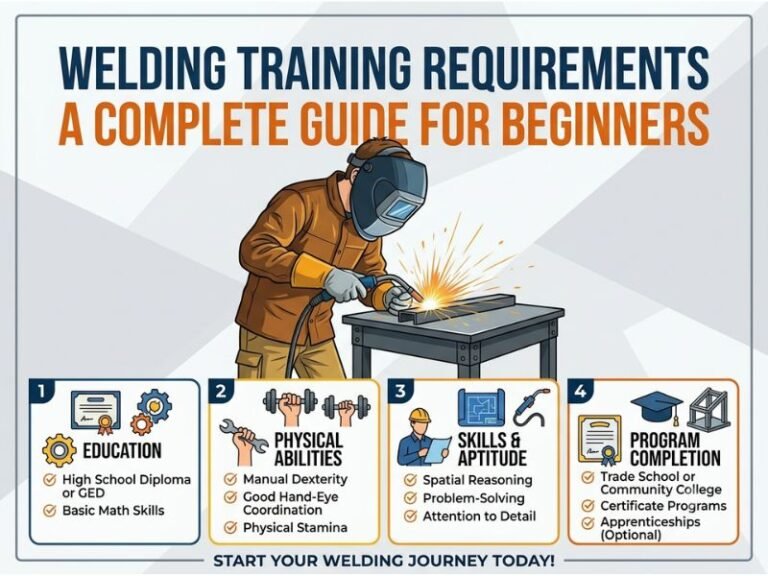
The goal is not to make a novice job-ready after a single class. A useful training program should help a student control the arc, recognize common defects, practice safely, and understand what additional instruction or qualification may be required for professional work.
What Basic Welding Training Teaches
Basic welding training is introductory instruction in joining metals through heat pressure or both Most beginner programs focus on fusion welding in which an arc or flame melts the edges of a joint and sometimes a separate filler metal The.
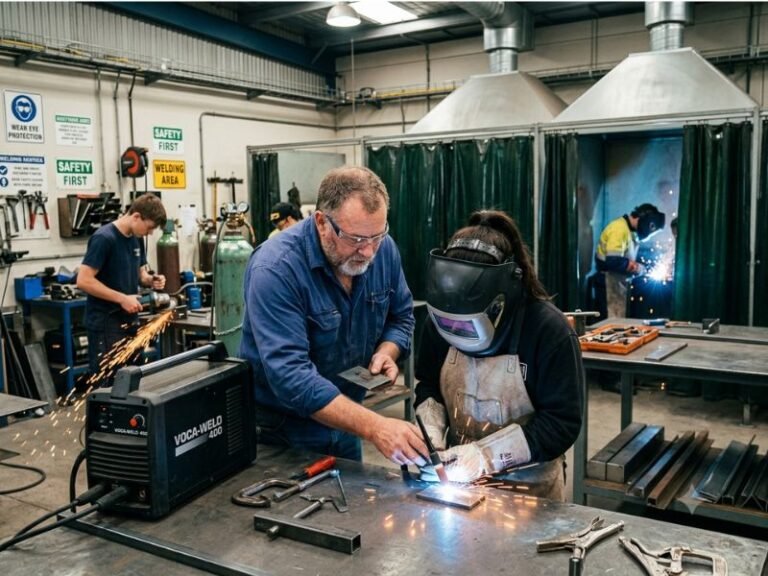
A sound introductory course normally combines classroom explanation with supervised practice. Students learn how welding equipment works, how to prepare a joint, how to select a process, and how to protect themselves from heat, fumes, radiation, sparks, electric shock, and fire.
Training may also introduce:
- Welding symbols, joint types, and basic shop terminology
- Machine polarity, amperage, voltage, and wire-feed concepts
- Electrode, filler-metal, and shielding-gas selection
- Flat-position beads before more difficult positions
- Visual inspection and common weld discontinuities
- Workplace procedures, housekeeping, and emergency response
Introductory instruction is different from a professional welding qualification. A class can teach fundamental technique, but an employer, customer, code, or project specification may require separate testing. Qualification requirements depend on the type of work, the process, the base metal, the joint, and the applicable standard.
Core Skills Covered in Entry-Level Training
Reading the work before striking an arc
Good welding starts before the machine is turned on. I advise beginners to learn how to identify the base metal, check its thickness, inspect the joint design, and look for paint, rust, oil, moisture, plating, or other contamination. These details affect heat transfer, arc behavior, fumes, and weld quality.
Students also learn the difference between a butt joint, lap joint, corner joint, and T-joint. A joint may require a square groove, bevel, root opening, fillet weld, or multiple passes. Even a small practice coupon can teach important lessons about fit-up and distortion.
Controlling the arc or flame
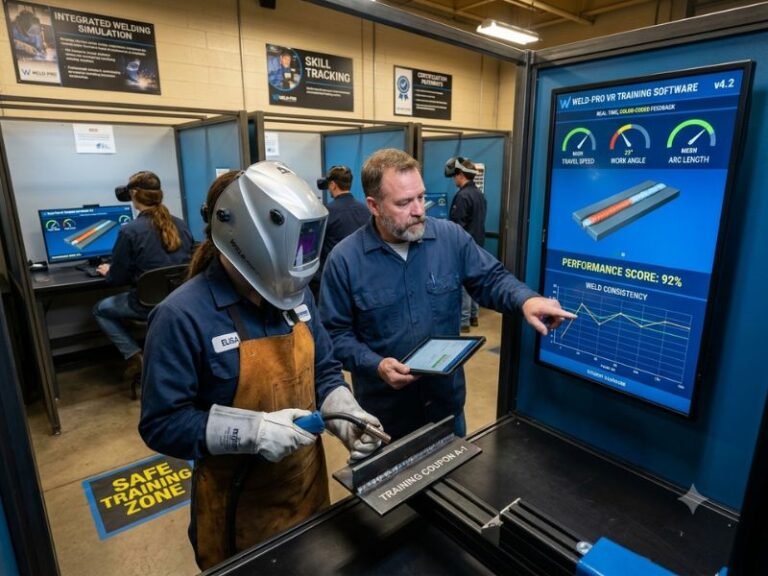
Arc welding requires control of travel speed, work angle, travel angle, arc length, and electrical settings. A long arc can create excessive spatter, poor shielding, and an unstable bead. A short or inconsistent arc can cause sticking, lack of fusion, or an uneven appearance.
Beginners generally practice straight beads on clean plate before moving to joints This isolates hand control from the additional challenge of maintaining a consistent joint path The objective.
Preparing and finishing a joint
Preparation includes cutting, fitting, clamping, cleaning, and sometimes preheating. Tack welds hold parts in alignment, but poor tack placement can pull a joint out of position. Welders also learn to remove slag between passes, brush or grind as appropriate, and avoid leaving sharp edges or trapped contamination.
After welding, visual inspection looks for cracks, visible porosity, undercut, overlap, incomplete fusion, excessive spatter, poor profile, and incorrect dimensions. Visual inspection cannot reveal every internal problem, but it is an essential first check and a practical habit for every skill level.
Choosing a Beginner Welding Process
No single process is best for every learner. The right choice depends on the material, thickness, work location, available equipment, desired productivity, and type of project. A training center often introduces more than one process so students can compare their strengths and limitations.
SMAW: stick welding
Shielded metal arc welding (SMAW), commonly called stick welding, uses a flux-coated consumable electrode. The coating produces shielding as it burns and leaves slag that must be removed after the weld cools.
Stick equipment can be relatively portable and useful outdoors because it does not depend on a separate shielding-gas cylinder. It can weld many steels and handle less-than-perfect field conditions better than some gas-shielded processes. However, beginners must manage electrode angle, arc length, slag removal, and frequent electrode changes.
Stick welding is a valuable foundation because it teaches arc control and puddle awareness. It can also feel less forgiving at first, particularly with small-diameter electrodes and thin material.
GMAW: MIG welding
Gas metal arc welding (GMAW), often called MIG welding, feeds a continuous wire electrode through a welding gun. Shielding gas protects the molten weld pool from atmospheric contamination. Some equipment can also use flux-cored wire, although the setup and technique may differ.
MIG welding is popular for introductory practice because the continuous wire feed lets a learner focus on gun movement rather than repeatedly replacing an electrode. It is commonly used for mild-steel fabrication, repair, automotive work, and production applications.
Its limitations matter too. Wind can disturb the shielding gas, contaminated metal can cause porosity, and incorrect voltage or wire-feed settings can create burn-through, excessive spatter, or an unstable arc. Training should include gas-flow checks, gun-angle practice, and proper cleaning rather than treating MIG as an automatic process.
GTAW: TIG welding
Gas tungsten arc welding (GTAW), commonly called TIG welding, uses a nonconsumable tungsten electrode and a separate filler rod when filler is needed. It provides precise control and can produce clean, attractive welds on materials such as steel, stainless steel, and aluminum.
TIG requires coordination of the torch, filler rod, foot pedal or amperage control, and shielding gas. It is slower and usually more demanding for a beginner than MIG. Introductory programs may teach basic TIG after students understand puddle control and joint preparation through simpler exercises.
FCAW and oxyfuel processes
Flux-cored arc welding (FCAW) uses a tubular wire filled with flux. Depending on the wire, the process may use external shielding gas or rely on the flux to generate shielding. It is useful for certain structural and outdoor applications, but students must understand wire type, polarity, slag removal, and fume production.
Oxyfuel welding and cutting use fuel gas and oxygen rather than an electric arc. These processes can teach flame adjustment, heat control, cutting, brazing, and equipment safety. They also carry serious fire, cylinder, hose, and flashback risks, so they require formal instruction and careful supervision.
Safety Requirements for Welding Training
Safety is not a separate lesson that can be postponed until after technique practice. I consider it part of every repetition. A student should know the hazards of the specific process and material before starting work.
Personal protective equipment
Typical protection includes a properly rated welding helmet, safety glasses with side protection, flame-resistant clothing, welding gloves, sturdy work boots, and hearing protection when noise levels require it. Clothing should cover exposed skin and avoid synthetic fabrics that can melt when hit by sparks.
Helmet shade selection must match the process and current range. A training instructor or the equipment manufacturer should provide the correct guidance. Looking at an arc without suitable protection can injure the eyes, and a regular pair of safety glasses is not a substitute for a welding helmet.
Ventilation and respiratory hazards
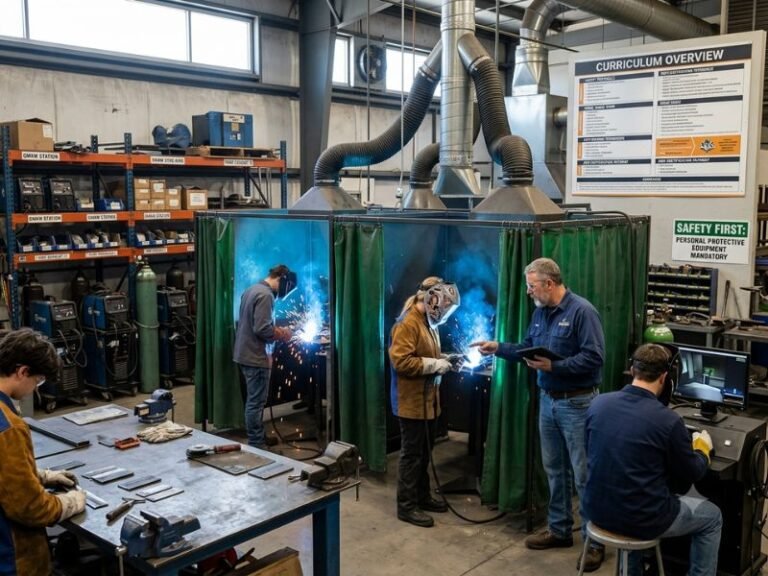
Welding fumes vary with the process, base metal, coatings, filler metals, and contaminants. Galvanized coatings, stainless steel, lead-based paint, solvents, and unknown surfaces deserve particular caution. Training should teach local exhaust ventilation, positioning that keeps the head out of the fume plume, and the need to identify coatings before heating them.
Respiratory protection is not a simple replacement for ventilation. A qualified safety professional should determine the appropriate controls and respirator program when respiratory protection is necessary. I would never recommend welding on an unknown coating merely because the metal appears clean.
Fire, electric, and cylinder safety
Remove combustible materials from the work area or shield them with suitable fire-resistant barriers. Sparks can travel farther than expected and can ignite material outside the immediate workbench. A fire extinguisher should be accessible, and hot metal should be marked or isolated so another person does not touch it accidentally.
Inspect electrode holders, guns, cables, leads, plugs, and grounds before use. Damaged insulation, wet conditions, and improper connections increase shock risk. Gas cylinders must be secured upright, fitted with the correct regulator, kept away from damage, and handled according to applicable procedures.
Training facilities should also explain hot-work permits, fire watches, lockout procedures, and emergency reporting when those controls apply. In the United States, OSHA rules and local fire codes may affect workplace welding. A course should not encourage a student to bypass site-specific requirements.
What to Expect During Practical Instruction
A well-structured class usually progresses from simple to complex tasks. Early exercises may involve identifying equipment, setting up a machine, striking an arc, and running beads on flat plate. Later work can include fillet welds, butt joints, different positions, thicker or thinner material, and more than one welding process.
A typical practice sequence
- Put on the required protective equipment and inspect the work area.
- Identify the metal, thickness, joint type, and process requirements.
- Clean and fit the pieces, then clamp or tack them as instructed.
- Choose initial machine settings from approved guidance.
- Run a controlled bead while watching the puddle and listening to the arc.
- Allow the work to cool safely and remove slag or spatter as required.
- Inspect the result and record what should change on the next attempt.
Practice should be deliberate rather than rushed Repeating a flawed motion can make the flaw feel normal I prefer an approach in which a student changes one variable.
Instructor feedback and supervision
Hands-on correction is one of the strongest reasons to attend an in-person program. An instructor can identify unsafe posture, poor cable placement, an incorrect torch angle, or a settings problem before it becomes a habit. Video lessons can explain concepts, but they cannot fully replace supervised practice with live equipment.
A beginner should ask how much shop time is included, how many students share each machine, what materials are available, and whether an instructor watches each student weld. A low-cost class with very little equipment access may provide less practical value than a slightly longer program with structured practice.
Equipment for Learning at Home
Home practice can reinforce classroom instruction, but it should not be the first place a person learns basic safety. I recommend starting with supervised training, then setting up a dedicated workspace that matches the process and local requirements.
A basic setup may include:
- A welding power source suited to the selected process and available electrical service
- Appropriate leads, gun or electrode holder, work clamp, and consumables
- A certified welding helmet, safety glasses, gloves, jacket, and boots
- A stable, noncombustible work surface and suitable clamps
- Ventilation or local exhaust designed for the work area
- Fire protection and a method for isolating hot metal
- Hand tools for cleaning, measuring, cutting, and deburring
Buying a machine before choosing a process can lead to unnecessary expense. I would first decide what metal and thickness the learner expects to weld, where the work will occur, what power is available, and whether gas cylinders can be stored and used safely.
Manufacturer instructions matter. A machine that can perform a process in theory may still require specific accessories, polarity, gas, wire, electrode, duty-cycle limits, or electrical protection. Beginners should not copy settings from an unrelated machine or material and assume the result will be safe or correct.
How to Choose a Basic Welding Course
The best course is not necessarily the one with the shortest schedule or the broadest list of processes. I would evaluate the program against the learner’s immediate goal: personal fabrication, maintenance, farm or shop work, entry-level employment, or preparation for a more advanced technical program.
Questions worth asking
- Are safety, ventilation, fire prevention, and material hazards taught in detail?
- How much time does each student spend welding rather than watching?
- Which processes, metals, thicknesses, and positions are included?
- Are helmets, machines, consumables, and other protective items supplied?
- What experience and credentials do the instructors have?
- Does the program offer practice outside scheduled class time?
- Is a completion certificate different from a welding qualification test?
- Does the course explain applicable OSHA, AWS, employer, or local requirements?
Community colleges, vocational schools, union training centers, private trade schools, and employer programs may all provide useful options. Program quality varies, so I would inspect the facility if possible. Clean ventilation systems, maintained equipment, organized consumables, and clear safety procedures are encouraging signs.
Certificate versus qualification
A certificate may confirm attendance or completion of a course. It does not automatically prove that a person is qualified to weld every joint, material, or position. Professional qualification commonly involves a specified test, a controlled procedure, and documented acceptance criteria.
The American Welding Society publishes widely used welding standards and certification information, but the correct requirement comes from the employer, code, customer, or project specification. Anyone pursuing employment should ask the employer which process qualifications and supporting skills are expected.
Common Beginner Mistakes
Most early problems are understandable and correctable. The important step is to connect each defect with a change in preparation, settings, movement, or safety practice.
Moving too quickly
Excessive travel speed can leave a narrow bead with poor fusion or insufficient penetration. Moving too slowly can create an oversized bead, excessive heat input, burn-through, or distortion. Watching the puddle instead of staring only at the arc helps a learner judge speed.
Ignoring joint cleanliness
Oil, paint, rust, moisture, mill scale, and coatings can cause porosity, inclusions, unstable arc behavior, or dangerous fumes. Cleaning does not guarantee a perfect weld, but skipping it removes one of the easiest variables to control.
Using the wrong settings or consumables
Amperage, voltage, wire-feed speed, polarity, electrode type, wire diameter, gas mixture, and travel speed interact. A student should use approved setup information for the exact material and process rather than adjusting randomly. Changes should be recorded so successful settings can be repeated.
Trying difficult positions too soon
Overhead and vertical welding require more control of the puddle and body position than flat welding. A learner who cannot maintain a consistent flat bead will usually struggle more when gravity works against the weld pool. Progression should be based on demonstrated control, not impatience.
Judging quality by appearance alone
A smooth bead can still have lack of fusion, inadequate penetration, cracks, or other hidden problems. Conversely, some surface irregularity does not automatically mean the entire joint is unusable. Training should teach visual criteria and explain when destructive or nondestructive testing is needed.
Building Skill After the First Class
Improvement comes from regular, focused practice. I suggest keeping a simple welding log with the process, material, thickness, consumable, settings, joint type, position, and observations. Photos can help compare bead profile and consistency, but they should supplement instructor feedback rather than replace inspection.
Useful early goals include:
- Setting up equipment safely without skipping an inspection
- Maintaining a consistent arc length and travel speed
- Producing uniform beads on clean practice coupons
- Making sound fillet welds on T-joints
- Recognizing common defects and explaining likely causes
- Cleaning, measuring, and inspecting work methodically
After fundamentals become reliable, a learner can select a specialty. Structural steel, pipe, automotive repair, manufacturing, maintenance, artistic fabrication, and aluminum work involve different procedures and expectations. Additional training may cover blueprint reading, metallurgy, weld symbols, fabrication math, inspection, or code-based qualification.
Physical conditioning also matters. Welding often requires kneeling, bending, reaching, working in restricted spaces, and maintaining a stable position while wearing protective equipment. Good ergonomics reduce fatigue and make consistent technique easier.
FAQ About Basic Welding Training
What is included in basic welding training?
Most introductory programs include welding safety equipment identification joint preparation machine setup basic process theory flat-position practice simple joints and visual inspection The exact curriculum depends on the.
How long does basic welding training take?
There is no single standard length. An introductory workshop may last a few hours or days, while a technical program may continue for weeks or months. Time alone does not establish competence. The amount of supervised welding, quality of feedback, and range of practice usually matter more than the course title.
Can a beginner learn welding without experience?
Yes. Beginners can learn the fundamentals, but they should start with qualified instruction and controlled practice. Welding involves hazards that are not obvious from watching online videos, including fumes, arc radiation, fire, electrical energy, and hot metal. Experience should develop gradually rather than through unsupervised experimentation.
Is MIG welding the best starting process?
MIG is often a convenient starting point because it uses continuous wire and can be relatively easy to practice on mild steel It is not automatically the best.
Does completing a beginner course qualify someone for a welding job?
Usually, no. Course completion shows that a student received instruction, but an employer may require skill demonstrations, process-specific tests, experience, blueprint knowledge, or code qualifications. I recommend asking the target employer about requirements before choosing a program.
What should a beginner practice first?
Start with equipment inspection, safe setup, striking or initiating the arc, and straight beads on clean material. Then practice fillet welds and simple butt joints in the flat position. Once control is consistent, move to other positions, materials, and processes under supervision.
Is welding certification required in the United States?
Requirements vary by employer, industry, project, jurisdiction, and governing code. Some jobs require documented qualification for a specific welding procedure, while others use employer testing or on-the-job evaluation. A general class certificate is not the same as a process-specific qualification, so the applicable employer or project standard should be checked.
Conclusion
Basic welding training is valuable because it combines technique with judgment choosing the right process preparing the joint controlling the puddle recognizing defects and protecting people from predictable.