Swagelok Orbital Welding Training: Key Facts and Helpful Guidance
Many people assume that Swagelok orbital welding training is simply a short class on operating an automated weld head. That is only part of the picture. A successful orbital weld depends just as much on tube preparation, material control, shielding gas, fit-up, cleanliness, and documented procedure control.
I see the most useful training as a combination of welding fundamentals and process discipline. The equipment may automate torch travel and rotation, but it does not correct contaminated tubing, poor alignment, an incorrect program, or inadequate purge gas.
This guide explains what the training generally covers, who benefits from it, how to prepare, what questions to ask a local provider, and how to judge whether a course fits a regulated or high-purity application. Because course names, schedules, equipment, and credentials can vary by location, I will distinguish broadly applicable guidance from details that should be confirmed directly with the training provider.
What Swagelok orbital welding training usually covers
Swagelok orbital welding training generally refers to instruction in automated or semi-automated gas tungsten arc welding (GTAW), commonly called TIG welding, for tubing and related components. “Orbital” means that the welding torch travels around the stationary tube, usually under a programmed sequence of current, speed, and other parameters.
The exact curriculum depends on the Swagelok sales and service center, partner facility, equipment used, and application. A well-structured course commonly addresses:
- Orbital GTAW principles and terminology
- Equipment setup, torch components, and weld-head operation
- Tube and fitting preparation
- Material identification and handling
- Electrode selection, alignment, and inspection
- Shielding gas and internal purge practices
- Machine programming and parameter control
- Weld setup, tack welding, and joint fit-up
- Visual inspection and basic weld evaluation
- Common weld defects and corrective actions
- Safety, documentation, and repeatable work practices
The central objective is repeatability. A manual weld can sometimes be adjusted in real time by an experienced welder. An orbital system relies more heavily on a correctly prepared joint and a properly controlled program. Training therefore connects manual GTAW knowledge with the specific demands of automated tube welding.
Training is not automatically the same as certification
Course completion, an attendance certificate, an operator qualification, a performance qualification, and an employer authorization are different things. A training provider may issue proof that a participant completed instruction, but that document may not qualify the person to weld under a particular code, customer specification, or quality system.
Before enrolling, I would ask exactly what credential is awarded and what it means. Important questions include:
- Is the course a skills class, an operator course, or a formal qualification?
- Is a practical weld test included?
- Who evaluates the welds?
- Are test results documented?
- Does the credential apply to a specific machine, material, diameter range, or procedure?
- Will an employer or customer recognize the credential?
If a project is governed by a welding code, engineering specification, or customer-approved procedure, the applicable requirements must be checked separately. Training can improve capability, but it does not replace required procedure qualification or welder performance qualification.
Why orbital welding requires specialized instruction
Orbital welding appears straightforward because the machine controls the torch movement. In practice, the process has several variables that interact closely. A small change in tube gap, electrode extension, purge quality, or current timing can affect penetration, bead shape, discoloration, and consistency.
A machine can repeat a program accurately, but it cannot determine whether the tubing was cut square or whether the internal surface was properly protected. It also cannot identify every material mix-up or compensate for a joint that has shifted during setup.
Specialized instruction helps operators understand the difference between a machine problem and a preparation problem. For example, a poor weld may be caused by:
- Incorrect tube-to-fitting alignment
- Excessive or inconsistent wall gap
- Dirty tube ends or tooling
- Improper electrode position
- Insufficient shielding or purge gas
- A program that does not match the material and wall thickness
- Excessive arc length or electrode contamination
- Incorrect heat input or travel timing
- Movement of the joint during welding
That diagnostic ability is more valuable than memorizing a sequence of button presses. It allows an operator to stop, identify the likely cause, and avoid producing a large batch of questionable welds.
Core subjects in a strong course
Tube preparation and fit-up
Preparation starts before the weld head is mounted. Tube ends normally need to be cut square, deburred, cleaned, and protected from handling contamination. The fitting and tube must align correctly, and the joint must maintain the intended insertion depth and gap.
Training should show how to inspect the joint before welding rather than treating the weld program as a substitute for inspection. The operator should know which tools are acceptable for cutting and deburring, how to prevent scratches, and how to keep cleaned surfaces from being touched or exposed unnecessarily.
Fit-up is especially important for thin-wall tubing. A large or uneven gap can change penetration around the circumference. Misalignment may create a weld that looks acceptable from one angle but has an inconsistent internal profile.
Materials and cleanliness
Orbital welding is common in applications where contamination, corrosion resistance, or internal surface quality matters. Stainless steel tubing is frequently associated with the process, but material compatibility must always be confirmed for the particular job. Different alloys and wall thicknesses require appropriate procedures and settings.
A course should explain how oil, fingerprints, dust, marker residue, carbon steel particles, and moisture can affect a weld. It should also address dedicated or controlled tools where the application requires them. Cleanliness is not a cosmetic concern: contamination can cause porosity, discoloration, inclusions, or loss of corrosion resistance.
I would look for instruction that connects cleaning practices to the final service environment. A general fabrication job and a high-purity gas system may have very different cleaning, packaging, and acceptance requirements.
Shielding gas and internal purging
Shielding gas protects the molten weld pool and hot electrode area from atmospheric contamination. Internal purge gas protects the inside of the tube. For stainless and other reactive materials, inadequate internal purging can produce heavy oxidation, often called sugaring, on the root side of the weld.
Good training should cover gas selection, flow control, connections, leak checking, purge time, venting, and the effect of excessive flow. More gas is not always better. Turbulent flow can draw air into the weld area, while leaks or poor venting can prevent the intended atmosphere from developing.
The correct purge method depends on the joint, material, tubing configuration, and procedure. An operator should learn how to verify the purge rather than assuming that gas is flowing simply because a regulator is open.
Electrodes, torch setup, and machine controls
Orbital welding equipment typically includes a power supply, weld head, torch and electrode assembly, cables, gas controls, and programming interface. Training should explain how these components work together and how to inspect them before use.
Relevant setup topics may include electrode type, grinding direction, tip geometry, electrode extension, centering, arc gap, collet selection, and torch alignment. The appropriate arrangement depends on the equipment and procedure, so generic settings should not be copied from an unrelated machine.
Machine programming may involve current levels, pulse settings, rotation speed, dwell times, upslope and downslope, wire feed if used, and segment-specific values. The operator needs to understand what each setting does and which changes are permitted under the approved procedure.
That last point matters in controlled production. An operator should not casually change a parameter because a weld “looks better” without knowing whether the change affects qualification or acceptance. Training should reinforce the difference between troubleshooting within an approved range and creating an unapproved process variation.
What the hands-on portion should look like
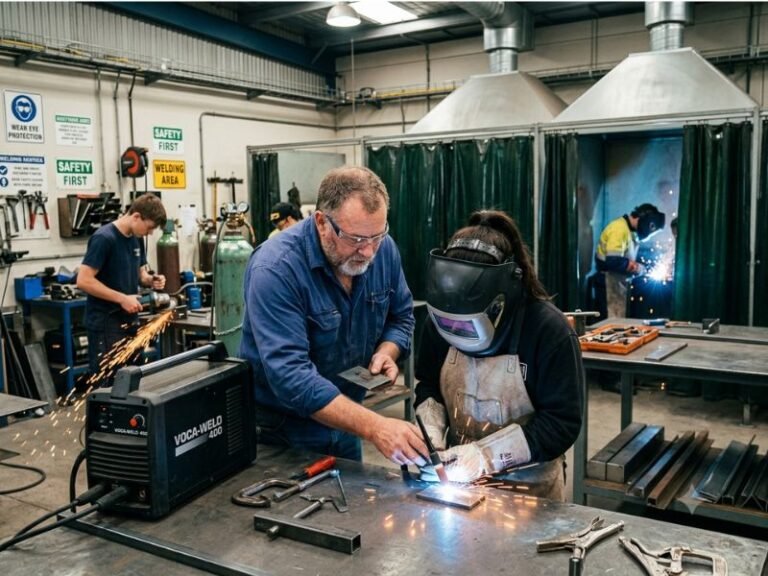
Orbital welding is difficult to learn through lecture alone. A useful class provides time to set up equipment, prepare joints, run welds, inspect results, and repeat the process after correcting mistakes.
A practical sequence may include:
- Reviewing the equipment and safety controls
- Identifying tubing, fittings, consumables, and tools
- Preparing and cleaning sample joints
- Installing the weld head and electrode
- Establishing shielding and purge gas
- Loading or entering a suitable weld program
- Running sample welds
- Inspecting the weld visually and, when applicable, with additional methods
- Adjusting preparation or approved process variables
- Repeating the weld to demonstrate consistency
The instructor should explain why a result is acceptable or unacceptable, not merely label it good or bad. A participant gains more from understanding the relationship between a defect and its cause than from watching a perfect demonstration.
Hands-on access also reveals whether the course matches the intended work. A person welding small-bore stainless tubing for a clean utility system may need different practice from someone working with larger-diameter process piping or unusual alloys.
Inspection and acceptance
Visual inspection is usually the first evaluation step. Depending on the specification, the inspector may consider bead uniformity, alignment, surface profile, discoloration, undercut, cracks, porosity, incomplete fusion, arc strikes, and internal oxidation.
Visual appearance alone does not prove that a weld meets every requirement. Some applications call for borescope inspection, radiography, liquid penetrant testing, pressure testing, helium leak testing, metallographic examination, or other controls. The governing specification determines what is required.
Training should teach operators to document weld identification, program selection, material, and inspection results where the quality system calls for those records. Traceability is particularly important when many similar welds are produced or when a system will support critical operations.
Who should consider this training?
The most obvious candidates are welders, fabricators, and technicians who will make or support orbital tube welds. The course may also benefit:
- Maintenance technicians working on instrument or process tubing
- Quality inspectors who need to understand weld variables
- Supervisors responsible for production consistency
- Engineers developing or reviewing tube-welding procedures
- Commissioning personnel working on controlled systems
- Managers evaluating orbital equipment or operator capability
Prior manual GTAW experience is often helpful because it gives the participant a foundation in arc behavior, tungsten handling, heat control, and weld defects. However, manual welding experience does not automatically qualify someone to operate an orbital system correctly.
A beginner may need introductory welding instruction before taking a specialized orbital course. An experienced welder may instead need focused training on a particular weld head, power supply, programming method, and production procedure. Asking about prerequisites can prevent a mismatch.
How to choose the right Swagelok course
Start by defining the work rather than choosing a course based only on its title. The right training depends on the materials, tube sizes, wall thicknesses, joint designs, equipment, cleanliness requirements, and acceptance criteria involved.
Confirm the provider and equipment
Swagelok operates through a network of local sales and service centers, and training availability can differ by location. A local provider may offer its own schedule, facility, instructors, equipment, and course scope. I would confirm the current details directly instead of assuming that every location offers the same orbital welding class.
Ask whether the practical sessions use the same or comparable equipment planned for the job. A participant trained on one manufacturer’s control interface may still need familiarization on another system. Differences in weld-head design, programming terminology, gas control, and maintenance can matter.
Compare course depth
Useful comparison questions include:
- How much time is hands-on?
- How many participants share each machine?
- Does the course include joint preparation and cleaning?
- Are purge practices demonstrated and checked?
- Are weld defects intentionally reviewed?
- Is a practical assessment included?
- Are course materials provided for later reference?
- Does the instructor address the intended materials and tube sizes?
- Is post-course technical support available?
A short orientation may be sufficient for an operator who already has qualified welding experience and only needs machine familiarization. It may be inadequate for someone who must establish a new orbital welding process from the beginning.
Match the course to compliance needs
For pharmaceutical, semiconductor, aerospace, energy, medical, or other controlled applications, training should be considered alongside the project quality plan. The course itself may not define acceptance criteria, weld procedure requirements, documentation rules, or customer approvals.
Ask the employer, engineer, quality representative, or customer what evidence is required. That evidence might include training records, a performance qualification, approved weld procedures, equipment calibration records, inspection reports, or material traceability. The training provider can explain its offering, but the project authority determines what the work requires.
How to prepare before attending
Preparation makes technical training more productive. Before the class, I would write down the actual questions that arise in the shop or on the job site. Examples include recurring discoloration, inconsistent penetration, fit-up problems, purge difficulties, program selection, or uncertainty about inspection.
It also helps to gather basic information about the intended work:
- Tube and fitting materials
- Outside diameters and wall thicknesses
- Joint types and fitting configurations
- Expected production volume
- Required internal cleanliness
- Applicable code, customer specification, or acceptance standard
- Available orbital welding equipment
- Existing weld procedures and inspection methods
If the class has prerequisites, review GTAW fundamentals beforehand. Important concepts include amperage, arc length, tungsten contamination, heat input, shielding gas, purge gas, weld pool control, and common weld discontinuities.
Bring practical questions rather than expecting a generic class to solve an undefined process. A provider may be able to advise on course fit, but it cannot responsibly select a production procedure without the necessary engineering and material information.
Common mistakes to avoid
Treating the program as the complete process
Loading a saved program does not guarantee a sound weld. The program must correspond to the material, joint, dimensions, electrode setup, gas conditions, and approved procedure. Operators should verify the complete setup before starting.
Ignoring internal weld quality
A weld can look acceptable on the outside and still have excessive internal oxidation or another root-side problem. This is why purge verification and, where required, internal inspection are essential.
Changing several variables at once
If a weld has a defect, changing current, travel speed, gas flow, electrode position, and fit-up simultaneously makes the cause difficult to identify. A controlled troubleshooting approach isolates likely variables and records what changed.
Skipping joint preparation
Orbital equipment cannot compensate reliably for out-of-square cuts, inconsistent insertion, contamination, or poor alignment. Preparation may take less time than repairing a rejected weld or investigating a system contamination event.
Assuming manual welding skill is enough
Manual GTAW experience is valuable, but orbital welding adds programming, machine setup, weld-head alignment, gas management, and procedural control. A capable manual welder still needs equipment-specific instruction.
Confusing attendance with qualification
A certificate showing course attendance may not satisfy a project requirement for a qualified welder or approved operator. The distinction should be resolved before work begins, not after a customer or auditor asks for records.
Questions to ask a local training provider
A direct conversation with the local Swagelok sales and service center can clarify whether the course fits the intended application. I would ask:
- What is the official course name and current duration?
- Is orbital welding included in the curriculum, or is the course focused on another type of tube joining?
- Which weld heads, power supplies, and control systems are used?
- What materials, diameters, and wall thicknesses are covered?
- What welding experience or prerequisites are expected?
- How much of the class is hands-on practice?
- How are welds inspected and discussed?
- Is there a written or practical assessment?
- What documentation is issued at completion?
- Does the documentation represent training completion or formal qualification?
- Can the course address high-purity, sanitary, or other controlled applications?
- What follow-up support is available after the class?
These questions also help identify a course that is primarily product familiarization versus one designed to build practical welding competence. Neither type is inherently wrong; the right choice depends on the operator’s existing skills and the job’s risk.
FAQ: Swagelok orbital welding training
What is Swagelok orbital welding training?
It is specialized instruction in orbital GTAW for tubing and related components, generally combining equipment operation with joint preparation, cleaning, purge control, programming, weld inspection, and defect prevention. The exact content depends on the local provider and course offering.
Does Swagelok orbital welding training make someone a certified welder?
Not necessarily. Training completion and formal welder certification or performance qualification are separate matters. The provider should explain what credential it issues, while the employer, customer, code, or quality system determines what qualification is required.
Do I need prior TIG welding experience?
Prior GTAW experience is often beneficial and may be required for an advanced or equipment-focused course. Beginners may need foundational welding instruction first. Confirm prerequisites with the specific training location.
Is hands-on practice included?
Many practical courses include hands-on setup and sample welds, but the amount of practice can vary. Ask how many participants share each machine, what materials are used, and whether the course includes a practical assessment.
Will the training cover my specific orbital welding machine?
That depends on the provider and equipment available. Confirm the weld-head and power-supply models used in class. If the production machine is different, additional familiarization may be necessary.
Does the course teach high-purity tube welding?
It may address cleanliness, purge control, and internal weld quality, but the scope varies. High-purity work also involves application-specific cleaning, inspection, packaging, documentation, and acceptance requirements, so those details must be confirmed.
How should I verify whether the training meets a project requirement?
Compare the course credential with the project specification and ask the responsible quality or engineering authority. Check whether the requirement concerns training, operator authorization, welder performance qualification, procedure qualification, or documented inspection.
Conclusion
Good Swagelok orbital welding training is more than an equipment demonstration. It teaches operators to control preparation, cleanliness, fit-up, purge gas, programming, inspection, and documentation as one connected process. I recommend confirming the local course scope, hands-on content, equipment, prerequisites, and credential before enrolling. That careful comparison is the best way to choose training that supports consistent welds and satisfies the actual demands of the work.