Welding Abbreviations: Common Shop Acronyms and What They Mean
Welding abbreviations are shortened names for welding processes, equipment, positions, and documents; learning the common ones helps you read job instructions and talk clearly at the shop. The same abbreviation can mean different things depending on where it appears, so context matters.
Have you ever looked at a weld procedure and felt like somebody typed with one hand while holding a torch with the other? Or heard a welder say “TIG it” when the paperwork said GTAW?
I’ve misread a short process note on a rushed job and had to stop, pull the paperwork back out, and check what the instruction actually meant. It was a small delay, not a ruined weld, but that kind of mix-up is easy to make when every line is packed with letters.
This article translates the common abbreviations you’ll meet in shop talk, job documents, and welding classes. I’ll also point out where casual shorthand stops being safe to rely on.
If you can tell process names from position codes and procedure documents, you’re less likely to grab the wrong setup, misunderstand a weld symbol, or ask for the wrong thing at the counter. That saves time and helps you catch unclear instructions before they become rework.
This should take about 9 minutes to read. By the end, you’ll be able to:
- Match common welding processes with their acronyms.
- Read frequent machine, polarity, and position shorthand.
- Tell a casual shop term from a controlled document abbreviation.
- Know when to check a procedure or ask for clarification.
Welding Abbreviations: the Common Terms and What They Mean
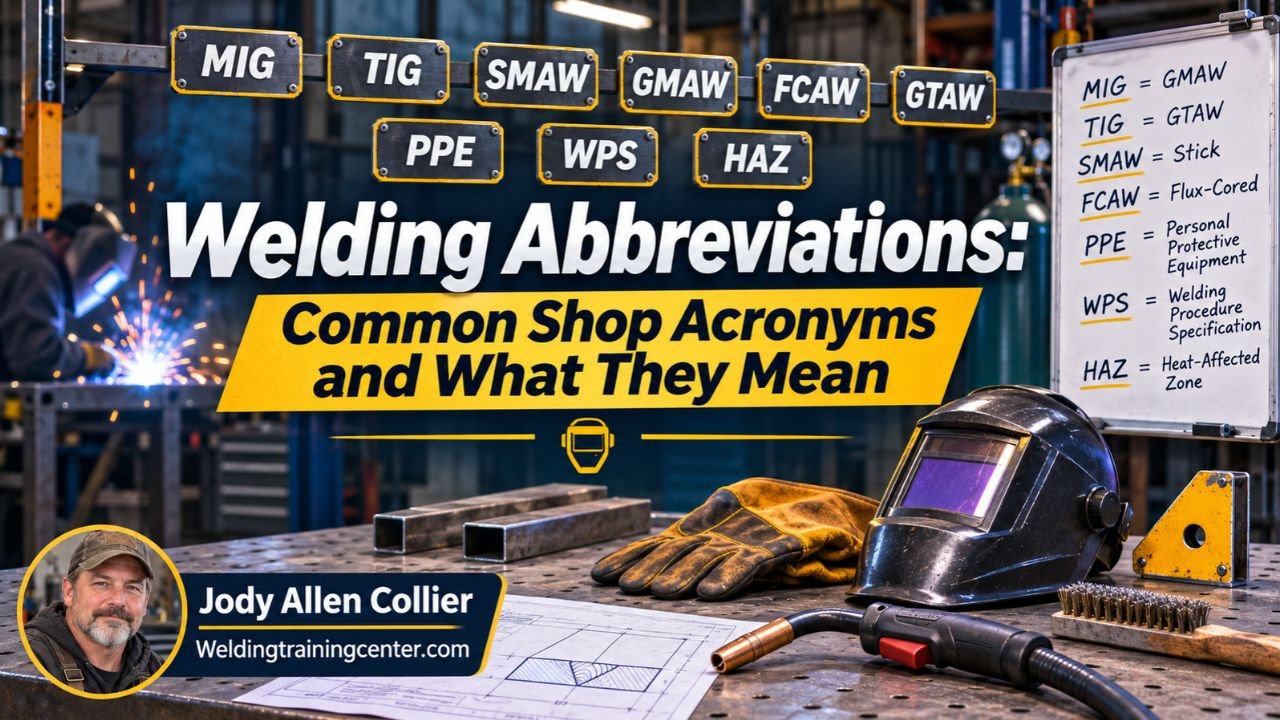
Welding abbreviations shorten names for processes, equipment, weld positions, and paperwork; the most common process codes include SMAW, GMAW, GTAW, and FCAW. Read the surrounding instruction before acting, since a familiar letter combination can have a specific meaning in a particular procedure.
| Abbreviation | Meaning | Where you’ll see it |
|---|---|---|
| SMAW | Shielded metal arc welding | Stick welding procedures and job instructions |
| GMAW | Gas metal arc welding | Wire-feed welding procedures |
| GTAW | Gas tungsten arc welding | Tungsten-electrode welding procedures |
| FCAW | Flux-cored arc welding | Tubular wire processes |
| SAW | Submerged arc welding | Mechanized or heavy fabrication work |
| PAW | Plasma arc welding | Specialized arc-welding applications |
| OAW | Oxyacetylene welding | Gas-welding instructions and training |
| MIG | Metal inert gas, a common name for GMAW | Shop conversation and equipment descriptions |
| TIG | Tungsten inert gas, a common name for GTAW | Shop conversation and equipment descriptions |
SMAW is stick welding, where a flux-coated electrode creates the arc and supplies filler metal. GMAW uses a continuously fed wire electrode and shielding gas, while FCAW uses tubular wire with flux inside; some FCAW setups also use shielding gas.
GTAW uses a nonconsumable tungsten electrode, with filler metal added separately when needed. MIG and TIG are widely used everyday names, but the formal process names are more precise, especially on procedures and qualification records.
The basic mechanics behind an arc, filler metal, and shielding gas are explained in how welding works. If a job sheet lists SMAW and your machine is set up for GMAW, stop and confirm the intended process before striking an arc.
The short answer to “Are MIG and GMAW the same?” is that MIG commonly refers to GMAW, but the formal code is the safer term for paperwork. Shielding gas details can vary, so don’t assume that the informal name tells you the full setup.
Pro Tip: When you’re unsure about a process abbreviation, compare it with the process name and equipment requirements in the applicable welding procedure, not just the machine’s front panel.
Process, Machine, and Position Shorthand
Welding shorthand also describes electrical output, polarity, electrode type, and the position of the joint. Those details matter because two welds made with the same process can call for different equipment settings or techniques.
| Term | Plain meaning | Why it matters |
|---|---|---|
| AC | Alternating current | Current changes direction; the procedure or equipment specifies its use |
| DC | Direct current | Current flows in one direction |
| DCEP | Direct current electrode positive | Electrode is connected to the positive terminal |
| DCEN | Direct current electrode negative | Electrode is connected to the negative terminal |
| CC | Constant current | Output is designed to hold current steady as arc length changes |
| CV | Constant voltage | Output is designed to hold voltage steady as conditions change |
| FCAW-G | Gas-shielded flux-cored arc welding | Uses flux-cored wire with added shielding gas |
| FCAW-S | Self-shielded flux-cored arc welding | Uses flux-cored wire without external shielding gas |
| F | Flat position | Weld is made from above the joint |
| H | Horizontal position | Weld is made on a horizontal joint |
| V | Vertical position | Weld is made on a vertical joint |
| O | Overhead position | Weld is made from beneath the joint |
Polarity abbreviations describe which output terminal connects to the electrode. DCEP means the electrode connects to positive, while DCEN means it connects to negative; follow the procedure and electrode manufacturer’s instructions rather than guessing from habit.
CC and CV describe how a power source controls its output. Stick and TIG machines commonly use constant-current output, while GMAW machines commonly use constant-voltage output, though the required setup depends on the process and equipment.
Position shorthand often appears in qualification codes and weld instructions. F, H, V, and O are plain position labels, while numbered codes such as 1G or 3G identify specific test positions and joint orientations; the governing code or procedure explains the exact qualification scope.
If a job says “FCAW-S, vertical,” the self-shielded process and vertical position both matter. Swapping in gas-shielded wire because it’s already on the cart changes the process, even if the machine looks ready to go.
Process names like SMAW, GMAW, GTAW, and FCAW are also covered in basic welding process names. That comparison helps when a shop uses a nickname on the floor but the work instruction uses the formal abbreviation.
What should you do when the shop term and job sheet don’t match? Pause and ask the supervisor or check the approved procedure, because a conversational nickname doesn’t authorize a different process.
A few machine terms are easy to confuse:
- Amps (A) measure welding current.
- Volts (V) measure electrical potential.
- Wire feed speed (WFS) describes how quickly consumable wire feeds toward the arc.
- IPM means inches per minute and may describe wire feed speed.
- CFH means cubic feet per hour and may describe shielding-gas flow.
Use the units and the machine control labels together. A number without its unit is like a recipe that says “add 10,” then walks out of the kitchen.
Welding Documents, Standards, and Shop Language
Welding paperwork uses abbreviations to identify procedures, qualifications, organizations, and safety gear. A welder should know the difference between a document title, a test record, and a casual term before relying on any of them.
| Abbreviation | Meaning | Typical use |
|---|---|---|
| WPS | Welding procedure specification | Gives the approved welding instructions |
| PQR | Procedure qualification record | Records results from qualifying a procedure |
| WPQ | Welder performance qualification | Records a welder’s qualification test results |
| WQTR | Welder qualification test record | Name used for a record of welder qualification testing |
| AWS | American Welding Society | Organization that publishes welding standards and other material |
| ASME | American Society of Mechanical Engineers | Organization associated with codes used in some industries |
| PPE | Personal protective equipment | Helmet, gloves, protective clothing, and other safety gear |
| SDS | Safety data sheet | Hazard and handling information for a product |
A WPS tells you how a weld is to be made within its stated limits. A PQR documents testing used to support a procedure qualification, while a welder’s performance qualification record documents a person’s test results; the job’s governing code determines what documents apply.
I once treated an abbreviated note as if it were just a reminder and started setting up before checking the full procedure. A missing detail changed what I needed to confirm, so I stopped and read the controlled document instead; the pause was far cheaper than guessing.
Important Tip: If a WPS or drawing has an abbreviation you can’t identify, ask before welding. Don’t fill gaps in a controlled instruction with memory or a shop nickname.
AWS stands for American Welding Society, but AWS on a document doesn’t by itself tell you which standard or edition applies. Look for the full standard designation and any project requirements; AWS’s role in welding helps distinguish the organization’s name from the specific rules governing a job.
Shop slang can be useful for quick conversation, but slang isn’t a substitute for a formal process name or written instruction. Terms such as “stick,” “wire,” and “TIG” are common informal labels; common welding slang can help you follow shop talk without treating every nickname as a technical specification.
Why can’t you just use whichever meaning sounds right? Because the wrong reading may change the process, consumable, position, or safety step, and those differences can affect the finished weld.
Other document abbreviations you may run into include:
- BOM: bill of materials, a list of specified parts and materials.
- NDE: nondestructive examination, a broad term for checking a weld without damaging the part.
- VT: visual testing, an inspection method based on viewing the weld.
- RT: radiographic testing, an inspection method that uses radiation to examine a weld.
- UT: ultrasonic testing, an inspection method that uses sound waves.
Inspection abbreviations tell you what kind of examination is involved, not whether the weld has passed. The acceptance rules come from the applicable code, drawing, or project documents.
Treat PPE and SDS as practical safety terms, not paperwork clutter. Before using a chemical product or cleaning material, check its safety information and follow the shop’s ventilation and protective-equipment requirements.
A quick way to decode a new abbreviation is to work through this order:
- Check whether it names a process, setting, position, document, or inspection.
- Read the full line and nearby notes, not just the letters.
- Look in the approved WPS, drawing, code, or equipment manual named by the job.
- Ask the responsible person if the meaning still isn’t clear.
That habit is especially helpful when the same letters appear in unrelated contexts. The surrounding words usually narrow the meaning, but a controlled document or qualified person should settle any safety or quality question.
- Process codes such as SMAW and GTAW identify specific welding methods.
- Informal names like MIG and TIG may not include every setup detail.
- WPS, PQR, and welder qualification records serve different purposes.
- If an abbreviation could change the process or safety steps, verify it before work.
FAQs About Welding Abbreviations
What does SMAW mean in welding?
SMAW means shielded metal arc welding, commonly called stick welding. The process uses a flux-coated consumable electrode to create the arc and provide filler metal. A procedure may also list the electrode classification, position, and electrical settings, so the SMAW abbreviation alone isn’t a complete set of welding instructions.
Are MIG and GMAW the same thing?
MIG is a common shop name for gas metal arc welding, whose formal abbreviation is GMAW. The names are closely related in everyday use, but a procedure may specify shielding gas and other details that the word MIG doesn’t communicate. Use GMAW when you’re reading formal job documents.
What does GTAW stand for?
GTAW stands for gas tungsten arc welding, a process that uses a nonconsumable tungsten electrode. Welders often call it TIG. Filler metal can be added separately when the joint requires it, so the process name doesn’t mean every weld uses filler.
What’s the difference between a WPS and a PQR?
A WPS is the welding procedure specification that gives the instructions for making a weld within its stated limits. A PQR is a procedure qualification record that documents testing supporting a qualified procedure. The terms describe different documents, and neither should be substituted for the other.
What do DCEP and DCEN mean?
DCEP means direct current electrode positive, and DCEN means direct current electrode negative. The terms describe the electrode’s polarity connection to the power source. The correct choice depends on the approved procedure, electrode, and equipment, so check those details instead of relying on a general rule.
Does AWS mean a welding code?
AWS means American Welding Society, the name of an organization that publishes standards and other welding material. The abbreviation by itself doesn’t identify the rule that applies to a particular job. Check the full standard designation and project documents before deciding which requirements govern the work.
Make the Abbreviation Match the Job
Welding abbreviations are useful shortcuts, but they’re only useful when you read them in context. A process code, a machine setting, and a qualification document can all appear on the same page, and each one answers a different question.
I’d use the formal wording on job paperwork and save shop shorthand for conversation. That small distinction makes it easier to catch a mismatch before setup, especially when a job involves multiple processes or position requirements.
The next time a note looks like alphabet soup, identify what kind of term it is, check the full instruction, and ask if anything still feels unclear. A few seconds of checking beats an avoidable setup change or a weld you have to do twice.