Fusion Welding Training: Processes, Skills, Safety and Careers
Fusion Welding training teaches students how metals are joined by melting the base material at the joint and allowing the molten weld metal to solidify into a permanent connection. Depending on the process, filler metal may be added, while shielding gas, flux, or another protective method may be used to protect the molten weld pool.
A good Fusion Welding training program goes beyond learning how to strike an arc or produce an acceptable-looking bead. Students need to understand heat control, base-metal behavior, filler-metal selection, joint preparation, welding positions, common defects, safety, and the relationship between machine settings and weld quality.
Fusion welding covers several important industrial processes, including SMAW, GMAW, FCAW, GTAW, and Submerged Arc Welding. The American Welding Society distinguishes fusion welding from solid-state welding because fusion welding forms the joint by melting adjoining materials, while solid-state processes create bonding without melting the base materials.
What Is Fusion Welding Training?
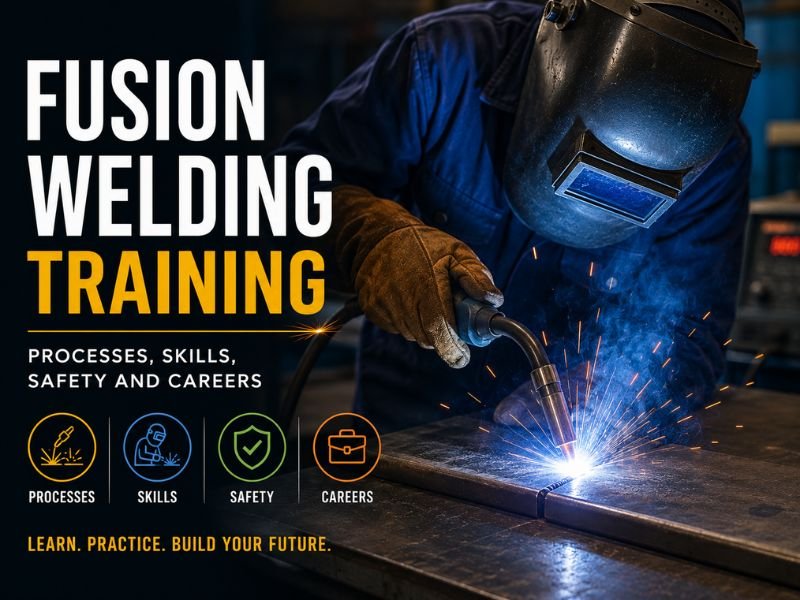
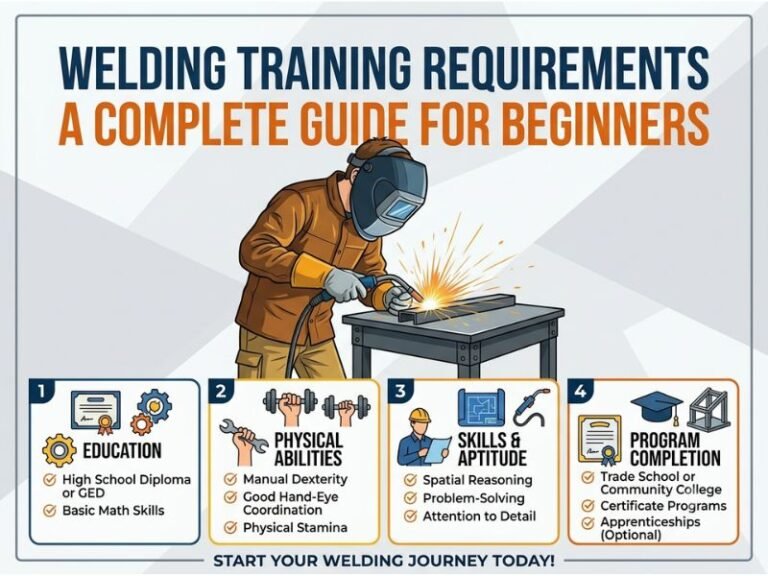
Fusion Welding training is technical and practical instruction focused on welding processes that melt the base metal to form a joint.
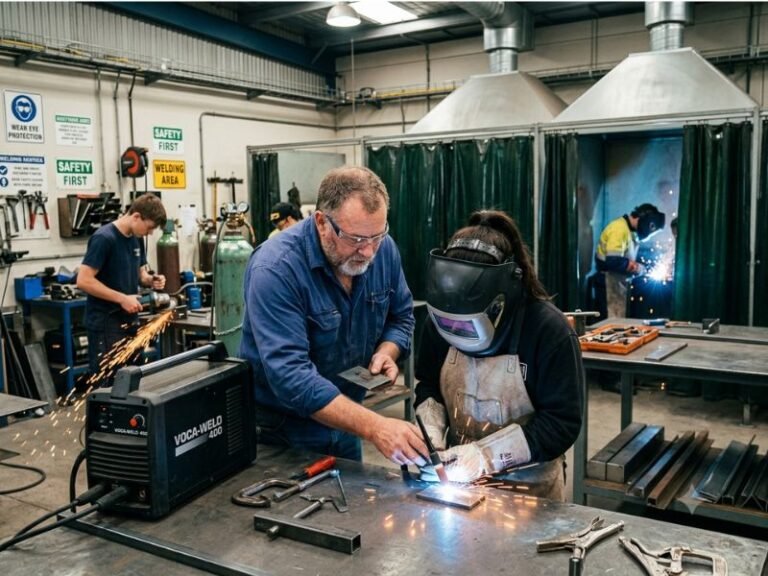
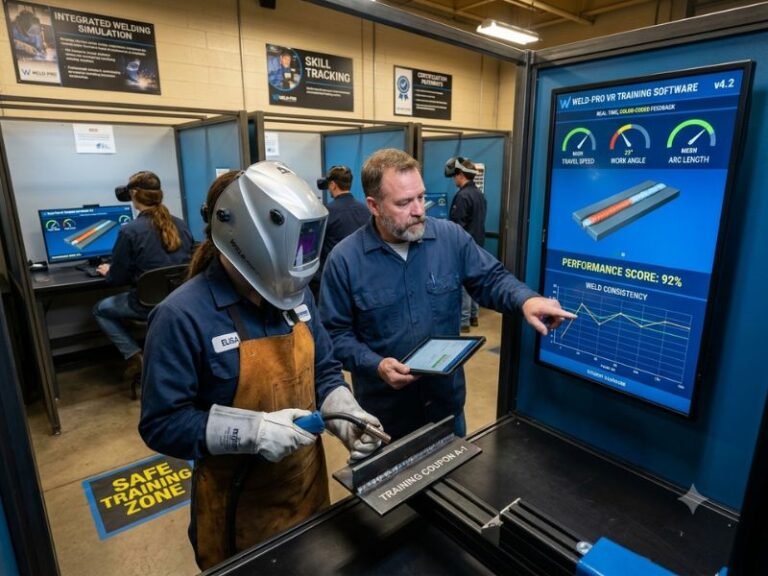
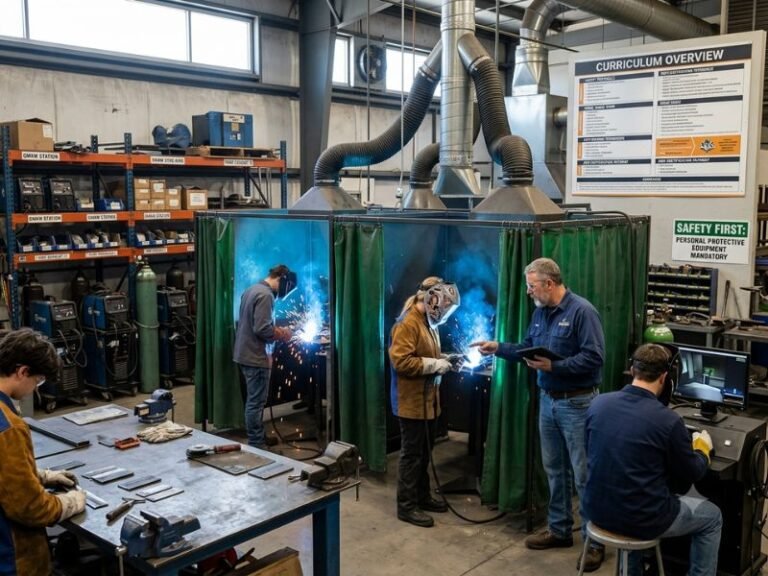
A complete program may combine classroom instruction, demonstrations, welding-booth practice, inspection, and performance testing.
Students typically learn about:
- Welding processes and equipment
- Base metals and filler metals
- Welding current and voltage
- Joint design and fit-up
- Shielding gases and fluxes
- Welding positions
- Heat input and distortion
- Weld discontinuities and defects
- Welding safety
- Welding Procedure Specifications
- Basic inspection principles
AWS provides welding education frameworks through its SENSE program, which establishes minimum standards and guidelines that schools can use when developing welding education and training programs.
What Is Fusion Welding?
Fusion welding creates a joint by supplying enough concentrated heat to melt the adjoining base-metal surfaces.
The molten material forms a weld pool. When that pool cools and solidifies, it produces the welded joint.
Some fusion processes also melt a filler metal into the joint. Others can produce certain welds without additional filler.
The heat source can vary considerably. Common sources include:
- Electric arcs
- Gas flames
- High-energy beams
The defining feature is not the exact heat source. It is the melting and subsequent solidification of material at the joint. AWS welding science references make this melting distinction when separating fusion welding from solid-state welding.
Who Should Take Fusion Welding Training?
Fusion welding instruction can serve both beginners and experienced tradespeople.
It is particularly relevant to:
- Welding students
- Fabricators
- Maintenance technicians
- Manufacturing employees
- Automotive and transportation workers
- Structural welding personnel
- Existing welders adding another process
- Supervisors who need stronger process knowledge
A beginner may start with basic safety, joint terminology, machine controls, and simple welds.
An experienced welder may focus on a new process, material, position, code requirement, or production application.
Is Previous Welding Experience Required?
Not necessarily.
Entry-level welding programs are designed to build fundamental skills from the beginning. More specialized courses may expect students to understand welding terminology, electrical principles, basic metallurgy, and common joint configurations.
Previous experience becomes particularly useful when studying why parameter changes affect penetration, bead shape, heat input, or distortion.
Which Processes Are Covered in Fusion Welding Training?
“Fusion welding” describes a family of welding processes rather than one specific machine or technique.
The exact processes taught depend on the program.
Shielded Metal Arc Welding
Shielded Metal Arc Welding, or SMAW, uses a flux-coated consumable electrode.
The arc melts both the electrode and base metal. The electrode coating provides shielding and forms slag over the cooling weld.
SMAW remains relevant to structural work, field welding, repair, and applications where portability matters.
Gas Metal Arc Welding
Gas Metal Arc Welding, commonly called MIG welding, uses a continuously fed wire electrode and external shielding gas.
Training typically emphasizes:
- Voltage
- Wire-feed speed
- Travel speed
- Gun angle
- Contact-tip distance
- Shielding-gas coverage
GMAW is widely applicable to fabrication and production work because continuous wire feeding supports efficient welding.
Flux-Cored Arc Welding
Flux-Cored Arc Welding uses a tubular wire electrode containing flux.
Depending on the electrode, FCAW can use external shielding gas or operate as a self-shielded process.
AWS describes FCAW as a semi-automatic or automatic arc welding process that uses a continuously fed consumable flux-filled electrode.
Gas Tungsten Arc Welding
Gas Tungsten Arc Welding, or TIG welding, uses a nonconsumable tungsten electrode.
Filler metal is added separately when required.
GTAW training usually places strong emphasis on:
- Arc length
- Heat control
- Torch angle
- Shielding gas
- Filler placement
- Surface cleanliness
The process is particularly useful where precise heat control and clean weld appearance are important.
Submerged Arc Welding
Submerged Arc Welding uses a continuous electrode while the arc operates beneath granular flux.
It is commonly mechanized and is particularly valuable for long welds and heavy fabrication. AWS identifies SAW as a fusion welding process in which the arc is established beneath a blanket of granular flux.
Fusion Welding Equipment
Training should help students understand the function of each major piece of equipment instead of simply memorizing machine settings.
Welding Power Source
The power source supplies the electrical energy used by arc welding processes.
Different processes may use constant-current or constant-voltage characteristics, AC or DC output, and different polarity arrangements.
Correct settings depend on the welding process, electrode, material, thickness, and applicable procedure.
Torch, Gun, or Electrode Holder
The device used to deliver welding current depends on the process.
Examples include:
- SMAW electrode holder
- GMAW welding gun
- FCAW gun
- GTAW torch
- SAW welding head
Each system controls the electrode and arc differently.
Wire Feeding Equipment
GMAW, FCAW, and SAW commonly use continuous wire feed.
Feed consistency is important because unstable feeding can produce an unstable arc or inconsistent weld.
Shielding-Gas Equipment
Processes using external gas shielding require equipment such as:
- Gas cylinder
- Regulator
- Flowmeter
- Hoses
- Welding gun or torch
Gas flow must be sufficient to protect the weld pool without creating unnecessary turbulence or waste.
Base Metals in Fusion Welding Training
Welding behavior changes significantly with material type.
Carbon Steel
Carbon steel is common in welding education because it is widely used in fabrication and construction.
Students learn how thickness, surface condition, joint preparation, and heat input influence weldability.
Stainless Steel
Stainless steel requires more attention to heat input, filler selection, and contamination control.
Excessive heat can also contribute to distortion and changes in the heat-affected region.
Aluminum
Aluminum presents different challenges because it has high thermal conductivity and a persistent surface oxide layer.
Training may therefore emphasize cleaning, shielding, filler selection, and controlled heat application.
Other Alloys
Advanced programs may cover low-alloy steels, nickel alloys, titanium, magnesium, or other specialized materials.
AWS aerospace fusion-welding requirements, for example, address fusion welding across several alloy families, including aluminum-, nickel-, iron-, cobalt-, magnesium-, and titanium-based materials.
Filler Metals and Shielding
Filler metal is selected according to the base material, process, mechanical-property requirements, and welding procedure.
Common forms include:
- SMAW electrodes
- Solid MIG wire
- Flux-cored wire
- TIG filler rod
- SAW electrode wire
Using a filler simply because it melts successfully does not make it appropriate for the joint.
Why Shielding Matters
Molten weld metal can react with the surrounding atmosphere.
Fusion welding processes therefore use different methods to protect the welding zone.
GMAW and GTAW commonly use shielding gas. SMAW relies heavily on electrode coating, FCAW uses flux within the electrode, and SAW operates beneath granular flux.
Poor shielding can contribute to porosity, oxidation, and inconsistent weld quality.
Welding Parameters Students Learn to Control
Good welding depends on relationships among several variables rather than one “correct” machine setting.
Welding Current
Current affects heat generation, electrode melting, and penetration.
Too little current can contribute to poor fusion, while excessive current may cause an unsuitable bead profile, excessive penetration, or unnecessary heat.
Arc Voltage
Voltage is closely related to arc characteristics and bead profile.
Its exact effect depends on the welding process.
Travel Speed
Travel speed determines how quickly the heat source moves along the joint.
An excessively slow travel rate can introduce unnecessary heat and deposit too much weld metal. Excessive speed can contribute to a narrow bead or inadequate fusion.
Electrode and Torch Position
Torch angle and electrode position direct heat and filler metal into the joint.
Even suitable electrical parameters can produce poor results when the arc is directed incorrectly.
Heat Input and the Heat-Affected Zone
Heat control is one of the most important concepts in Fusion Welding training.
The welding arc or flame does more than melt the immediate joint.
Heat also travels into the surrounding base metal. AWS welding references treat heat flow as a fundamental part of fusion-welding science because heating and cooling influence the welded material.
What Is the Heat-Affected Zone?
The heat-affected zone, or HAZ, is the portion of base metal that does not melt but experiences thermal changes from welding.
Those temperature cycles can affect material properties.
This is why a technically sound weld cannot be judged only by the visible surface of the bead.
Why Preheat and Interpass Temperature Matter
Certain materials and welding procedures specify preheat or interpass-temperature requirements.
These controls may be important for managing cooling behavior, hydrogen-related cracking risk, mechanical properties, or procedure compliance.
There is no single correct preheat temperature for all fusion welding.
Joint Design and Fit-Up
A well-set welding machine cannot compensate for every joint-preparation problem.
Students learn common joint configurations such as:
- Butt joints
- Lap joints
- T-joints
- Corner joints
- Edge joints
Groove welds may also involve specific root openings, groove angles, and root faces.
Proper fit-up influences penetration, weld-metal volume, distortion, and repeatability.
Welding Positions in Training
Fusion welding programs usually introduce several welding positions.
Flat Position
Flat welding generally gives the student the greatest control over the molten weld pool and is commonly used for developing basic technique.
Horizontal Position
Horizontal welding introduces greater influence from gravity and requires improved bead control.
Vertical Position
Vertical welding requires the welder to manage molten metal against gravity.
Technique and applicable procedure determine whether progression is upward or downward.
Overhead Position
Overhead welding places additional demands on weld-pool control and operator protection.
As position becomes more difficult, consistent technique and correct parameters become increasingly important.
Common Fusion Welding Defects
Recognizing defects is a major part of learning to evaluate welding quality.
Porosity
Porosity consists of gas cavities trapped in the solidified weld.
Potential contributors include contamination, poor shielding, moisture, or unsuitable process conditions.
Lack of Fusion
Lack of fusion occurs when weld metal does not adequately fuse with the base metal or a previous weld pass.
Heat input, travel speed, electrode placement, joint preparation, and technique may all contribute.
Incomplete Penetration
Incomplete penetration means the weld does not extend as required through the joint root.
Joint geometry and welding variables both matter.
Undercut
Undercut is a groove at the weld toe that is not adequately filled with weld metal.
It can be influenced by heat, travel, electrode position, and technique.
Slag Inclusion
Slag inclusion is particularly relevant to flux-producing processes.
Poor cleaning between passes or unfavorable bead placement can trap slag within the weld.
Cracking
Cracks deserve serious attention because their causes can involve metallurgy, hydrogen, joint restraint, cooling behavior, or procedure variables.
A crack should not be treated as a cosmetic surface defect.
Welding Distortion
Fusion welding introduces localized heating followed by cooling and contraction.
That uneven thermal cycle can distort a component.
Students learn that distortion is affected by:
- Heat input
- Material thickness
- Joint design
- Weld sequence
- Restraint
- Amount of deposited weld metal
Distortion control is important because a structurally acceptable weld can still create an unusable assembly if dimensions move outside tolerance.
Fusion Welding Safety Training
Welding instruction must include safety as a core technical skill.
OSHA identifies welding hazards that include metal fumes, ultraviolet radiation, burns, eye damage, electrical shock, cuts, and crushing injuries.
Arc Radiation
Electric arcs can produce intense ultraviolet and infrared radiation.
Appropriate welding helmets, filter lenses, protective clothing, and screens help protect welders and nearby personnel.
Welding Fumes
Welding can generate fumes and gases whose hazards depend on the process, consumables, base metal, coatings, and work environment.
Ventilation and other exposure controls are therefore important. OSHA specifically identifies welding fumes as a health concern and sets requirements addressing ventilation and protection in applicable workplaces.
Electrical Hazards
Arc welding equipment presents electric-shock risks.
OSHA’s arc-welding rules address equipment condition and electrical safety practices, including taking defective equipment out of service until it is safe.
Fire and Hot-Metal Hazards
Sparks, slag, and heated workpieces can ignite nearby combustible materials.
OSHA requires fire hazards to be removed or protected where welding and cutting are performed.
Learning to Read a Welding Procedure Specification
Industrial welding often requires work to follow a Welding Procedure Specification, commonly called a WPS.
A WPS may identify:
- Welding process
- Base material
- Filler metal
- Current
- Voltage
- Polarity
- Welding position
- Joint design
- Preheat
- Interpass temperature
- Other applicable variables
Learning to follow a WPS helps move a student from general welding practice toward controlled production welding.
Weld Inspection Basics
Welders should be able to identify obvious conditions in their own work.
Visual inspection may consider:
- Weld size
- Bead profile
- Undercut
- Surface porosity
- Cracks
- Overall consistency
Training may also introduce destructive tests such as bend testing and nondestructive examination methods such as penetrant, magnetic particle, ultrasonic, or radiographic testing.
Specialized NDT methods require additional knowledge and, where applicable, specific qualification.
Fusion Welding Training vs. Welder Qualification
Training and qualification are related but different.
Training develops knowledge and skill. Qualification demonstrates that a welder can meet specified test requirements.
AWS SENSE, for example, distinguishes welding education standards from specific qualification and certification requirements. AWS provides separate specifications for qualification and certification of entry and advanced welders within that framework.
Completing a welding course does not automatically qualify someone for every process, material, thickness, position, or code application.
A production job may require a specific performance qualification.
Where Are Fusion Welding Skills Used?
Fusion welding processes are used across a wide range of industries because different methods can be adapted to very different materials and production needs.
Common areas include:
- Structural fabrication
- Manufacturing
- Automotive production and repair
- Heavy equipment
- Pipe fabrication
- Pressure equipment
- Shipbuilding
- Aerospace
- Industrial maintenance
The particular welding process matters. A procedure suited to thin automotive sheet is not automatically appropriate for heavy structural plate or aerospace alloy components.
How Long Does Fusion Welding Training Take?
There is no universal course length.
Training may range from short process-specific instruction to multi-month trade-school programs, apprenticeships, or employer-based programs.
AWS offers welding education resources for different career stages and describes SENSE as a framework that educators can use to build welding curricula around defined knowledge and performance expectations.
Course duration therefore matters less than the competencies actually covered and demonstrated.
Frequently Asked Questions
What Is Fusion Welding Training?
Fusion Welding training teaches the principles and practical skills involved in welding processes that melt the base material. It may cover equipment, welding parameters, filler metals, shielding, heat control, joints, defects, inspection, and safety.
Is Fusion Welding Difficult to Learn?
Basic welding principles can be learned progressively, but consistent weld quality requires practice and an understanding of heat, joint geometry, electrode control, and process variables.
Which Processes Are Considered Fusion Welding?
Common examples include SMAW, GMAW, FCAW, GTAW, and SAW. Other processes can also fall within the broader fusion-welding category when the joining mechanism involves melting the adjoining materials.
Does Fusion Welding Always Require Filler Metal?
No. Some fusion welds can be produced without added filler metal. The need for filler depends on the process, joint, material, thickness, and welding procedure.
What Metals Can Be Fusion Welded?
Fusion-welding processes are used with carbon and low-alloy steels, stainless steels, aluminum alloys, nickel alloys, titanium alloys, and other weldable metals. The process, filler, shielding, and procedure must suit the specific material.
What Is the Difference Between Fusion Welding and Solid-State Welding?
Fusion welding melts adjoining material to create the weld. Solid-state welding creates the bond without melting the base materials, typically through combinations of heat, pressure, deformation, and diffusion.
Can You Get Certified After Fusion Welding Training?
Training can prepare a student for qualification or certification requirements, but course completion does not automatically qualify someone for every welding job. Qualification depends on the applicable process, test, code, employer, and production requirements.
Is Fusion Welding Training Useful for Industrial Jobs?
Yes. Fusion-welding processes are fundamental to structural fabrication, manufacturing, transportation, maintenance, pressure equipment, shipbuilding, aerospace, and many other metalworking industries.
Conclusion
Fusion Welding training builds the technical understanding and practical control needed to produce sound welded joints using processes that melt the base material. Effective training covers far more than bead appearance; it connects equipment, current, voltage, travel speed, filler metal, shielding, joint preparation, heat input, weld defects, and safety.
Students should also understand that welding processes are not interchangeable. GMAW, GTAW, SMAW, FCAW, and SAW may all create fusion welds, but each has different equipment, operating characteristics, consumables, and applications.
The strongest training develops the ability to understand what the weld is doing and why. That foundation can support later process specialization, performance qualification, and work in fabrication, manufacturing, maintenance, structural welding, transportation, and other industries that depend on controlled fusion welding.