Shipyard Welding Training: Practical Guide and Important Details
A new shipyard welder may spend the first day reading a weld procedure, identifying confined-space hazards, and learning how materials move through the yard—not striking an arc. The work can involve awkward positions, thick plate, tight compartments, weather exposure, and quality checks that leave little room for guesswork.
That is why a short general welding class does not always prepare someone for ship construction or repair. Shipyard welding training combines welding fundamentals with maritime safety, production practices, inspection requirements, and qualification tests.
I will explain what this training includes, which welding processes matter, how certification and job qualifications differ, what to look for in a program, and how to prepare for a first shipyard position. The goal is to help a beginner, career changer, or experienced welder choose training that matches actual shipyard work.
What Shipyard Welding Training Covers
Shipyard welding training prepares a person to weld components used in ships, barges, submarines, offshore vessels, and marine repair projects. The work may include hull plate, structural frames, decks, piping, tanks, bulkheads, brackets, and machinery foundations.
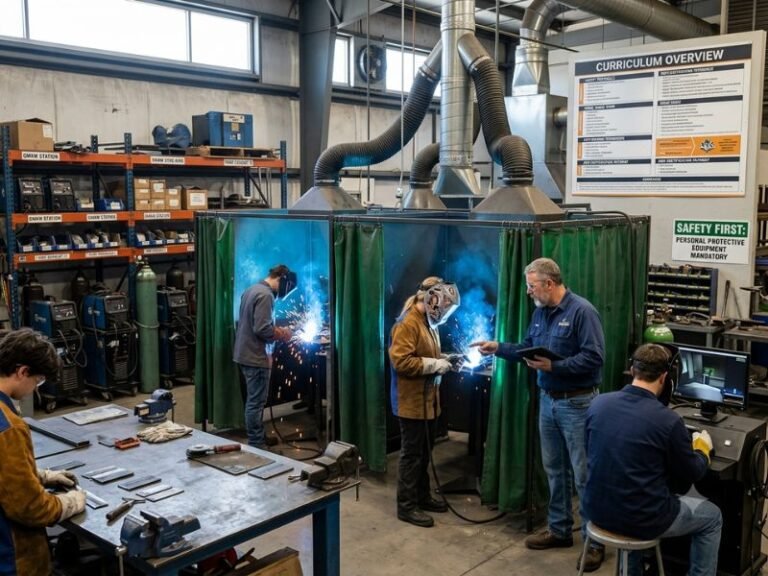
A quality program normally combines classroom instruction, hands-on practice, safety education, and performance testing. The exact curriculum varies by school, union, employer, and vessel type, but the main subjects are consistent:
- Welding theory and electrical fundamentals
- Blueprint and weld-symbol reading
- Joint design, fit-up, tack welding, and alignment
- Shielded metal arc welding, commonly called stick welding
- Gas metal arc welding, including short-circuit and spray techniques
- Flux-cored arc welding, with or without external shielding gas
- Gas tungsten arc welding for selected pipe or precision work
- Welding positions used in ship construction and repair
- Material identification and basic metallurgy
- Distortion control, heat input, and weld sequence
- Visual inspection and weld defect recognition
- Fire prevention, ventilation, confined-space safety, and fall protection
Training also teaches production discipline. A shipyard welder must follow the approved welding procedure specification (WPS), use the correct filler metal, keep surfaces clean, document work when required, and stop when conditions are unsafe or unclear. Creativity has value, but changing a procedure without authorization can create a quality or safety problem.
Why Shipyard Welding Is Different
Shipyard welding uses many of the same arc-welding principles taught in a fabrication shop, but the working environment is more complex. A welder may work inside a narrow tank one day and on an exposed deck the next. The position, access, ventilation, temperature, and wind can change quickly.
Large structures and difficult access
Ship sections are often assembled in stages. Some welds are completed before a compartment becomes difficult to enter; others must be made after surrounding structures are in place. This creates overhead, vertical, horizontal, and restricted-access welds.
Training should therefore move beyond flat-position practice. I would look for repeated practice on realistic joints, including fillet welds, groove welds, lap joints, tee joints, and connections involving plate of different thicknesses.
Strict quality requirements
A marine weld can affect watertight integrity, structural strength, fatigue resistance, or the safe operation of equipment. Shipyards may use visual testing, magnetic particle testing, dye penetrant testing, radiographic testing, or ultrasonic testing depending on the component and applicable requirements.
A welder does not usually perform every nondestructive examination, but training should explain what inspectors look for. Common concerns include lack of fusion, incomplete penetration, porosity, undercut, overlap, cracks, excessive reinforcement, arc strikes, and unacceptable profile.
Maritime hazards
Shipyard hazards include hot work, fumes, fire, compressed gases, electrical energy, lifting operations, moving equipment, noise, poor footing, work at height, and confined spaces. A vessel can contain residues or atmospheres that make hot work especially dangerous.
Safety training should cover permits, gas testing, ventilation, fire watches, emergency communication, respirator requirements, lockout and tagout, and rescue procedures. OSHA requirements apply to many U.S. shipyard activities, while employers may also follow company rules, coast guard requirements, classification society standards, or customer specifications.
Core Welding Processes to Learn
No single process makes someone ready for every shipyard job. The best combination depends on the yard’s production methods and the type of work being performed.
Shielded metal arc welding
Shielded metal arc welding (SMAW), often called stick welding, remains important for field work, repair, and situations where portability matters. It can handle outdoor conditions better than processes that rely heavily on an external shielding gas, although wind and contamination still affect results.
Training should include electrode selection, polarity, arc length, travel angle, rod storage, slag removal, and control of starts and stops. A beginner also needs to understand how moisture can affect low-hydrogen electrodes and why storage procedures matter.
Flux-cored arc welding
Flux-cored arc welding (FCAW) is widely associated with high-production structural welding. It can provide strong deposition rates and may be used with self-shielded or gas-shielded wire.
Students should learn how wire type, shielding gas, voltage, wire-feed speed, contact-tip-to-work distance, travel angle, and stickout influence the weld. Flux removal between passes is essential when the procedure requires it. Poor cleaning can trap slag and lead to defects.
Gas metal arc welding
Gas metal arc welding (GMAW), commonly known as MIG welding, can be productive and relatively easy to learn at a basic level. Shipyard programs may teach short-circuit transfer for thinner material or spray and pulsed techniques for other applications.
Because GMAW depends on shielding gas, students must understand drafts, leaks, regulator settings, gun angle, and surface cleanliness. A stable arc does not automatically mean a sound weld. Fit-up, penetration, and procedure requirements still control the result.
Gas tungsten arc welding
Gas tungsten arc welding (GTAW), or TIG welding, provides precise control and a clean weld when properly performed. It is more common for selected pipe, stainless steel, aluminum, and specialty applications than for all structural hull welding.
TIG training can be valuable, but a beginner should not choose a program solely because it offers TIG. A program focused on shipyard employment should prioritize the processes and positions demanded by local employers.
Shipyard Welding Certifications and Qualifications
One of the most confusing parts of this career is the difference between completing a class, holding a general certification, and passing an employer or project qualification test.
Course completion
A school certificate may show that a student attended training and met the school’s requirements. It can help demonstrate preparation, but it does not automatically qualify a person to weld every joint, material, process, or position.
Welder performance qualification
A welder performance qualification records the conditions under which a person successfully welded a test coupon. The qualification may be limited by process, position, base-metal group, thickness, filler metal, backing, and other variables.
For example, passing a flat-position test with one process does not necessarily authorize overhead structural welding with another process. The employer or governing code determines how a test is administered and what range it covers.
Employer and shipyard tests
Many shipyards test applicants or new hires using company procedures. A candidate may be asked to weld a plate or pipe coupon in a specified position and then have it visually or destructively examined. Some employers accept current qualifications from another organization; others require a yard-specific test.
Before paying for a program, I recommend asking which qualifications the training supports and whether local yards recognize them. Useful questions include:
- Which welding processes and positions are practiced?
- Does the school administer performance qualification tests?
- Which code, standard, or employer procedure governs the test?
- Are test plates, consumables, and examination fees included?
- How long are qualifications documented or maintained?
- Does the program help graduates prepare for a specific employer test?
AWS certifications can be relevant, but an AWS credential and a shipyard qualification are not automatically interchangeable. The employer, contract, or applicable code controls the acceptance criteria.
Safety Training for Shipyard Welders
Safety is not a separate subject that can be memorized and forgotten after orientation. It shapes how a welder sets up a job, communicates with a crew, enters a compartment, and responds to changing conditions.
Hot work and fire prevention
Hot work can ignite paint, insulation, fuel residues, dust, packaging, or materials on the opposite side of a bulkhead. Training should cover hot-work permits, combustible removal, fire blankets, fire watches, extinguishing equipment, and post-work monitoring.
A welder must also recognize that heat travels through steel. A safe-looking work area on one side may be dangerous on the other side. Communication with nearby trades is part of the job.
Confined spaces
Tanks, voids, compartments, and other restricted areas may have limited entry and exit or hazardous atmospheres. Confined-space instruction should address atmospheric testing, oxygen deficiency, toxic gases, ventilation, attendant responsibilities, entry permits, and rescue planning.
Ventilation must remove fumes without spreading hazards or disturbing shielding gas. A fan alone does not make a space safe, and a respirator does not replace atmospheric testing or hazard control.
Welding fumes and personal protective equipment
Appropriate eye protection, welding helmets, gloves, flame-resistant clothing, hearing protection, respiratory protection when required, and fall protection are basic controls. The correct shade, lens condition, and helmet fit matter because poor visibility can cause both weld defects and injuries.
Fume exposure depends on the material, coating, electrode, process, ventilation, and duration of work. Painted or coated steel may release especially hazardous contaminants when heated. Surface preparation and the employer’s exposure-control program must be followed.
Electrical, gas, and fall hazards
Welding machines, leads, grounds, cylinders, hoses, and regulators must be inspected and used correctly. Damaged cables and improvised connections can create shock, fire, or arc hazards.
Shipyard work may involve scaffolds, ladders, staging, lifts, and open edges. A competent training program treats fall protection and housekeeping as part of welding—not as unrelated construction topics.
What a Strong Training Program Looks Like
Facilities and marketing language can be impressive, but the daily training experience matters more. I would evaluate a program using the following practical criteria.
Enough hands-on welding time
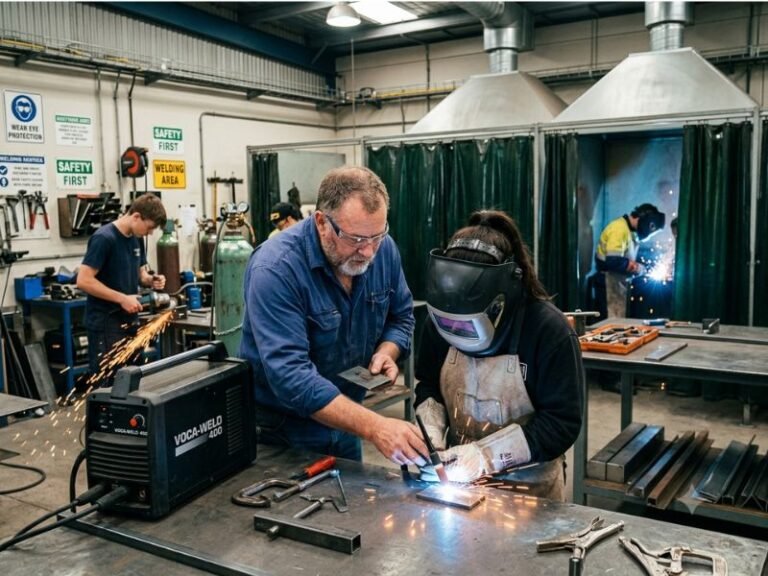
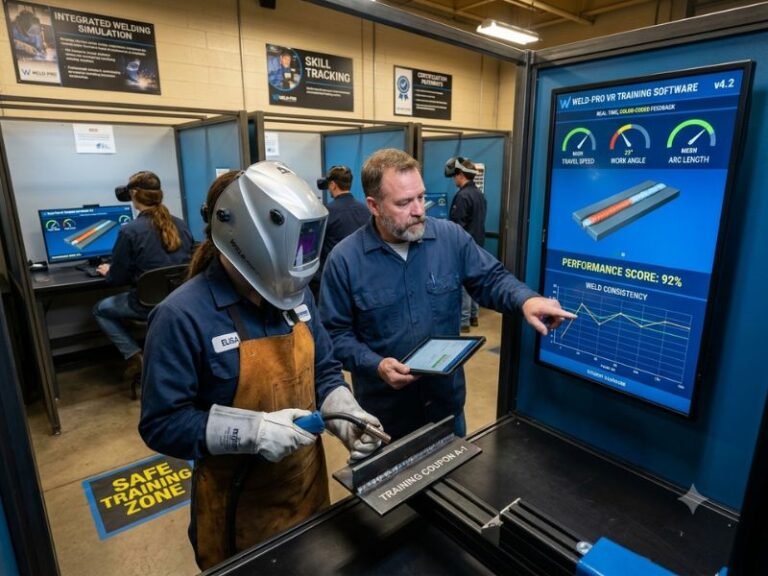
Welding skill comes from controlled repetition followed by useful correction. Ask how much time students spend under the hood, how many booths or machines are available, and how instructors monitor practice.
A class can explain amperage, voltage, polarity, and travel speed in a few hours. Building consistency takes much longer. The program should provide enough material and consumables for students to make mistakes, understand them, and try again.
Instructors with relevant knowledge
Instructors should understand welding technique and the realities of industrial or maritime production. They should be able to explain fit-up, distortion, inspection, procedure compliance, and safe work in restricted spaces.
Ask whether instructors have shipyard, structural, pipe, fabrication, inspection, or welding-supervision backgrounds. Teaching credentials are useful, but relevant technical experience also matters.
Realistic equipment and materials
A shipyard-focused program should expose students to the processes, plate thicknesses, joint configurations, and welding positions used by nearby employers. Equipment does not need to copy one particular yard, but training should not be limited to easy flat coupons if local jobs demand out-of-position work.
Good programs also teach machine setup, consumable identification, cylinder handling, lead management, and basic troubleshooting. Those details affect productivity from the first shift.
Inspection and documentation
Students should learn to inspect their own work before handing it to someone else. Training may include weld gauges, visual acceptance criteria, defect identification, repair methods, and simple records showing the process and settings used.
This builds a useful habit: produce the weld correctly, verify it, and communicate any problem instead of hiding it.
Employer connections
Job placement claims deserve specific questions. Does the school have current relationships with shipyards, contractors, unions, or staffing departments? Are interviews held on campus? Do employers recognize the school’s tests?
A placement rate without information about job type, location, wages, retention, or qualification requirements is difficult to evaluate. Ask for details in writing when possible.
Choosing a Training Path
There is no single route into shipyard welding. The right choice depends on prior experience, available time, budget, and the requirements of local employers.
Community college or technical school
These programs may offer a broad foundation in welding theory, multiple processes, blueprint reading, and general fabrication. They can be a good choice for someone starting from zero or seeking a credential that supports several industries.
The limitation is that a general welding program may devote limited time to marine safety, shipboard access, or employer-specific tests. I would confirm the practical content before enrolling.
Union apprenticeship
An apprenticeship can combine classroom education with paid or supervised work, depending on the sponsoring organization and agreement. It may provide a structured progression through skills, safety, and job responsibilities.
Entry requirements, testing, geographic availability, and application dates vary. Competition may also be significant, so basic welding preparation can strengthen an application.
Employer-sponsored training
Some shipyards hire entry-level workers and teach processes through an internal program. This route can provide direct exposure to the yard’s procedures and expectations.
The tradeoff may be less flexibility and a narrower initial skill range. Read the employment terms carefully, including training obligations, testing, shift requirements, and advancement standards.
Short-term private programs
A focused boot camp can help a motivated person prepare for a welding test quickly. It may be useful for someone who already understands basic safety and needs practice in a particular process or position.
Short programs are less suitable when they promise job readiness without enough hands-on time. A certificate earned after minimal practice cannot substitute for reliable technique.
How to Prepare Before Enrollment
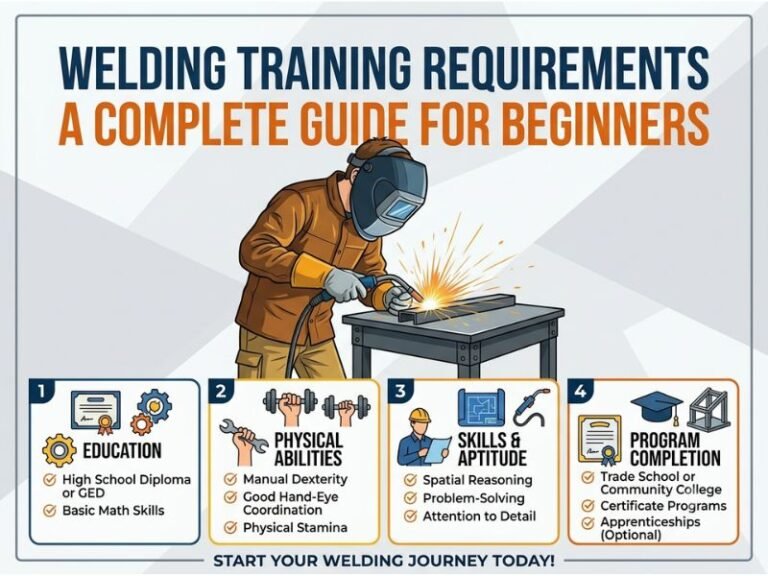
Preparation does not require buying an expensive machine. I would begin by researching nearby shipyards and reading actual job postings. Note the requested processes, positions, shift schedules, physical demands, safety credentials, and qualification tests.
Next, compare programs against those requirements. A school that teaches FCAW and structural plate may be a stronger local match than one that emphasizes ornamental TIG work, even if the latter sounds more advanced.
Before the first lab session, review basic math, fractions, measurement, and unit conversions. Practice reading simple drawings and identifying dimensions, angles, symbols, and notes. Shipyard work also rewards physical preparation: safe lifting habits, balance, endurance, and comfort working on ladders or platforms.
During training, keep a record of processes, electrodes or wires, material thicknesses, positions, settings, and instructor feedback. This creates a personal reference for troubleshooting and gives useful detail during job interviews.
Common Mistakes to Avoid
- Choosing by certificate name alone: A credential has value only when it matches employer and project requirements.
- Ignoring out-of-position welding: Shipyard work rarely stays in the easiest position.
- Skipping blueprint practice: Welders must understand joint details, dimensions, symbols, and sequence notes.
- Treating safety orientation as paperwork: Hazard recognition affects every setup and work decision.
- Using one setting for every joint: Material, thickness, position, wire, electrode, and procedure all influence machine settings.
- Overlooking fit-up: A skilled arc cannot fully correct a badly aligned or contaminated joint.
- Failing to clean between passes: Slag, rust, paint, and moisture can contribute to discontinuities.
- Hiding defects: Reporting a problem early is safer and usually easier than allowing a failed weld to continue through production.
- Assuming one qualification covers all work: Welding qualifications have defined limits.
- Believing speed is the main measure of skill: Production matters, but an acceptable weld made safely and consistently comes first.
Shipyard Welding Training FAQ
How long does shipyard welding training take?
Training length ranges from a short employer course to a multiyear apprenticeship or technical-school program. The useful measure is not calendar time alone; it is whether the student has enough supervised practice to perform required processes and positions safely and pass the relevant qualification test.
Can a beginner enter shipyard welding training?
Yes. Many programs accept beginners, although applicants may need to meet age, education, physical, or drug-screening requirements set by the school or employer. Beginners should expect to learn safety, measurement, fit-up, and welding fundamentals before attempting production-level work.
Do I need a welding certificate to get a shipyard job?
Not always. Some yards hire entry-level helpers or welders and provide testing after hire. A certificate can improve readiness and show commitment, but the hiring employer may require its own performance test before assigning production welds.
Which welding process is best for shipyard work?
There is no universal best process. FCAW and SMAW are important for many structural and repair applications, while GMAW and GTAW may be required for specific production, pipe, aluminum, stainless, or precision work. Local job postings provide the clearest indication of which process to prioritize.
Is shipyard welding training physically demanding?
Yes. The work may require standing, kneeling, climbing, lifting, wearing protective equipment, handling leads, and working in cramped or elevated locations. Physical demands vary by job, but training should prepare students to work safely without sacrificing fit-up, posture, or weld control.
Does an AWS certification qualify me for every shipyard job?
No. An AWS certification or qualification may demonstrate ability under defined conditions, but a shipyard can require additional tests based on its procedures, contract, vessel type, process, material, and position. Always verify acceptance with the specific employer.
What should I bring to a welding training program?
Follow the school’s equipment list. Common requirements may include safety boots, flame-resistant clothing, gloves, eye protection, hearing protection, and a welding helmet with the specified lens shade. Do not substitute personal equipment for required site rules, and ask before buying expensive gear.
Conclusion
A strong Shipyard welding training program teaches more than arc control. It develops safe work habits, blueprint and procedure discipline, out-of-position technique, inspection awareness, and preparation for the qualifications that employers actually use. I would compare programs by hands-on practice, instructor knowledge, realistic equipment, safety depth, and local employer connections—not by the certificate title alone. With the right training path and consistent practice, a new welder can enter shipyard work better prepared to produce sound welds and build a durable marine career.