Oil and Gas Welding Training: Key Facts and Helpful Guidance
Many people assume oil and gas welding training is mainly about learning how to strike an arc. In practice, the most important outcomes are safe work habits, accurate fit-up, code-based welding, and the ability to produce repeatable welds under demanding field conditions.
Oil and gas welding training prepares candidates for work on pipelines, process piping, storage facilities, refineries, drilling operations, and related industrial equipment. A strong program combines welding fundamentals with safety, inspection requirements, procedure control, and practical qualification testing.
What Oil and gas welding training covers
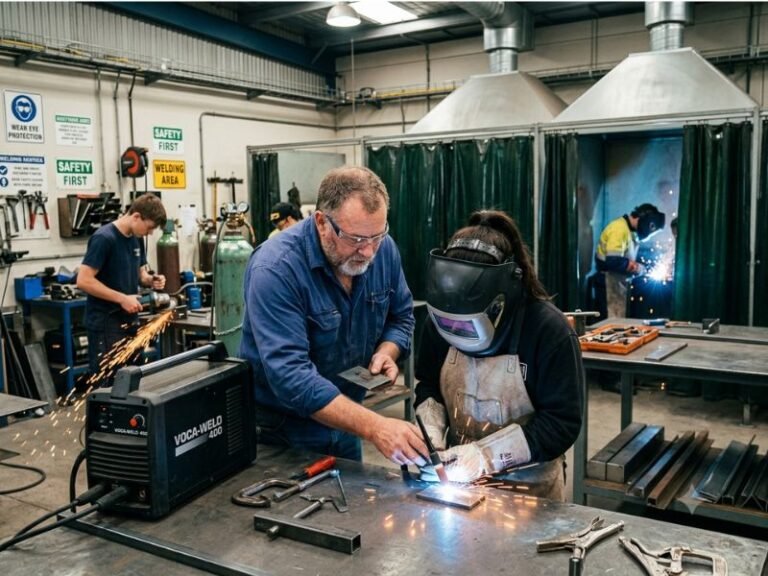
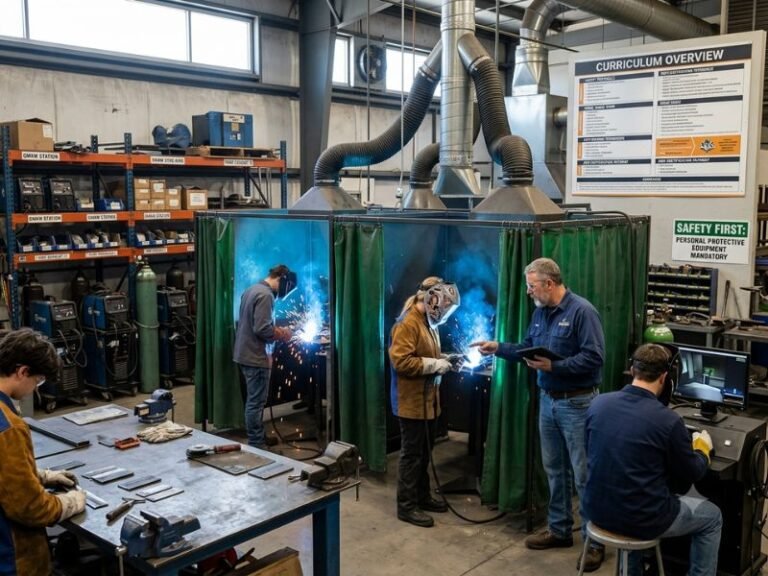
Oil and gas welding training teaches a welder how to join specific materials and thicknesses using approved procedures. The curriculum usually combines classroom instruction, demonstrations, supervised practice, and performance testing.
Core instruction commonly includes:
- Reading welding symbols, drawings, and joint details
- Understanding base metals, filler metals, and shielding gases
- Preparing, aligning, and tacking pipe or structural components
- Controlling amperage, voltage, travel speed, and heat input
- Welding in flat, horizontal, vertical, and overhead positions
- Recognizing weld discontinuities and correcting technique problems
- Following a welding procedure specification (WPS)
- Preparing for visual inspection and nondestructive examination
The exact content depends on the employer, training center, equipment, and intended work. A pipeline welder may spend substantial time on open-root pipe joints, while a process-piping trainee may focus on precise fit-up, stainless steel, and combined GTAW and SMAW procedures.
Essential welding processes
SMAW
Shielded metal arc welding, or stick welding, remains important in many oil and gas environments. It is portable, works outdoors, and does not require an external shielding gas. Training often emphasizes electrode selection, arc length, polarity, storage, and controlled passes.
Pipe welding practice may include root, hot, fill, and cap passes. Each pass has a specific purpose. A poor root can create incomplete penetration, internal undercut, or excessive reinforcement that later affects inspection.
GTAW
Gas tungsten arc welding, commonly called TIG, is used where clean, controlled welds are required. It is frequently associated with pipe roots, stainless steel, alloy materials, and applications where contamination must be minimized.
Trainees learn torch control, tungsten preparation, filler addition, purge practices, and heat management. GTAW is slower than some other processes, but its precision can make it valuable for critical joints.
GMAW and FCAW
Gas metal arc welding and flux-cored arc welding may be used for shop fabrication, structural work, pressure-related components, and production welding. These processes can provide higher deposition rates than GTAW, but they still require careful control of wire type, shielding, polarity, travel speed, and interpass cleaning.
Training should explain when a process is permitted by the governing procedure. A welder cannot substitute one process, electrode, or filler metal for another simply because the equipment is available.
Pipe welding and fit-up skills
Pipe welding requires more than holding a consistent arc. The welder must understand joint geometry, root opening, internal alignment, bevel angle, hi-low, tack placement, and access around the circumference.
Important practical skills include:
- Measuring and cutting pipe accurately
- Cleaning bevels and removing moisture, oil, paint, and scale
- Maintaining the required root gap and alignment
- Placing secure, correctly sized tacks
- Managing starts and stops between welding positions
- Controlling distortion and avoiding excessive reinforcement
- Cleaning each pass before depositing the next one
Position welding is central to oil and gas work. A trainee may practice fixed pipe positions such as 5G and 6G, depending on the target qualification. The 6G position is especially demanding because the pipe is fixed at an angle, requiring continuous adjustments in body position, electrode angle, travel speed, and puddle control.
Good training also teaches the reason behind each fit-up requirement. A root opening that is too narrow can restrict penetration. An excessive gap can cause burn-through or an oversized root bead. Consistent preparation improves both weld quality and test performance.
Codes, procedures, and qualifications
Oil and gas welding is controlled by project specifications, company procedures, and applicable industry codes. Training should introduce the relationship between a welding procedure, a welder qualification, and an inspected production weld.
A WPS identifies permitted variables such as the welding process, base-metal range, filler metal, position, preheat, interpass temperature, electrical settings, and joint design. A procedure qualification record, where required, documents how the procedure was tested. A welder performance qualification shows that a particular person can produce an acceptable weld within defined limits.
Commonly referenced frameworks may include standards from the American Welding Society, the American Society of Mechanical Engineers, the American Petroleum Institute, or project-specific owners and contractors. The applicable standard varies by the type of work. A training provider should explain which code or employer qualification its practical tests support rather than implying that one certificate qualifies a person for every oil and gas job.
Qualification is also limited by variables such as process, material group, thickness, pipe diameter, position, backing, and filler metal. Passing one test does not automatically authorize every welding task. Employers may require additional tests, site orientation, drug screening, safety training, or documented work history.
Safety training for oil and gas welding
Safety is a central part of the trade because welding may occur near flammable liquids, combustible gases, pressurized systems, heavy equipment, and confined spaces. A competent course teaches hazard recognition before production practice begins.
Key topics include:
- Hot-work permits and fire-watch responsibilities
- Gas testing and atmospheric monitoring
- Lockout/tagout and verification of isolation
- Confined-space hazards and entry controls
- Welding fumes, ventilation, and respiratory protection
- Arc flash, ultraviolet exposure, and eye protection
- Electrical grounding and equipment inspection
- Compressed-gas cylinder storage and handling
- Fall protection, ladders, scaffolds, and elevated work
- Emergency response and incident reporting
A major caution is that a pipe or vessel must not be welded until the responsible authority confirms that it is safe to work on. Isolation, draining, purging, cleaning, and testing requirements depend on the system and site. A welder should never rely on assumptions about what a line previously carried.
Personal protective equipment usually includes a properly rated welding helmet, safety glasses, flame-resistant clothing, gloves, hearing protection where needed, and suitable footwear. PPE reduces exposure, but it does not replace permits, ventilation, gas testing, or safe isolation.
Inspection and weld quality
Training should connect welding technique to inspection results. A weld can look acceptable at a glance and still contain an unacceptable discontinuity. Visual inspection may identify undercut, overlap, cracks, porosity, poor profile, arc strikes, incomplete cleaning, or dimensional problems.
Depending on the job, welds may also undergo nondestructive examination such as radiographic testing, ultrasonic testing, magnetic particle testing, or liquid penetrant testing. These methods have different uses and limitations. The welder does not perform every inspection method, but understanding them helps explain why root quality, cleanliness, and consistent parameters matter.
Some projects also use destructive tests during procedure or performance qualification. Bend tests, tensile tests, and macro examinations can reveal internal weaknesses that are not obvious from the surface.
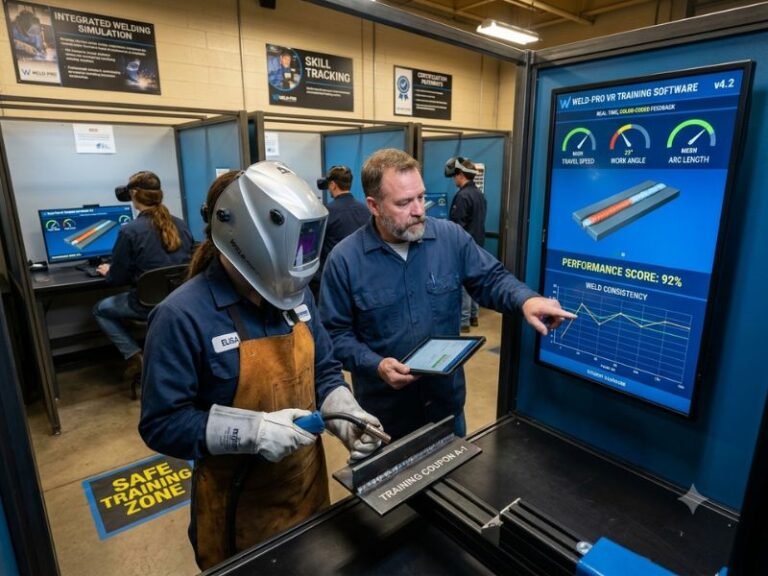
The best training environment treats failed tests as technical feedback. The trainee should identify whether the cause was poor fit-up, incorrect settings, contamination, unstable travel, improper electrode manipulation, inadequate preheat, or another controllable factor.
How to choose a training program
Compare programs by practical relevance rather than by marketing language alone. Before enrolling, I would look for clear answers to the following questions:
- Which welding processes are taught?
- Does the course include pipe welding and fixed-position practice?
- What materials, diameters, and thicknesses are available?
- Which codes or employer qualification tests does the program address?
- How much shop time does each trainee receive?
- Are WPS documents used during practice?
- Does instruction include hot-work and oil and gas site safety?
- Are testing and inspection requirements explained?
- What credentials are issued, and what do they actually prove?
- Are instructors qualified to teach both welding technique and industrial safety?
Hands-on time matters. A short class can provide useful orientation, but it may not create enough repetition for a beginner to control a pipe root or pass a performance test. A program should also maintain safe equipment, adequate ventilation, suitable practice materials, and a clear process for correcting technique.
Be cautious with claims of guaranteed employment or universal certification. Training can improve readiness, but hiring depends on skill, qualifications, location, work authorization, physical demands, employer requirements, and current project demand.
Preparing for training and qualification
Basic preparation can make training more productive. Review shop mathematics, fractions, measurements, angles, and unit conversions. Learn the names of common welding tools and practice reading simple fabrication drawings. Familiarity with electrical safety and PPE expectations is also useful.
During practice, focus on repeatable habits rather than speed. Keep the joint clean, follow the WPS, check settings before welding, maintain the correct angle, and inspect every pass. Ask the instructor to identify one or two specific improvements instead of trying to change everything at once.
Keep a record of completed courses, process qualifications, code tests, safety cards, and employer evaluations. Qualification documents should show their scope and any limits. If a certificate has an expiration, continuity, renewal, or employer-specific condition, maintain the required records.
Physical readiness also matters. Oil and gas welding may involve awkward positions, heat, noise, climbing, outdoor conditions, and long periods of concentration. Training cannot remove those demands, but it can help a candidate understand them before accepting field work.
Frequently asked questions
What is oil and gas welding training?
It is technical and safety instruction for welding work used in pipelines, process piping, refineries, storage facilities, and related industrial operations. It normally covers welding processes, pipe fit-up, procedure control, inspection, hazard prevention, and qualification testing.
How long does oil and gas welding training take?
There is no single required length. Duration depends on prior welding ability, the processes taught, the target qualification, and the amount of shop practice. A beginner generally needs more supervised practice than an experienced welder preparing for a specific test.
Do I need a certification to work as an oil
Many employers require a welder performance qualification for the specific work. The required test depends on the employer, project, material, process, and governing code. A general course-completion certificate is not necessarily the same as a production-welding qualification.
Which welding process is best for oil and gas work?
No single process is best for every job. SMAW is portable and widely useful, GTAW offers precise weld control, and GMAW or FCAW may suit selected shop and field applications. The approved WPS and project requirements determine which process is allowed.
Can training qualify me for every pipeline or refinery job?
No. Qualifications have defined limits, and employers may require different processes, positions, materials, tests, safety credentials, or experience. A candidate should verify the exact requirements with the hiring company or contractor.
Is pipe welding required in every oil and gas welding
No. Some programs emphasize structural fabrication or general industrial welding. Anyone targeting pipeline or process-piping work should confirm that the course includes relevant pipe diameters, fixed positions, joint designs, and qualification practice.
Conclusion
Effective Oil and gas welding training develops more than arc control. It builds safe decision-making, precise fit-up, procedure discipline, inspection awareness, and qualification readiness. Choose a hands-on program that matches the process, pipe work, code expectations, and safety conditions of the job you want to pursue.