Arc Welding Training: Skills, Costs, Courses, and Careers
Arc welding training teaches students the fundamentals of joining metals using an electric arc as the heat source. It is one of the most important areas of welding education because several major welding processes, including Shielded Metal Arc Welding (SMAW), rely on arc-based technology.
Arc welding skills are widely used in construction, manufacturing, repair, fabrication, shipbuilding, and industrial maintenance. Because the process requires manual control of heat, movement, and weld quality, proper training is essential for anyone who wants to develop professional welding skills.
In this guide, I will explain what arc welding training includes, how the process works, what skills students learn, course options, costs, certification requirements, and how to choose the right welding program in the United States.
Whether you are starting a welding career, improving your trade skills, or exploring a hands-on profession, understanding arc welding training can help you choose the right path.
What Is Arc Welding Training?
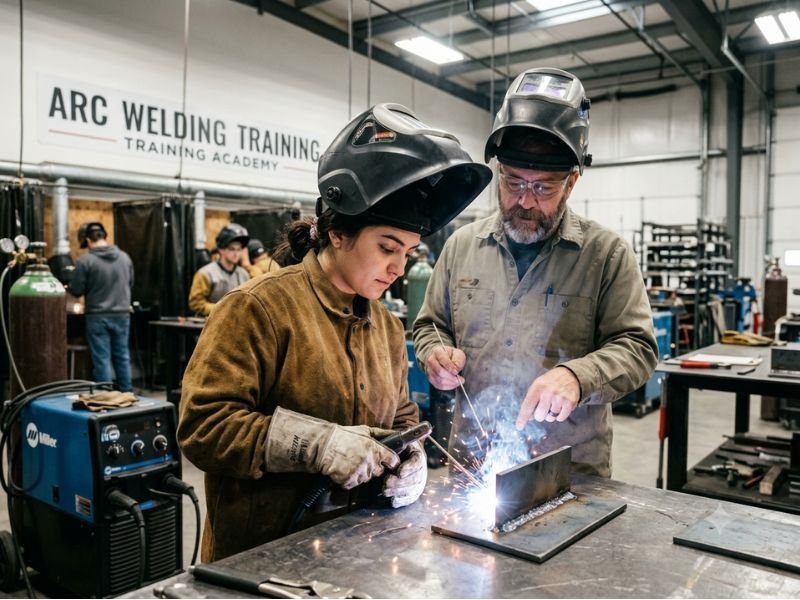
Arc welding training is structured instruction in welding processes that use an electric arc to generate heat for joining metals.
An electric arc forms between an electrode and the workpiece. The intense heat melts the base metal and filler material, creating a weld joint after cooling.
The term “arc welding” describes a broad category rather than a single process. Common arc welding methods include:
- SMAW (Stick Welding)
- GMAW (MIG Welding)
- GTAW (TIG Welding)
- FCAW (Flux-Cored Arc Welding)
Each process uses different equipment, techniques, and applications, but all depend on controlling an electric arc to create a quality weld.
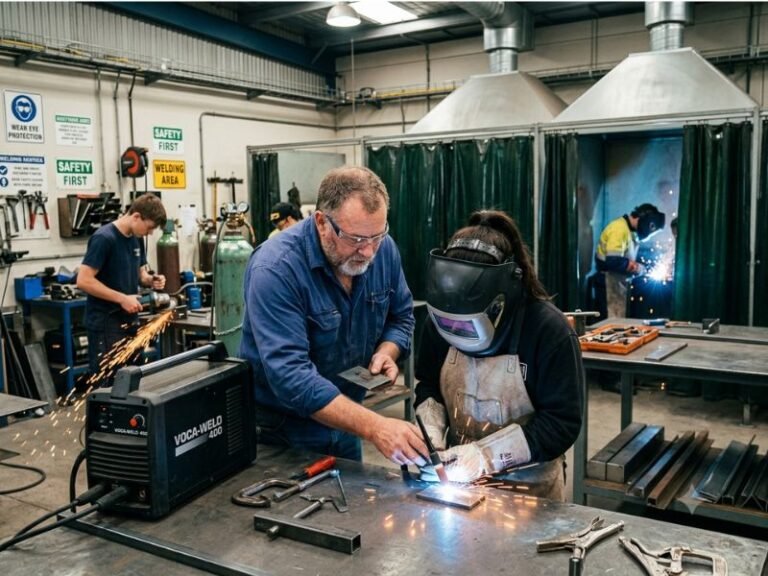
A complete arc welding training program teaches students safety, equipment operation, welding techniques, material preparation, inspection methods, and workplace standards.
Why Learn Arc Welding?
Arc welding remains one of the most valuable skills in the welding industry because it applies to a wide range of materials, environments, and job roles.
One major advantage is versatility. Arc welding processes are used for thin sheet metal, heavy structural steel, pipe systems, machinery, and industrial components.
Many industries rely on skilled welders because welding is essential for manufacturing, construction, repair, and infrastructure projects.
Arc welding also provides a strong foundation for career growth. Once students understand welding fundamentals such as heat control, joint preparation, weld defects, and inspection, they can expand into specialized areas.
Common applications include:
- Structural steel fabrication
- Equipment repair
- Automotive manufacturing
- Shipbuilding
- Pipeline construction
- Industrial maintenance
- Metal fabrication
What Do You Learn in Arc Welding Training?
A professional arc welding program focuses on developing both technical knowledge and practical ability.
Students learn how welding equipment works, how materials react to heat, how to control the welding process, and how to produce consistent welds.
Welding Safety and Workplace Practices
Safety is the first part of arc welding training because welding involves electrical energy, intense light, heat, fumes, and fire hazards.
Students learn how to identify workplace risks and use proper protection before beginning practical welding.
Important safety topics include:
- Proper personal protective equipment
- Welding helmet selection
- Electrical safety
- Fire prevention
- Ventilation requirements
- Safe handling of hot metal
- Gas-cylinder awareness
- Workplace hazard assessment
Typical protective equipment includes welding helmets, gloves, flame-resistant clothing, safety glasses, and protective footwear.
Training also teaches students how to inspect equipment before use and maintain a safe welding environment.
Understanding Arc Welding Equipment
Learning welding equipment is a major part of professional training.
Although equipment varies depending on the welding process, common components include:
- Welding power source
- Electrode or welding wire
- Welding torch or electrode holder
- Welding leads
- Ground clamp
- Shielding gas equipment when required
Students learn how power sources control current, voltage, polarity, and welding performance.
Incorrect settings can cause problems such as poor penetration, unstable arcs, excessive spatter, and weak welds.
Understanding equipment allows welders to troubleshoot problems instead of simply adjusting settings randomly.
Arc Welding Processes Covered in Training
A complete program may introduce multiple arc welding processes.
Shielded Metal Arc Welding (SMAW)
SMAW, commonly called stick welding, uses a flux-coated consumable electrode.
The flux creates shielding gas and slag that protect the weld pool from contamination.
Stick welding is widely used in:
- Construction
- Structural steel
- Pipe welding
- Outdoor repair
- Heavy equipment maintenance
Students learn electrode selection, arc control, welding positions, and defect prevention.
Gas Metal Arc Welding (GMAW)
GMAW, commonly known as MIG welding, uses continuously fed wire and shielding gas.
It is popular because it is efficient, productive, and suitable for many manufacturing applications.
Training includes:
- Machine setup
- Wire selection
- Shielding gas selection
- Gun control
- Welding parameters
- Joint preparation
Gas Tungsten Arc Welding (GTAW)
GTAW, commonly called TIG welding, uses a nonconsumable tungsten electrode.
It provides excellent control and high-quality welds but requires advanced coordination.
Students learn:
- Torch control
- Filler rod technique
- Heat management
- Precision welding
TIG is commonly used for stainless steel, aluminum, aerospace components, and high-quality fabrication.
Flux-Cored Arc Welding (FCAW)
FCAW uses a tubular wire containing flux.
It is widely used for:
- Heavy fabrication
- Structural welding
- Shipbuilding
- Outdoor applications
Students learn wire selection, machine setup, welding parameters, and production techniques.
Welding Machine Settings and Parameters
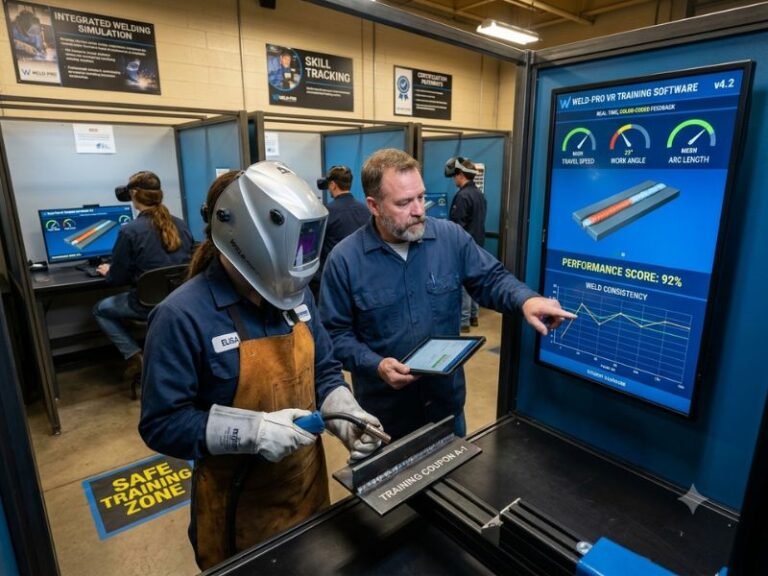
Arc welding training teaches students how different settings influence weld quality.
Important variables include:
Current
Current controls heat input and affects penetration and weld size.
Too much current can cause overheating and excessive penetration, while too little current can create weak fusion.
Voltage
Voltage influences arc characteristics, bead shape, and stability.
Incorrect voltage settings may cause poor appearance, spatter, or inconsistent welds.
Travel Speed
Travel speed affects the size and quality of the weld bead.
Moving too quickly may cause incomplete fusion, while moving too slowly can create excessive buildup.
Electrode Selection
The correct electrode or wire depends on:
- Base metal
- Thickness
- Welding position
- Required strength
- Application
Choosing the wrong material can reduce weld performance.
Welding Techniques Taught in Training
Successful arc welding depends on consistent technique.
Students practice:
- Maintaining proper arc length
- Controlling travel speed
- Managing weld puddles
- Maintaining correct angles
- Starting and stopping welds properly
- Producing consistent bead profiles
A professional welder must control both the equipment and the physical movement required to create quality welds.
Welding Positions
Most professional arc welding programs include multiple positions.
Flat Position
The flat position is usually the first skill beginners develop.
Students learn basic arc control, bead formation, and machine adjustment.
Horizontal Position
Horizontal welding requires better control because gravity affects the molten weld pool.
Students learn how to maintain proper weld shape and prevent defects.
Vertical Position
Vertical welding requires careful heat control and consistent movement.
It is commonly required in structural and pipe applications.
Overhead Position
Overhead welding is one of the most challenging positions because molten metal moves downward.
Students learn advanced control techniques and safety practices.
Joint Types and Weld Preparation
Arc welding training includes common joint designs used in industry.
Butt Joints
Butt joints connect two pieces placed edge-to-edge.
Students learn preparation, alignment, penetration control, and multi-pass welding.
Fillet Welds
Fillet welds are common in fabrication and structural work.
They are used for:
- T-joints
- Lap joints
- Corner joints
Groove Welds
Groove welding is used where deeper penetration and stronger joints are required.
Students may practice:
- Root passes
- Fill passes
- Cap passes
Proper preparation is essential for producing reliable welds.
Welding Defects and Troubleshooting
Understanding defects is a critical part of arc welding education.
Porosity occurs when gas becomes trapped inside the weld. Contamination, moisture, or poor shielding can contribute.
Cracking can result from improper procedures, incorrect materials, or excessive stress.
Undercut occurs when the weld removes material along the edge of the joint.
Lack of fusion happens when weld metal does not properly bond with the base metal.
Slag inclusion can occur when slag becomes trapped between welding passes.
Professional training teaches students how to identify causes and improve welding techniques.
Arc Welding Training Options in the United States
Students have several options depending on their career goals.
Trade Schools and Technical Institutes
Trade schools provide focused welding education with extensive practical training.
Programs often include:
- Multiple arc welding processes
- Fabrication
- Blueprint reading
- Inspection
- Safety
- Welding testing preparation
This option is suitable for students seeking direct entry into welding careers.
Community College Programs
Community colleges often offer welding certificates, diplomas, and technical programs.
Benefits may include:
- Experienced instructors
- Modern equipment
- Flexible schedules
- Financial aid opportunities
Some programs also include manufacturing and fabrication skills.
Short-Term Welding Courses
Short courses can introduce beginners to welding fundamentals.
They may focus on:
- Safety
- Equipment operation
- Basic welding techniques
- Simple projects
However, professional skill requires continued practice.
Apprenticeships and Employer Training
Apprenticeships provide workplace learning under experienced professionals.
Students gain practical experience while developing industry skills.
Employer training can also teach company-specific procedures and equipment operation.
Online Arc Welding Training
Online courses can explain welding theory, safety, equipment, and troubleshooting.
However, welding is a hands-on trade. Students must practice physically to develop proper coordination and technique.
How Long Does Arc Welding Training Take?
Training duration depends on the program and career goals.
A beginner course may cover basic concepts quickly, while career-focused programs can take several months.
Longer programs may include:
- Multiple welding processes
- Fabrication
- Blueprint reading
- Inspection
- Qualification preparation
Learning speed depends on practice time, instructor feedback, previous experience, and required skill level.
I recommend comparing programs based on hands-on welding hours rather than only course duration.
How Much Does Arc Welding Training Cost?
Costs vary depending on the school, location, program length, and included materials.
Common expenses include:
- Tuition
- Lab fees
- Welding equipment
- Safety gear
- Consumables
- Testing fees
- Tools
Before enrolling, ask whether the program includes materials, equipment access, certification testing, and additional fees.
A higher-cost program may provide better value if it offers more practice time and stronger career support.
Arc Welding Certification and Qualifications
Completing training does not automatically qualify a welder for every job.
A training certificate confirms course completion, while a welding qualification demonstrates successful performance on a specific practical test.
Qualification requirements may depend on:
- Welding process
- Material
- Thickness
- Position
- Joint design
- Employer standards
The American Welding Society (AWS) provides welding certification programs, and many employers conduct their own qualification tests.
How to Choose an Arc Welding Training Program
Choosing the right program requires careful evaluation.
Review the curriculum and confirm that it includes the welding processes you want to learn.
Compare hands-on practice time because welding skills develop through repetition.
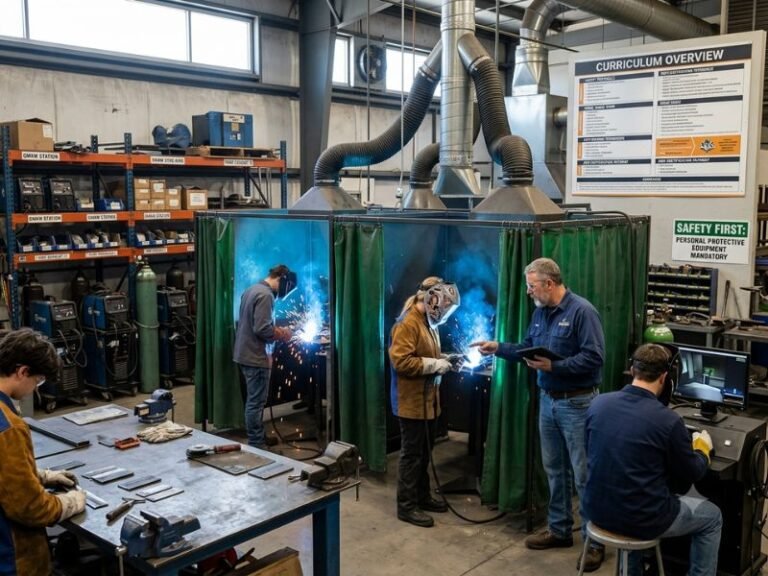
Evaluate instructor experience and facility quality. A good welding lab should have functional equipment, proper ventilation, safe work areas, and enough practice materials.
I recommend visiting the school before enrolling and asking about graduate outcomes, certification preparation, and total program costs.
Arc Welding Career Opportunities
Arc welding skills support many careers.
Common positions include:
- Welder
- Fabrication welder
- Structural welder
- Pipe welder
- Production welder
- Maintenance welder
- Welding technician
Industries using arc welding include:
- Construction
- Manufacturing
- Energy
- Shipbuilding
- Automotive
- Heavy equipment
- Industrial repair
Additional skills such as inspection, fabrication, robotics, blueprint reading, and multiple welding processes can improve career opportunities.
Advantages and Challenges of an Arc Welding Career
Arc welding offers strong career potential because welding skills are needed across many industries.
Advantages include:
- Wide industry demand
- Multiple career paths
- Opportunities for specialization
- Transferable technical skills
However, welding careers also involve challenges.
Workers may experience heat, fumes, physical strain, repetitive work, and demanding environments.
Success requires technical ability, safety awareness, reliability, and continuous improvement.
Common Arc Welding Training Mistakes
One common mistake is focusing only on equipment operation instead of understanding welding fundamentals.
Another mistake is avoiding practice. Welding requires repetition to develop consistent results.
Some beginners also ignore safety procedures, which can create serious workplace risks.
Finally, choosing a program based only on price can lead to limited training opportunities. The quality of instruction and practical experience are more important factors.
Frequently Asked Questions
Is arc welding difficult to learn?
Arc welding requires practice because the welder must control heat, movement, and weld quality manually. Proper training makes the learning process easier.
Is arc welding the same as stick welding?
Not exactly. Stick welding is one type of arc welding process. Arc welding is a broader category that includes SMAW, GMAW, GTAW, and FCAW.
How long does arc welding training take?
Basic skills can be introduced quickly, but professional ability usually requires weeks or months of structured practice.
Do I need welding school to become an arc welder?
Not always. Some welders learn through apprenticeships or employer training, but formal programs provide structured development.
Can I learn arc welding online?
Online resources can teach concepts, but hands-on practice is required to develop real welding skills.
What certification is best for arc welding?
The best qualification depends on the welding process, industry, employer, material, and job requirements.
Conclusion
Arc welding training provides the foundation for developing practical welding skills used in construction, manufacturing, repair, and industrial applications.
A strong program should teach safety, equipment operation, welding techniques, inspection, and real hands-on practice across relevant welding processes.
I recommend choosing a training program based on instructor experience, practical training hours, facility quality, and certification opportunities rather than focusing only on cost.
With proper education, consistent practice, and a commitment to safety, arc welding can become a valuable skill that supports long-term career opportunities in the welding industry.