Oil Rig Underwater Welder Salary: Key Facts and Helpful Guidance
An oil rig underwater welder in the United States may earn roughly $60,000 to more than $150,000 a year, with highly experienced, specialized, or heavily scheduled workers sometimes earning more. Actual pay depends on commercial-diving credentials, welding qualifications, offshore rotation, overtime, project conditions, and whether the work is inspection, maintenance, construction, or emergency repair.
The phrase oil rig underwater welder salary sounds like one job with one standard paycheck, but offshore underwater welding is a combination of several trades. A worker may be a commercial diver, an underwater welder, a nondestructive testing technician, a rigging specialist, and an offshore maintenance worker at different points in the same project. Each added qualification can affect both employability and compensation.
Pay also has to be evaluated against the system surrounding it. Offshore work is scheduled around vessel access, weather, production requirements, diving limits, client approvals, and crew availability. Acting early to earn the right certifications can open better assignments, but paying for every course or accepting a dangerous job simply because it advertises a high daily rate can create unnecessary cost and risk.
In practical terms, this guide explains salary ranges, hourly and day-rate structures, rotation schedules, overtime, benefits, taxes, training costs, career progression, and the warning signs of misleading job advertisements. By the end, you should be able to compare an offer realistically, identify which credentials have the greatest value, and decide whether offshore commercial diving fits your financial and safety priorities.
- ✓Annual earnings vary widely because offshore underwater welding is usually paid through a mix of base wages, overtime, per diem, travel pay, and project premiums.
- ✓Commercial-diving certification and documented underwater welding ability are more important than a short recreational-diving course.
- ✓High advertised rates may reflect long rotations, irregular work, hazardous conditions, unpaid travel, or limited benefits.
- ✓Inspection, nondestructive testing, saturation diving, and supervisory skills can improve long-term earning potential.
- ✓The safest comparison is total compensation divided by realistic working time, not the largest hourly number in an advertisement.
What the oil rig underwater welder salary really
There is no single national pay scale for this occupation. Offshore welders are commonly employed through commercial diving contractors, marine construction companies, oilfield service firms, shipyards, engineering contractors, or maintenance providers rather than directly by the oil company that owns the platform.
The employer, worksite, contract duration, and type of diving can therefore change the pay structure. A worker performing routine splash-zone repairs may be paid differently from a diver completing a complex subsea intervention, and both may earn less than a specialist assigned to a time-critical shutdown or saturation project.
- Who pays you: Confirm whether the offer comes from a diving contractor, staffing agency, vessel operator, or asset owner.
- What “annual” means: Ask whether the figure assumes full-year employment, continuous rotations, maximum overtime, or repeated project assignments.
- What is included: Separate base wage from per diem, travel reimbursement, hazard pay, bonuses, and lodging.
- What work is covered: Underwater welding, inspection, rigging, cutting, photography, and general maintenance may be paid under different classifications.
Broad U.S. earning ranges
As a practical planning estimate, entry-level or early-career commercial divers who have limited offshore experience may see total annual earnings in the lower part of the market, often around $45,000 to $75,000 when work is consistent. That range can be lower in a slow year or higher when overtime and travel-heavy assignments are available.
Experienced offshore divers with reliable welding qualifications, strong safety records, and several useful skills may commonly target approximately $75,000 to $120,000 in total gross pay. Senior divers, supervisors, specialized inspection personnel, and workers assigned to demanding projects may reach $120,000 to $180,000 or more, although such figures are not guaranteed salaries and may require extensive time away from home.
These ranges are best used for orientation rather than negotiation. A job offering $400 per day for intermittent work may produce less annual income than a salaried or hourly position paying less per day but providing steady rotations, paid travel, benefits, and guaranteed minimum hours.
Why online salary figures conflict
Salary websites often combine commercial divers, underwater welders, marine construction divers, and offshore technicians into one category. Some report wages, some report annual income, and some rely on self-reported figures that may include unusually productive years or specialized assignments.
Another source of confusion is the difference between a base rate and a working rate. A base rate may apply to scheduled hours, while overtime begins after a daily or weekly threshold. A day rate may cover a 12-hour shift, travel within a worksite, or standby time, but the contract should define those details.
For that reason, the most useful question is not “What is the average salary?” It is “What would a qualified worker with this experience, rotation, and certification profile reasonably earn under this contract?”
How offshore pay is calculated
Most compensation disputes begin with an unclear pay structure. Two jobs can advertise nearly identical numbers while producing very different take-home results because one uses hourly payroll and the other uses a project day rate.
Before comparing offers, identify the unit of pay, the expected schedule, the minimum guaranteed work, and the conditions that trigger additional compensation. Written answers matter because verbal promises about overtime or future projects are difficult to use when payroll does not match expectations.
- Hourly employment: Find the regular rate, overtime threshold, double-time rules if any, and whether training or travel is paid.
- Day-rate work: Confirm the number of hours covered, standby treatment, weather delays, and whether meals or lodging are included.
- Project pay: Ask when payment occurs, what happens if the job is canceled, and whether the rate covers all required tasks.
- Rotation schedule: Compare paid days offshore with unpaid days at home and determine whether the schedule is seasonal or year-round.
Hourly wages and overtime
Hourly employment can provide clearer payroll records and may make overtime easier to calculate. However, the regular rate may appear modest until overtime, travel allowances, offshore premiums, or bonuses are added.
Offshore shifts are often longer than a conventional eight-hour workday. A contract might schedule extended shifts during a short project, but the exact treatment of those hours depends on the employer’s payroll practices, the employment agreement, and applicable wage rules. Do not assume that every hour spent away from home is paid at the same rate.
Day rates and rotation pay
A day rate can be attractive because it is easy to understand and may be higher than a local hourly wage. The weakness is that day-rate work can hide unpaid mobilization, demobilization, weather delays, medical clearance, waiting time, or gaps between projects.
Ask whether the rate applies to:
- Travel to and from the port or heliport
- Required safety meetings and equipment checks
- Standby caused by weather or platform operations
- Mandatory medical examinations and training
- Days spent waiting for a vessel or diving window
- Days at home between rotations
A worker should also calculate the effective rate. For example, if a contract pays $500 per offshore day but requires a 14-day rotation with seven unpaid days at home, the annual result depends entirely on how many rotations the company can actually provide.
Per diem, travel, and bonuses
Per diem is not the same as wages. It may help cover meals and incidental expenses, but it should not be treated as guaranteed salary. Travel reimbursement may also cover only approved transportation, not every hour spent traveling.
Bonuses require special caution. A completion bonus, safety bonus, or emergency-call premium may be conditional, discretionary, or dependent on the client paying the contractor. Ask what must happen for the bonus to vest and whether the employer has paid it consistently in previous contracts.
Experience, credentials, and location that influence pay
The strongest wage differences usually come from the value a diver can provide without compromising safety or supervision. A contractor may pay more for someone who can weld, inspect, document, rig, plan a job, and communicate clearly with the surface team than for a worker who can perform only one narrow task.
Credentials do not automatically create a higher salary. Their value depends on whether employers in the target market need them, whether they are current, and whether the worker can demonstrate competent field performance. Training that is expensive but rarely used may produce less return than a practical qualification requested repeatedly in job postings.
- Commercial-diving qualification: This establishes a professional foundation that recreational-diving credentials generally do not provide.
- Welding proof: Employers may look for welding training, practical tests, procedure familiarity, and records of acceptable work.
- Inspection skills: Nondestructive testing, visual inspection, and documentation can broaden assignments beyond welding alone.
- Offshore reliability: Medical fitness, safety performance, teamwork, and a dependable work history strongly affect repeat calls.
Commercial-diving training
Commercial diving is not an extension of recreational scuba diving. Professional divers work within a surface-supplied system, use communications and umbilicals, follow a dive plan, and operate under a formal surface-support structure. The training path normally includes classroom instruction, practical diving, decompression procedures, emergency response, equipment use, and occupational safety.
This is an important consideration for oil rig underwater welder salary.
School selection deserves careful review. Compare the program’s recognition in the employers’ target market, the amount of actual in-water training, graduate employment information, equipment condition, instructor qualifications, and total cost. A short course that promises immediate offshore work may be less useful than a thorough program with realistic job preparation.
Welding and underwater cutting ability
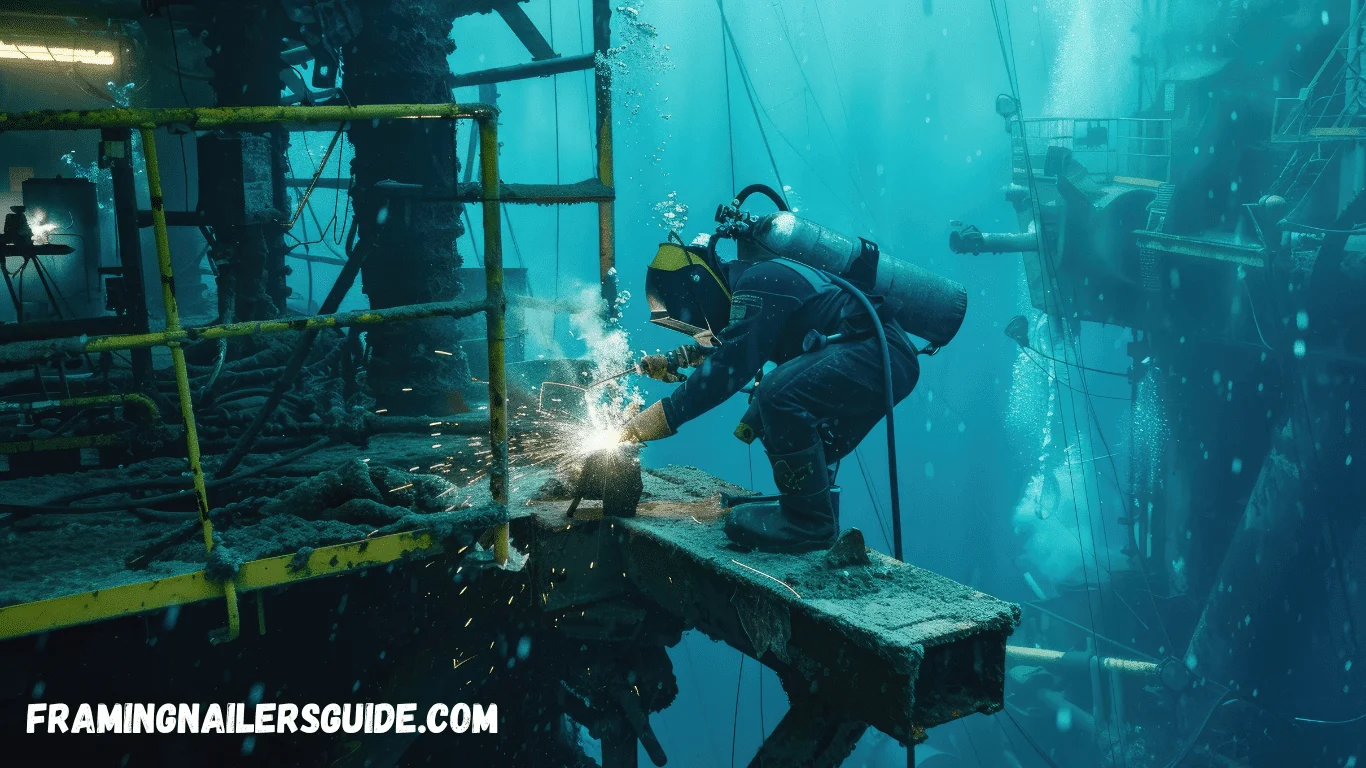
Underwater welding can involve wet welding, dry or habitat welding, cutting, burning, fitting, and repair preparation. The job may require different techniques depending on the structure, material, access, current, visibility, and client procedure.
Employers may test a diver’s ability before hiring or assignment. A certificate alone cannot replace sound judgment, control of heat input, preparation quality, communication with the tender and supervisor, and the ability to stop when conditions are unsafe.
Inspection and nondestructive testing
Inspection skills can make a diver more useful between welding tasks. Depending on the employer and qualification path, relevant work may include visual inspection, thickness measurement, underwater photography, magnetic particle testing, ultrasonic methods, or inspection reporting.
These abilities can also improve career resilience. Welding demand may fall when a construction phase ends, while inspection and maintenance work may continue across a broader range of marine assets. The best credential is the one that matches actual contract demand and can be maintained properly.
Geography and offshore region
Pay is affected by where the work occurs, but location alone does not determine earnings. Gulf Coast markets, coastal ports, shipyards, inland waterways, and international projects may have different labor demand, living costs, travel requirements, and contract norms.
Remote assignments can pay a premium because they involve difficult logistics, scarce qualified labor, or extended time away from home. That premium may be offset by unpaid travel, repeated medical clearances, visa requirements, expensive relocation, or long gaps between jobs.
Oil rig underwater welder salary by career stage
Career progression is usually based on accumulated competence rather than time served alone. A new commercial diver may begin with supervised tasks, equipment handling, general maintenance, and support work before receiving responsibility for complex welding or inspection.
The progression can be uneven. A diver might advance quickly after joining a busy contractor, or remain at the same level if the employer has little offshore work or does not provide opportunities to gain logged experience. Keeping accurate records of dives, tasks, equipment, training, and supervisor feedback makes advancement easier to demonstrate.
- Entry stage: Build safe work habits, surface-support knowledge, equipment familiarity, and a credible commercial-diving record.
- Developing stage: Add welding, cutting, rigging, inspection, and offshore-specific experience while learning to work efficiently.
- Experienced stage: Handle complex tasks, interpret procedures, document work, and solve problems without bypassing controls.
- Senior stage: Lead teams, plan dives, supervise risk controls, coordinate with clients, or specialize in demanding technical work.
Entry-level expectations
Entry-level workers should be cautious about advertisements that promise six-figure earnings immediately after graduation. A new graduate may hold foundational credentials but still lack the logged dives, offshore references, welding performance, and judgment that employers require for independent assignments.
Early work may include lower-paid training, shop preparation, equipment maintenance, deck duties, tendering, and local commercial diving. Those tasks are not wasted time: they teach how the entire diving operation functions and can prevent a worker from treating underwater welding as an isolated skill.
Mid-career earning potential
At the mid-career level, a diver’s value often comes from versatility. Someone who can perform quality work, understand permits and isolation requirements, support inspections, manage tools, and communicate problems promptly may receive more consistent calls than someone who accepts only welding tasks.
This is also the stage when workers should examine fatigue and sustainability. Chasing every high-paying rotation can accelerate income, but excessive travel, extended shifts, and poor recovery may increase error risk and shorten a career.
Senior diver, supervisor, and specialist roles
Senior roles may involve planning, supervision, client coordination, quality documentation, emergency management, and responsibility for the dive team. These positions can pay more because the worker influences the safety and productivity of the entire operation.
Specialist paths may include saturation diving, inspection, subsea construction, project supervision, or technical support. They often require additional training, strict medical standards, extensive experience, and a willingness to accept more demanding conditions. Higher pay should be viewed as compensation for higher responsibility and exposure, not as a reason to bypass qualification requirements.
Costs, risks, and benefits that change the real value of an offer
Gross pay is only one part of the decision. A commercial diver may spend substantial money on initial schooling, welding practice, medical examinations, travel, tools, certifications, and maintaining credentials. The employer may cover some of these costs, but the arrangement varies widely.
Offshore work also carries physical and operational risks. Diving near industrial structures can involve entanglement, contaminated water, currents, poor visibility, dropped objects, electrical hazards, pressure-related injuries, vessel movement, and restricted access. A high wage cannot make an uncontrolled dive acceptable.
- Benefits: Compare health insurance, retirement contributions, paid leave, disability coverage, life insurance, and workers’ compensation arrangements.
- Work continuity: Determine whether the employer guarantees hours or simply places workers on a call list.
- Personal expenses: Include renewals, medicals, travel to the departure point, equipment, taxes, and time between projects.
- Safety system: Look for clear stop-work authority, competent supervision, maintained equipment, emergency planning, and realistic schedules.
Training and certification costs
Training costs may include tuition, housing, meals, transportation, welding consumables, examinations, medical evaluations, and time away from paid work. Before enrolling, request a complete written cost estimate rather than relying on a headline tuition number.
Ask whether the school’s graduates obtain the type of work you want. A program may prepare students well for inland commercial diving but offer little access to offshore oil and gas assignments. That does not make the school ineffective; it means the program should be judged against the intended career path.
These practical limitations also matter for oil rig underwater welder salary.
Insurance and long-term protection
Benefits can be worth tens of thousands of dollars over a year, especially when health insurance, retirement contributions, paid leave, and disability protection are included. A contractor offering a higher day rate without benefits may leave the worker responsible for costs that an employee would not see directly.
Commercial diving is physically demanding, and income protection deserves particular attention. Read eligibility rules, exclusions, waiting periods, and coverage limits. If the position is independent-contractor work, ask which protections the company provides and which obligations shift to you.
Safety as an economic issue
Safety is not merely a compliance topic. A weak safety system can cause injuries, lost work, damaged equipment, contract disputes, and an interrupted career. A contractor that pressures divers to work through poor visibility, inadequate isolation, missing communications, or unsuitable weather is offering risk rather than genuine opportunity.
A professional worker should be able to ask about the dive plan, emergency arrangements, surface support, equipment maintenance, and stop-work procedures without being treated as difficult. A recruiter who avoids those questions is a warning sign.
How to compare two offshore job offers
Compare offers on the same assumptions. Convert each package into estimated annual gross compensation, then subtract predictable work-related costs and assign a value to benefits and unpaid time. This does not produce a perfect forecast, but it exposes differences hidden by impressive daily rates.
For example, Offer A might pay a lower hourly rate but provide steady rotations, paid travel, medical coverage, retirement contributions, and training. Offer B might advertise a much higher day rate but provide no guaranteed schedule, no benefits, and unpaid travel. Offer B may still be better for an experienced worker with another source of coverage, but the headline figure does not answer the question by itself.
- Annualize conservatively: Use the number of rotations the employer can document, not the maximum theoretical schedule.
- Separate pay types: List wages, overtime, per diem, bonuses, travel reimbursements, and benefits in different columns.
- Price downtime: Estimate unpaid days at home, weather delays, canceled work, and time spent waiting for mobilization.
- Check exit conditions: Review notice requirements, repayment clauses, training agreements, and deductions for equipment or housing.
A simple comparison formula
Start with expected paid days or hours. Multiply them by the applicable rate, add only realistic bonuses and allowances, and then subtract known personal costs. Do not add per diem to wages unless it is paid regardless of whether expenses are incurred and is treated that way under the contract.
Next, estimate the value of benefits and divide the total by the number of days you will be committed to the job, including unpaid travel and required availability. This produces an effective compensation figure that is more useful than an hourly or day-rate comparison alone.
Questions to ask before accepting
- Is the position an employee role or independent-contractor assignment?
- What is the exact regular rate, overtime rate, and day-rate definition?
- How many paid days or hours are guaranteed?
- Are travel, training, medical examinations, and safety meetings paid?
- Who provides diving equipment, welding equipment, personal protective equipment, and consumables?
- What happens when weather, platform operations, or client decisions stop the work?
- Which credentials must remain current, and who pays for renewal?
- What benefits begin immediately, and what waiting periods apply?
- What are the rotation length, expected notice, and likely gaps between projects?
- Who has final authority to stop a dive?
Common compensation warning signs
Be careful when an advertisement uses a very high annual number without stating the schedule or pay basis. Other warning signs include requests for large upfront payments to secure a job, pressure to misrepresent experience, vague “guaranteed” bonuses, refusal to provide a written offer, and instructions to purchase specialized equipment before employment is confirmed.
Legitimate employers may require background checks, medical clearance, or qualification verification, but those processes should be explained clearly. Never let a recruiter’s urgency replace your own review of the contract and safety arrangements.
Building a stronger path into offshore underwater welding
A realistic career plan begins with the type of work you want and the market where you intend to work. The route for a diver targeting Gulf Coast oil and gas maintenance may differ from the route for someone seeking shipyard repair, inland construction, inspection, or international subsea work.
Early preparation should focus on employability rather than collecting every possible certificate. The goal is to become a dependable member of a dive team, then add qualifications that solve real problems for contractors.
- Choose the market: Identify regional employers and the credentials they repeatedly request before paying for training.
- Build a record: Keep copies of dive logs, welding tests, inspection work, training, medical clearances, and supervisor references.
- Develop adjacent skills: Rigging, hydraulics, inspection, documentation, and equipment maintenance can increase assignment options.
- Protect your reputation: Accurate reporting, punctuality, teamwork, and responsible stop-work decisions lead to repeat opportunities.
Use job postings as a planning tool
Review multiple postings from actual contractors and note repeated requirements. If the same employers request commercial-diving credentials, underwater inspection, welding tests, and offshore experience, those patterns are more useful than a generic career article promising a fixed salary.
Also track the language used for compensation. “Up to,” “potential,” “projected,” and “with overtime” describe possibilities, not guaranteed income. Look for the regular wage, expected schedule, benefits, and employment status.
Keep documentation organized
Offshore hiring can move quickly, and missing records can delay mobilization. Maintain a current résumé, credential copies, dive logs, training records, medical documents, references, and a list of equipment competencies.
Never exaggerate a logged dive, welding qualification, or inspection ability. Offshore teams rely on accurate competence information when planning work, and a false claim can endanger the entire crew as well as destroy future employment prospects.
Develop professional judgment
The most valuable skill may be recognizing when a job should not proceed. A diver who identifies an isolation problem, defective equipment, changing current, poor visibility, or unclear instruction before entering the water protects the team and the client’s asset.
That judgment develops through formal training, supervised work, careful debriefing, and respect for procedures. It cannot be replaced by confidence or a high advertised pay rate.
Frequently asked questions about oil rig underwater welder salary
What is the starting oil rig underwater welder salary in the United States?
Starting earnings can vary from roughly the mid-$40,000s to the $70,000s annually when work is steady, but a new graduate may earn less during training or between assignments. The amount depends on commercial-diving preparation, welding ability, location, employer, and how much offshore work is actually available.
A first job should be judged by the quality of supervision, logged experience, safety culture, and path to useful qualifications—not only by the opening wage.
Can an underwater welder make over $100,000 a year?
Yes, experienced commercial divers can exceed $100,000 in a strong year, particularly when they work offshore, accept overtime or extended rotations, and have specialized welding, inspection, supervisory, or saturation-diving experience. The figure is not automatic and may require substantial time away from home.
Always ask whether the advertised number is guaranteed base pay or a maximum that assumes full project availability, overtime, bonuses, and allowances.
Does saturation diving pay more than ordinary offshore welding?
Saturation diving can pay more because it involves specialized training, complex life-support systems, extended pressure exposure, and demanding project conditions. However, it is not simply a higher-paid version of ordinary underwater welding; it requires an appropriate career path, medical fitness, experience, and employer qualification.
The additional pay should be weighed against the physical demands, time commitment, training requirements, and potential gaps between specialized projects.
Do underwater welders get paid during rotation days at home?
Some employers provide salary, rotation pay, paid leave, or a guaranteed schedule that covers certain home days. Others pay only for days worked or days mobilized. There is no universal rule, so the contract must state whether time at home is paid, unpaid, or covered through a different allowance.
This distinction can change annual income dramatically. A high offshore rate with long unpaid gaps may produce less predictable earnings than a lower rate with a stable schedule.
Is underwater welding dangerous enough to justify higher pay?
The work involves serious hazards, including pressure-related injury, entanglement, electrical energy, contaminated water, currents, dropped objects, restricted access, and poor visibility. Higher pay may reflect skill scarcity, difficult logistics, and responsibility, but it does not make an uncontrolled operation acceptable.
Before accepting a position, evaluate the employer’s training, equipment maintenance, communications, emergency procedures, dive planning, and stop-work culture.
What qualifications help increase offshore underwater welding pay?
A recognized commercial-diving qualification is the foundation. Depending on the target market, additional value may come from underwater welding tests, inspection and nondestructive testing skills, rigging, surface-supplied diving experience, offshore safety training, project documentation, and supervisory ability.
Choose credentials based on repeated employer requirements and realistic career goals. More certificates are not automatically better if they are outdated, irrelevant, or unsupported by practical experience.
Is underwater welding a good career financially?
It can be financially rewarding for workers who tolerate travel, irregular schedules, physical demands, and strict safety requirements. Earnings may rise substantially with experience and specialization, but the career can also involve training costs, downtime, health considerations, and uncertain project availability.
The best fit is someone who evaluates total compensation and long-term sustainability rather than pursuing the highest short-term rate.
Conclusion
The oil rig underwater welder salary can range from moderate early-career earnings to well above $100,000 for experienced specialists, but the number depends on far more than the welding itself. Commercial-diving credentials, offshore experience, specialty qualifications, rotation length, overtime, benefits, downtime, and the employer’s safety system all affect the real value of the work.
Because underwater industrial work carries serious hazards, do not accept a premium rate without confirming the contract, training requirements, equipment standards, emergency support, and stop-work authority. Compare realistic annual income and total benefits, not just an impressive day rate.
Before applying or accepting an offer, create a written comparison of the pay rate, guaranteed work, rotation, benefits, personal costs, required credentials, and safety controls.