Stick Welding Training: Skills, Costs, Courses, and Careers
Stick welding training helps students develop the skills required to perform Shielded Metal Arc Welding (SMAW), one of the most widely used welding processes in construction, maintenance, fabrication, and industrial repair.
Unlike some modern welding methods that rely on automated wire feeding or controlled environments, stick welding requires the welder to manually control the electrode, arc length, travel speed, and weld puddle. This makes it a challenging but highly valuable skill for people who want to work in demanding environments where portability, strength, and reliability are important.
In this guide, I will explain how stick welding training works, what skills students learn, how long courses take, what costs to expect, how certification works, and how to choose the right training program in the United States.
Whether you are a beginner exploring skilled trades, an experienced worker adding welding skills, or someone planning a welding career, understanding the training process can help you make a better decision.
What Is Stick Welding Training?
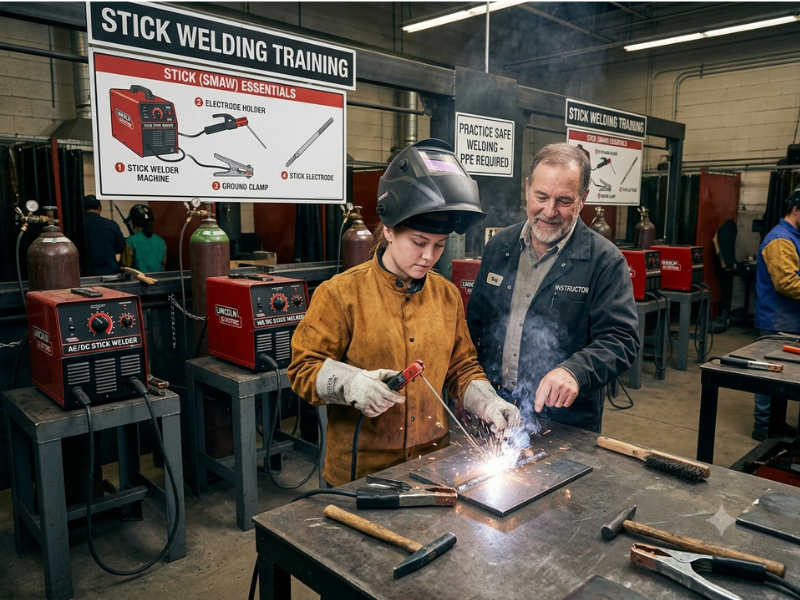
Stick welding training is professional instruction in Shielded Metal Arc Welding (SMAW), a welding process that uses a flux-coated consumable electrode to join metal.
During the welding process, an electric arc forms between the electrode and the base metal. The heat created by the arc melts the electrode and the workpiece, forming a weld pool. As the electrode burns, the flux coating produces shielding gas and creates slag that protects the weld from contamination.
A complete SMAW training program usually combines classroom knowledge with extensive hands-on practice. Students learn how to operate welding equipment, select the correct electrodes, prepare materials, control the welding arc, inspect welds, and correct common defects.
Unlike learning only the theory behind welding, practical training is essential because welding quality depends heavily on physical control, repetition, and experience.
Why Learn Stick Welding?
Stick welding remains an important skill because it performs well in situations where other welding processes may be less practical.
One of the biggest advantages of SMAW is its ability to work effectively outdoors. Since the electrode coating creates shielding protection, stick welding is less affected by wind compared with gas-shielded processes. This makes it common in construction sites, pipeline work, structural welding, equipment repair, and maintenance operations.
Stick welding is also valuable for joining thick materials. Industries that work with heavy steel structures often use SMAW because it can produce strong welds in challenging conditions.
Another reason many welders learn stick welding is that it develops fundamental welding skills. Learning to control an electrode manually teaches important concepts such as arc stability, heat control, weld puddle management, and defect prevention. These skills create a strong foundation for learning other processes such as MIG and TIG welding.
What Do You Learn in Stick Welding Training?
A professional stick welding course should cover more than simply running a weld bead. Students need to understand safety, equipment, materials, welding techniques, inspection methods, and workplace standards.
Welding Safety and Equipment Protection
Safety is the first stage of professional welding education because SMAW involves intense heat, electrical energy, ultraviolet radiation, fumes, and hot metal.
Students learn how to work safely with welding machines, protect themselves from exposure, and maintain a controlled work environment.
Proper personal protective equipment is a major part of training. This usually includes a welding helmet, safety glasses, welding gloves, flame-resistant clothing, and protective footwear.
Training also covers ventilation, fire prevention, electrical safety, proper grounding, safe handling of hot materials, and workplace hazard awareness.
Good welding technique cannot compensate for poor safety practices. Professional welders must understand how to prevent injuries before they begin working.
Understanding Stick Welding Equipment
A major part of SMAW training involves learning how the equipment works and how each component affects weld quality.
The main components include the welding power source, electrode holder, ground clamp, welding leads, and electrodes.
Students learn how different machines operate, including the differences between AC and DC welding current, polarity selection, amperage adjustment, and duty cycle.
The electrode holder must maintain a secure connection while allowing the welder to control the electrode comfortably. Damaged cables, poor connections, or incorrect machine settings can create unstable arcs and inconsistent welds.
Students also learn the importance of maintaining equipment because professional welding requires reliable performance from every component.
Electrode Selection and Handling
Electrode selection is one of the most important skills in stick welding.
Different electrodes provide different levels of penetration, usability, strength, and position capability. The correct choice depends on the material, thickness, welding position, and project requirements.
Common SMAW electrodes include E6010, E6011, E6013, and E7018. Each electrode has specific characteristics.
For example, some electrodes provide deep penetration and are commonly used for root passes, while others provide smoother finishes or easier operation for beginners.
Students also learn proper electrode storage. Low-hydrogen electrodes such as E7018 require controlled storage because moisture absorption can increase the risk of welding defects and cracking.
Proper electrode handling is a small detail that can significantly affect final weld quality.
Essential Stick Welding Techniques
Stick welding requires coordination between the welder’s hands, eyes, and machine settings.
One of the first skills students develop is controlling arc length. The distance between the electrode and the workpiece affects penetration, stability, spatter, and bead appearance.
A long arc can create excessive spatter and poor control, while an arc that is too short may cause the electrode to stick to the metal.
Students also learn electrode angle and travel speed. The correct angle helps control the direction of molten metal and improves weld appearance. Travel speed affects bead size, penetration, and heat input.
A welder moving too quickly may create incomplete fusion, while moving too slowly can create excessive buildup and overheating.
Advanced training includes controlling weaving patterns, managing multiple passes, and producing consistent weld profiles.
Welding Positions in SMAW Training
Professional welding programs teach multiple welding positions because real-world projects rarely happen in a single comfortable position.
The flat position is usually the starting point because gravity helps control the weld pool. Students learn basic electrode control, arc stability, and consistent bead formation.
Horizontal welding introduces additional difficulty because molten metal tends to move downward. Students must adjust their angle, speed, and heat control.
Vertical welding requires more advanced control because the welder must manage the movement of molten metal against gravity.
Overhead welding is one of the most challenging positions because the welder must control heat, safety, and weld puddle movement while working below the joint.
Many industries require welders to demonstrate skills in multiple positions, especially for structural and pipe welding.
Stick Welding Joint Types
Training programs normally include several common joint designs.
A butt joint connects two pieces placed edge-to-edge. Students learn proper preparation, alignment, penetration control, and multi-pass welding techniques.
Fillet welds are extremely common in fabrication and structural work. They are used in T-joints, lap joints, and corner joints. Students learn how to control weld size, bead shape, and fusion.
Advanced programs may include groove welds, which require more preparation and multiple welding passes. These skills are important for applications where weld strength and penetration are critical.
Common Stick Welding Defects and Troubleshooting
Understanding defects is a major part of becoming a professional welder.
Porosity occurs when gases become trapped inside the weld. Common causes include contamination, moisture, incorrect technique, or poor electrode handling.
Slag inclusion happens when slag becomes trapped between weld passes. Proper cleaning between passes helps prevent this problem.
Undercut occurs when the weld removes too much base metal along the edge of the joint. Incorrect amperage, travel speed, or electrode angle can contribute to undercut.
Lack of fusion happens when the weld metal does not properly bond with the base metal. This may result from insufficient heat, poor preparation, or incorrect technique.
Cracking is one of the most serious defects and may result from improper procedures, hydrogen exposure, unsuitable materials, or excessive stress.
Professional welders learn to identify defects visually and understand how to adjust their technique to prevent them.
Stick Welding Training Options in the United States
Students have several options for learning SMAW depending on their goals, schedule, and budget.
Trade Schools and Technical Institutes
Trade schools provide career-focused welding education with structured schedules and extensive shop practice.
Programs often combine stick welding with other processes such as MIG, TIG, and flux-cored welding. They may also include blueprint reading, fabrication, welding inspection, and workplace safety.
This option is often suitable for students who want a direct pathway into skilled trade employment.
Community College Welding Programs
Community colleges commonly offer welding certificates, diplomas, and technical programs.
These programs may provide access to experienced instructors, modern facilities, and financial aid opportunities.
Some students choose community colleges because they combine technical training with broader educational resources.
Short-Term Stick Welding Courses
Short courses are designed for beginners, hobbyists, maintenance workers, or employees who need additional welding skills.
They can introduce basic equipment operation, electrode selection, and simple welding techniques.
However, short courses usually provide limited practice time. Becoming job-ready requires repeated welding experience.
Apprenticeships and Employer Training
Apprenticeships combine classroom instruction with real workplace experience.
Students learn under experienced professionals while developing practical skills. Employer training can also be valuable because it teaches procedures specific to a company’s equipment and products.
How Long Does Stick Welding Training Take?
The time required depends on the student’s goals.
A beginner course may introduce safety, equipment setup, and basic weld beads within a short period. However, developing consistent professional-level skills requires much more practice.
Career-focused programs may last several months and include multiple welding processes, fabrication, inspection, blueprint reading, and qualification preparation.
Learning speed depends on:
- Previous mechanical experience
- Practice frequency
- Instructor feedback
- Material type
- Welding position
- Quality requirements
I recommend comparing programs based on hands-on welding hours rather than simply choosing the shortest course.
How Much Does Stick Welding Training Cost?
The cost of welding training varies depending on the school, location, program length, and included materials.
Students should consider more than tuition alone. Additional expenses may include:
- Welding helmet
- Gloves and protective clothing
- Welding electrodes
- Hand tools
- Books
- Testing fees
- Transportation
- Lab fees
Before enrolling, ask the school what is included in the tuition price.
Important questions include:
- Are welding materials provided?
- Is equipment available during practice?
- Are certification tests included?
- Are there additional laboratory fees?
- How much supervised welding time is included?
A more expensive program may provide better value if it includes more practice time, better equipment, and stronger career support.
Stick Welding Certification and Qualifications
Completing a welding class does not automatically mean a welder is qualified for every job.
A course completion certificate simply confirms that a student finished training. A welding qualification demonstrates that a person can successfully complete a specific test under defined conditions.
A welding test may evaluate:
- Material type
- Thickness
- Electrode classification
- Welding position
- Joint design
- Inspection requirements
The American Welding Society (AWS) provides welding certification programs, and many employers also perform their own qualification tests based on company requirements.
A welder qualified for one application may not automatically qualify for another. The requirements depend on the industry, employer, project, and applicable welding standards.
How to Choose a Stick Welding Training Program
Choosing the right program requires looking beyond advertisements.
First, review the curriculum. A strong program should include safety, machine setup, electrodes, welding positions, inspection, and practical projects.
Next, compare hands-on training hours. Welding is a physical skill, so students need enough time using equipment rather than only listening to lectures.
The quality of instructors is also important. Experienced instructors can identify mistakes quickly and help students develop better habits.
I recommend visiting the facility before enrolling. Look at the welding booths, machines, ventilation systems, safety equipment, and available practice materials.
Finally, understand the total cost and the credential you receive after completion.
Stick Welding Career Opportunities
Stick welding skills are used in many industries because of the process’s flexibility and reliability.
Common career paths include:
- Structural welding
- Pipe welding
- Maintenance welding
- Fabrication welding
- Construction welding
- Industrial repair welding
Industries that use SMAW include construction, energy, shipbuilding, manufacturing, heavy equipment repair, infrastructure projects, and maintenance operations.
Additional skills can improve career opportunities. Welders who understand blueprint reading, fabrication, inspection, pipe welding, and multiple welding processes often have more options.
Advantages and Challenges of a Stick Welding Career
Stick welding offers several advantages.
The equipment is portable, the process works well outdoors, and the skill is valuable in many industries. Welders who develop strong SMAW skills can work in construction, repair, industrial maintenance, and specialized fields.
However, the career also has challenges.
Welding can involve heat, fumes, physically demanding positions, outdoor environments, and strict quality requirements. Some jobs require travel, overtime, or working in difficult conditions.
Success depends on more than welding ability. Reliability, safety awareness, communication, and problem-solving are also important.
Common Stick Welding Training Mistakes
One common mistake is choosing a program only because it is inexpensive. A low-cost course may provide limited practice time or outdated equipment.
Another mistake is focusing only on certification instead of developing real welding ability. Certification is valuable, but employers also look at practical skills and work habits.
Some beginners also practice without proper feedback. Incorrect arc length, electrode angle, or travel speed can become difficult habits to change.
Finally, rushing through the learning process often creates weak foundations. Strong welders develop their skills through consistent practice and careful correction.
Frequently Asked Questions
Is stick welding difficult to learn?
Stick welding can be challenging because the welder manually controls the electrode, arc length, and travel speed. With structured training and regular practice, beginners can develop strong skills.
How long does it take to become a stick welder?
Basic skills can be learned relatively quickly, but professional ability usually requires months of practice and experience.
Is stick welding still used today?
Yes. SMAW remains widely used in construction, repair, pipelines, structural work, and outdoor welding applications.
Do I need welding school to become a stick welder?
Not always. Some welders learn through apprenticeships or employer training. However, formal education can provide safer and more structured skill development.
Can I learn stick welding online?
Online resources can teach theory, but welding requires physical practice. Hands-on training is necessary to develop proper technique.
What certification is best for stick welding?
The best qualification depends on the industry, employer, material, welding position, and specific job requirements.
Conclusion
Stick welding training provides the foundation for developing practical welding skills used in construction, fabrication, repair, and industrial applications.
A quality program should teach more than how to create a weld bead. It should develop safety awareness, equipment knowledge, electrode control, inspection skills, and the ability to produce consistent welds.
I recommend comparing programs based on instructor experience, hands-on training hours, equipment quality, curriculum, and certification opportunities rather than focusing only on price.
With proper training, patience, and continuous practice, stick welding can become a valuable skill that creates long-term opportunities in the welding industry.