Aviation Welder Salary: Essential Information and Useful Advice
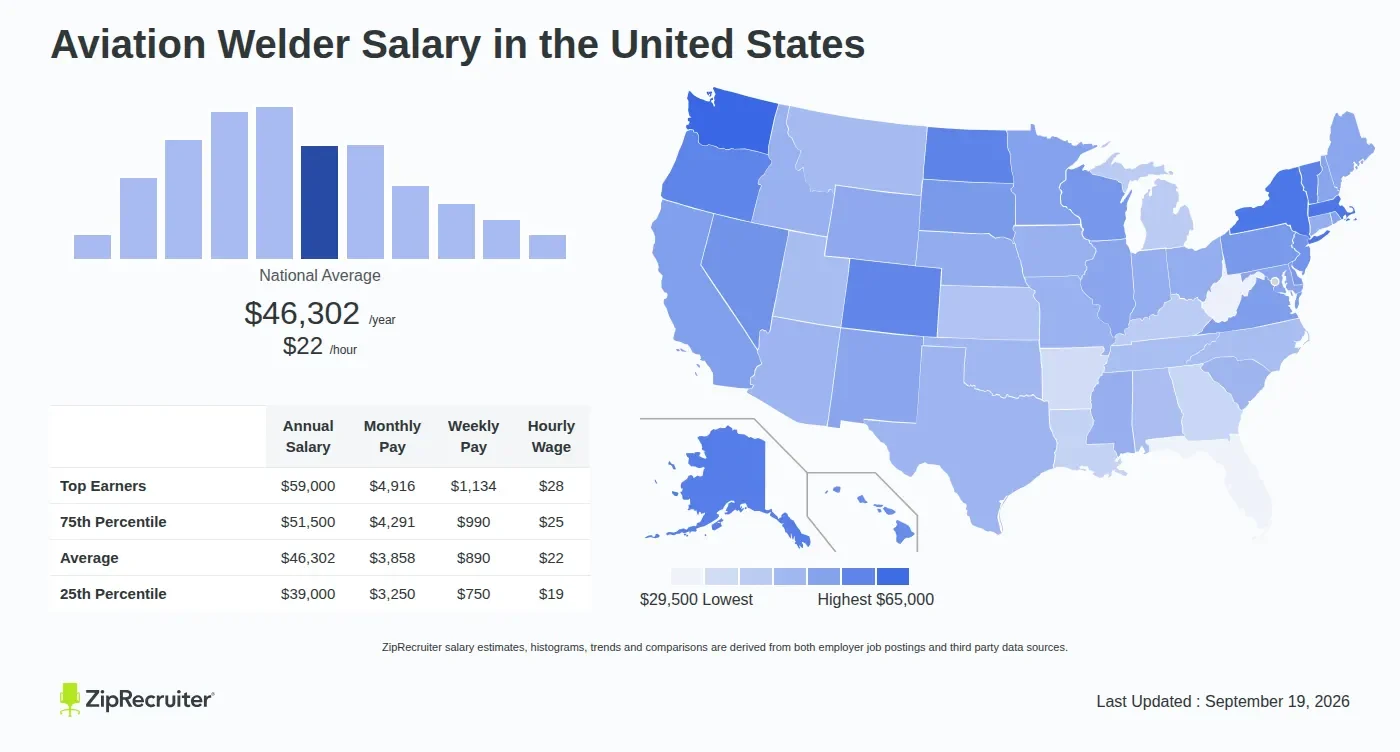
In the United States, aviation welders commonly earn about $45,000 to $75,000 annually, with experience, certifications, location, and overtime pushing some roles higher.
A clean aircraft weld can look like proof of high earning potential, yet appearance alone says little about the paycheck behind it. A polished job title may conceal entry-level pay, temporary contracts, expensive relocation, or demanding shifts.
That difference matters because aviation welding is a specialized manufacturing trade, not one uniform occupation. Pay depends on whether you work on aircraft structures, engines, aerospace components, military programs, or maintenance and repair. The same skill can also be valued differently by an aircraft manufacturer, defense contractor, repair station, or small precision-fabrication shop.
This guide explains aviation welder salary, including the practical details and important limitations.
This guide explains aviation welder salary, including the practical details and important limitations.
This guide explains what shapes an aviation welder salary in the United States, how realistic pay ranges differ by experience, which certifications and processes can improve your prospects, and how to compare an offer beyond its hourly rate. You will also learn what employers typically evaluate, why overtime can distort annual figures, and how to decide whether a job posting represents a strong career step or merely an attractive number.
- ✓U.S. aviation welding pay varies widely because the occupation covers several industries, processes, and responsibility levels.
- ✓Experience with aerospace alloys, precision welding, blueprint reading, and inspection requirements can raise earning potential.
- ✓Annual salary may include substantial overtime, shift premiums, bonuses, or contract work, so compare the full compensation package.
- ✓Certification helps, but documented quality, repeatable work, and regulated-industry experience often matter just as much.
What an Aviation Welder Salary Usually Looks Like
There is no single government wage category that perfectly captures every aviation welder. Some workers are classified as welders, cutters, solderers, and brazers; others fall under aircraft manufacturing, aerospace engineering, maintenance, or structural assembly occupations. As a result, published wage figures should be treated as reference points rather than a guaranteed rate for one job title.
For a practical U.S. estimate, entry-level aviation welders may see offers around $35,000 to $50,000 per year, depending on region and prior training. Welders with several years of relevant experience often fall near $45,000 to $75,000, while highly capable specialists, lead workers, or employees in demanding defense and aerospace markets may reach $80,000 or more. These ranges are broad because overtime and local labor costs can change the result substantially.
Hourly pay is often easier to compare. A posting might advertise $20 to $35 per hour, while advanced positions can exceed that range. At 40 hours per week, every $1 increase in hourly pay equals roughly $2,080 in annual base wages before overtime, taxes, bonuses, and unpaid time are considered.
- Base rate: Separate guaranteed hourly pay from estimated overtime or performance bonuses.
- Classification: Confirm whether the role is production welding, aircraft maintenance, component repair, or precision fabrication.
- Work schedule: Evening, overnight, weekend, and rotating shifts may add premiums but also affect quality of life.
- Location: Compare pay with housing, transportation, taxes, and the concentration of aerospace employers nearby.
Why Aviation Welding Pay Varies So Much
The biggest salary differences usually come from the difficulty and consequences of the work. Aircraft components must meet strict dimensional, material, traceability, and inspection requirements. A welder who can produce consistent, defect-free joints on thin or heat-sensitive alloys may be more valuable than someone whose experience is limited to general steel fabrication.
Materials are a major factor. Aluminum, stainless steel, titanium, nickel alloys, and other aerospace materials require different heat control, cleaning practices, shielding, and post-weld handling. TIG welding is especially relevant in many precision applications, but employers may also seek MIG, orbital welding, resistance welding, brazing, or specialized repair skills.
Industry setting matters as well. A small supplier may offer a lower base wage but provide broad hands-on experience. A large aircraft or defense manufacturer may pay more and offer stronger benefits, although the work can be highly repetitive, closely measured, and subject to security or production requirements.

- Production versus repair: Repair work often demands troubleshooting and judgment, while production work may emphasize speed and repeatability.
- Commercial versus defense: Defense roles may involve additional documentation, background requirements, and specialized procedures.
- General versus precision: Tight tolerances and thin materials can increase training demands and employer expectations.
- Employee versus contractor: Contract wages may look higher but can provide less predictable hours or fewer benefits.
Skills That Can Increase Your Earning Potential
Employers rarely pay more simply because a person has held a welding job for a certain number of years. They pay for useful capability: producing acceptable welds consistently, understanding the applicable procedure, identifying problems early, and completing records accurately.
Strong blueprint reading is one of the most transferable advantages. Aviation welders may need to interpret symbols, dimensions, tolerances, material specifications, weld callouts, and revision-controlled instructions. A worker who understands why a joint must be prepared a particular way can often prevent rework rather than merely correct it afterward.
Inspection awareness also matters. Familiarity with visual inspection, dye penetrant testing, radiographic or ultrasonic concepts, weld discontinuities, and nonconformance procedures can make a candidate more useful. You may not perform every inspection yourself, but you should understand how your process affects the final acceptance decision.

Certifications and documented qualifications
Certification requirements depend on the employer and job. Some companies qualify welders through internal testing against a written procedure, while others prefer credentials associated with recognized welding standards or aerospace quality systems. A certification is valuable when it matches the materials, process, position, and employer’s actual needs.
Keep a clear record of processes and materials you have worked with. A resume that says “TIG welding” is less informative than one that identifies thin-wall aluminum, stainless steel tubing, titanium components, or precision assemblies—provided those details are accurate and can be demonstrated in a skills test. This is an important consideration for aviation welder salary.
- Build process depth: Become highly reliable in one relevant process before collecting unrelated credentials.
- Document quality: Track qualifications, completed training, inspection experience, and measurable production achievements.
- Practice precision: Thin sections, heat control, fit-up, cleanliness, and distortion management are valuable aerospace habits.
- Learn the paperwork: Traceability, traveler documentation, nonconformance reporting, and revision control are part of the job.
Education, Experience, and the Path to Better Pay
A four-year degree is not normally required to begin a welding career. Many people enter through a technical school, community college, apprenticeship, military training, or employer-sponsored program. The most useful program combines welding practice with metallurgy, shop math, blueprint reading, safety, and inspection fundamentals.
Entry-level workers should focus on becoming dependable before chasing the highest advertised wage. Attendance, safe work habits, clean fit-up, and the ability to follow a procedure closely can lead to additional qualifications. In regulated manufacturing, reliability is not a minor advantage; it protects production schedules and reduces expensive scrap.
After gaining experience, a welder can move toward aerospace component repair, welding inspection, production lead work, quality assurance, tooling, or supervision. Some workers also become manufacturing technicians or inspectors, while others specialize in difficult materials and high-precision assemblies.
How to turn experience into leverage
Review job postings from the employers you actually want to join. Note repeated requirements such as TIG on aluminum, titanium experience, ability to read engineering drawings, familiarity with non-destructive testing, or willingness to work a second shift. Those repeated requirements show where training may produce the strongest return.
When requesting a raise or applying for a better role, connect your experience to business results. Reduced rework, stronger first-pass yield, cross-training, successful qualification tests, and dependable work on difficult parts are more persuasive than a general statement that you are experienced.
- Chasing the headline rate: A high number may depend on excessive overtime, short-term demand, or an undesirable shift.
- Ignoring quality experience: Fast welding without consistent acceptance can limit advancement.
- Listing every skill equally: Employers need to know which process and materials you can perform confidently today.
How to Compare an Aviation Welder Job Offer
Two offers with the same annual figure may have very different value. Start with guaranteed base pay, then examine overtime rules, shift differentials, paid holidays, vacation, health insurance, retirement contributions, bonuses, and commuting costs. If the role is contract-based, ask how long the assignment is expected to last and whether conversion to permanent employment is realistic.
Ask how the company calculates its advertised annual salary. A figure based on 40 hours per week is different from one based on regular overtime. For example, $28 per hour produces about $58,240 in base wages at 40 hours weekly, while overtime can raise gross earnings—but only if those hours remain available and sustainable.
Also evaluate the work itself. A slightly lower-paying position may be the better decision if it provides recognized qualifications, exposure to aerospace materials, stable mentorship, and a clear progression path. Conversely, a high-paying job may be less useful if it offers no training, unstable scheduling, or work that does not build transferable skills.
- Guaranteed earnings: Identify base wages and separate them from optional overtime, bonuses, and per diem.
- Benefits value: Estimate premiums, deductibles, retirement contributions, paid leave, and insurance coverage.
- Advancement: Ask how wage increases, reclassification, qualification tests, and promotions work.
- Physical demands: Confirm standing, awkward positions, fumes, heat, protective equipment, and shift expectations.
Location, Overtime, and Other Compensation Factors
Aviation manufacturing tends to cluster near major production, maintenance, defense, and space-industry centers. Areas with many employers may provide more openings and better mobility, but they may also have higher housing costs and stronger competition. A smaller market can offer a lower cost of living, although fewer employers may make changing jobs harder.
Overtime is common during production increases, contract deadlines, or staffing shortages. It can make an aviation welder salary appear unusually high in a strong year. Treat overtime as variable income unless the employer can show a stable pattern and you are comfortable with the schedule required to earn it.
Shift premiums can improve pay for evening or overnight work, and some employers offer relocation assistance, signing bonuses, tuition support, or tool allowances. Read the conditions carefully. A bonus may require a minimum employment period, and relocation repayment clauses can affect your decision if the job ends early.
Frequently Asked Questions About Aviation Welder Salary
What is the average aviation welder salary in the United
A reasonable broad estimate is about $45,000 to $75,000 per year, although entry-level roles may fall below that range and experienced specialists may earn more. The exact figure depends on location, process, industry, shift, and overtime.
Do aviation welders make more than general welders?
They can, particularly when they work with aerospace alloys, tight tolerances, complex procedures, or regulated documentation. However, the title alone does not guarantee higher pay; skill level, employer type, and local demand remain important.
Which welding process is most useful for aerospace work?
TIG is widely relevant because it offers precise control for many thin materials and critical joints. Employers may also value MIG, resistance welding, brazing, orbital welding, and specialized processes, so the best choice depends on the target role.
Are certifications required to become an aviation welder?
Requirements vary. Some employers conduct qualification tests under their own procedures, while others expect recognized certifications or prior qualifications. Always compare the credential with the specific process, material, and standard named in the job posting.
Can military experience improve aviation welding pay?
Yes, if it provides documented experience with aircraft structures, maintenance procedures, welding processes, inspection, or regulated records. Translate military duties into civilian terms and identify the materials, equipment, qualifications, and responsibilities involved.
Is overtime included in advertised aviation welding salaries?
Sometimes. Ask whether the posted annual amount means base pay at 40 hours, expected overtime, shift premiums, bonuses, or a combination. Use guaranteed base wages as the safest comparison between employers.
Conclusion
An aviation welder salary can range from a modest entry-level wage to a strong specialist income, but the number makes sense only alongside the work conditions behind it. Experience with aerospace materials, precision processes, inspection requirements, and controlled documentation can improve your options, while overtime and location can make annual figures look better—or worse—than they first appear.
Compare the full offer, build skills that match real aerospace vacancies, and keep evidence of your qualifications and quality results. That approach helps you choose a role that offers not only better pay now, but also a credible path to higher-value work.
Collect three current local job postings, compare their base rates and requirements, and choose one skill or qualification that appears repeatedly.