Sanitary Welding Training: Clear Overview and Expert Insights
Many people assume sanitary welding is simply ordinary TIG welding performed on stainless steel. The weld may look similar, but the acceptance criteria are much stricter: contamination, internal defects, surface finish, drainage, documentation, and cleaning performance can all determine whether a system is acceptable.
Sanitary welding training prepares welders and inspectors to work on process piping, tanks, vessels, and equipment used in food, beverage, dairy, pharmaceutical, biotechnology, and other hygienic applications. I view it as a combination of welding skill, material control, code awareness, and disciplined inspection.
This overview explains what the training covers, how courses differ, which qualifications matter, how to choose a program, and which mistakes can prevent an otherwise attractive weld from being accepted. It is designed to help a new or experienced welder make a practical training decision.
What Is Sanitary Welding Training?
Sanitary welding training is specialized instruction for joining materials and components in systems that must resist contamination and remain easy to clean. Most programs focus on stainless steel tube and pipe joined with gas tungsten arc welding, commonly called TIG or GTAW.
The work appears in product-contact systems such as milk lines, beverage skids, pharmaceutical water loops, clean-in-place piping, mixing equipment, and process vessels. A sanitary weld is not judged only by its outside appearance. The finished joint must also support hygienic operation throughout the system’s service life.
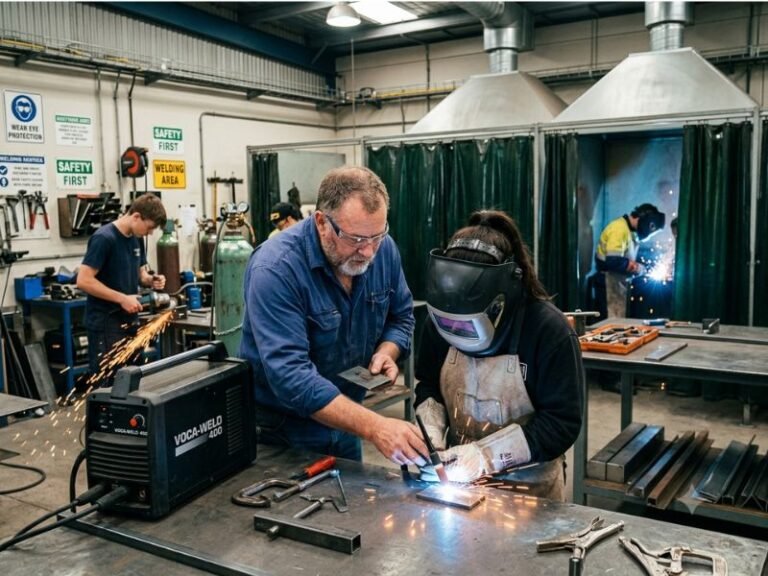
Training normally combines classroom instruction with extensive hands-on practice A student may learn how to prepare tube fit a joint purge the inside establish a stable arc control.
How Sanitary Welding Differs From General Pipe Welding
General pipe welding often emphasizes strength, code compliance, pressure containment, and productivity. Sanitary welding includes those concerns but adds requirements related to cleanability and contamination control.
- Internal discoloration must be limited because heavy oxidation can create a rough, contaminated surface.
- Incomplete penetration, excessive reinforcement, suck-back, and internal concavity may create areas that trap product or cleaning chemicals.
- Crevices, undercut, arc strikes, spatter, and irregular transitions can interfere with sanitation.
- Materials, filler metals, purge gas, tools, and handling methods must be controlled to avoid iron contamination and other foreign material.
- Welds may need consistent appearance and traceability across an entire installation.
A strong-looking bead can still fail if the inside of the tube was not adequately shielded. That is why effective training teaches the complete weld system rather than treating the visible bead as the only objective.
Who Needs This Training?
Entry-level welders often take sanitary welding classes to develop a specialized skill before applying for fabrication or field positions. Experienced pipe welders may enroll when moving into pharmaceutical, dairy, biotechnology, or high-purity process work.
Training can also benefit orbital weld technicians pipefitters fabrication supervisors quality-control personnel inspectors and maintenance technicians A supervisor who understands purge control and weld acceptance can make better.
Typical Student Backgrounds
- Beginning welders with basic TIG instruction
- Commercial or industrial pipe welders changing specialties
- Fabricators working with stainless steel tube
- Maintenance personnel responsible for hygienic process equipment
- Orbital welding operators who need stronger fundamentals
- Quality personnel reviewing weld documentation and visual results
Some schools accept complete beginners, while others expect prior TIG experience. Before enrolling, I would check whether the program teaches arc fundamentals from the beginning or assumes that the student already understands amperage, tungsten preparation, shielding gas, and manual torch control.
What Does Sanitary Welding Training Cover?
The best course content connects theory directly to the decisions a welder makes at the bench or in the field. A typical program may include the following subjects.
Stainless Steel and Hygienic Materials
Students learn how common stainless steel grades behave during welding, including austenitic grades frequently used for sanitary tubing. Instruction may cover heat tint, distortion, sensitization concerns, corrosion resistance, and the effect of contamination from carbon-steel tools.
Material identification matters because the wrong tube, fitting, filler, or cleaning method can compromise an entire installation. Training should address material certificates, heat numbers, protective film, storage, and segregation from unsuitable metals.
TIG Welding Fundamentals
Manual sanitary welding usually relies on GTAW because it provides precise control and a clean, concentrated arc. Core skills include tungsten selection and grinding, torch angle, arc length, amperage control, filler addition, travel speed, and shielding-gas management.
Students practice maintaining a consistent weld pool around small-diameter tube. They also learn that a stable bead often depends more on preparation and rhythm than on simply increasing current. Excessive heat can cause distortion, burn-through, broad heat tint, and loss of corrosion resistance.
Joint Preparation and Fit-Up
Sanitary tube requires accurate cuts square ends proper alignment and a controlled gap The exact joint design depends on the material wall thickness welding procedure and equipment A.
Training commonly includes tube cutting, deburring, end preparation, alignment, tack welding, and the use of sanitary fittings such as elbows, tees, reducers, ferrules, and valves. Students should learn to protect prepared ends from dust, oil, fingerprints, and damaged packaging.
Internal Purging
Internal purging replaces air inside the tube with an inert gas, usually argon, to protect the root of the weld from oxidation. This is one of the defining skills in sanitary welding.
Effective instruction covers purge dams purge plugs venting gas flow leak control purge time and the relationship between flow and turbulence More gas is not automatically better Excessive.
Students should also understand that the purge setup must match the joint and the work environment A small tube a long spool a complex fitting and a field.
Heat Control and Weld Appearance
Heat control affects penetration, distortion, surface oxidation, and the final finish. Training teaches students to coordinate amperage, travel speed, filler addition, pulse settings when appropriate, and interpass temperature.
Color can provide a useful warning but appearance alone does not prove quality A bright uniform weld may still have an internal flaw and a discolored weld may require evaluation.
Orbital Welding
Orbital welding uses a machine-controlled torch to rotate around the tube. It can improve repeatability on production work, but it does not eliminate the need for skilled judgment.
Operators must understand programming, tube alignment, electrode condition, gas connections, weld schedules, calibration, and the effect of variables such as wall thickness and joint geometry. A machine can repeat a bad setup very consistently. Training should include setup verification, first-piece inspection, troubleshooting, and documentation.
Codes, Standards, and Qualification
Sanitary welding requirements come from several sources rather than one universal certificate. The governing requirements may include the owner’s specification, a welding procedure specification, project documents, customer standards, and applicable codes.
ASME Section IX
ASME Boiler and Pressure Vessel Code Section IX is widely associated with the qualification of welding procedures and welders A welder qualification test demonstrates that a person can.
A course completion certificate is not automatically the same as an employer qualification or a Section IX performance qualification I would ask the training provider exactly what testing.
ASME BPE and Hygienic Design Standards
ASME BPE is commonly referenced in bioprocessing and pharmaceutical applications. It addresses hygienic design, materials, surface finishes, fabrication, inspection, and related topics. It can influence expectations for weld profiles, surface condition, documentation, and system construction.
3-A Sanitary Standards
3-A Sanitary Standards are important in certain dairy and food-processing applications. They address equipment design and sanitary construction. A 3-A symbol authorization applies to qualifying equipment or systems under the relevant program; it should not be confused with a universal individual welder license.
Owner and Employer Requirements
A pharmaceutical manufacturer, dairy processor, engineering contractor, or equipment builder may impose requirements that are stricter or more specific than a general course outline. These can include sample welds, boroscope inspection, radiography, ferrite checks, surface roughness limits, weld maps, welder continuity records, and detailed material traceability.
The practical lesson is simple: training is valuable, but the project specification determines acceptance. A student should learn how to read the applicable documents rather than assuming that one certificate qualifies the student for every sanitary welding job.
How a Sanitary Weld Is Made
A disciplined sequence reduces defects and makes the work easier to inspect. The exact procedure varies, but the following steps describe the general process.
- Review the requirements. Confirm the material, tube size, wall thickness, joint design, filler metal, purge method, welding process, inspection criteria, and documentation requirements.
- Control the materials. Verify tube and fittings, preserve identification, and keep stainless components away from carbon-steel dust, dirty benches, and contaminated tools.
- Prepare the joint. Cut the tube square, remove burrs, clean the ends with approved materials, and inspect for dents or scratches that could affect alignment.
- Fit and align the parts. Establish the required gap and alignment. Avoid forcing parts together or creating a mismatch that must be hidden with excessive welding.
- Set up the purge. Install suitable dams or plugs, provide a controlled gas path, and confirm that air can escape. Seal leaks without creating contamination or unsafe pressure.
- Tack the joint. Place sound, properly fused tacks according to the welding procedure. Poor tacks can become inclusions or cause uneven penetration.
- Weld with controlled heat. Maintain arc length, travel speed, torch position, filler addition, and shielding. Keep the arc and filler within the protected area.
- Inspect the joint. Check the outside and, when required, the inside using visual inspection, a borescope, dye penetrant, radiography, or another specified method.
- Record the work. Complete weld maps, welder identification, material traceability, inspection results, repairs, and continuity records as required.
The sequence matters because many weld failures originate before the arc starts. A contaminant, poor alignment, damaged ferrule, or leaking purge setup cannot usually be corrected by better torch movement.
Equipment and Shop Practices
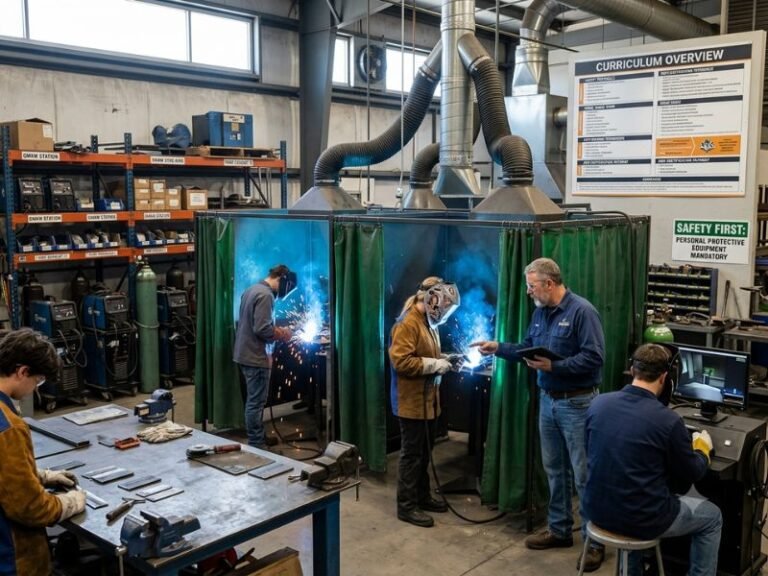
A sanitary welding class should provide more than a TIG power source. Students need an environment that reflects the cleanliness and precision of actual hygienic fabrication.
- TIG power source with stable low-amperage control
- Suitable torches, collets, gas lenses, and tungsten electrodes
- Clean argon supply with appropriate regulators and flow controls
- Tube stands, alignment tools, purge equipment, and sanitary fittings
- Dedicated stainless-steel brushes, files, abrasives, and cleaning materials
- Inspection lighting and gauges for fit-up and weld evaluation
- Orbital equipment when machine welding is part of the course
- Personal protective equipment and appropriate ventilation
Tool segregation deserves special emphasis. A brush used on mild steel should not later be used on stainless tube. Carbon-steel particles can embed in the stainless surface and create rust or corrosion problems that appear after fabrication.
Clean handling also includes wiping gloves, protecting tube openings, keeping parts off dirty floors, and avoiding unnecessary contact with prepared surfaces. These habits may feel slow at first, but rework and contamination investigations are slower and more expensive.
Choosing the Right Training Program
Course length alone does not tell me whether a program is useful. I would compare the curriculum, practice time, equipment, instructor qualifications, testing, and connection to local employers.
Questions to Ask Before Enrollment
- Does the course teach manual TIG, orbital welding, or both?
- How much of the schedule is hands-on practice?
- What tube sizes, wall thicknesses, and joint types are included?
- Does the class cover internal purging and oxidation control in detail?
- Are welding procedures provided, or must students bring employer procedures?
- Is a performance qualification test included?
- Who witnesses and records the test?
- Does the credential identify the process and qualification limits?
- Are inspection, documentation, and weld traceability covered?
- Does the school use dedicated sanitary tools and clean fabrication areas?
- Are job placement claims specific and verifiable?
A short introductory class may be appropriate for someone deciding whether to enter the field. A working pipe welder may need a focused qualification course instead. An orbital operator may benefit most from a program that emphasizes programming, purge verification, and production documentation.
In-Person, Employer-Based, and Online Options
In-person training is usually the strongest choice for beginners because weld quality depends on physical coordination, fit-up, torch control, and immediate instructor feedback. Employer-based training can be highly relevant because it uses the company’s procedures, equipment, and acceptance standards.
Online material can help with terminology, safety, code concepts, and visual examples. It cannot substitute for supervised arc time or a formal performance qualification. I would treat online instruction as preparation or review rather than complete sanitary welding training.
Common Mistakes That Cause Rejection
Focusing Only on the Outside Bead
A smooth external bead does not guarantee a sanitary root. Incomplete penetration, oxidation, excessive internal reinforcement, and concavity can remain hidden. Welders must understand how fit-up, purge, and heat settings affect the inside of the joint.
Using Excessive Shielding or Purge Gas
High flow rates may seem protective, but turbulence can pull air into the shielding area. The correct setup depends on the torch, joint, tube volume, purge path, and procedure. Students should learn how to establish stable coverage instead of relying on maximum flow.
Allowing Contamination
Dirty gloves, an unprotected tube opening, an oily fitting, or an incorrect brush can introduce contamination. Even a small foreign particle may produce an inclusion or compromise the surface.
Overheating the Joint
Excess heat can enlarge the heat-affected area, increase discoloration, distort thin-wall tube, and make penetration difficult to control. Slow travel is not always safer. The welder must maintain the heat range required by the procedure.
Ignoring Fit-Up
A wide or inconsistent gap often leads to burn-through, excessive filler, poor root profile, or an uneven bead. Accurate preparation usually improves both appearance and acceptance more than last-minute torch adjustments.
Assuming Every Certificate Has the Same Value
Some certificates document attendance, some confirm course completion, and some represent a witnessed qualification under defined variables. Employers and customers may treat these documents very differently. Students should understand the exact credential before paying for a course.
How to Prepare for Training
A student can get more value from class by reviewing basic TIG concepts beforehand. I would practice safe torch handling, tungsten preparation, filler-rod control, and reading a simple welding procedure if those skills are unfamiliar.
It also helps to learn common sanitary components and terms, including ferrule, tri-clamp, tube OD, orbital head, purge dam, heat tint, sugaring, borescope, weld map, and passivation. Understanding the vocabulary makes instructor feedback easier to apply.
Physical preparation matters as well. Sanitary fabrication may require extended standing, awkward positions, close visual work, and careful hand coordination. Proper eye protection, flame-resistant clothing, gloves, hearing protection when appropriate, and attention to ventilation should be treated as part of professional performance.
During class, I would keep a record of successful settings, joint conditions, purge arrangements, and recurring mistakes. The goal is not to memorize one machine’s numbers. The goal is to understand why a change in wall thickness, diameter, fit-up, or joint geometry requires a different setup.
Career Value and Limitations
Sanitary welding skills can support careers with process-piping contractors, food and beverage manufacturers, pharmaceutical equipment builders, biotechnology facilities, dairy plants, breweries, and specialty fabrication shops. Demand and pay vary by region, industry, travel expectations, shift schedule, and qualification level.
Training does not guarantee employment. Employers may still require drug screening, safety training, blueprint reading, pipefitting ability, stainless fabrication experience, background checks, or a company-specific weld test. Some field positions also involve travel, confined spaces, cleanroom protocols, or strict production documentation.
Manual TIG remains important for repairs, complex fittings, tie-ins, and locations where an orbital head cannot be used. Orbital welding can be valuable for repeatable production, but operators still need manual welding knowledge to understand joint preparation, root protection, and defect causes.
FAQ About Sanitary Welding Training
Is sanitary welding training difficult for a beginner?
It can be challenging because the student must develop precise TIG control while also learning cleanliness purging fit-up and inspection A beginner can start successfully with a foundational.
Do I need TIG experience before taking sanitary welding training?
Not always. Some programs teach basic TIG before moving into tube welding, while others are designed for experienced welders. Check the prerequisites carefully. A student with no TIG background may need a longer course or an introductory class before attempting a qualification test.
What type of welding is used most often in sanitary applications?
GTAW or TIG welding is the most common process for high-quality sanitary tube and pipe because it offers accurate heat control and a clean weld Orbital GTAW is.
Does course completion qualify me to weld on every sanitary project?
No. Course completion, a school certificate, and a formal performance qualification are different things. Qualification depends on the procedure, variables, governing code, employer requirements, and project scope. Always confirm what the credential covers and whether a separate employer test is required.
How important is argon purging in sanitary welding?
It is critically important for protecting the inside of many stainless tube welds from oxidation. Poor purging can cause sugaring, roughness, contamination, and rejection. Training should explain gas flow, venting, purge volume, leak control, and how to verify that the root received adequate protection.
Can online classes replace hands-on sanitary welding training?
Online classes can explain terms, safety, code concepts, and basic process theory. They cannot provide the physical practice and supervised evaluation needed to develop manual TIG control or complete a legitimate performance qualification. For most students, online learning works best as a supplement.
What should I bring to a sanitary welding class?
Follow the school s equipment list but expect to need approved protective clothing welding gloves safety glasses hearing protection when required and possibly a hood with suitable lens.
How can I tell whether a program is credible?
Look for clear prerequisites, experienced instructors, dedicated stainless equipment, substantial hands-on time, written procedures, defined inspection methods, and transparent qualification documents. A credible provider should explain exactly what the student will be able to do after training rather than promising universal certification or guaranteed employment.
Conclusion
Sanitary welding training is most valuable when it develops more than bead appearance It should teach controlled TIG technique internal purging clean material handling accurate fit-up inspection documentation.