Combination Welding Training: Skills, Processes & Career Guide
Combination Welding training teaches students to work with several major welding processes instead of becoming familiar with only one method. A typical multi-process program may include Shielded Metal Arc Welding (SMAW), Gas Metal Arc Welding (GMAW/MIG), Flux-Cored Arc Welding (FCAW), and Gas Tungsten Arc Welding (GTAW/TIG), along with welding safety, joint preparation, blueprint basics, inspection, and practical shop skills. AWS welding-education resources cover these same core processes as part of structured welder training.
For students considering Combination Welding training, the main advantage is versatility. Different jobs, materials, positions, and production environments favor different welding processes. Learning several processes gives a welder a broader technical foundation and makes it easier to understand why one process may be better suited to a particular joint than another.
Combination welding can also have a more specific meaning in pipe work, where more than one welding process may be used on the same joint. For example, a GTAW root and hot pass may be followed by SMAW fill and cap passes when the applicable procedure calls for that combination. Lincoln Electric currently teaches this type of mixed-process pipe welding in its advanced pipe curriculum.
What Is Combination Welding Training?
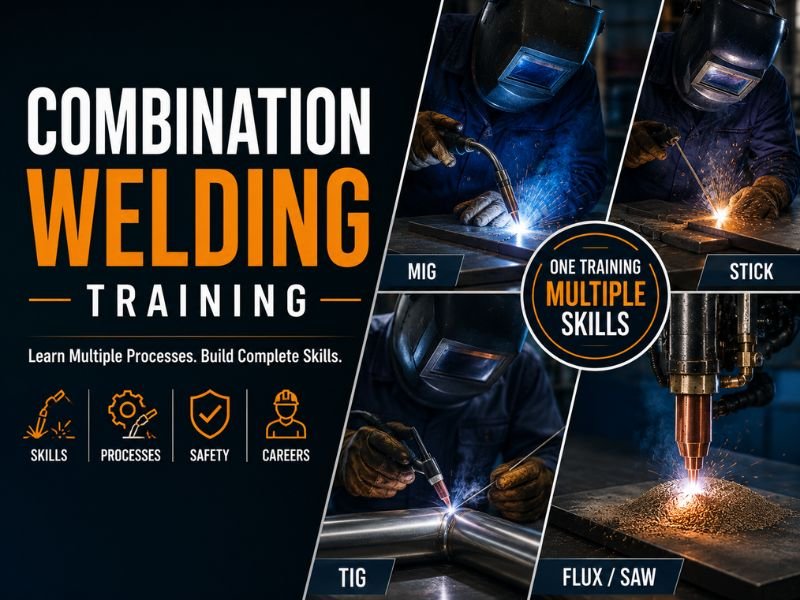
Combination Welding training is a welding-education path that develops practical ability in multiple welding processes.
Instead of spending the entire program on one machine or electrode type, students learn how different welding systems operate and how their techniques compare.
A comprehensive program can include:
- SMAW or stick welding
- GMAW or MIG welding
- FCAW or flux-core welding
- GTAW or TIG welding
- Welding safety
- Joint design
- Welding symbols
- Fit-up and fabrication
- Weld discontinuities
- Visual inspection
AWS’s Fundamentals of Welding curriculum includes safety, welding symbols and joint design, SMAW, GMAW, FCAW, GTAW, discontinuities, and visual inspection, illustrating the breadth of knowledge expected in structured multi-process welding education.
Why Is It Called Combination Welding?
The term “combination” generally refers to learning or applying more than one welding process.
In a training program, that may mean spending separate portions of the course learning stick, MIG, flux-core, and TIG welding.
In specialized pipe welding, it can mean using two processes on the same joint because each provides a particular advantage at a specific stage of the weld.
For example, GTAW can be used for root and hot passes, followed by low-hydrogen SMAW for fill and cap passes. That is a real mixed-process approach taught in current professional pipe-welding instruction.
It is important, however, not to confuse multi-process training with universal qualification. Learning four processes does not automatically qualify a welder for every position, material, thickness, or production code.
What Welding Processes Are Taught?
The exact curriculum varies between schools and employers, but four processes form the core of many general welding programs. AWS specifically includes SMAW, FCAW, GMAW, and GTAW in its welding-education framework and instructor training.
Shielded Metal Arc Welding (SMAW)
SMAW is commonly known as stick welding.
The process uses a consumable flux-coated electrode. The arc melts the electrode and base metal, while the electrode coating provides shielding and forms slag over the cooling weld.
Students typically learn:
- Electrode selection
- Amperage control
- Arc length
- Travel speed
- Work and travel angles
- Slag removal
- Multi-pass welding
Stick welding is especially useful for teaching arc control because the welder manually maintains both electrode position and arc length.
Gas Metal Arc Welding (GMAW/MIG)
MIG welding uses a continuously fed wire electrode and external shielding gas.
The operator controls gun movement while the wire feeder supplies electrode automatically.
Training commonly focuses on:
- Voltage
- Wire-feed speed
- Gun angle
- Contact-tip-to-work distance
- Travel speed
- Shielding-gas coverage
GMAW is widely taught because continuous wire feeding makes it relevant to fabrication and production environments. AWS includes GMAW as one of the principal processes in its welding curriculum.
Flux-Cored Arc Welding (FCAW)
FCAW uses a tubular electrode containing flux.
Depending on the electrode type, the process may operate with external shielding gas or as a self-shielded system.
Students learn many skills that overlap with GMAW, including wire-feed control and gun positioning, but FCAW also introduces flux and slag management.
The process is an important part of structured welding education and is included in AWS multi-process training resources.
Gas Tungsten Arc Welding (GTAW/TIG)
TIG welding uses a nonconsumable tungsten electrode to create the arc.
Filler metal, when required, is normally added separately.
GTAW training emphasizes precise control of:
- Arc length
- Torch angle
- Heat input
- Shielding gas
- Filler placement
- Surface cleanliness
Because the electrode and filler are controlled separately, TIG often demands greater coordination than wire-feed welding.
Why Learn More Than One Welding Process?
No single welding process is ideal for every job.
Different processes offer different advantages in terms of portability, deposition rate, precision, outdoor suitability, material compatibility, and production speed.
A welder who understands several processes can better recognize why a fabrication procedure specifies one method instead of another.
Multi-process training also reinforces concepts that apply across nearly all welding methods, including:
- Joint fit-up
- Heat control
- Travel speed
- Electrode positioning
- Weld-pool control
- Defect recognition
- Workpiece preparation
AWS’s SENSE framework is intentionally designed as a broad welding-education foundation rather than a single-process course, with training across multiple welding methods and supporting technical knowledge.
Welding Safety in Combination Training
Safety deserves substantial attention because switching processes can introduce different equipment, shielding methods, fumes, and electrical conditions.
OSHA identifies welding hazards including metal fumes, ultraviolet radiation, burns, eye damage, electrical shock, cuts, and crushing injuries. Proper work practices and PPE are central methods of controlling these hazards.
Arc Radiation
Electric welding arcs can produce intense ultraviolet and other radiant energy.
Training should therefore cover welding helmets, appropriate filter lenses, protective clothing, and protection for nearby workers.
Welding Fumes
Welding fumes vary with the process, electrode, base metal, coatings, and work environment.
Adequate ventilation and exposure controls are important regardless of whether the student is practicing SMAW, GMAW, FCAW, or GTAW. OSHA specifically identifies metal-fume exposure as a welding health hazard.
Electrical and Fire Hazards
Arc-welding equipment introduces electrical risks, while sparks, slag, and hot metal can create fire hazards.
Students need to understand equipment condition, cable inspection, safe connections, combustible-material control, and hot-work practices as part of normal welding technique rather than as separate classroom trivia.
Equipment Used in Combination Welding Training
A multi-process student becomes familiar with several types of welding equipment.
Welding Power Sources
Different welding processes use different power-source characteristics.
Students may encounter:
- Constant-current equipment
- Constant-voltage equipment
- AC capability
- DC capability
- Multi-process welding machines
Understanding what the controls actually change is more valuable than memorizing one machine’s panel.
MIG and Flux-Core Equipment
Wire-feed systems typically include:
- Power source
- Wire feeder
- Welding gun
- Drive rolls
- Contact tip
- Electrode spool
- Shielding-gas equipment when required
Stable feeding and correct consumable setup are important for consistent arc behavior.
TIG Equipment
TIG systems introduce additional components such as:
- TIG torch
- Tungsten electrode
- Gas cup
- Shielding gas
- Filler rod
- Remote amperage control on suitable systems
Stick-Welding Equipment
SMAW equipment is comparatively simple and generally includes a power source, electrode holder, welding leads, and work connection.
The operator, however, has direct responsibility for maintaining electrode angle and arc length throughout the weld.
Joint Preparation and Fit-Up
Combination Welding training should develop fabrication skills as well as arc skills.
Common joints include:
- Butt joints
- T-joints
- Lap joints
- Corner joints
- Edge joints
Students may also learn groove preparation involving bevel angles, root faces, and root openings.
Good fit-up matters with every welding process.
A perfectly adjusted welder cannot fully compensate for badly aligned material, inconsistent root gaps, or poor surface preparation.
Welding Positions Covered in Training
Students commonly begin in easier positions before progressing to more demanding ones.
Flat Welding
Flat welding allows gravity to help keep the molten weld pool in the joint and is commonly used to develop basic control.
Horizontal Welding
Horizontal welding requires more attention to puddle placement because gravity can pull molten metal downward.
Vertical Welding
Vertical welding increases the challenge of controlling the molten pool.
The applicable process, electrode, and procedure determine whether upward or downward progression is appropriate.
Overhead Welding
Overhead welding requires greater control and places additional importance on body position, heat management, and protective equipment.
Advanced programs may also include pipe positions such as 2G, 5G, or 6G. Lincoln Electric’s current pipe program, for example, progresses students through multiple pipe positions and mixed GTAW/SMAW work.
Welding Parameters Students Learn to Control
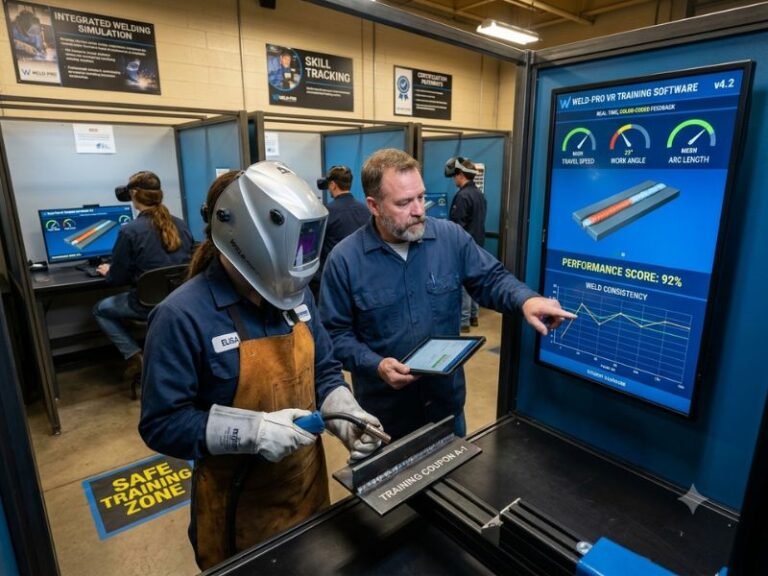
Multiple welding processes look different, but the same core idea applies: welding quality depends on controlling interacting variables.
Amperage
Current influences heat and penetration.
Its effect varies by process and electrode, so students learn to select settings based on the welding procedure and application rather than assuming more amperage always produces a better weld.
Voltage
Voltage is particularly important in wire-feed processes and influences arc characteristics and bead shape.
Wire-Feed Speed
GMAW and FCAW students learn the relationship between wire-feed speed, current, deposition, and arc behavior.
Travel Speed
Moving too slowly can introduce excessive heat and weld buildup, while excessive speed can reduce bead size or contribute to poor fusion.
Electrode and Gun Angle
Work angle and travel angle influence where heat and filler metal are directed.
That skill transfers across several processes even though the equipment changes.
Hands-On Skills Developed During Training
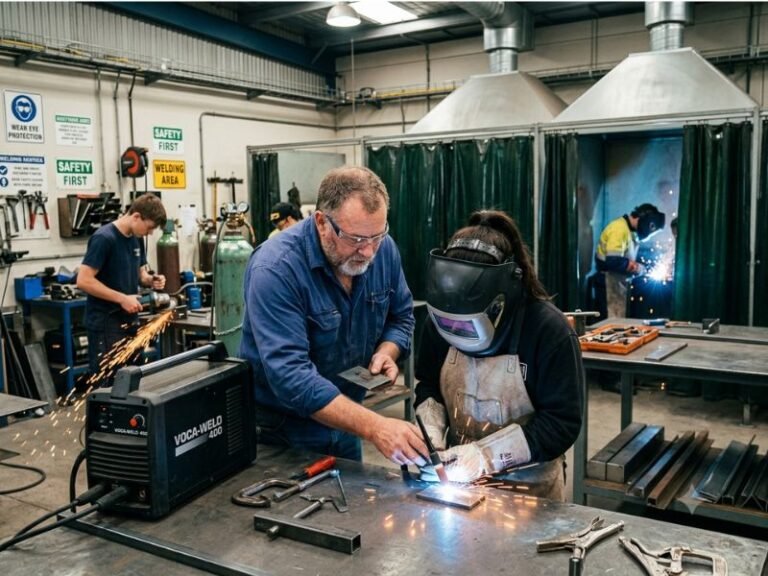
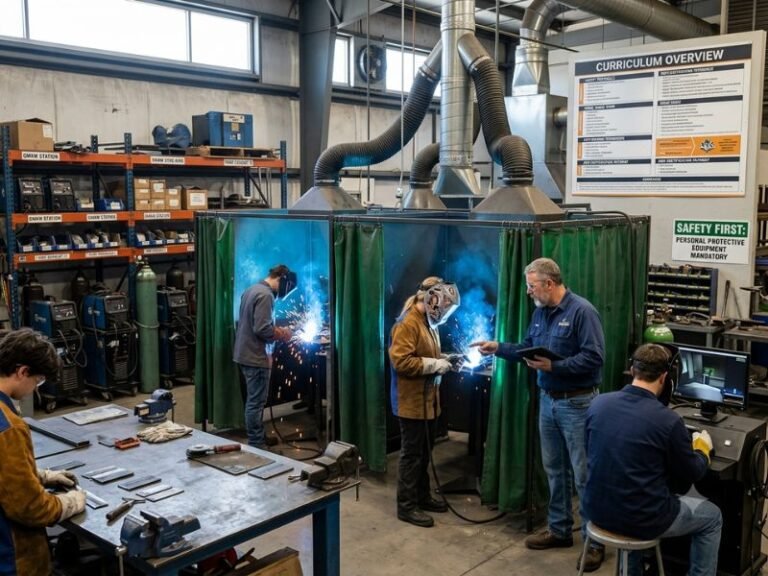
Combination welding is fundamentally practical training.
Students need repeated booth time to develop consistency.
Arc Control
SMAW students learn to maintain arc length as an electrode gets shorter.
TIG students manage a small, controlled arc with a nonconsumable tungsten.
MIG and FCAW students concentrate more on gun position, travel, and wire-feed behavior.
Weld-Pool Control
Regardless of process, the welder needs to recognize the edges of the molten pool and understand whether the weld is tying into both sides of the joint.
Multi-Pass Welding
Thicker joints may require several passes.
Training can introduce:
- Root passes
- Hot passes where applicable
- Fill passes
- Cap passes
- Interpass cleaning
Multi-process pipe welding may also require switching processes between passes, such as GTAW for the root and SMAW for later passes.
Common Welding Defects Students Learn to Recognize
AWS’s welding curriculum includes both discontinuity recognition and visual inspection, because producing a bead is only part of welder training.
Porosity
Porosity can result from contamination, inadequate shielding, moisture, or other process conditions.
Lack of Fusion
Lack of fusion occurs when weld metal does not properly fuse with the base material or a previous weld bead.
Insufficient heat, incorrect electrode placement, poor technique, or excessive travel speed may contribute.
Incomplete Penetration
Joint design, root opening, electrode placement, and process parameters can all affect penetration.
Undercut
Undercut appears as an unfilled groove along the weld toe.
Technique and welding parameters both require evaluation when it occurs.
Slag Inclusion
Slag-producing processes such as SMAW and many FCAW applications require proper cleaning between passes.
Failure to remove slag or poor bead placement can trap nonmetallic material inside the weld.
Blueprint and Welding Symbol Basics
A production welder needs to understand what the drawing requires before making the weld.
AWS’s current fundamentals curriculum devotes substantial instruction to welding symbols and joint design alongside process training.
Combination Welding training may therefore introduce:
- Basic drawing dimensions
- Joint locations
- Fillet-weld symbols
- Groove-weld symbols
- Weld size
- Weld length
- Basic fabrication layout
This knowledge connects welding-booth technique to actual fabrication work.
Learning to Follow a WPS
A Welding Procedure Specification, or WPS, defines the conditions intended for a particular weld.
Depending on the job, it may specify:
- Welding process
- Base material
- Filler metal
- Position
- Current
- Voltage
- Polarity
- Joint design
- Preheat or interpass requirements
Following a WPS teaches students that production welding is controlled work, not simply choosing settings based on personal preference.
Combination Welding Training vs. Certification
Training and qualification should not be treated as interchangeable terms.
Training develops skills. Qualification demonstrates ability under specified test requirements.
AWS maintains separate standards and training related to welder performance qualification, illustrating that learning a process and formally qualifying for production work are distinct activities.
A student who completes combination training may have experience with several processes but may still need separate qualification tests for a particular:
- Process
- Position
- Material
- Joint
- Procedure
- Employer or code requirement
AWS SENSE provides structured welding-education credentials, but the framework itself is broader than a universal license to perform every welding job.
How Long Does Combination Welding Training Take?
There is no single standard duration.
Program length depends on:
- Number of processes taught
- Plate vs. pipe training
- Welding positions
- Amount of shop practice
- Previous experience
- Qualification goals
A basic multi-process course may focus on introductory plate welding, while advanced pipe training can require significant additional practice. Lincoln Electric’s current ASME pipe course, for example, lists 180 clock hours and requires prior welding ability because it progresses into advanced pipe positions and GTAW/SMAW combination work.
The number of hours alone does not determine training quality. What matters is whether the student can repeatedly produce acceptable work and explain the welding variables involved.
Where Are Combination Welding Skills Used?
Multi-process welding knowledge can be useful wherever employers use different welding processes for different tasks.
Common areas include:
- Structural fabrication
- Manufacturing
- Industrial maintenance
- Pipe fabrication
- Pressure-related fabrication
- Shipbuilding
- Heavy equipment
- Transportation fabrication and repair
A fabrication shop may use MIG for production work, TIG for precision stainless components, and stick or flux-core for heavier structural work.
Knowing several processes makes it easier for a welder to adapt to those different requirements.
Frequently Asked Questions
What Is Combination Welding Training?
Combination Welding training teaches multiple welding processes within one broader program. Common processes include SMAW, GMAW, FCAW, and GTAW, together with safety, joint design, welding symbols, discontinuities, and inspection fundamentals.
Is Combination Welding Good for Beginners?
Yes, introductory programs can teach beginners the fundamentals progressively. Advanced combination pipe programs may require previous plate-welding experience before enrollment.
Do Combination Welders Learn MIG and TIG?
Many multi-process programs include both GMAW/MIG and GTAW/TIG along with SMAW and FCAW. AWS welding-education materials include all four processes.
Is Combination Welding the Same as Pipe Welding?
No. Combination Welding training may include plate, structural, fabrication, or pipe welding. Pipe training is a more specific application, although advanced pipe welding may combine processes such as GTAW and SMAW.
How Long Does Combination Welding Training Take?
There is no universal duration. Course length depends on the number of welding processes, positions, materials, and practical skills included. Advanced pipe programs can require significantly more practice than introductory multi-process training.
Can You Get Certified After Combination Welding Training?
Training can prepare a student for welding qualifications, but completing the course does not automatically qualify the person for every production weld. Performance qualification is based on defined requirements and testing.
What Is the Hardest Welding Position to Learn?
Difficulty varies by process and individual welder, but vertical, overhead, and fixed-position pipe welding generally require more weld-pool control than basic flat welding. Advanced pipe programs therefore commonly require prior welding skills before progressing to positions such as 5G and 6G.
Is Combination Welding Training Useful for Industrial Jobs?
It can provide a strong foundation because industrial employers may use different welding processes for different materials and applications. Multi-process training also develops transferable skills in fit-up, heat control, weld-pool control, safety, and defect recognition. AWS’s SENSE framework reflects this broad, multi-process approach to welder education.
Conclusion
Combination Welding training provides a broader welding foundation by teaching several processes rather than limiting students to one method. Programs commonly include stick, MIG, flux-core, and TIG welding while also developing safety, joint preparation, parameter control, welding-position, fabrication, and inspection skills.
The real value is not simply being able to operate four different machines. A well-trained combination welder understands how process selection, heat, filler metal, joint geometry, travel speed, and technique affect the finished weld.
Training also needs to be separated from qualification. Multi-process education can prepare a welder for a wider range of work, but specific structural, pipe, pressure, or other production jobs may require additional performance qualification. For students interested in fabrication and industrial welding, that combination of broad process knowledge and hands-on skill provides a strong base for more specialized welding work.