6G Welding Certification Training: Skills, Tests & Career Guide
6G welding certification training prepares welders to make groove welds on fixed pipe positioned at an incline, requiring control through several welding orientations during one complete joint. Because the pipe does not rotate, the welder must adapt body position, electrode or torch angle, travel speed, and puddle control while moving around the circumference.
For welders interested in advanced pipe work, 6G welding certification training usually focuses on much more than producing an attractive cap. Training can cover pipe fit-up, root penetration, fill and cap passes, welding parameters, interpass cleaning, defect recognition, Welding Procedure Specifications (WPSs), safety, and preparation for a performance qualification test.
The American Welding Society describes the 6G pipe test as one of the more demanding and respected welder qualification tests because welding around fixed pipe requires positional control throughout the joint. The exact qualification obtained, however, depends on the welding process, code, test variables, and certification program involved.
What Is 6G Welding Certification Training?
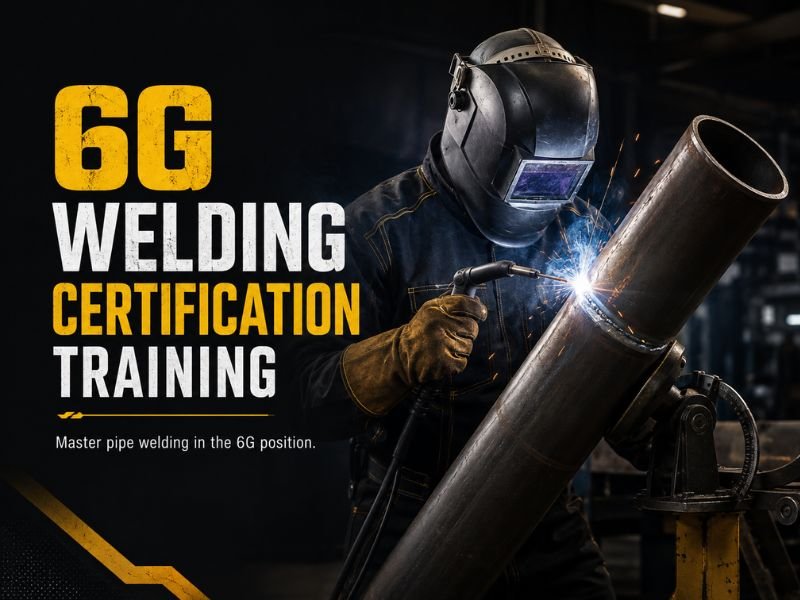
6G welding certification training is advanced pipe-welding instruction designed to help a welder develop the skills required for a fixed-position pipe qualification test.
Training may include:
- Pipe preparation and fit-up
- Tack welding
- Root-pass control
- Fill and cap passes
- SMAW, GTAW, or process combinations
- Welding around a fixed pipe
- Defect troubleshooting
- WPS interpretation
- Visual inspection
- Qualification-test preparation
Current professional pipe-welding courses demonstrate this progression. Lincoln Electric’s ASME pipe course, for example, takes welders from basic pipe methods into advanced pipe techniques and introduces 6G while also covering GTAW root and hot-pass work in combination with SMAW.
Training itself should not be confused with certification. A course develops skill; certification or performance qualification requires completing a specified welding test under the applicable program or code. AWS’s Certified Welder program is performance based and requires testing through an AWS Accredited Test Facility for AWS certification.
What Does 6G Mean in Welding?
The designation describes the position and type of weld.
The G refers to a groove weld on pipe. In the 6G position, the pipe is fixed at an inclined angle rather than being rotated as the weld progresses.
Because the pipe remains stationary, different areas of the joint place the welder in different relationships to gravity.
The upper portion may feel relatively favorable, while the sides and lower section require increasingly different puddle control.
Why the Fixed Pipe Matters
When pipe can rotate, the welder can keep the active welding area in a convenient position.
That advantage disappears in 6G.
The welder must move around the pipe while maintaining:
- Correct arc length
- Appropriate electrode or torch angle
- Controlled travel speed
- Consistent penetration
- Proper bead placement
This combination of changing orientations is what makes 6G useful as a demanding pipe-welding qualification position. AWS specifically notes that a 6G test covers welding positions around a fixed pipe.
6G vs. Other Pipe Welding Positions
Understanding the basic pipe positions helps explain why 6G training usually comes after foundational pipe practice.
1G
In a typical 1G pipe arrangement, the pipe can rotate while welding. The welder can work in a comparatively favorable position.
2G
The pipe is positioned vertically and remains fixed while the weld progresses around the joint.
5G
The pipe is horizontal and fixed. The welder has to move around it, encountering changing positions.
6G
The pipe is fixed at an incline, requiring control around the entire circumference without rotating the workpiece.
ASME welder performance qualification records specifically document the position used for the qualification test, including 6G, along with other variables such as process, pipe diameter, progression, filler metal, and test results.
Is 6G Welding Difficult to Learn?
6G is generally an advanced pipe-welding position because several skills have to remain consistent at once.
The welder cannot simply find one comfortable body position and repeat the same hand movement around the joint.
As the weld progresses, gravity changes how the molten pool behaves.
The welder needs to adapt without losing control of:
- Penetration
- Arc length
- Puddle size
- Electrode placement
- Filler-metal addition
- Bead shape
This is why many 6G-focused programs expect students to have welding fundamentals before attempting advanced pipe work. Lincoln Electric’s current advanced pipe instruction progresses from basic pipe methods toward 6G rather than treating it as an introductory welding exercise.
Who Should Take 6G Welding Certification Training?
6G training is most relevant to welders pursuing pipe-focused work.
Potential students include:
- Experienced plate welders moving into pipe
- Pipe-welding students
- Industrial maintenance welders
- Pipefitters who also perform welding
- Welders pursuing pressure-related fabrication
- Welders interested in refinery, plant, or power-industry work
A complete beginner can eventually learn 6G welding, but starting directly with an inclined fixed pipe usually skips several foundational skills.
Experience with flat, vertical, and overhead welding helps because those puddle-control skills appear again around a 6G joint.
What Welding Processes Are Used for 6G Training?
There is no single welding process that defines 6G.
The position describes the test orientation, while the welding process is specified separately.
SMAW for 6G Pipe Welding
Shielded Metal Arc Welding, commonly called stick welding, is widely used in pipe-welding training.
The welder manually controls a flux-coated consumable electrode while maintaining suitable arc length and travel.
Training may emphasize:
- Electrode angle
- Arc length
- Amperage
- Vertical progression
- Root control
- Slag removal
- Fill-pass placement
- Cap profile
Lincoln Electric currently teaches SMAW pipe welding for both ASME-oriented vertical-up work and API-oriented vertical-down applications, demonstrating why process and progression must be identified rather than assuming every 6G weld uses the same technique.
GTAW for 6G Pipe Welding
Gas Tungsten Arc Welding, or TIG welding, uses a nonconsumable tungsten electrode and separate filler metal when filler is required.
GTAW can provide precise control of the pipe root, which is why it appears frequently in advanced pipe training.
The welder needs to coordinate:
- Torch position
- Arc length
- Filler addition
- Shielding gas
- Travel
- Root penetration
Contamination control is especially important because tungsten, filler metal, and joint surfaces need to remain suitable for the process.
Combination GTAW and SMAW
One common training approach uses GTAW for the root and hot pass, followed by SMAW for subsequent passes.
This lets the student develop precise TIG root control while also practicing efficient stick-welding fill and cap work.
Lincoln Electric’s current ASME pipe curriculum specifically teaches GTAW root and hot-pass techniques within a broader SMAW pipe course.
That does not mean every 6G qualification uses GTAW/SMAW.
The process used during a qualification test must match the applicable test procedure and governing requirements.
Pipe Fit-Up Skills for a 6G Test
Good pipe welding begins before the arc starts.
A perfectly controlled electrode cannot fully compensate for badly prepared pipe ends or inconsistent alignment.
Pipe Bevel
Groove preparation creates the space required for the root and subsequent weld passes.
An inconsistent bevel changes the amount of metal and access available around the joint.
Root Face
The root face, sometimes called the land, is the small un-beveled portion at the pipe edge.
Its dimensions influence how the root responds to welding heat.
Root Opening
The root opening is the gap between the prepared pipe ends.
If the gap varies significantly around the circumference, root penetration becomes more difficult to keep consistent.
Current professional 6G training specifically addresses the relationship between land and gap because these dimensions directly affect root control.
Alignment
Internal misalignment between two pipe ends is often called hi-lo.
Poor alignment changes root geometry and can make one section considerably more difficult to weld than another.
Root, Fill, and Cap Skills
A 6G test is not one continuous layer of weld metal. Groove joints generally require the welder to build the joint through controlled passes.
Root Pass
The root is the foundation of the weld.
The goal is consistent fusion and penetration through the joint without creating excessive internal reinforcement or other unacceptable conditions.
Root-pass quality depends heavily on:
- Fit-up
- Heat
- Arc placement
- Travel speed
- Filler control
- Welder consistency
Hot Pass
Some welding procedures use a hot pass after the root.
Its exact purpose and technique depend on the process and WPS, so it should not be treated as a universal requirement for every 6G test.
Fill Passes
Fill passes build the groove toward the outside surface.
The welder must place each bead so the joint fills evenly without trapping slag or creating areas of poor fusion.
Cap Pass
The cap is the visible final layer.
A sound cap normally requires consistent width, controlled reinforcement, smooth tie-in at the toes, and freedom from unacceptable visible discontinuities.
A visually attractive cap is valuable, but it cannot compensate for defects buried in the root or fill layers.
Body Position and Clock Positions
Pipe welders frequently describe locations around a pipe using a clock face.
The top is approximately 12 o’clock, one side corresponds to 3 o’clock, the bottom is 6 o’clock, and the opposite side is 9 o’clock.
This terminology helps instructors and welders discuss where a technique or problem occurs.
In 6G, the pipe inclination complicates these relationships further because the joint is not simply horizontal.
The operator has to continually maintain torch or electrode control while body position changes.
Welding Parameters in 6G Training
A qualification weld should be produced within the requirements of the applicable procedure.
Amperage
Current strongly influences heat and electrode melting.
Too little heat can contribute to inadequate fusion, while excessive current can make root or puddle control more difficult.
Arc Length
A consistent arc helps maintain stable heat input and bead behavior.
This becomes harder when moving through awkward parts of the pipe.
Travel Speed
Travel speed affects how much heat and filler metal are concentrated in a given area.
The challenge is maintaining suitable travel even as body position changes.
Polarity
Polarity must match the process, electrode, and procedure.
It should never be changed simply because another polarity feels easier during practice.
ASME qualification documentation records key welding variables such as process, progression, filler-metal information, backing conditions, position, and test results, illustrating why a qualification cannot be reduced to the words “6G test” alone.
Common 6G Welding Defects
Troubleshooting defects is a major part of test preparation.
Lack of Fusion
Lack of fusion can occur when weld metal fails to join adequately with the base metal or previous bead.
Possible contributors include poor electrode placement, excessive travel speed, unsuitable heat, or unfavorable bead placement.
Incomplete Penetration
Root fit-up, root face, opening, heat, and technique can all affect penetration.
Slag Inclusion
SMAW and other slag-producing processes require thorough cleaning and controlled bead placement.
Slag trapped between passes can cause test failure even when the finished cap looks acceptable.
Porosity
Contamination, moisture, or shielding problems in gas-shielded processes can contribute to porosity.
Undercut
Poor cap control, excessive travel, unsuitable current, or electrode angle can leave an unfilled groove at the weld toe.
Cracking
Cracks are serious welding discontinuities and may involve material properties, hydrogen, restraint, or procedure conditions.
A welder should never treat cracking as a cosmetic problem.
Why Interpass Cleaning Matters
Each weld pass becomes the foundation for the next one.
Slag, debris, or poorly blended bead edges left behind can become trapped under later weld metal.
Training therefore develops habits such as:
- Thorough slag removal
- Appropriate wire brushing
- Careful grinding when permitted
- Inspection of bead edges before continuing
Cleaning is not wasted time between “real” welds. It is part of producing a sound multi-pass joint.
Learning to Follow a WPS
A Welding Procedure Specification defines the welding conditions intended for a particular joint.
Depending on the qualification, a WPS may specify:
- Welding process
- Base metal
- Filler metal
- Pipe dimensions
- Position
- Current
- Polarity
- Progression
- Shielding gas
- Joint design
- Preheat
- Interpass conditions
ASME Section IX training specifically addresses the relationship between WPS development and welding-personnel qualification, including essential variables used to qualify welders and welding operators.
A 6G welder therefore needs more than hand skill. The welder must be able to reproduce the required procedure.
What Happens During a 6G Qualification Test?
The exact test depends on the code and certification program, but the general purpose is to demonstrate that the welder can produce an acceptable weld under controlled conditions.
Test Coupon
The welder receives or prepares pipe according to the required joint configuration.
The pipe is fixed in the specified position and cannot simply be rotated into a more convenient orientation during the test.
Welding
The coupon is welded using the specified process and parameters.
Changing processes or essential test conditions without authorization can affect the validity of the qualification.
Visual Inspection
The completed weld is normally subject to visual evaluation.
The inspector may evaluate visible conditions such as weld profile, undercut, cracks, and other discontinuities according to the applicable acceptance criteria.
Bend or Volumetric Testing
Depending on the qualification rules, completed coupons may be evaluated by mechanical testing or an approved volumetric examination.
ASME’s suggested Welder Performance Qualification record includes fields for visual examination, bend-test results, and alternative volumetric examination such as radiographic or ultrasonic testing where applicable.
Training, Qualification, and Certification Are Different
These terms are often mixed together, but they describe different things.
Training
Training develops knowledge and practical skill.
A school can train a student to weld 6G pipe without that course alone constituting an industry-wide certification.
Performance Qualification
A performance qualification documents that a welder successfully demonstrated welding ability under defined test conditions.
The resulting qualification has limits based on the governing rules and test variables.
Certification
Certification is a credential issued through a specific certification program.
For example, AWS states that a Certified Welder earns certification by successfully completing a performance-based test through an AWS Accredited Test Facility.
Is There One Universal 6G Certification?
No.
Saying a person is “6G certified” does not provide the complete qualification details.
The actual scope can depend on:
- Welding code or standard
- Process
- Pipe diameter
- Thickness
- Material
- Filler metal
- Backing
- Welding progression
- Test procedure
AWS itself notes that the appropriate certification depends on career requirements even though 6G is a highly respected pipe test.
For pressure-related work, ASME Section IX may govern welding procedure and personnel qualification. Other industries can use different codes and standards.
AWS and ASME 6G Qualification
AWS and ASME should not be treated as interchangeable labels.
AWS Certified Welder
AWS operates a Certified Welder program based on performance testing.
AWS Accredited Test Facilities administer certification tests under the program, and AWS QC47 defines requirements related to welder certification and test-facility accreditation.
ASME Section IX
ASME Section IX covers qualification of welding procedures and welding personnel for applications where that code is invoked.
Its welder-performance records document essential test information such as process, pipe position, diameter, progression, filler metal, and examination results.
The employer, project specification, or governing construction code determines which qualification is relevant.
6G Welding Safety Training
Advanced pipe skills do not reduce the basic hazards of arc welding.
OSHA identifies welding hazards including metal fumes, ultraviolet radiation, burns, eye damage, electrical shock, and other physical hazards.
Arc Radiation
Appropriate helmets, filter lenses, clothing, and protection for nearby workers are required according to the welding operation and workplace rules.
Welding Fumes
Pipe welding can produce fumes from the electrode, filler metal, base material, or coatings.
Ventilation and exposure controls need to suit the work environment.
Fire Hazards
Sparks, slag, and hot pipe can ignite nearby materials.
OSHA requires fire hazards to be removed or protected where welding or cutting is performed.
Grinding Hazards
Pipe preparation and interpass work frequently involve grinders.
Eye and face protection, correct wheel selection, tool condition, and control of sparks are important parts of practical training.
How Long Does 6G Welding Certification Training Take?
There is no standard training duration.
A welder who already produces consistent groove welds on pipe may need focused 6G practice and test preparation.
Someone transitioning from beginner plate welding may need substantially more time to develop:
- Pipe fit-up
- Root control
- Vertical welding
- Overhead welding
- Multi-pass technique
- Process-specific pipe skills
Current professional training also shows why a universal duration would be misleading. Lincoln Electric’s pipe courses build from basic pipe methods toward advanced techniques and 6G rather than treating the position as an isolated one-day skill.
Where Are 6G Welding Skills Used?
6G welding skills are especially relevant to industries that use fixed piping systems and code-controlled pipe fabrication.
Examples can include:
- Process-pipe fabrication
- Refineries and petrochemical facilities
- Power-generation facilities
- Pressure-related fabrication
- Industrial plants
- Shipbuilding
- Heavy maintenance
The exact qualification required for any job depends on the employer and governing code.
Passing one 6G test should therefore not be interpreted as automatic authorization to weld every type of industrial pipe.
Frequently Asked Questions
What Is 6G Welding Certification Training?
6G welding certification training develops the pipe fit-up, positional welding, root, fill, cap, parameter-control, safety, and test-preparation skills needed for a fixed inclined pipe performance test.
What Does 6G Mean in Welding?
6G refers to a groove-weld pipe position in which the pipe remains fixed at an incline. The welder has to work around the joint rather than rotating the pipe into a convenient welding position.
Is 6G the Hardest Welding Position?
It is one of the more demanding common pipe-welding qualification positions because a fixed inclined pipe requires control across changing welding orientations. Difficulty still depends on the process, material, access, and individual welder.
Can a Beginner Take 6G Welding Training?
A beginner can eventually learn 6G, but foundational plate and pipe skills are highly useful first. Current advanced pipe courses typically develop basic pipe technique before introducing 6G work.
What Welding Process Is Used for a 6G Test?
There is no single required process for every 6G test. SMAW, GTAW, and process combinations can be used depending on the applicable procedure and qualification requirements.
Is TIG Required for 6G Welding?
No. TIG is common in some pipe procedures, particularly for root welding, but 6G describes the pipe position rather than one required welding process.
How Long Does 6G Welding Training Take?
There is no universal duration. Training time depends on previous welding experience, process, pipe skill, and qualification goal. An experienced pipe welder may need focused preparation, while a beginner may need much broader foundational training first.
Does a 6G Qualification Cover Every Pipe Welding Job?
No. The qualification range depends on the governing rules and variables such as process, diameter, thickness, filler metal, progression, and other test conditions.
Is AWS 6G Certification the Same as ASME Qualification?
No. AWS Certified Welder certification and ASME Section IX performance qualification operate under different requirements. The project, employer, or governing construction code determines which qualification is applicable.
Conclusion
6G welding certification training prepares a welder for one of the more demanding common pipe-welding positions by combining fixed-pipe control, accurate fit-up, root penetration, fill and cap technique, parameter management, defect recognition, WPS knowledge, and welding safety.
The most important distinction is that training, qualification, and certification are not interchangeable. Training builds the skill to attempt the test. Performance qualification documents successful welding under defined variables, while certification depends on the specific program under which the test is administered.
A successful 6G test can demonstrate strong positional pipe-welding ability, but its actual scope is determined by the process, pipe dimensions, materials, procedure, code, and other qualification variables. For welders pursuing industrial pipe work, understanding those details is just as important as learning to weld around the pipe itself.