What Is Open Circuit Voltage? A Welder’s Guide to Safe Starts
Open circuit voltage (OCV) is the electrical voltage available at a welding machine’s output when the machine is powered on but no welding arc is active. It provides the electrical potential needed to start an arc before normal welding current begins flowing.
You might notice that your welder lists a voltage much higher than the number used while welding. That can be confusing, especially when you’re learning how amperage and voltage work together. The difference comes down to what the machine is doing before and after an arc starts.
I’ve found that separating idle voltage from actual welding voltage makes machine specifications much easier to read. Say you’re using a stick welder on a piece of mild steel. The machine may have enough voltage available for arc starting, yet your electrode still sticks because of the current setting or your technique.
There’s another side to OCV that deserves attention. The voltage that helps start an arc can also create an electric shock hazard when the electrode isn’t welding. Why do some machines automatically reduce that voltage while others keep it available?
In this guide, I’ll explain how OCV works, what voltage ranges are normal, and how to judge arc-starting performance without overlooking electrical safety.
What Is Open Circuit Voltage in Welding?
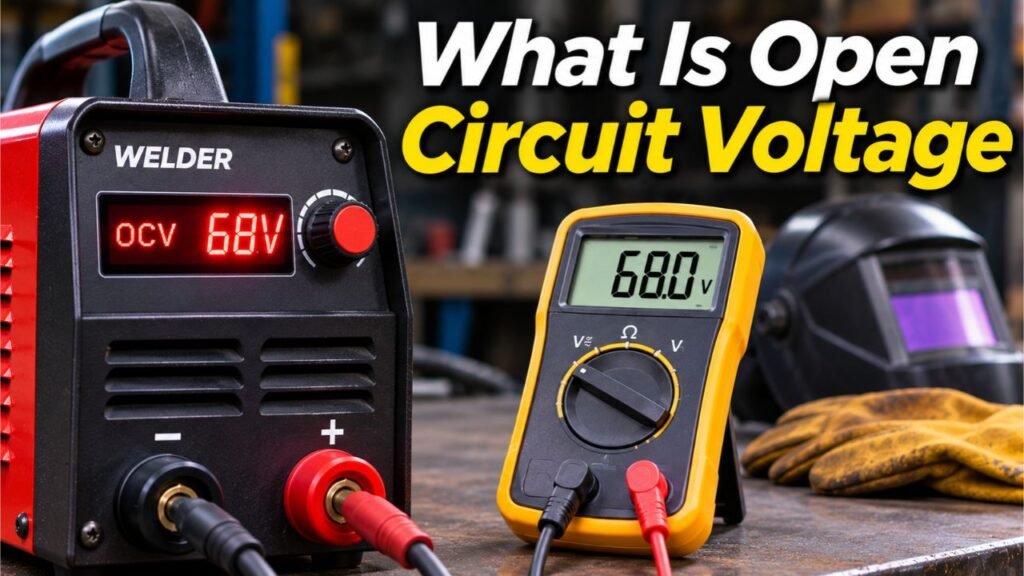
Open circuit voltage is the voltage measured between a welding machine’s output connections when no welding arc or other load is drawing current. It’s often called no-load voltage because the machine isn’t delivering normal welding current.
Think of it as electrical pressure waiting to do work.
A welding power source has two main output connections: one leads to the electrode or torch, and the other connects to the workpiece through the work lead.
When the welding circuit is open, there isn’t a complete path for normal welding current to flow. The output can still have voltage across those connections.
How OCV Changes When You Strike an Arc
The difference becomes clear when you compare a machine sitting idle with one actively welding.
Consider a stick welder with these example readings:
- Before striking an arc: The output measures 70 volts with no welding current flowing.
- While welding: The voltage drops to approximately 24 volts as current flows through the established arc.
- After the arc stops: The machine returns to its normal idle output condition, depending on its control system.
These are example readings, not settings that apply to every welding machine.
The higher initial voltage helps establish an electrical path through the small gap between the electrode and the metal.
Once an arc forms, the electrical conditions change. The machine supplies the current needed for welding, and the voltage across the active circuit normally falls.
This lower operating voltage is called arc voltage. It changes with the welding process, arc length, and power source.
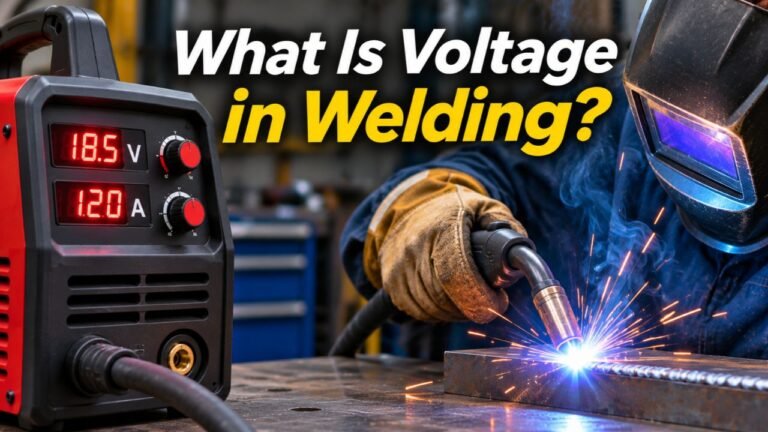
Want a closer look at what these numbers mean during an actual weld? My guide to voltage in welding explains how it affects arc behavior and bead shape.
Open Circuit Voltage vs. Welding Voltage
The main difference is when each voltage exists.
OCV describes the output with no active welding load. Arc voltage describes the electrical potential across the welding arc while it’s burning.
For example, a welder rated for 75 volts OCV doesn’t mean you should set 75 volts to weld a steel joint.
The machine may operate at a much lower voltage while the arc is established.
On a stick welder, the current adjustment dial also isn’t an OCV control. It normally sets the desired welding current.
Key Takeaways:
- OCV describes the machine’s idle output condition.
- Working arc voltage is a separate measurement.
- A high idle reading doesn’t mean high welding current.
Why Open Circuit Voltage Matters When Starting an Arc
OCV matters because the welding machine must establish an arc before it can maintain one. Sufficient starting voltage helps the electrode begin conducting electricity through the arc gap.
This is especially noticeable with shielded metal arc welding (SMAW), commonly called stick welding.
Higher OCV Can Make Arc Starting Easier
A stick electrode has a flux coating that protects the molten weld metal and helps stabilize the arc.
Different electrode types have different starting and operating requirements.
Some electrodes need more favorable electrical conditions to start cleanly or restart after a short interruption.
A machine with adequate OCV can help overcome the initial resistance to establishing the arc. This becomes useful when the electrode doesn’t light easily.
Ever had a welding rod stick to the plate the moment you touched it?
I’ve learned to check electrode condition, current setting, and workpiece cleanliness before blaming the machine’s voltage. A poor start can come from several small problems working together.
For instance, an E7018 low-hydrogen electrode may be harder to restart when hardened slag covers its tip. That isn’t automatically an OCV problem.
Why OCV Doesn’t Control Welding Heat
Open circuit voltage shouldn’t be confused with welding amperage.
Amperage is the amount of electrical current flowing through the welding circuit, measured in amps.
On a typical constant-current stick welder, the machine works to hold current near the selected value while arc voltage changes.
This means:
- OCV helps determine the available voltage before the arc starts.
- Welding current strongly affects electrode melting and heat input.
- Arc length influences the voltage needed to maintain the arc.
Increasing OCV doesn’t automatically increase weld penetration.
For practical examples of current selection, read my guide to welding amperage basics.
Pro Tip: If an electrode repeatedly sticks, check the recommended amperage range printed on its package. Make a short practice bead on clean scrap metal before deciding the machine has an electrical fault.
Can OCV Be Too Low?
Yes. If the available starting voltage is too low for the electrode and power source combination, starting and restriking the arc may become difficult.
Some machines intentionally operate with reduced idle voltage and raise their output when they detect electrode contact.
A properly designed system can provide good arc starts without leaving the full normal OCV present between welds.
The important question isn’t simply how high the number is. It’s whether the power source can start and maintain the process you’re using.
How Much Open Circuit Voltage Is Normal on a Welder?
Many conventional stick welding machines have an OCV somewhere around 50 to 80 volts. The actual value depends on the machine design, output type, operating mode, and safety features.
Some equipment operates outside that typical range.
Typical OCV and Arc Voltage Ranges
For general reference:
- Conventional stick welding OCV: Often approximately 50 to 80 volts.
- Established stick welding arc voltage: Commonly around 20 to 30 volts.
- Machines with reduced-voltage modes: May have substantially lower idle readings.
These figures are broad examples. The manufacturer’s specifications take priority over any general range.
A modern inverter welder, for example, may behave differently from an older transformer machine.
An inverter uses electronic controls to regulate welding output, while a traditional transformer machine relies more heavily on magnetic components.
Maximum OCV Limits for Welding Equipment
In the United States, workplace welding equipment has specific voltage limits.
Under the federal arc-welding equipment voltage limits, the general maximum open circuit voltage values include:
| Welding equipment | Maximum OCV |
| Manual AC arc welding | 80 volts |
| Manual DC arc welding | 100 volts |
| Automatic AC arc welding | 100 volts |
| Automatic DC arc welding | 100 volts |
Special welding processes requiring higher OCV must have added protection against accidental contact.
These are regulatory maximums, not recommended operating targets. Applicable requirements may also depend on the work setting.
Is Higher OCV Always Better?
No. A higher OCV can help with difficult arc starts, but more voltage isn’t automatically better.
Too much emphasis on the highest possible OCV can distract you from electrode compatibility, output stability, and operator protection.
When I compare welding machines, I give more weight to how well the power source supports the intended process than to which model advertises the largest OCV number.
For a home fabrication project using common stick electrodes, a compatible machine with reliable starts is a better choice than one selected only for a high no-load voltage.
Key Takeaways:
- Common OCV ranges aren’t universal specifications.
- Maximum permitted voltage isn’t a performance target.
- Process compatibility matters more than the biggest number.
How OCV Works With Stick, MIG, and TIG Welding
OCV behaves differently across welding processes because the power sources use different output controls and arc-starting methods.
A voltage reading that makes sense on a stick welder may not describe what happens at a MIG gun.
Stick Welding
Stick welding normally uses a constant-current (CC) power source, which regulates current while allowing voltage to vary as the arc changes.
The electrode starts the arc through brief contact with the workpiece.
Adequate OCV helps start that arc and supports restarting after interruptions.
Some machines also use hot-start and arc-force controls.
Hot start briefly boosts current during arc initiation, while arc force adjusts current response when the arc becomes very short.
Neither feature is the same as increasing the machine’s rated OCV.
MIG Welding
MIG welding, also called gas metal arc welding (GMAW), commonly uses a constant-voltage (CV) power source.
A CV system works to maintain a relatively steady welding voltage while current changes with wire feeding and arc conditions.
On many MIG machines, the output becomes energized only when the gun trigger activates the output contactor, a switch that controls electrical power to the welding circuit.
As a result, a machine may display a preset voltage even when its gun isn’t electrically live.
Why does that matter?
You can’t assume that the number shown on every MIG control panel is a direct OCV measurement.
TIG Welding
Tungsten inert gas welding (TIG), formally gas tungsten arc welding (GTAW), uses a nonconsumable tungsten electrode.
TIG machines commonly use constant-current output.
Depending on the machine, the arc may start through high-frequency starting or lift-arc operation.
High-frequency starting uses a separate high-voltage, high-frequency signal to initiate the arc without touching the tungsten to the metal. That starting signal isn’t the same specification as the normal welding output’s OCV.
Does AC or DC Change Open Circuit Voltage?
Yes, the power source’s AC or DC design affects how OCV is specified and measured.
Alternating current (AC) repeatedly reverses direction. Direct current (DC) flows with one polarity.
In stick welding, an AC arc must remain stable as current passes through zero during each cycle. The electrode and power source must be suited to that operating condition.
My explanation of AC versus DC welding covers the practical differences between these outputs.
DC welding also has two common polarity arrangements:
- DC electrode positive (DCEP)
- DC electrode negative (DCEN)
Polarity determines the direction of conventional current flow relative to the electrode. It affects arc behavior and the way heat is distributed.
Changing polarity doesn’t, by itself, create a predictable increase or decrease in OCV.
For the electrical connections and electrode applications, my DCEN and DCEP comparison explains the differences.
Is Open Circuit Voltage Dangerous?
Yes. Open circuit voltage can create an electric shock hazard because exposed parts of the welding output circuit may remain energized while no arc is burning.
A welder that isn’t actively laying down a bead isn’t necessarily electrically safe to touch.
Why Electric Shock Can Happen Without Welding
An electrical shock occurs when current passes through the body.
If your body creates a conductive path between energized welding components and the work circuit, current can flow through you.
Risk increases with:
- Wet gloves or damp clothing.
- Sweaty skin and poor electrical insulation.
- Damaged electrode holders or welding cables.
- Contact with large metal structures.
- Restricted spaces where avoiding contact is difficult.
Say you’re welding under a steel trailer, and your sleeve becomes damp while your arm rests against the frame. You stop welding to change the electrode, but the output remains energized.
That combination creates a much more hazardous situation than a dry, open work area where accidental contact is less likely.
What Is a Voltage Reduction Device?
A voltage reduction device (VRD) is a safety feature that lowers the welding output voltage when an arc isn’t active.
The device monitors the welding circuit and allows the machine to provide the output needed for arc starting when its operating conditions are met.
Some VRD-equipped welders reduce idle voltage to roughly 15 volts, although the actual value varies by machine.
I prefer using the manufacturer’s intended VRD setting whenever the job calls for added protection. Turning it off just to avoid a minor change in starting technique can trade a useful safety measure for little benefit.
A VRD reduces one electrical hazard. It doesn’t remove every source of shock or make damaged equipment safe.
Practical Safety Precautions Around OCV
Follow these habits before handling energized welding equipment:
- Wear dry welding gloves with intact insulation.
- Inspect electrode holders, connectors, and cable jackets for damage.
- Keep your body insulated from the workpiece and grounded metal.
- Switch off the welding output or power source before changing components when the equipment instructions require it.
- Remove stick electrodes from holders during breaks and shut down unattended equipment.
- Follow the machine’s instructions for VRD operation and work in damp or restricted areas.
The professional guidance on electrical hazards in arc welding explains why idle welding voltage deserves attention.
Important Tip: If a welding cable has exposed conductors or an electrode holder has cracked insulation, take the equipment out of service before the next weld. Electrical tape isn’t a substitute for a properly repaired or replaced damaged component.
Key Takeaways:
- An inactive arc doesn’t mean the output is harmless.
- Moisture and metal contact increase shock exposure.
- VRD provides added protection but doesn’t replace safe work habits.
How to Find and Check Open Circuit Voltage on Your Welder
The safest starting point is the manufacturer’s rating plate or instruction manual. You usually don’t need to measure live output voltage to learn your machine’s OCV rating.
Find the OCV Specification
Look for labels such as:
- OCV
- Open Circuit Voltage
- No-Load Voltage
- U₀
The symbol U₀ is commonly used on welding equipment rating plates to identify the no-load voltage.
For example, a machine might have a specification reading:
U₀ = 68 V
That means its rated open circuit voltage is 68 volts under the manufacturer’s specified conditions.
Some equipment lists separate values for normal output and reduced-voltage operation.
Don’t Confuse Input Voltage With OCV
A welder’s input voltage is the electrical supply used to power the machine.
For example, a machine designed for a 120-volt household circuit or a 240-volt supply isn’t automatically producing that same voltage at its welding output.
Its input and output circuits perform different jobs.
You may also find a duty cycle rating on the specification plate.
Duty cycle describes how long the welder can operate at a stated output during a defined period, commonly 10 minutes, without exceeding its thermal rating.
It doesn’t tell you the machine’s idle output voltage.
For help interpreting that specification, my article on welding duty cycle explains the operating limits.
Can You Measure OCV With a Multimeter?
Yes, a trained person can measure OCV using suitable electrical test equipment and the manufacturer’s procedure.
The measurement is generally taken across the welding output under the required no-load conditions.
But this involves exposed energized connections and isn’t a good first electrical test for someone unfamiliar with live-circuit measurements.
A qualified technician should use a properly rated meter, intact leads, the correct AC or DC measurement mode, and the specified precautions.
Never place a meter set to measure current directly across a voltage source. That can damage the meter and create an electrical hazard.
My habit is to check the machine’s stated specifications and control settings before considering an electrical measurement. A surprising display reading may be normal behavior in a reduced-voltage mode.
If the output doesn’t match the manual or the machine shows an electrical fault, stop using it and arrange qualified service.
Key Takeaways:
- The rating plate is the first place to check.
- Input supply, duty cycle, and OCV describe different things.
- Live testing belongs in trained hands.
Common Open Circuit Voltage Mistakes to Avoid
Most OCV confusion comes from treating an idle electrical rating as though it were an adjustable welding setting.
The problem usually starts when someone compares numbers that describe different operating conditions.
Treating the OCV Rating Like a Voltage Setting
A stick welder may list 70 volts OCV and have an amperage control on its front panel.
That doesn’t mean the operator should try to adjust the arc to 70 volts.
Instead, set the welding current for the electrode and workpiece, following the machine and electrode instructions.
Assuming Every Display Shows Actual OCV
Digital displays can show preset values, measured output, or standby information depending on the model and selected process.
A display reading by itself doesn’t prove how much voltage is present at exposed welding connections.
Check what the display is designed to show before using it to diagnose a fault.
Blaming Every Failed Arc Start on Low Voltage
Worn electrode holders, loose work-return connections, contaminated metal, and poor arc technique can all produce starting problems.
I recommend ruling out the simple setup issues first. Otherwise, you can end up chasing your tail while the actual problem is a weak connection or an unsuitable electrode setting.
Ignoring Electrode and Machine Compatibility
Some electrodes have specific AC or DC requirements and may need a power source with suitable arc-starting and current-response characteristics.
Don’t jump the gun and assume that any welder with a high OCV will run every electrode equally well.
Check the electrode classification and power source capabilities together.
FAQs about what is open circuit voltage
Does open circuit voltage change when you increase amperage?
Not necessarily. On many constant-current welding machines, the rated OCV is largely determined by the power source design rather than the amperage control position.
Some machines change their idle output according to the selected process or operating mode. Check the manufacturer’s documentation instead of assuming a direct relationship between amperage and OCV.
Can a welding machine have zero open circuit voltage?
Yes, some machines can show or measure zero volts at their external output while an output contactor is open or a control circuit has disabled welding power.
That doesn’t necessarily mean the machine is defective. A zero reading can be normal for its operating state, although a fault is another possibility.
Is open circuit voltage the same as short circuit voltage?
No. Open circuit means the normal current path is incomplete, while a short circuit creates a very low-resistance path between electrical points.
During a short circuit, current can rise sharply and the output voltage usually drops. Welding machines control that response according to their design and selected process.
Can you use a welding machine with low OCV?
Yes, if the machine is designed to start and maintain the required welding process at that voltage.
A VRD-equipped machine can operate with reduced idle voltage and respond when electrode contact is detected. Difficult arc starts should be diagnosed using the manual rather than immediately bypassing the reduced-voltage feature.
Does OCV tell you how powerful a welder is?
No. OCV alone can’t tell you how much welding current a machine can supply or how well it performs under load.
For machine capability, compare rated output current, rated welding voltage, duty cycle, and supported processes. Two welders with similar OCV ratings may have very different output capacities.
Choose a Welder With the Right OCV for Safe Arc Starting
Open circuit voltage is worth checking when you’re choosing a welder, troubleshooting difficult starts, or reviewing electrical safety. But I wouldn’t use the highest OCV rating as the deciding factor.
A better choice is a machine that supports your electrodes, provides steady welding output, and includes appropriate protection for the work environment.
For most beginners, learning how the machine behaves during startup is more useful than trying to change electrical settings that the manufacturer has already designed into the power source.
If your welder has trouble starting an arc, don’t assume the OCV needs to be higher. Start with the specified electrode requirements, the correct current setting, and the condition of the equipment.
Your clearest next step is simple: find the OCV rating in your welder’s manual and check whether the machine has a voltage reduction feature. That gives you a sound starting point for safer, more informed welding.