How Does MIG Welding Work: Complete Guide and Practical Tips
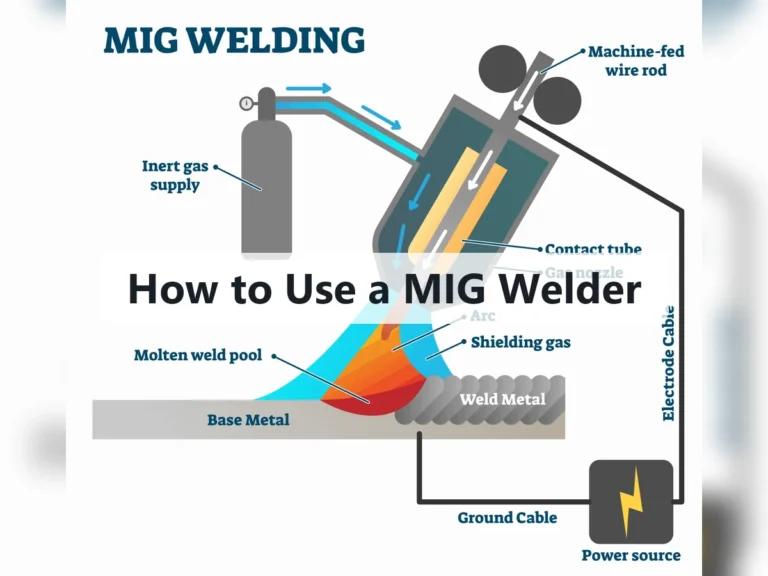
MIG welding uses a continuously fed wire electrode, an electric arc, and shielding gas to melt and join metal.
A steady electrical arc jumps between the wire and the workpiece creating enough heat to melt both the wire and a small area of base metal The molten.
You can often tell whether the process is working correctly by watching the arc and listening to it A smooth consistent frying or sizzling sound a stable bead. This guide examines “how does mig welding work” and explains the details that matter in practice.
Understanding how does mig welding work makes it easier to choose wire gas polarity voltage and wire-feed speed instead of treating the machine like a box of mysterious.
- ✓MIG creates an arc between a continuously fed wire and the workpiece, melting both into a joint.
- ✓Shielding gas, clean metal, correct polarity, and a reliable ground are essential for a stable weld.
- ✓Voltage mainly influences arc length, while wire-feed speed strongly influences amperage and deposition rate.
- ✓Short-circuit, globular, spray, and pulsed transfer suit different thicknesses, positions, and materials.
- ✓Good welds depend on preparation and technique as much as machine settings.
How Does MIG Welding Work Inside the Welding
MIG stands for metal inert gas although modern descriptions often use the technically broader term gas metal arc welding GMAW The name refers to a process in which.
When the wire approaches the grounded metal, the machine supplies voltage that establishes an arc. Arc heat melts the wire tip and the edges of the joint, producing a small liquid weld pool. As the gun moves, the pool solidifies behind it and forms a bead.
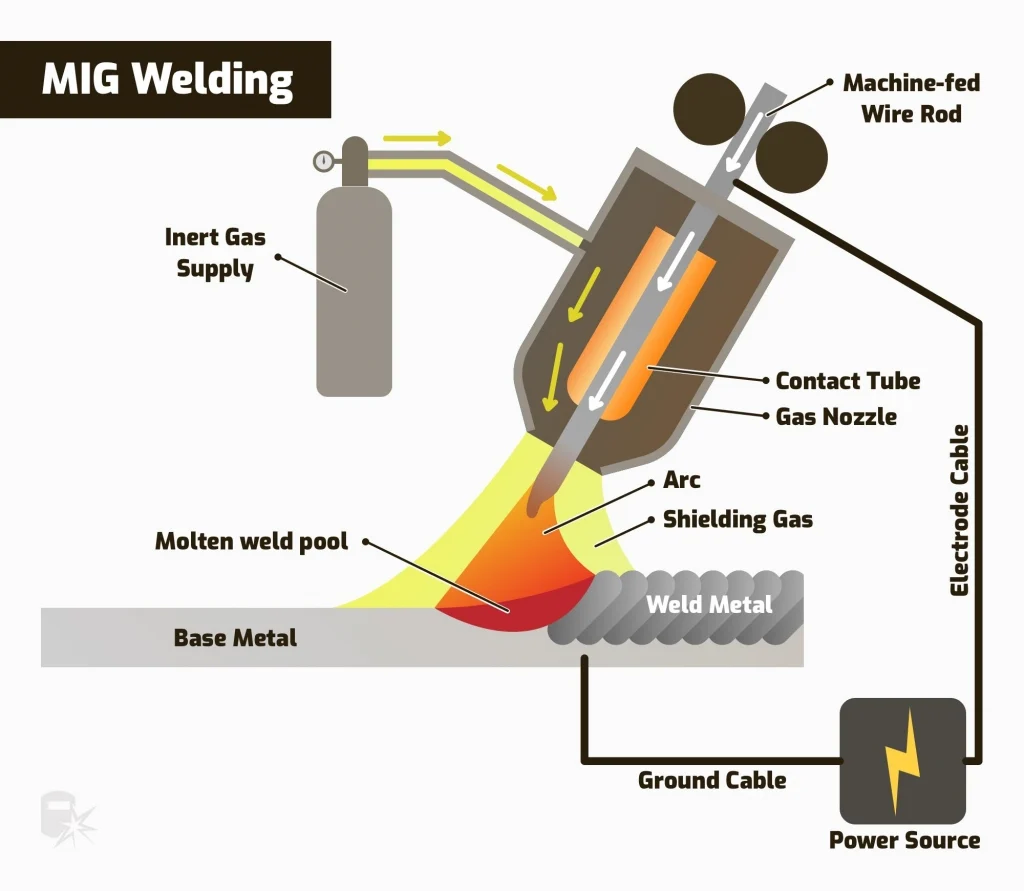
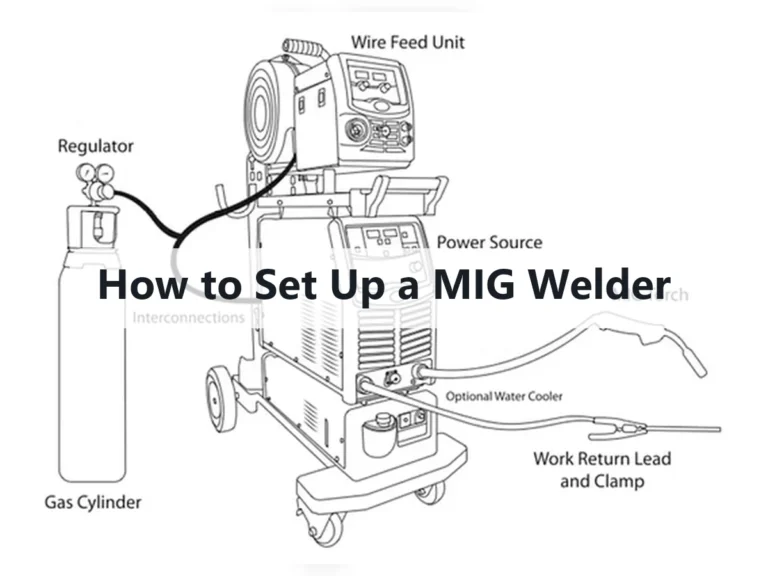
- Power source: The welder converts incoming electrical power into controlled welding current and voltage.
- Wire electrode: The consumable wire supplies filler metal and carries current to the arc.
- Work lead: The clamp connects the workpiece back to the power source so current can flow.
- Shielding gas: Gas surrounds the arc and molten pool, limiting atmospheric contamination.
Unlike a stick electrode MIG wire does not need to be replaced after each rod The drive rolls push wire from the spool through a liner and contact.
Many MIG machines use a constant-voltage power source The operator selects a voltage and wire-feed speed while the machine responds to changes in arc length If the wire.
What actually melts?
The arc does not simply glue two cold surfaces together It melts a small portion of each base-metal edge and combines that metal with molten electrode wire The.
Heat input depends on current voltage travel speed and the efficiency of the process Holding the gun too long in one place increases heat and may cause distortion.
What Are the Main MIG Welding Components?
A basic MIG system has more than a power source and gun. Each part affects arc stability, wire delivery, gas coverage, or electrical continuity. A fault in any link can look like a setting problem at the gun.
The spool sits in the feeder where drive rolls grip the wire and push it through a guide liner The contact tip transfers current to the wire while.
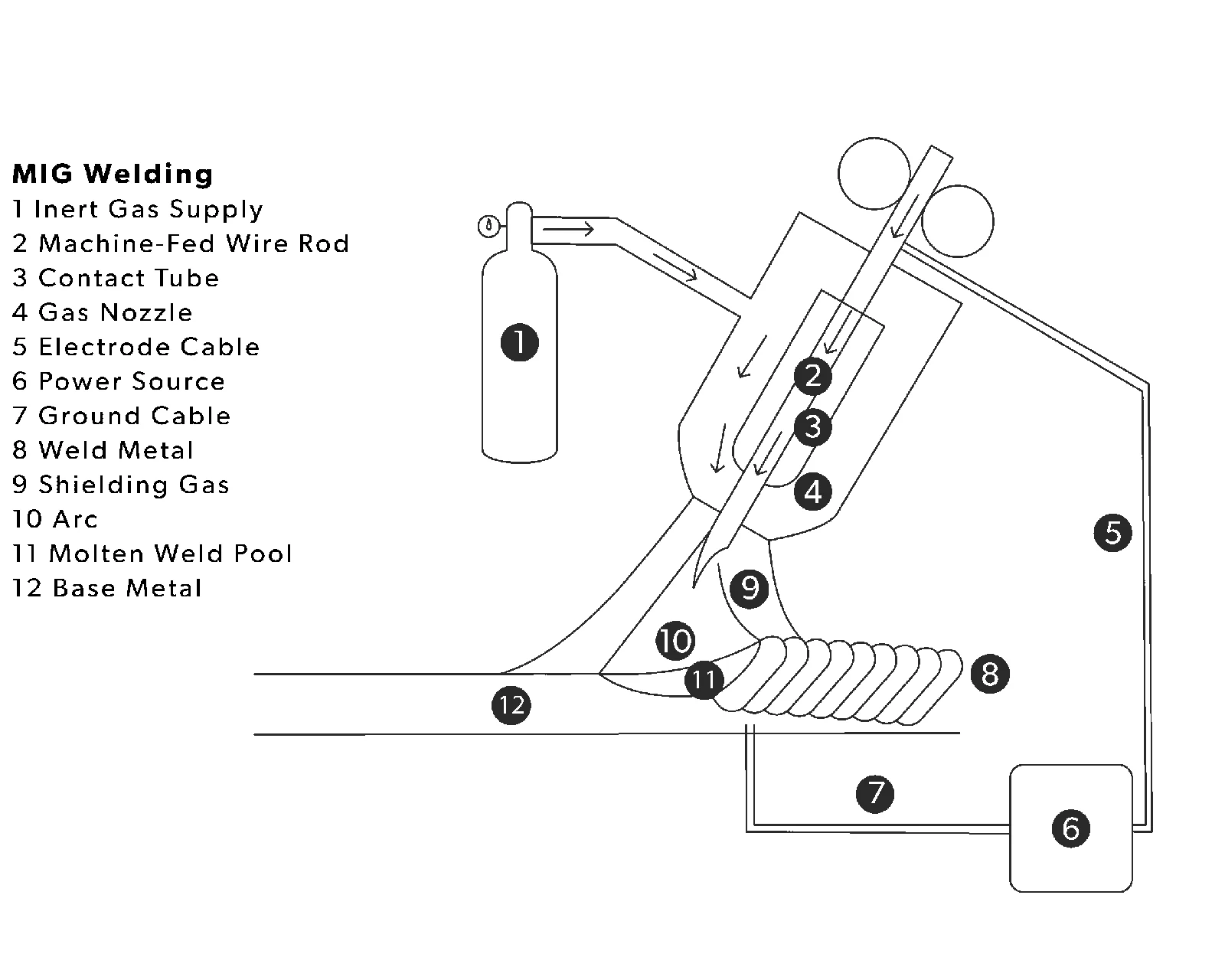
- Drive-roll match: The groove must suit the wire diameter and type; excessive tension can deform soft wire.
- Contact tip fit: A worn, blocked, or incorrect tip can cause burnback and inconsistent current transfer.
- Gas path: Inspect the cylinder connection, regulator, hose, solenoid, nozzle, and diffuser for leaks or blockage.
- Ground connection: Clamp to clean, solid metal rather than paint, rust, scale, or a loose worktable.
Solid wire and flux-cored wire
Solid MIG wire is commonly paired with an external shielding gas. It produces relatively clean welds and is popular for fabrication, automotive repair, sheet metal, and shop work. The gas choice depends on the base metal and desired arc characteristics.
Flux-cored wire contains powdered ingredients inside the tubular electrode Some flux-cored wires require external gas while self-shielded types generate their own protective atmosphere and are useful outdoors where.
Why polarity matters
Polarity determines which side of the circuit is positive and which is negative Solid wire with an appropriate shielding gas commonly runs on direct-current electrode positive often called.
Incorrect polarity can produce excessive spatter, an unstable arc, poor penetration, or a bead that looks unusually tall and irregular. Before changing settings, verify that the gun and work leads are connected for the wire being used.
How Does MIG Welding Work With Shielding Gas and Arc Transfer?
Shielding gas is not an optional finishing touch. The molten weld pool readily reacts with oxygen, nitrogen, and moisture in the air. Those reactions can create porosity, excessive oxidation, brittle weld metal, or an unstable arc.
Common gas choices include carbon dioxide argon and blends of the two Carbon dioxide can provide deeper penetration and economical operation but generally creates more spatter Argon-rich blends. This distinction matters when answering “how does mig welding work”.
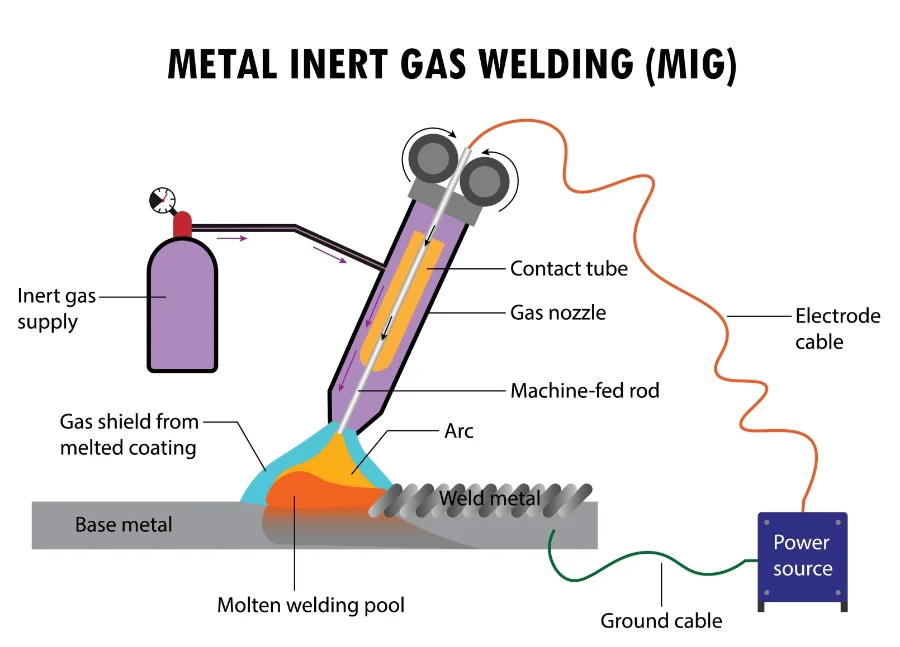
- Wind: Outdoor drafts can carry shielding gas away before it protects the pool.
- Flow: Too little gas leaves the pool exposed; too much can create turbulence that draws in air.
- Nozzle: Spatter buildup can restrict the gas outlet and disturb coverage.
- Leaks: A loose fitting or damaged hose can empty a cylinder without providing useful protection.
The way molten metal transfers from the wire to the workpiece also changes the sound, heat, spatter, and suitable applications. Transfer mode depends on wire diameter, current, voltage, shielding gas, and material thickness.
| Transfer mode | What happens | Typical advantages | Important limits |
|---|---|---|---|
| Short-circuit | The wire repeatedly touches the pool and briefly shorts the arc. | Lower heat, good control, useful on thinner steel and many positions. | Can create spatter or lack of fusion if travel and settings are wrong. |
| Globular | Larger droplets detach irregularly from the wire. | Can deliver useful deposition at intermediate settings. | Often produces more spatter and a rougher bead. |
| Spray | Small droplets travel continuously across the arc. | High deposition, smooth bead, strong fusion on suitable material. | Requires higher current and is less suitable for thin metal or many out-of-position welds. |
| Pulsed spray | Current pulses control droplet transfer without a constant high-current arc. | Lower average heat with spray-like transfer and reduced spatter. | Needs compatible equipment and more precise setup. |
How to Set Up a MIG Welder Correctly
A reliable setup begins with the joint, not the machine dial. Identify the base metal, thickness, joint type, welding position, and whether the job is indoors or exposed to wind. Then select a compatible wire and gas combination before adjusting voltage and feed speed.
Remove paint oil heavy rust mill scale and moisture from the area to be welded Clean metal makes the arc easier to control and gives the weld pool.
- Confirm the wire type, diameter, polarity, and recommended gas.
- Install the spool so the wire unwinds in the direction indicated by the feeder.
- Choose drive-roll grooves and set enough tension to feed smoothly without crushing the wire.
- Thread the liner, trim the wire cleanly, and verify that it exits the contact tip without drag.
- Connect the gas, check for leaks, and set flow according to the equipment and conditions.
- Clean the joint, attach the work clamp to bare metal, and test on similar scrap.
- Adjust voltage, wire-feed speed, and travel technique from the test weld rather than guessing on the final piece.
Voltage, wire-feed speed, and inductance
On many conventional machines wire-feed speed is closely related to welding amperage Increasing feed speed adds more wire and generally increases current decreasing it lowers the amount of.
Voltage largely influences arc length and puddle shape. Too little voltage can produce a short, violent arc and a tall, narrow bead. Too much can make the arc broad and unstable, increase spatter, and risk undercut or excessive fluidity.
Some machines offer inductance or arc-control adjustment. This can change how quickly current rises during short-circuit transfer, influencing arc softness, puddle fluidity, and spatter. Treat it as a refinement after wire, polarity, voltage, and feed speed are correctly matched.
Stickout, angle, and travel speed
Contact-tip-to-work distance, often called stickout, affects resistance heating and current delivery. Excessive stickout can reduce effective penetration and make the arc harder to direct. Very short stickout increases the chance of contact-tip damage or accidental contact with the pool.
A modest work angle helps direct the arc into the joint A slight push angle often gives a clear view and a flatter bead while a pull angle.
Travel speed controls how long heat acts on each section. Move steadily enough to maintain a consistent pool, pause briefly at the toes when needed, and avoid rapid whipping unless a specific joint or wire procedure calls for it.
How Does MIG Welding Work on Different Metals?
MIG is versatile, but “MIG” does not mean one universal setting works for every metal. Steel, stainless steel, and aluminum differ in thermal conductivity, oxide behavior, wire handling, and gas requirements.
Mild steel is the most forgiving starting material. It is commonly welded with solid steel wire and a carbon-dioxide or argon-rich blend. Stainless steel requires compatible stainless wire and gas, careful cleaning, and attention to heat input because contamination and excessive heat can damage corrosion resistance.
- Mild steel: A practical general-purpose choice for learning, fabrication, brackets, frames, and repairs.
- Stainless steel: Needs dedicated wire, suitable shielding gas, clean tools, and controlled heat.
- Aluminum: Usually needs an argon-based gas, a compatible aluminum wire, and a feeder setup that prevents soft wire from buckling.
- Galvanized steel: Zinc coating must be handled carefully because heating it can produce hazardous fumes; preparation and ventilation are critical.
Why aluminum is more demanding
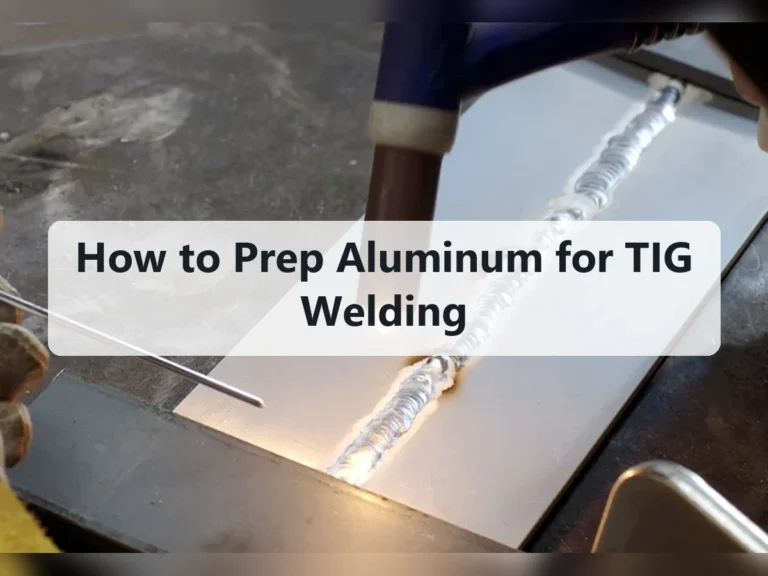
Aluminum conducts heat quickly and has a tenacious oxide layer that melts at a much higher temperature than the underlying metal It also uses soft wire that can.
Aluminum generally benefits from a clean stainless brush reserved for aluminum, correct gas coverage, and a smooth travel motion. Dirty oxide, poor feeding, or an inadequate gas setup can create black soot, worm tracks, porosity, and incomplete fusion.
Indoor versus outdoor welding
Gas-shielded MIG performs best in a controlled environment. Even a modest breeze can disturb the protective envelope, especially around a long stickout or wide nozzle. Screens can reduce drafts, but they must not create a confined space or prevent proper ventilation.
Keep these limitations in mind when considering “how does mig welding work”.
For exposed outdoor work, self-shielded flux-cored wire may be more practical. It still requires clean preparation, correct polarity, and appropriate technique, and its fumes and slag demand their own controls.
Common MIG Weld Problems and What They Mean
Weld appearance provides clues, but surface appearance alone cannot prove internal strength. A bead may look smooth while hiding lack of fusion, porosity, or an undersized throat. For critical work, use the inspection method and qualification requirements appropriate to the application.
Start troubleshooting with simple causes: clean the joint, check the clamp, inspect the nozzle and tip, verify polarity, confirm gas flow, and compare settings with the wire guidance. Change one factor at a time so you can identify the actual cause.
- Porosity: Look for pinholes, bubbles, or a porous fracture; check gas coverage, contamination, drafts, and moisture.
- Excessive spatter: Check voltage-to-feed balance, polarity, stickout, gas choice, and arc length.
- Undercut: Reduce excessive travel speed or heat concentration and pause appropriately at the joint edges.
- Cold lap or poor fusion: Improve cleaning, joint access, heat placement, and travel speed rather than simply making the bead larger.
| Observed problem | Likely causes | Useful first checks |
|---|---|---|
| Wire stubs into the plate | Feed speed too high, voltage too low, poor contact, or restricted wire path | Check tip, liner, drive-roll tension, polarity, and voltage/feed balance |
| Wire burns back to the tip | Feed interruption, excessive arc length, tip too large, or feed speed too low | Inspect liner and rolls; use the correct tip and stabilize stickout |
| Arc pops and crackles | Dirty metal, poor ground, incorrect polarity, inadequate gas, or mismatched settings | Clean the joint, clamp to bare metal, and verify the wire procedure |
| Large, cold-looking bead | Travel too fast, insufficient heat, excessive work angle, or poor joint access | Slow slightly, improve arc direction, and confirm adequate voltage/current |
| Porous bead | Gas leak, wind, blocked nozzle, contamination, or damp consumable | Check flow and hose, clean spatter, shield the area, and clean the base metal |
Reading the bead profile
A useful bead usually has consistent width smooth transitions at the toes and reinforcement appropriate to the joint A very convex bead may indicate inadequate wetting or excessive filler while a very flat or concave bead can reflect too much heat excessive travel or poor.
Do not solve every defect by increasing power. More heat can worsen burn-through, distortion, undercut, and metallurgical damage. The better correction may be cleaning, changing the angle, reducing stickout, slowing travel, improving fit-up, or selecting a different transfer mode.
Safety Practices for MIG Welding
MIG welding combines intense ultraviolet radiation, hot metal, sparks, compressed gas, electrical energy, fumes, and fire risk. A helmet with the appropriate shade, flame-resistant clothing, welding gloves, sturdy footwear, and suitable eye protection are basic controls, not optional accessories.
Provide effective ventilation that removes fumes without blowing away shielding gas. Welding coatings, galvanized metal, stainless steel, degreasers, and unknown painted surfaces can create especially dangerous fumes. Never weld on a container that may have held flammable material unless it has been professionally prepared for hot work.
- Protect vision: Use a properly functioning helmet and protect nearby people with welding screens.
- Control fire: Remove combustibles, watch for sparks traveling through gaps, and keep suitable fire-extinguishing equipment ready.
- Handle cylinders: Secure gas cylinders upright, protect valves, and use compatible regulators and hoses.
- Respect electricity: Keep hands, gloves, and clothing dry; inspect cables; and avoid welding in wet conditions.
Compressed-gas cylinders should not be dragged, lifted by the valve, or exposed to unnecessary heat. Close the cylinder valve when the equipment is not in use and release pressure from the hose according to the equipment’s normal shutdown procedure.
Confined spaces add serious hazards, including toxic fumes, oxygen deficiency, fire, and restricted escape. Do not treat a portable fan as a complete safety plan. Follow applicable workplace procedures and obtain qualified help when the environment or workpiece creates uncertainty.
When Is MIG the Best Welding Process?
MIG is attractive because it is fast, comparatively easy to learn, and capable of long continuous welds without repeatedly changing electrodes. It works well for production fabrication, vehicle panels and frames, shop repairs, gates, brackets, and many general steel projects.
Its limitations matter just as much Gas shielding makes standard solid-wire MIG vulnerable to wind and the equipment can be less convenient than a stick welder in remote.
- Choose solid-wire MIG: When you have a sheltered work area, clean material, and want a clean, productive process.
- Consider flux-cored wire: When outdoor performance, deposition, or penetration is more important than a clean slag-free bead.
- Consider TIG: When maximum control, appearance, thin material, or specialized metals justify slower, more precise work.
- Consider stick welding: When portability, outdoor tolerance, and simple field equipment matter more than continuous wire feeding.
For thin sheet, short-circuit MIG can provide useful control, but heat must still be managed carefully. For heavier plate, multiple passes, beveling, preheat, or a higher-deposition transfer mode may be needed. The correct process depends on joint design and required properties, not only on convenience.
FAQ: How Does MIG Welding Work?
Does MIG welding require shielding gas?
Solid-wire MIG normally requires an external shielding gas. Self-shielded flux-cored wire can protect the arc through its flux ingredients, so it can be used without a gas cylinder, although it is technically a flux-cored variation of gas metal arc welding rather than conventional solid-wire MIG.
Is MIG welding easy for a beginner?
MIG is often one of the more approachable arc-welding processes because the wire feeds continuously and the machine can provide coordinated controls. Beginners still need practice with cleaning, fit-up, gun angle, travel speed, settings, and safety; ease of striking an arc does not guarantee a sound joint.
Why does my MIG weld make a popping sound?
Occasional small changes can be normal, but frequent popping commonly indicates an unstable arc. Check the wire-feed path, contact tip, ground clamp, polarity, gas coverage, base-metal cleanliness, and the balance between voltage and wire-feed speed.
How far should the MIG gun be from the metal?
Use the wire manufacturer’s recommended contact-tip-to-work distance as the starting point, then keep it consistent. Excessive stickout reduces control and can affect penetration, while an overly short distance can damage the tip or cause the wire to contact the pool.
Can MIG weld rusty or painted metal?
It may produce an arc over contamination, but that does not make the joint reliable. Rust, paint, oil, mill scale, and coatings can cause porosity, inclusions, poor fusion, and hazardous fumes, so remove contaminants from the weld area whenever possible.
Why is shielding gas coming out but the weld is still porous?
Visible gas flow does not prove that the weld pool is protected. Look for leaks, excessive wind, a blocked nozzle, an incorrect flow rate, a damaged hose, excessive stickout, or contamination on the metal. Turbulent flow can also draw air into the coverage zone.
Can MIG weld aluminum?
Yes, but aluminum usually requires an argon-based shielding gas, compatible aluminum wire, careful cleaning, and a wire-feeding system designed to prevent soft wire from buckling. A spool gun or push-pull feeder can make feeding more reliable than a long conventional gun liner.
Conclusion
How does mig welding work? A power source creates an arc between continuously fed wire and the workpiece, melting filler and base metal while shielding gas protects the liquid pool. Good results depend on matching wire, polarity, gas, voltage, feed speed, joint preparation, and travel technique.
MIG is productive and versatile, but it cannot overcome contaminated metal, poor gas coverage, unsafe ventilation, or an unsuitable process choice. Diagnose the arc and bead systematically, and treat every weld as a combination of sound preparation, controlled heat, and safe working conditions.
Before welding the final joint, make a test bead on clean, similar material and adjust only one variable at a time while checking arc sound, bead shape, and fusion.