Welding Fundamentals Training: A Complete Beginner’s Guide
Welding can look simple from a distance: create an arc, melt the metal, and join two pieces together. In practice, producing a safe and reliable weld requires knowledge, coordination, preparation, and repeated hands-on practice.
Welding fundamentals training introduces beginners to the principles behind professional welding. It explains how welding equipment works, why different metals respond differently to heat, how to prepare a joint, and how to recognize defects before they cause a failure.
A strong fundamentals course should not focus only on making an attractive bead. Students also need to understand safety, electricity, welding terminology, equipment settings, filler materials, blueprint symbols, joint design, and quality control.
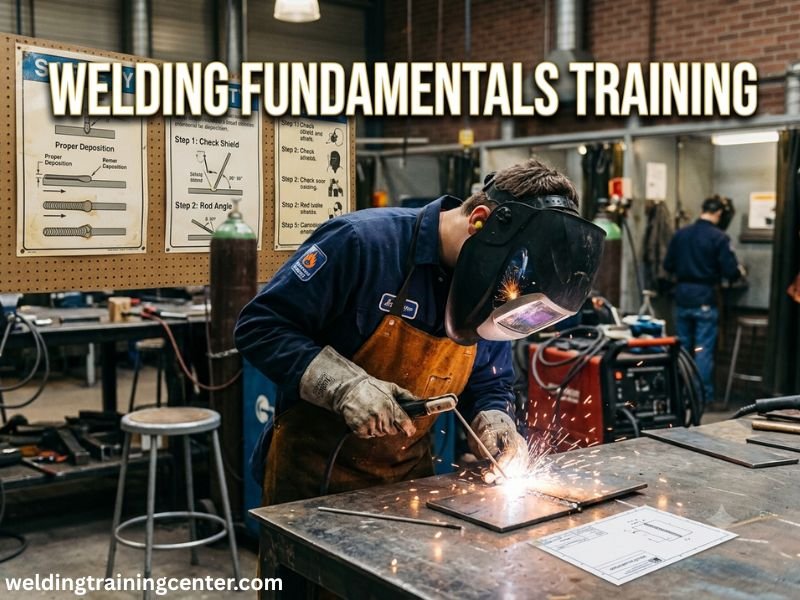
These foundational skills support nearly every later welding path. Whether you plan to work in manufacturing, construction, equipment repair, structural fabrication, or industrial maintenance, you need to understand the basics before attempting advanced procedures.
This guide explains what beginner welding training should cover, how the major processes differ, what mistakes students commonly make, and how to choose a course that provides useful practical experience.
What Is Welding Fundamentals Training?
Welding fundamentals training is an introductory program that teaches the technical knowledge and practical skills required to begin welding safely.
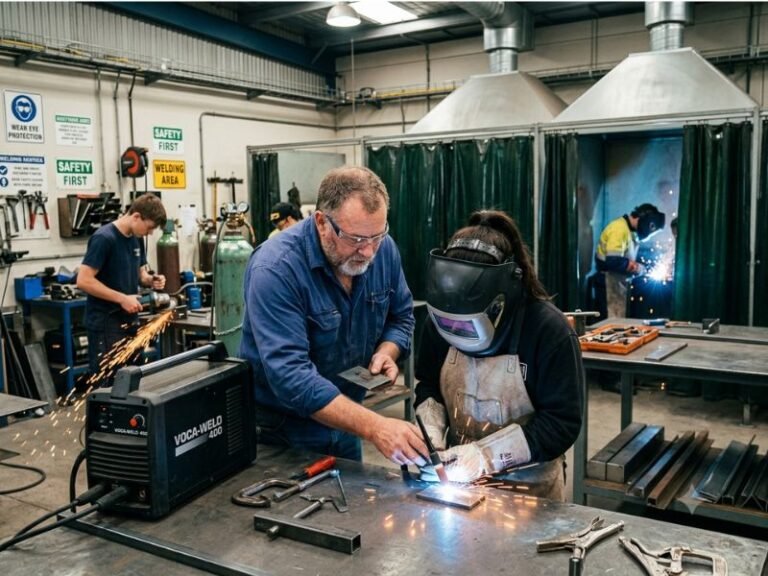
The classroom portion typically explains welding terminology, electrical principles, basic metallurgy, weld design, equipment, consumables, and quality requirements. The practical portion allows students to prepare metal, adjust machines, strike an arc, control a weld pool, and inspect completed work.
The American Welding Society’s Welding Fundamentals course covers the science and practical application of commonly used welding processes, along with electrical theory, weldability, terminology, safety, weld design, and welding quality control.
A beginner course should help students understand the difference between performing a practice weld and producing work that follows an actual specification. Professional welding requires consistency. A welder may need to repeat the same joint many times while maintaining the required size, penetration, appearance, and strength.
Fundamentals training does not make someone an expert in every welding process. Its purpose is to establish a reliable base that can be developed through additional shop practice, employment, apprenticeships, or specialized courses.
Welding Safety Comes First
Safety should be the first subject taught in any welding course.
An electric arc produces intense visible light as well as ultraviolet and infrared radiation. Welding also creates hot metal, sparks, fumes, gases, electrical hazards, and the possibility of fire.
OSHA identifies metal-fume exposure, ultraviolet radiation, burns, eye damage, electrical shock, cuts, and crushing injuries among the hazards associated with welding, cutting, and brazing. Many of these risks can be controlled through correct work practices and suitable personal protective equipment.
Beginner training should explain how to select and use:
- A properly rated welding helmet
- Safety glasses with side protection
- Flame-resistant clothing
- Welding gloves
- Appropriate work boots
- Hearing protection
- Respiratory protection when required
Students also need to understand ventilation and fume extraction. Wearing a helmet does not protect the lungs from metal fumes or shielding gases. The work area must have suitable airflow and any required local exhaust system.
Fire prevention is another essential topic. Sparks and slag can travel beyond the immediate welding area and ignite paper, wood, solvents, clothing, or other combustible material. OSHA requires movable fire hazards to be relocated when practical or protected from welding heat, sparks, and slag.
Training should also cover electrical connections, grounding, cylinder storage, equipment inspection, confined spaces, and hot-work procedures. A course that treats safety as a brief introductory lecture is incomplete.
Understanding the Welding Arc
Most beginner welding courses start with the basic science of an electric arc.
An arc forms when electrical current travels across a controlled gap between an electrode and the workpiece. The heat produced by the arc melts the base metal and, in many processes, a filler material. As the molten weld pool cools, it solidifies and forms the joint.
Students should learn the basic relationship between:
- Voltage
- Amperage
- Polarity
- Arc length
- Travel speed
- Electrode or wire-feed speed
- Heat input
These variables influence the shape and quality of the weld.
For example, settings that are too low may produce poor fusion or an unstable arc. Excessive heat may create burn-through, excessive penetration, distortion, or undercut. Moving too quickly can leave a narrow weld with inadequate fusion, while moving too slowly may create an oversized bead and unnecessary heat buildup.
Fundamentals training should not teach students to memorize one machine setting for every job. Metal thickness, joint type, welding position, wire or electrode size, shielding gas, and process all influence the required setup.
The goal is to understand why a change is needed and how the weld pool responds.
The Four Main Processes Beginners May Study
A fundamentals program commonly introduces students to several arc-welding processes. The amount of practice devoted to each one varies by school.
Gas Metal Arc Welding
Gas metal arc welding, commonly called MIG welding, uses a solid consumable wire that is continuously fed through a welding gun. An external shielding gas protects the molten weld pool from atmospheric contamination.
AWS describes GMAW as a process using a continuously heated solid-wire electrode fed from a welding gun. It is often considered accessible to beginners, although correct setup and technique remain necessary for sound welds.
Students normally practice setting wire-feed speed and voltage, maintaining the correct contact-tip distance, positioning the gun, and controlling travel speed.
GMAW is frequently used in production welding, automotive fabrication, general manufacturing, and repair shops. It works best when the material and joint area are properly cleaned and the shielding gas is protected from strong airflow.
Shielded Metal Arc Welding
Shielded metal arc welding is commonly called stick welding. It uses a consumable electrode coated in flux.
As the electrode melts, the flux helps protect the molten weld metal. It also forms slag over the bead, which must usually be removed between passes.
SMAW is a manual process that requires the welder to control arc length, electrode angle, and travel speed while the electrode becomes progressively shorter. AWS notes that it requires skill in reading the arc and manipulating the electrode.
Stick welding is widely associated with construction, maintenance, field repair, structural work, and outdoor applications. It can be more forgiving of wind than a process relying entirely on externally supplied shielding gas.
Gas Tungsten Arc Welding
Gas tungsten arc welding, usually called TIG welding, uses a nonconsumable tungsten electrode to create the arc. An inert shielding gas protects the weld pool, and filler metal can be added separately when required.
TIG offers precise control but requires coordination between the torch, filler rod, and sometimes a foot or hand amperage control.
Beginners may initially find TIG more difficult than wire-fed welding. It requires careful torch positioning, controlled heat input, clean material, and protection of the tungsten electrode from contamination.
TIG is commonly taught for precise welding on stainless steel, aluminum, and thinner materials.
Flux-Cored Arc Welding
Flux-cored arc welding uses a continuously fed tubular wire containing flux. Some wires create their own shielding, while others require an external shielding gas.
AWS describes FCAW as a high-deposition process used for demanding fabrication applications. Self-shielded wire is useful for portable or outdoor work, while gas-shielded wire is often used in fabrication shops.
Students need to learn wire selection, polarity, electrical stickout, gun angle, travel speed, and slag removal.
Metal Preparation and Joint Fit-Up
A welding machine cannot compensate for poor preparation.
Before striking an arc, the student should know how to inspect, clean, measure, cut, and position the material. Rust, paint, oil, moisture, mill scale, and other contamination can affect arc stability and weld quality.
Cleaning requirements vary by process and material. GMAW and GTAW generally require especially clean surfaces, while some stick and flux-cored electrodes tolerate less-than-perfect field conditions. Tolerance does not mean preparation can be ignored.
Fit-up refers to the positioning and spacing of the parts before welding. Poor fit-up can result in inconsistent penetration, excessive filler use, burn-through, or an incorrect finished dimension.
Students should practice common joint types, including:
- Butt joints
- Lap joints
- T-joints
- Corner joints
- Edge joints
They should also understand groove angles, root openings, root faces, backing, tack welds, and distortion control.
Tack welds must hold the parts in alignment without preventing proper penetration during the final weld. Students should learn where to place tacks, how large they should be, and how to inspect them before continuing.
Welding Positions and Movement
A weld made on a horizontal practice table behaves differently from one made vertically or overhead.
The common welding positions include flat, horizontal, vertical, and overhead. Pipe welding uses additional position designations based on whether the pipe rotates and how it is oriented.
Gravity affects the molten weld pool. In the flat position, the pool is generally easier to control. In vertical or overhead welding, the welder must carefully manage heat, bead size, travel speed, and electrode movement to keep the metal in the joint.
Beginner training should normally begin with simple beads in the flat position. Students can then progress to basic joints and more difficult positions.
The goal is not to move through the course as quickly as possible. Students should develop repeatable control before advancing.
A useful practice sequence may include:
- Machine setup and arc initiation
- Straight beads on plate
- Overlapping beads
- Fillet welds
- Groove welds
- Multiple-pass welds
- Vertical and overhead positions
An instructor should evaluate technique throughout the process instead of examining only the final bead.
Blueprint Reading, Symbols, and Shop Math
Professional welders do not always receive verbal instructions. They may work from drawings, welding symbols, procedure documents, and written specifications.
Welding fundamentals training should introduce the parts of a welding symbol, including the reference line, arrow, basic weld symbol, dimensions, contour requirements, and supplementary information.
Students do not need to memorize every symbol immediately. They should learn how to locate information and interpret the symbols most relevant to common fillet and groove welds.
Basic shop mathematics is equally important. Welders may need to work with:
- Fractions and decimals
- Unit conversions
- Angles
- Dimensions and tolerances
- Material quantities
- Weld sizes
- Basic geometry
Incorrect measurement can make an otherwise acceptable weld useless. A fabricated part that is too short, out of square, or positioned incorrectly may fail inspection even when the weld itself looks good.
Students should practice using tape measures, combination squares, levels, calipers, fillet gauges, and other common measuring tools.
Learning to Identify Weld Defects
Welding fundamentals training should teach students to inspect their own work instead of waiting for an instructor to identify every problem.
Common discontinuities and defects include porosity, undercut, overlap, cracks, incomplete fusion, incomplete penetration, slag inclusions, excessive reinforcement, and burn-through.
A visible problem may have several possible causes.
Porosity, for example, may result from contamination, inadequate shielding gas, wind, moisture, a damaged gas line, or an incorrect torch angle. Undercut may be associated with excessive current, poor electrode positioning, a long arc, or excessive travel speed.
Students should be taught to investigate the complete setup rather than changing machine controls randomly.
Visual inspection begins with cleaning the finished weld and examining:
- Bead shape and consistency
- Weld size
- Toe fusion
- Surface cracks
- Undercut
- Porosity
- Crater condition
- Excessive spatter
- Joint alignment
More advanced training may introduce bend tests, break tests, liquid penetrant testing, magnetic particle testing, radiography, or ultrasonic testing. However, strong visual-inspection habits should come first.
Quality control is one of the essential subjects included in AWS welding fundamentals education.
Hands-On Practice Is Essential
Online lessons, textbooks, and videos can explain welding principles, but they cannot replace physical practice.
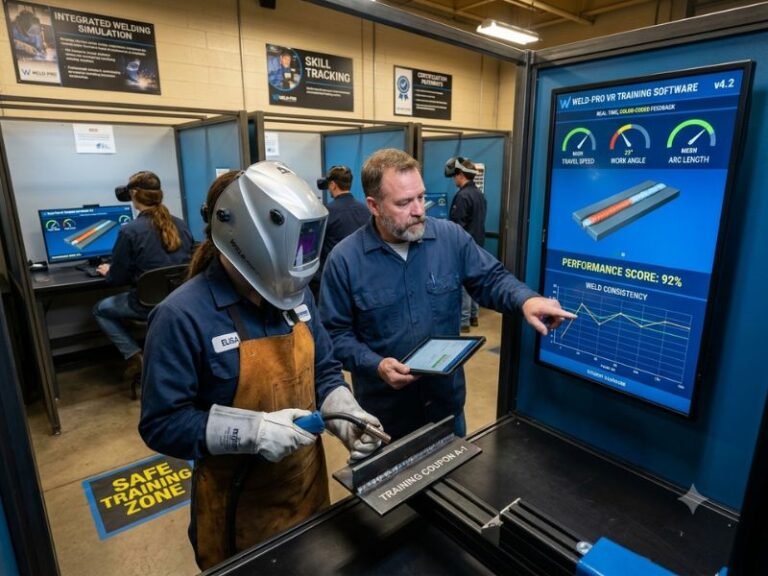
A student must learn to observe the weld pool, hear changes in the arc, maintain body position, control both hands, and make adjustments while welding. These abilities develop through repetition and instructor feedback.
An online fundamentals course may be useful for terminology, safety, process theory, metallurgy, and welding symbols. Practical skill development requires access to suitable equipment, materials, ventilation, and qualified supervision.
When comparing courses, ask how many hours students spend actively welding. Also ask whether they will:
- Set up the machine themselves
- Prepare their own materials
- Practice more than one position
- Receive individual instructor feedback
- Inspect and test their welds
- Repeat failed exercises
A program should allow students to make mistakes safely, understand their causes, and correct them.
How to Choose a Welding Fundamentals Course
The best program is not necessarily the longest or most expensive one.
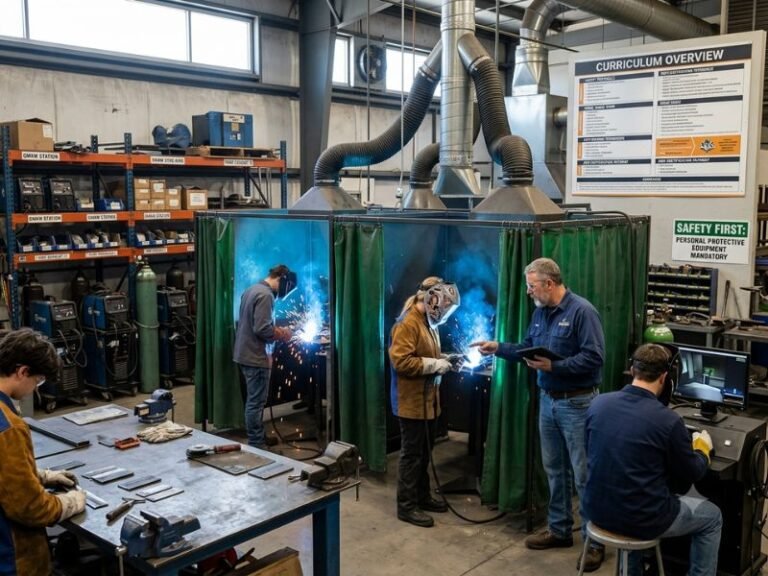
Start by reviewing the curriculum. It should include safety, process principles, machine setup, material preparation, joint design, welding positions, basic symbols, defect recognition, and supervised practice.
Tour the training facility when possible. Look at the condition of the machines, ventilation, work areas, safety equipment, and welding booths.
Ask how large the classes are and how instructors divide their time. Beginners often need immediate feedback. A high student-to-instructor ratio can allow poor habits to continue unnoticed.
You should also ask:
- Which processes are taught?
- How many practical hours are included?
- Are consumables included in tuition?
- Must students purchase helmets, tools, or clothing?
- Are evening or part-time schedules available?
- Does the course prepare students for a specific performance test?
- Can students repeat exercises outside regular class hours?
Be cautious with guarantees. Completing a short course does not guarantee certification, employment, or a particular salary.
Training Certificates and Welding Certification
A certificate of course completion is different from a welder performance certification.
A school certificate generally confirms that a student completed the school’s curriculum. The exact requirements are established by the institution.
The AWS Certified Welder program is performance-based. Candidates complete a welding performance qualification test at an AWS Accredited Test Facility. AWS states that no prerequisite course or prior certification is required; eligibility depends on being able to perform the required weld successfully. (American Welding Society)
Certification is normally connected to a specific process, material, position, procedure, or code. Passing one test does not qualify a welder for every type of work.
An employer may also require its own practical test, even when an applicant has completed school or holds another credential.
Fundamentals training prepares students to begin developing the control and technical understanding needed for these tests. It should not be advertised as automatic certification unless an actual performance test is included.
Common Beginner Mistakes
One frequent mistake is focusing only on bead appearance. A smooth-looking weld may still have inadequate penetration, incomplete fusion, or internal defects.
Other common mistakes include:
- Welding over dirty material
- Using settings without understanding them
- Holding an arc that is too long
- Moving too quickly or too slowly
- Ignoring joint fit-up
- Using an incorrect electrode angle
- Failing to remove slag between passes
- Practicing without inspecting the result
- Attempting advanced positions too early
- Neglecting ventilation and protective equipment
Beginners should avoid comparing their first welds with highly edited examples online. Progress should be measured by control, consistency, safety, and the ability to identify why a weld succeeded or failed.
Frequently Asked Questions
Is welding fundamentals training suitable for complete beginners?
Yes. A true fundamentals course should assume that students have little or no previous experience. It should begin with safety, terminology, equipment identification, basic setup, and simple flat-position practice before introducing more difficult joints.
Which welding process should a beginner learn first?
There is no universal answer. GMAW is often considered approachable because the machine continuously feeds the wire. However, local employers may place greater value on SMAW, FCAW, or GTAW. The best starting process depends on the student’s goals and regional job market.
Can welding fundamentals be learned online?
Technical topics such as safety principles, terminology, electrical theory, metallurgy, symbols, and process selection can be studied online. Actual welding skill requires supervised hands-on practice with suitable equipment and safety controls.
How long does fundamentals training take?
Course length varies from brief introductory workshops to semester-based programs. The number of supervised practical hours is often more important than the total number of calendar weeks.
Do I need to be strong at mathematics?
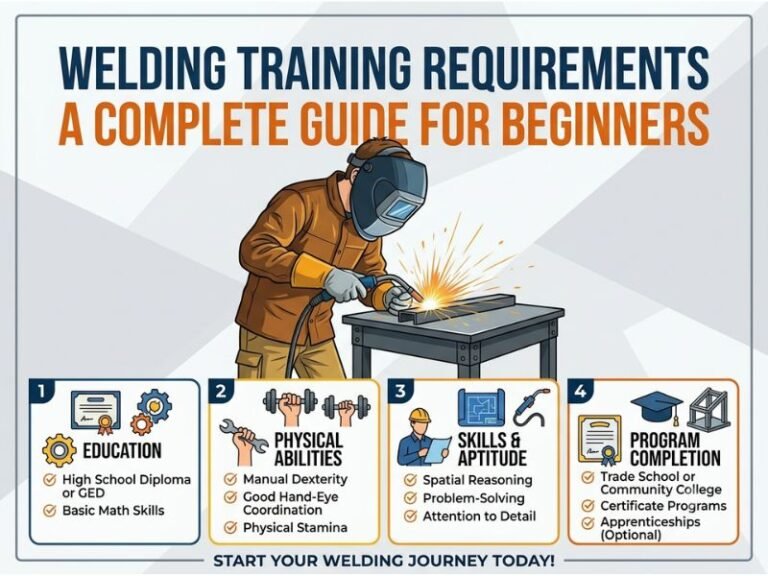
Advanced mathematics is not required for basic training, but students should be comfortable with measurements, fractions, decimals, angles, and simple geometry. These skills can be improved during the course.
Will a fundamentals course make me a certified welder?
Not automatically. A course may provide a completion certificate, but welding certification usually requires passing a specific performance test. Confirm whether testing is included before enrolling.
Is welding physically difficult?
Welding can involve standing, bending, kneeling, lifting materials, holding fixed positions, and working in heat. Training should teach efficient body positioning so students can maintain control without unnecessary strain.
What careers can welding fundamentals lead to?
Foundational training may support entry-level opportunities in manufacturing, fabrication, construction, repair, and maintenance. BLS reports that welders commonly enter the occupation with a high school diploma or equivalent plus technical and on-the-job training.
Conclusion
Welding fundamentals training establishes the technical and practical foundation needed to weld safely and consistently.
A useful beginner program should cover safety, arc principles, machine settings, major welding processes, material preparation, joint fit-up, positions, symbols, inspection, and defect correction. It should also provide enough supervised practice for students to understand how their technique affects the finished weld.
Before selecting a course, compare the curriculum, practical hours, instructor availability, safety systems, equipment, and complete cost. Do not judge a program solely by its length or advertising claims.
Strong welding skills develop through correct instruction, careful observation, repeated practice, and honest evaluation of every weld.