Welding Training Materials: Clear Overview and Expert Insights
A weak set of welding lessons can create more than confusion. It can teach unsafe habits, hide important defects, and leave a new welder unprepared for the actual demands of a shop, classroom, or job site. The cost may appear later as failed welds, damaged equipment, rework, or an avoidable injury.
Welding training materials should therefore do more than explain how an arc is created. They should connect safety, equipment, joint preparation, process selection, technique, inspection, and documentation in an order that a learner can follow. I find the strongest resources make difficult concepts visible without pretending that welding is simple.
This overview explains what effective training materials contain, how to compare print and digital options, which topics deserve the most attention, and how instructors or self-directed learners can identify gaps before practice begins. It also separates educational content from formal qualification requirements, because those two purposes are related but not identical.
What Welding Training Materials Include
Welding training materials are the instructional resources used to teach welding theory, safe work practices, equipment operation, process control, and inspection. They can include textbooks, process manuals, instructor presentations, workbooks, diagrams, videos, demonstrations, sample welds, practice assignments, inspection checklists, and qualification forms.
A complete resource normally supports three stages of learning:
- Knowledge: The learner understands terminology, welding processes, materials, hazards, and settings.
- Application: The learner uses equipment and follows a defined procedure during supervised practice.
- Verification: The learner demonstrates acceptable technique through visual inspection, testing, or a formal performance evaluation.
These stages should reinforce one another. A slide deck may explain shielding gas, but it cannot replace hands-on practice. A demonstration may show torch movement, but it does not automatically teach why a specific travel speed or electrode is appropriate. Good materials make those connections explicit.
Core Subjects a Strong Program Should Cover
Safety and hazard control
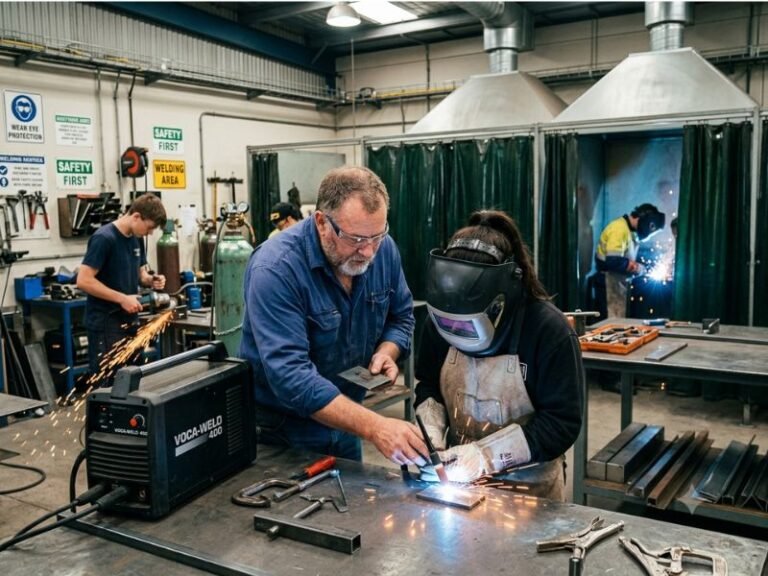
Safety content belongs at the beginning and throughout the program, not in a single page at the back of a workbook. Training should address arc radiation, sparks, hot metal, fumes, compressed gases, electrical energy, fire hazards, noise, and restricted work areas.
Practical safety instruction should explain how to inspect a work area, choose personal protective equipment, handle cylinders, manage ventilation, control ignition sources, and respond to abnormal conditions. It should also distinguish between general awareness and site-specific rules. A generic lesson cannot replace the employer’s hazard assessment, required procedures, or applicable regulations.
Useful materials show correct behavior through labeled illustrations or demonstrations. A learner should be able to identify suitable eye and face protection, understand why clothing must cover exposed skin, and recognize that gloves and protective garments must be appropriate for the process and task.
Welding processes
Materials should introduce the main processes without treating them as interchangeable. The most common subjects include:
- Shielded metal arc welding (SMAW): Uses a flux-coated consumable electrode and is valued for portability and outdoor applications.
- Gas metal arc welding (GMAW): Uses a continuously fed wire electrode and an externally supplied shielding gas or, in some configurations, a flux-cored wire.
- Flux-cored arc welding (FCAW): Uses tubular wire containing flux and may be self-shielded or gas-shielded.
- Gas tungsten arc welding (GTAW): Uses a nonconsumable tungsten electrode and offers precise control, particularly on thinner materials and selected alloys.
- Oxyfuel welding and cutting: Uses fuel gas and oxygen for heating, welding, brazing, or cutting tasks, depending on the equipment and procedure.
Each process section should explain equipment, consumables, polarity or current type where relevant, shielding, typical applications, advantages, limitations, and common defects. A process comparison table is especially useful because it helps a learner see why one method may be preferred for a particular material, thickness, position, production rate, or work environment.
Materials, joints, and positions
Welding lessons should connect the base material to the procedure. Steel, stainless steel, aluminum, and other alloys respond differently to heat, contamination, expansion, and cooling. Training materials do not need to cover every alloy in depth, but they should teach learners to verify material identification and follow the applicable procedure rather than guess.
Joint design is equally important. Butt, lap, tee, corner, and edge joints create different access and heat-flow conditions. Edge preparation, root opening, fit-up, tack welds, and joint cleanliness directly influence penetration and final profile.
Position instruction should cover the common designations used by the relevant training or qualification system, such as flat, horizontal, vertical, and overhead positions. Position changes affect puddle control, gravity, travel speed, and technique. A resource that teaches only flat-position welds leaves a major practical gap.
How Welding Lessons Should Progress
A logical sequence lowers cognitive load and gives learners a clear path from basic concepts to controlled performance. I would normally look for the following progression:
- Identify hazards, protective equipment, shop rules, and emergency controls.
- Recognize the process, power source, torch or gun, leads, work clamp, consumables, and controls.
- Prepare the work area and confirm material, joint design, and equipment condition.
- Practice machine setup and basic bead placement on suitable practice material.
- Develop control of arc length, work angle, travel angle, travel speed, and heat input.
- Produce simple joints in more than one position.
- Inspect welds, identify discontinuities, and connect visible results to technique.
- Complete structured exercises that resemble production or qualification work.
The order matters. Asking a beginner to memorize machine settings without explaining joint fit-up or travel control can produce false confidence. Conversely, presenting advanced metallurgy before the learner understands a basic weld puddle may overwhelm rather than help.
Every practical exercise should state its purpose, equipment, material, joint configuration, process settings, expected result, safety controls, and inspection criteria. A short reflection or troubleshooting question can help the learner understand what changed when the weld quality changed.
Print, Digital, and Hands-On Resources
Printed manuals and workbooks
Printed materials remain useful in classrooms and shops because learners can annotate diagrams, mark settings, and keep procedure notes next to the work area. A strong workbook uses clear drawings, consistent terminology, review questions, and practical assignments.
The limitation is that printed content can become outdated. Process technology, equipment interfaces, standards, and workplace requirements change. I would check the publication date and compare safety information with current instructions from the employer, equipment manufacturer, and applicable authority.
Videos and digital courses
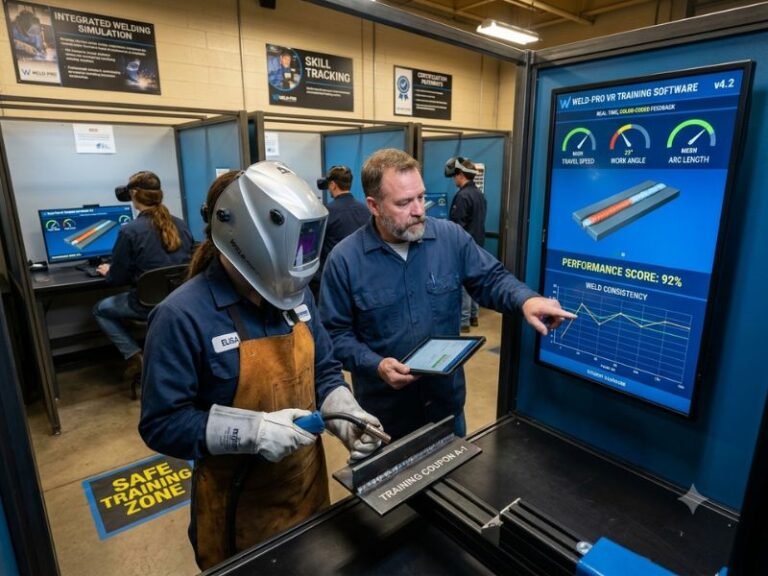
Video can show arc behavior, puddle movement, torch manipulation, and common mistakes more effectively than a still image. Interactive modules can also provide quizzes, equipment-identification exercises, and branching safety scenarios.
Digital resources vary widely in quality. A polished video may still omit ventilation, workpiece preparation, or inspection. The best digital lessons identify the process and material, show the relevant setup, explain why the operator moves in a particular way, and include close-up views without hiding the wider safety context.
Digital training is strongest when it prepares a learner for supervised practice. It is not a substitute for physical skill development, equipment orientation, or an authorized performance evaluation.
Demonstration pieces and sample welds
Actual weld samples add an important visual reference. A set might show acceptable beads beside examples of undercut, overlap, porosity, lack of fusion, excessive spatter, poor tie-in, or inconsistent profile. Labels should describe the visible condition without implying that visual appearance alone proves internal soundness.
Sample pieces are most valuable when they are linked to a cause-and-correction exercise. For example, the learner might inspect a sample, suggest possible causes, and then compare the result with information about travel speed, contamination, shielding, arc length, or heat input.
Choosing Materials for a Specific Goal
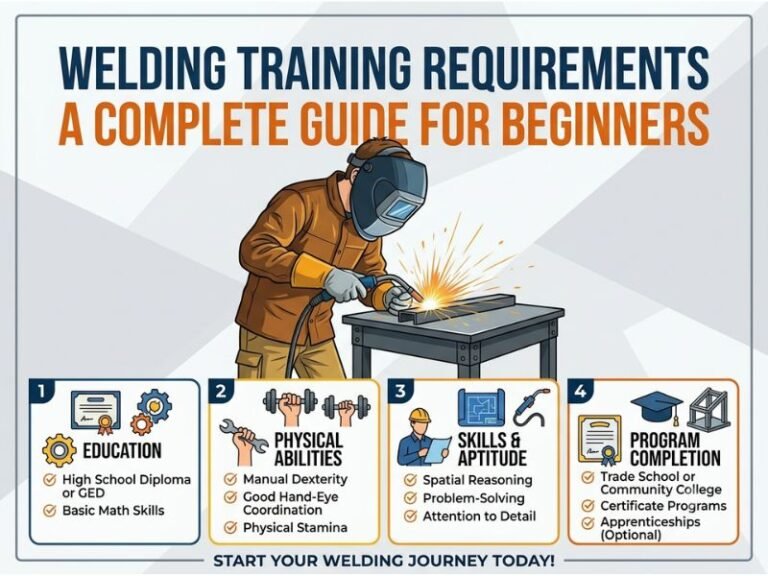
The right resource depends on the learner, process, material, and intended outcome. Before purchasing or assigning anything, I recommend defining the purpose in one sentence. “Learn basic GMAW on mild steel,” “prepare for an entry-level class,” and “support a qualification test” require different content.
| Training goal | Most useful resources | Important limitation |
|---|---|---|
| Basic orientation | Introductory textbook, safety module, labeled equipment diagrams | Does not establish practical competence by itself |
| Process development | Process-specific manual, demonstrations, practice assignments, settings log | Requires access to suitable equipment and supervision |
| Inspection skills | Defect charts, weld samples, visual inspection checklist, measurement tools | Visual inspection cannot reveal every internal condition |
| Qualification preparation | Applicable code or standard, procedure information, test plan, supervised practice | Training content cannot replace the official test or authorized evaluator |
| Workplace refresher | Short safety modules, equipment procedures, hazard-specific checklists | Must reflect the actual workplace and current equipment |
Look for clear learning objectives, accurate process terminology, readable illustrations, practical exercises, answer keys or evaluation criteria, and revision information. Materials should identify what the learner must know, what the learner must do, and how performance will be judged.
Instructor qualifications also matter. An instructor should be able to explain the content, demonstrate safe equipment use, observe technique, and give specific corrective feedback. A resource cannot compensate for an instructor who ignores unsafe behavior or cannot distinguish a technique problem from an equipment problem.
Safety Information That Should Not Be Missing
Safety instructions should be specific enough to guide action. “Use caution” is not a useful control. Materials should explain the hazard, the likely exposure, the preventive measure, and the response if conditions change.
Important areas include:
- Fire prevention, combustible-material control, and hot-work authorization where required.
- Ventilation and exposure control for fumes, gases, coatings, and contaminated materials.
- Electrical inspection, grounding or work connections, damaged leads, and wet conditions.
- Compressed-gas cylinder storage, transport, securing, valve protection, and regulator use.
- Safe grinding, cleaning, and preparation of surfaces and edges.
- Protection of nearby workers from arc flash, sparks, noise, and hot work.
- Safe handling of hot workpieces and clear marking of recently welded parts.
- Emergency actions, including fire response, injury reporting, and equipment shutdown.
Training content should direct learners to follow current requirements from the employer and relevant agencies. In the United States, OSHA rules may apply to workplace welding and related operations, while industry standards and local requirements may add further controls. The material should not present a general lesson as a substitute for a site-specific hazard assessment.
Using Procedures, Settings, and Reference Data
Beginners often search for a single “best” setting. Welding rarely works that way. Amperage, voltage, wire feed speed, travel speed, electrode or filler selection, shielding gas, polarity, material thickness, joint design, and position interact with one another.
Reference charts can provide a starting range, but they do not remove the need to verify the equipment manual and the applicable welding procedure. A training resource should teach learners to record what was used, observe the result, and make controlled changes rather than adjust several variables at once.
A useful settings log may include:
- Base-metal type and thickness
- Joint design, fit-up, and welding position
- Process, electrode or wire classification, and diameter
- Polarity, amperage, voltage, wire feed speed, or gas flow as applicable
- Preheat or interpass information when required by the procedure
- Travel speed, technique notes, and surface preparation
- Observed defects and the correction attempted
This record turns practice into information. It also helps an instructor identify patterns. If porosity appears only after a cylinder change, shielding deserves attention. If lack of fusion appears on thicker joints, preparation, heat input, travel speed, or technique may need review.
Inspection and Feedback
Inspection should be taught as a decision process, not as a hunt for a visually attractive bead. Learners should first confirm the weld’s intended size, location, continuity, profile, and tie-in. They should then examine the surrounding base metal and consider whether the joint matches the specified requirements.
Common visible discontinuities include cracks, undercut, overlap, excessive convexity, insufficient throat, incomplete fill, arc strikes, crater problems, and surface porosity. The exact acceptability of a condition depends on the applicable specification, drawing, code, or procedure. A defect chart should therefore explain the condition while directing the learner to the governing acceptance criteria.
Feedback is most effective when it is observable and actionable. “Improve your technique” is vague. “Keep the arc length more consistent and compare the bead width after the next pass” gives the learner something to control and evaluate.
I also prefer materials that encourage self-checking before an instructor intervenes. A learner who can describe the symptom, likely cause, attempted correction, and result develops a more transferable skill than someone who receives a setting without understanding it.
Common Mistakes in Welding Training Content
Teaching settings without context
Fixed numbers can mislead learners because different machines, materials, joint designs, and positions require different approaches. Charts should be presented as starting guidance tied to a process and procedure, not as universal answers.
Separating theory from practice
Heat input, shielding, polarity, and metallurgy become easier to understand when learners can connect them to a visible weld result. Theoretical explanations should be followed by a demonstration, exercise, inspection task, or troubleshooting example.
Ignoring setup and preparation
Many poor welds begin before the arc starts. Contamination, poor fit-up, incorrect consumable storage, weak tacking, damaged cables, and an unsuitable work connection can undermine an otherwise capable operator.
Using unclear photographs
Low-resolution images, missing labels, and inconsistent viewing angles make defect identification difficult. Materials should use close views alongside full-joint images and explain what the learner should notice.
Confusing training with certification
Completing a course or workbook may show that a learner studied the subject. It does not automatically prove qualification for a specific process, material, position, or procedure. Formal qualification depends on the applicable requirements and authorized evaluation.
Overloading beginners
A resource can be technically accurate and still be ineffective if it introduces too many processes, alloys, standards, and exceptions at once. Layered instruction works better: establish essential safety and fundamentals first, then add complexity as the learner demonstrates control.
Building a Practical Training Set
A small but effective training set can be assembled without collecting every available manual. Start with a current introductory text or course, a process-specific reference, a safety checklist, a settings and practice log, and an inspection guide. Add manufacturer manuals for the actual power source, feeder, torch, gun, regulators, and accessories in use.
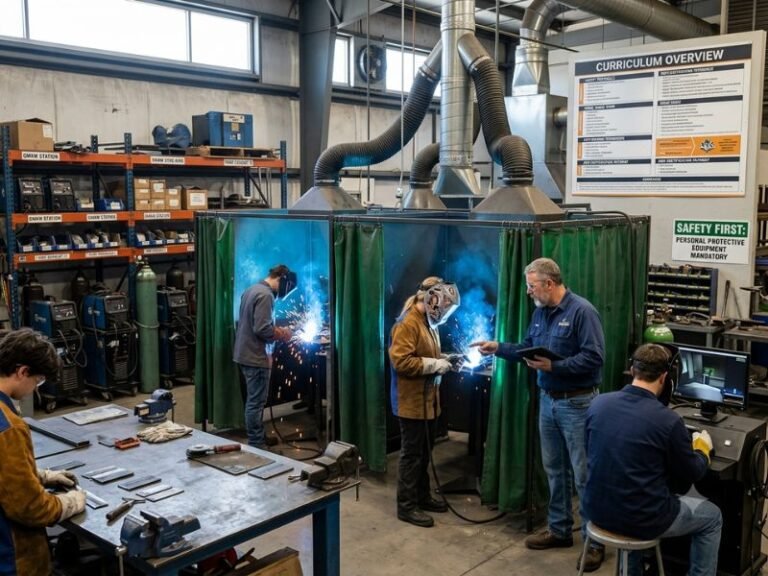
For classroom or shop instruction, include clearly labeled equipment diagrams, prepared practice coupons, sample welds, joint-design drawings, and evaluation rubrics. A short pre-task checklist can confirm that the learner has identified the material, checked the work area, selected protection, inspected the equipment, and understood the assignment.
Organize the files or printed resources by function rather than by publication date alone. A learner should be able to find safety information, machine setup instructions, process guidance, practice exercises, inspection criteria, and emergency procedures quickly. Remove superseded procedures from active folders so that outdated instructions are not mistaken for current requirements.
Accessibility also improves training. Use readable type, high-contrast diagrams, captions for videos, descriptive labels, and plain explanations for specialized terms. Technical accuracy and clear communication should support each other.
FAQ About Welding Training Materials
What are welding training materials?
They are resources used to teach welding safety, theory, equipment operation, process selection, joint preparation, technique, inspection, and evaluation. They may include manuals, workbooks, videos, diagrams, sample welds, practice assignments, checklists, and qualification references.
What should beginner welding training materials cover first?
Begin with workplace hazards, personal protective equipment, ventilation, fire prevention, electrical awareness, equipment identification, and safe work-area setup. Basic process terminology and supervised equipment orientation should come before complex procedure variables or advanced metallurgy.
Can welding training materials replace hands-on practice?
No. Written and digital content can explain concepts and prepare a learner for practice, but welding requires physical coordination and feedback. Safe, supervised practice is necessary to develop control of arc length, travel speed, angles, puddle movement, and joint technique.
Are online welding courses enough to become qualified?
An online course may provide useful theory and safety instruction, but it normally cannot replace hands-on evaluation. Qualification requirements depend on the applicable code, employer, procedure, customer, or other authority. The official requirement should be confirmed before relying on a course for qualification.
How can I tell if a welding workbook is reliable?
Check whether it identifies the processes and materials covered, explains safety in practical terms, uses consistent terminology, includes current revision information, provides exercises and evaluation criteria, and distinguishes general instruction from code or workplace requirements. Manufacturer and recognized industry references can help verify technical claims.
Should training materials include welding defect examples?
Yes. Defect examples help learners connect appearance with possible causes and corrective actions. They should also explain that visual appearance does not reveal every internal condition and that acceptance depends on the applicable specification or inspection method.
Do all welding processes use the same training materials?
No. General safety and basic joint concepts may transfer, but each process requires specific instruction for equipment, consumables, shielding, polarity, controls, technique, and typical defects. GTAW, GMAW, FCAW, SMAW, and oxyfuel work should not be taught as if their procedures were identical.
How often should welding training materials be updated?
Review them whenever equipment, procedures, materials, workplace hazards, regulations, or applicable standards change. Even without a major change, scheduled reviews can identify obsolete settings, broken links, outdated forms, or safety instructions that no longer match the work area.
Conclusion
The best Welding training materials create a clear chain from safe preparation to controlled practice and evidence-based evaluation. I look for resources that explain the process, show the equipment, connect technique to results, and make limitations visible. Used alongside qualified instruction, current procedures, and hands-on practice, they give learners a more reliable foundation for producing sound welds and working safely.