Welding Career Training: How to Start a Career in Welding
Welding is used to build, repair, and maintain products and structures found throughout modern life. Buildings, vehicles, manufacturing equipment, pipelines, ships, farm machinery, and household products may all involve welded components.
However, professional welding requires more than learning how to create an arc and join two pieces of metal. Welders must understand safety procedures, measurements, joint preparation, equipment settings, blueprints, welding symbols, and quality requirements.
A good welding career training program combines technical instruction with substantial hands-on practice. Depending on your goals, training may take place at a trade school, community college, apprenticeship program, high school technical program, military program, or workplace.
The right path depends on your budget, schedule, preferred industry, and local employment market. Some students want a short certificate that prepares them for an entry-level fabrication job. Others choose a longer program that covers multiple welding processes, inspection concepts, and advanced technical subjects.
This guide explains what welding training includes, how to compare programs, which certifications may matter, and what to expect when beginning a welding career.
What Is Welding Career Training?
Welding career training is a structured process that teaches students how to produce safe, repeatable welds according to specifications.
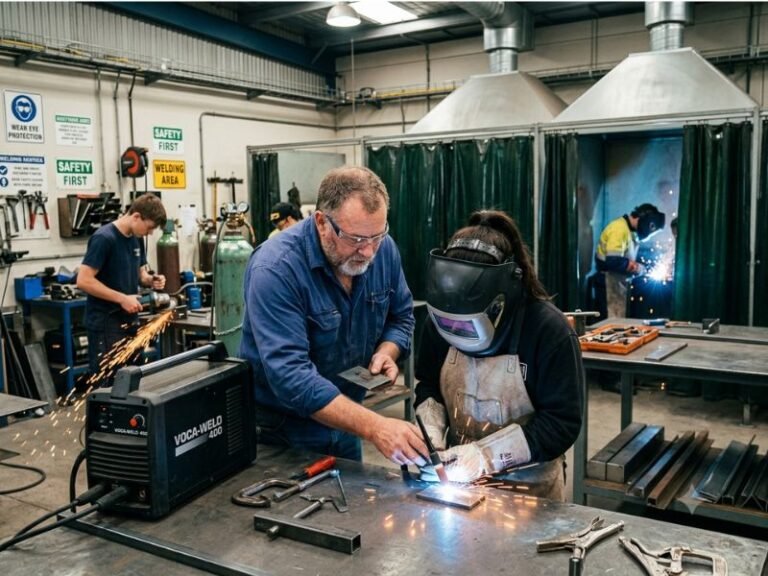
Training usually combines classroom instruction with shop practice. In the classroom, students may study welding terminology, safety, basic metallurgy, blueprint reading, shop mathematics, welding symbols, and quality standards.
In the shop, students learn how to prepare metal, set up equipment, select filler materials, control the welding arc, and inspect completed work. They may practice welding in flat, horizontal, vertical, and overhead positions.
The purpose is not simply to create a weld that looks acceptable. A professional welder must be able to follow instructions and repeatedly produce joints that meet the required strength, dimensions, and quality level.
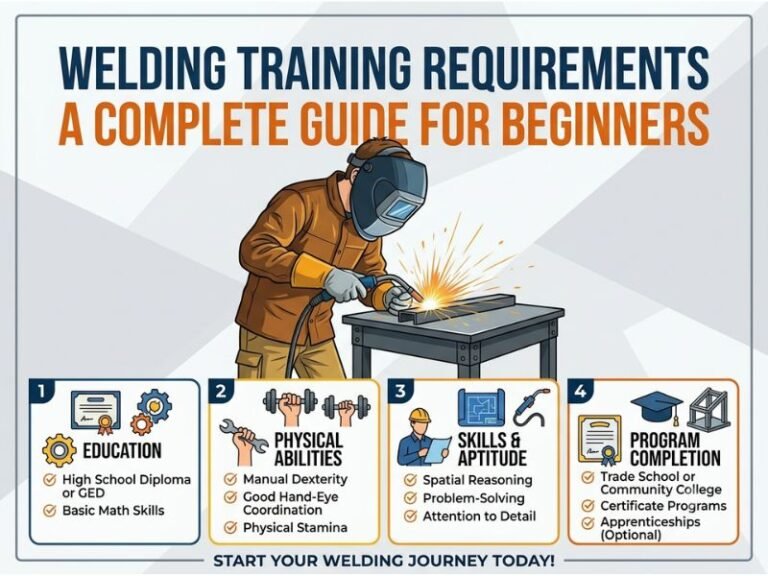
The U.S. Bureau of Labor Statistics states that welders typically enter the occupation with a high school diploma or equivalent, along with technical and on-the-job training. Employers may also require workers to complete company-specific welding tests.
Main Welding Training Paths
There is no single training route that works for every beginner. The four options below are among the most common.
Trade or Vocational School
A welding trade school usually offers a focused curriculum built around hands-on shop practice. Programs may cover several welding processes, cutting methods, fabrication, blueprint reading, and safety.
This route can be useful for career changers who want concentrated training without completing a traditional academic degree. Program length varies, so compare the actual curriculum rather than assuming that a longer course is automatically better.
Ask how many hours you will spend welding in a booth. A program with modern classrooms but limited practical time may not provide enough repetition to build reliable skills.
Private trade schools can also be expensive. Review tuition, equipment charges, protective clothing, books, consumables, testing fees, and transportation before enrolling.
Community College
Community colleges may offer short certificates, diplomas, or associate degrees in welding technology.
A certificate can focus mainly on employable welding skills, while an associate degree may include general education, technical mathematics, communication, and additional manufacturing courses.
Community colleges may provide academic support, financial-aid options, established facilities, and relationships with local employers. However, degree programs generally take longer than focused certificate courses.
This route may be appropriate when you want broader technical education or expect to move later into inspection, supervision, manufacturing technology, or another related field.
Apprenticeship
An apprenticeship combines paid employment with organized instruction. Apprentices learn under experienced workers while gaining practical job-site or shop experience.
The main advantage is that you earn money while developing skills. You also learn the procedures, productivity expectations, and safety rules used in real working conditions.
Apprenticeships can be competitive, and opportunities vary by region and industry. Applicants may need to pass an aptitude test, drug screening, physical assessment, interview, or other selection requirements.
Some programs are connected with unions, contractors, manufacturers, shipyards, or industrial employers.
Employer, Military, or High School Training
Some companies hire entry-level workers and provide basic welding instruction on the job. This may be effective when the employer has a structured program and experienced trainers.
High school career and technical education programs can also provide an early introduction to welding, shop safety, measurement, and fabrication.
Military technical training is another possible route for people who qualify and are interested in military service.
BLS identifies vocational schools, community colleges, private welding schools, military programs, and employer-based training as possible preparation routes for the occupation.
Skills You Should Learn During Welding Training
A complete beginner program should cover more than one method of creating a weld.
Common Welding Processes
Gas Metal Arc Welding, or MIG, uses a continuously fed wire electrode. It is common in manufacturing, automotive work, and general fabrication. Many beginners find it relatively accessible, although producing code-quality welds still requires practice.
Shielded Metal Arc Welding, or stick welding, uses a consumable electrode coated in flux. It is widely used in construction, repair, maintenance, and outdoor work.
Gas Tungsten Arc Welding, or TIG, uses a nonconsumable tungsten electrode. It offers precise control and is often used with stainless steel, aluminum, and thinner materials.
Flux-Cored Arc Welding also uses a continuously fed wire. It is common in structural fabrication, heavy manufacturing, and applications requiring high deposition rates.
A beginner does not need to master every process immediately. The best starting process depends partly on the industries and employers in your area.
Supporting Technical Skills
Employers need welders who can complete an entire assignment, not merely run a bead on a practice plate.
Useful supporting skills include:
- Reading blueprints and welding symbols
- Measuring and marking materials accurately
- Preparing and fitting joints
- Selecting electrodes and filler metals
- Setting amperage, voltage, and wire-feed speed
- Using grinders, saws, torches, and cutting equipment
- Identifying cracks, porosity, undercut, and incomplete fusion
- Performing basic visual inspection
- Following written procedures
Professional welders also need attention to detail, hand-eye coordination, reliability, problem-solving ability, and clear communication. BLS notes that welders interpret specifications, calculate dimensions, inspect materials, and adjust equipment settings while working.
How to Choose a Welding Career Training Program
Do not choose a program solely because it is nearby or has an impressive advertisement. Compare several schools before making a financial commitment.
Ask About Hands-On Practice
Find out how many hours per week students spend actively welding. Ask whether booth time is shared and how often equipment is unavailable.
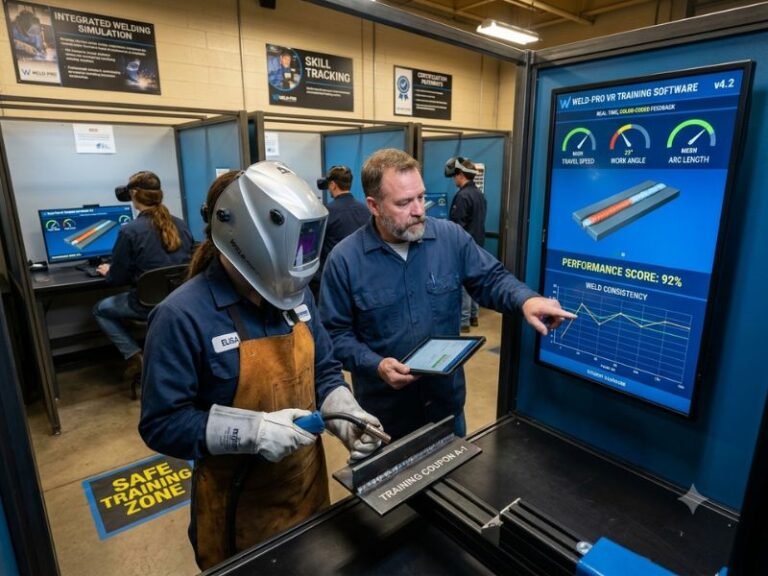
Instructor-to-student ratio also matters. Beginners need timely feedback to correct travel speed, electrode angle, arc length, positioning, and equipment settings.
Repeating a bad technique without supervision can turn it into a difficult habit.
Review the Curriculum
A solid beginner curriculum should include safety, joint preparation, welding positions, blueprint reading, welding symbols, shop mathematics, cutting, and basic inspection.
Ask which welding processes, metals, and positions are included. A program may advertise MIG, TIG, stick, and flux-core training but devote only a small amount of time to some of them.
Check whether the course prepares students for the actual processes used by nearby employers.
Inspect the Facilities
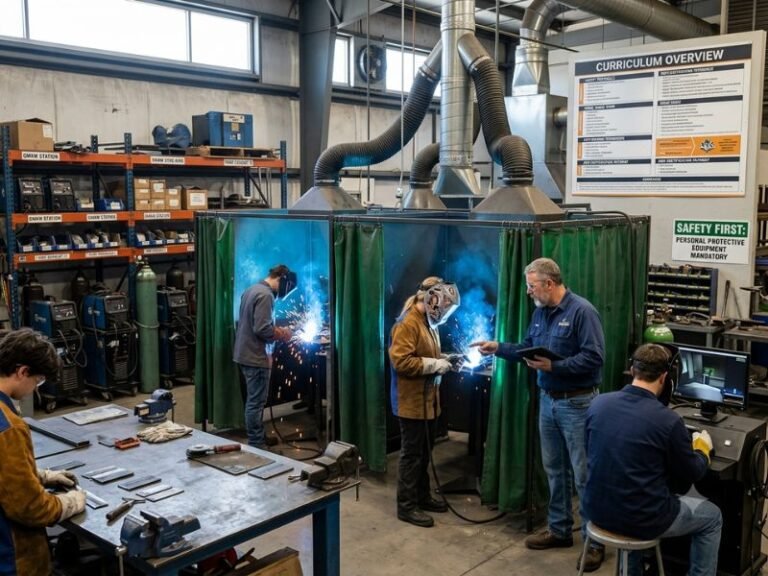
Tour the welding lab before enrolling. Look for adequate ventilation, organized work areas, maintained equipment, functioning safety systems, and enough welding booths for the class size.
Ask whether students learn to set up machines themselves. Someone who practices only on equipment prepared by an instructor may struggle during an employment test.
Investigate Employment Support
Ask the school which employers hire its graduates and how recently those employers recruited from the program.
Find out whether the school provides apprenticeship referrals, résumé assistance, interview preparation, job fairs, or practice for employer welding tests.
Treat guaranteed-job or unusually high starting-salary claims cautiously. Ask for written completion and placement data, including an explanation of how the figures were calculated.
Calculate the Complete Cost
Tuition may be only part of the total expense. Your budget may also need to cover:
- Registration and laboratory fees
- Welding helmet and protective clothing
- Boots, gloves, and safety glasses
- Hand tools and measuring tools
- Books and online materials
- Certification tests
- Transportation
- Lost income while attending class
Compare total cost with the amount of practical instruction provided. A lower-priced program may be a poor value when it offers very little supervised booth time.
Welding Certificates and Professional Certification
A welding school certificate and a professional welding certification are not the same.
A school certificate normally confirms that you completed the institution’s curriculum. It may show employers that you received training, but it does not necessarily prove that you passed a test for a particular welding code, process, material, or position.
The AWS Certified Welder program is performance-based. Candidates complete a practical welding test at an AWS Accredited Test Facility and weld according to a qualified Welding Procedure Specification, or WPS. The finished test weld is then evaluated against the applicable acceptance requirements. AWS does not require a specific educational background or previous certification before attempting the Certified Welder test. (American Welding Society)
A qualification may apply only to certain:
- Welding processes
- Materials
- Thickness ranges
- Joint types
- Positions
- Procedures or codes
Certification is therefore not a universal license for every welding job. Employers may still administer their own tests because their work involves different materials, positions, or procedures.
With experience and additional education, welders may later explore credentials related to inspection, education, supervision, or welding engineering.
How Long Does Welding Training Take?
Training time varies widely.
An introductory course may last several weeks, while a focused certificate program may require several months. Diploma and associate-degree programs can take one or two academic years. Apprenticeships commonly involve a longer period because participants develop skills while working and completing related instruction.
The shortest course is not necessarily the fastest route to employment. A student who finishes quickly but cannot pass a practical test may need additional training.
Before enrolling, ask how many actual welding hours the program includes. Two programs of similar length may provide very different amounts of shop experience.
Training costs also vary by school, location, program type, equipment, and available financial assistance. Request a written breakdown and investigate scholarships, workforce-development funding, employer sponsorship, veteran benefits, and federal financial aid where applicable.
Welding Career Options and Earning Potential
Welders work in many environments, including manufacturing plants, fabrication shops, construction sites, repair facilities, shipyards, industrial plants, and transportation-equipment companies.
Possible entry-level and experienced roles include:
- Production welder
- Fabricator
- Structural welder
- Maintenance welder
- Pipe welder
- Repair welder
- Welding technician
- Robotic welding operator
- Team leader
- Welding instructor
- Welding inspector
A new graduate will not automatically qualify for every specialty. Pipe, pressure-vessel, aerospace, and other advanced work may require additional experience, testing, or code-specific knowledge.
According to the U.S. Bureau of Labor Statistics, the median annual wage for welders, cutters, solderers, and brazers was $51,000 in May 2024. The lowest 10 percent earned under $38,130, while the highest 10 percent earned more than $75,850. Pay varies by location, experience, industry, schedule, overtime, and the difficulty of the work. (Bureau of Labor Statistics)
BLS projects employment in the occupation to grow 2 percent from 2024 through 2034. Despite that limited growth, approximately 45,600 openings are projected each year on average, mainly because existing workers leave the occupation or labor force.
Specialty welding jobs can sometimes pay considerably more than entry-level production work, but those positions should not be presented as the normal starting outcome for every graduate.
Safety Training Every Beginner Needs
Welding exposes workers to heat, intense light, electricity, fumes, sparks, sharp materials, and moving equipment.
OSHA identifies welding hazards that include metal fumes, ultraviolet radiation, burns, eye injuries, electrical shock, cuts, and crushing injuries. Proper procedures and protective equipment can help control many of these risks. (OSHA)
A responsible training program should teach:
- Correct helmet shade and eye protection
- Flame-resistant clothing and welding gloves
- Ventilation and fume extraction
- Safe handling of compressed-gas cylinders
- Fire prevention and hot-work procedures
- Electrical and equipment inspection
- Safe grinding and cutting
- Hearing protection
- Respiratory-protection requirements
- Confined-space precautions
Personal protective equipment is only one part of welding safety. Proper ventilation, equipment maintenance, hazard assessment, and safe work procedures are equally important.
Do not enroll in a program that treats safety instruction as a brief formality.
Step-by-Step Plan to Start a Welding Career
1. Decide What Type of Work Interests You
Research manufacturing, structural fabrication, construction, maintenance, repair, shipbuilding, and pipe welding. You do not need to select a permanent specialty immediately, but a general direction helps you compare programs.
2. Study the Local Job Market
Review entry-level welding advertisements in your area. Note which processes, materials, shifts, qualifications, and experience levels appear repeatedly.
This gives you a more realistic picture of what employers expect.
3. Compare Several Training Routes
Visit trade schools, community colleges, and apprenticeship organizations. Ask the same questions at each location so that you can compare cost, booth time, curriculum, completion rates, and employer relationships.
4. Build Foundational Skills
Practice accurate measurement, shop mathematics, blueprint reading, equipment setup, and metal preparation. Good welding begins before the arc is started.
5. Develop Consistency
One attractive weld is not enough. Employers need workers who can repeatedly meet specifications under realistic conditions.
Practice different positions and learn to recognize why a weld failed.
6. Prepare for Practical Tests
Ask potential employers what type of welding test they use. Practice the relevant process, position, joint, and material rather than preparing only for an unrelated school exercise.
7. Apply for Entry-Level Work
Your résumé should clearly list the processes, positions, metals, equipment, certifications, and practical projects you have completed.
Be accurate about your skill level. Employers often verify welding ability through a hands-on test.
Frequently Asked Questions
Is welding career training worth it?
It can be worthwhile when the program offers substantial hands-on practice, qualified instructors, suitable equipment, realistic career support, and a reasonable total cost. Its value also depends on the local job market and the student’s willingness to practice consistently.
Do I need a college degree to become a welder?
Most entry-level welding jobs do not require a four-year degree. Employers are generally more interested in practical skill, safety awareness, reliability, and the ability to pass required welding tests. Some advanced technical or management roles may benefit from additional education.
Can I become a welder without attending welding school?
Yes. Apprenticeships, military programs, employer training, high school technical education, and supervised work experience can also develop welding skills. However, beginners still need structured safety instruction and enough supervised practice to correct mistakes.
Which welding process should a beginner learn first?
There is no universal answer. MIG can be accessible to beginners, but local structural employers may prioritize stick or flux-core welding. Precision manufacturers may need TIG skills. Research nearby jobs before choosing a program based on one process.
Is AWS certification required for every welding job?
No. Requirements vary by employer, project, industry, and applicable welding code. Some companies value AWS credentials, while others administer their own performance tests using company procedures.
Is welding physically demanding?
It can be. Welders may stand for long periods, bend, kneel, climb, work overhead, handle materials, or enter restricted spaces. Working conditions depend heavily on the industry and workplace.
Can a welder move into inspection or supervision?
Yes. Experienced welders may move into quality control, inspection, supervision, training, estimating, or technical support. These roles often require additional experience, education, certification, or knowledge of welding codes and documentation.
Conclusion
Welding career training can provide a practical route into manufacturing, construction, repair, and other skilled industries.
A strong program should combine welding practice with safety, blueprint reading, measurements, joint preparation, equipment setup, and quality awareness. Trade schools, community colleges, apprenticeships, and employer programs can all be valid routes.
Before enrolling, tour multiple facilities, compare total costs, ask about weekly booth time, and research the processes required by local employers. Do not base your decision on guaranteed-job claims or impressive equipment alone.
Training can open the door, but long-term progress depends on consistent practice, safe work habits, reliability, continuing education, and the ability to produce acceptable welds repeatedly.