International Welding Specialist Training: IWS Course & Career
International Welding Specialist training prepares experienced welding and fabrication personnel to take on greater technical and supervisory responsibility in welded manufacturing. The International Welding Specialist (IWS) qualification focuses on welding processes, materials, joint design, fabrication, quality control, and the coordination of common or standard welding applications.
Unlike a basic welder-training program, IWS education is not primarily about learning how to make a first weld. It is designed for people who need to understand why a welding procedure works, how material behavior affects production, how weld quality is controlled, and how welding personnel and processes should be supervised.
Under the current 2026 IIW guideline, the Standard Route for IWS includes 245 minimum contact hours, including 60 hours of fundamental practical skills. IIW’s public description summarizes the program as more than 200 teaching hours and four qualification examinations.
What Is International Welding Specialist Training?
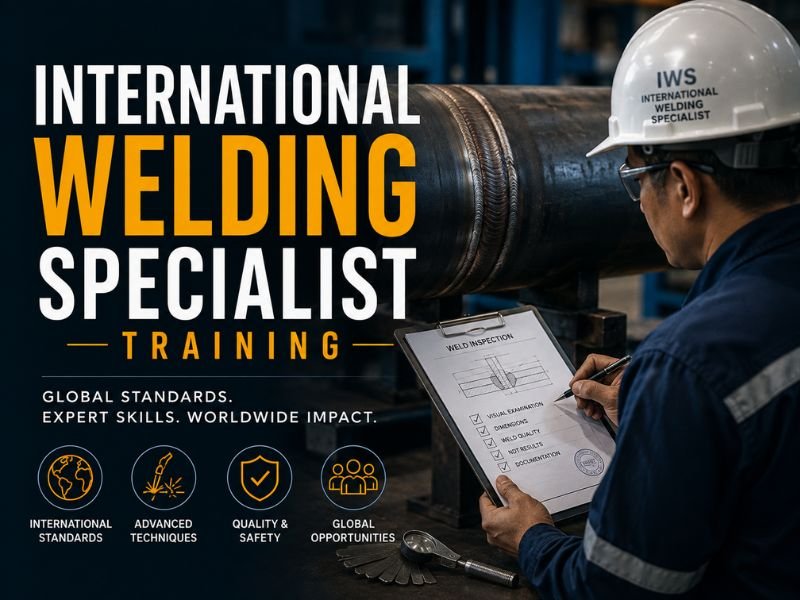
International Welding Specialist training is the education and examination pathway leading to the IIW International Welding Specialist qualification.
The program develops specialized theoretical and practical knowledge in welding technology. According to the current IIW qualification framework, an IWS should be able to develop or select appropriate solutions for common welding problems, manage and supervise standard welding applications, and supervise welding-related personnel within the limits of the role.
Training is organized around four main technical areas:
- Welding processes and equipment
- Materials and their behavior during welding
- Construction and design
- Fabrication and applications engineering
These same four areas form the core structure of the current IIW welding-coordination curriculum.
What Is an International Welding Specialist?
An International Welding Specialist is a person who has completed the applicable IIW education, training, and examination requirements at the IWS level.
IIW places IWS at its specialized welding-coordination level. The qualification is intended for people who need sufficient knowledge to supervise common or standard welding applications and address regular production problems without requiring the broader engineering-level depth expected of an International Welding Engineer.
An IWS is therefore different from a production welder.
A welder is generally qualified to perform a welding operation under defined conditions. An IWS is trained to understand and supervise the broader technical activities surrounding welded production.
Who Can Take IWS Training?
IWS is intended for applicants with an appropriate technical or professional background rather than complete beginners with no welding-related education or experience.
The current 2026 IIW guideline states that normal IWS entry should be based on specific technical education that is above professional-worker level but below the level required for International Welding Technologist. It gives examples such as an appropriate engineering-technician qualification or equivalent technical education.
For the main entry paths, the guideline currently requires at least two years of job-related experience. It also provides additional routes for International Welding Practitioner diploma holders and qualified professional workers with relevant welding experience.
Because national education systems differ, final eligibility is determined through the applicable IIW Authorized Nominated Body, or ANB.
Where Can You Take International Welding Specialist Training?
IIW welding qualifications are delivered through an international network of authorized organizations.
An Authorized Nominated Body (ANB) manages qualification activities within its authorized scope. This can include assessment, examinations, and issuing IIW diplomas.
An Approved Training Body (ATB) provides training under the supervision of an ANB. IIW specifically states that Standard Route candidates should enroll through an authorized training body.
This distinction matters when comparing courses. A private course using the phrase “International Welding Specialist” does not automatically make it an official IIW IWS qualification program.
How Is IWS Training Structured?
The current Standard Route is divided into several stages.
The 2026 guideline shows:
- IWS Part 1: up to 41 hours
- IWS Part 2: 60 hours
- IWS Part 3: at least 144 hours
- An intermediate examination
- A final examination
Together, the current minimum contact-hour structure totals 245 hours.
IIW also allows other qualification routes, including an Alternative Route in which previous education, training, and professional experience are assessed by the ANB. The Alternative Route is an assessment pathway, not an automatic way to skip training requirements.
Module 1: Welding Processes and Equipment
A major part of IWS training is understanding how common welding and cutting processes operate.
The current curriculum includes conventional welding and cutting processes, arc power-source fundamentals, and advanced welding processes at the level appropriate for an IWS.
Subjects may include processes such as:
- Shielded Metal Arc Welding (SMAW)
- Gas Metal Arc Welding (GMAW/MIG)
- Flux-Cored Arc Welding (FCAW)
- Gas Tungsten Arc Welding (GTAW/TIG)
- Submerged Arc Welding (SAW)
- Resistance welding
- Thermal cutting and related processes
The emphasis is not simply on operating the equipment. An IWS needs to understand process capabilities, limitations, consumables, parameters, and common production problems.
For example, a specialist should understand why a GMAW procedure may respond differently from an SMAW procedure when joint access, shielding conditions, deposition requirements, or welding position changes.
Module 2: Materials and Their Behavior During Welding
Welding subjects metal to rapid heating and cooling, so material behavior is a major part of IWS education.
The IIW curriculum includes metallic materials, steels and their weldability, corrosion and fracture considerations, structural and high-strength steels, and materials other than steel.
Training can cover subjects such as:
- Basic welding metallurgy
- Carbon and low-alloy steels
- Heat-affected zones
- Weldability
- Hydrogen-related cracking
- Preheat concepts
- Heat treatment
- Stainless steels
- Aluminum and other engineering materials
- Corrosion and wear
An IWS does not need the same depth of materials science expected at the IWE level, but the specialist must understand enough to recognize common material-related welding problems and apply approved procedures correctly.
Module 3: Construction and Design
IWS training also introduces the design considerations that affect welded fabrication.
The current IIW syllabus includes a dedicated competence unit for Design for Welding and Brazing.
At specialist level, this can involve understanding:
- Butt, lap, T-, and corner joints
- Groove and fillet welds
- Weld sizing
- Joint accessibility
- Basic load transfer
- Stress concentration
- Distortion
- Fatigue considerations
The purpose is not to turn an IWS into a structural design engineer. It is to ensure that the specialist understands how joint design affects welding, inspection, production, and service performance.
The current IIW learning outcomes include calculating simple weld sizes and recommending appropriate joint arrangements for basic structures or pressure-related applications.
Module 4: Fabrication and Applications Engineering
Fabrication and applications engineering is particularly important for people moving into welding supervision.
The current IWS curriculum includes quality-management principles, quality assurance and control of welded joints, testing used for quality control, and case studies.
Typical subjects can include:
- Production planning
- Welding documentation
- Inspection requirements
- Welding consumables
- Equipment
- Repair procedures
- Welder qualification
- Procedure qualification
- Quality records
- Welding coordination
This is where process, material, and design knowledge become practical production decisions.
Practical Skills in IWS Training
Although IWS is a technical and supervisory qualification, practical exposure remains part of the Standard Route.
The current guideline assigns 60 contact hours to fundamental practical skills for IWS.
The purpose is to develop practical understanding of welding-process behavior and limitations. Training may involve exposure to processes such as manual metal arc/stick welding, TIG, MIG/MAG, flux-cored welding, and gas processes according to the approved curriculum.
This practical component should not be confused with a production-welder qualification test. An IWS diploma does not automatically certify the holder as a welder for every process taught during the course.
Welding Procedure Specifications in IWS Training
Understanding the Welding Procedure Specification, or WPS, is essential for welding supervision.
A WPS can define variables such as:
- Welding process
- Base material
- Filler material
- Joint configuration
- Welding position
- Current
- Voltage
- Polarity
- Preheat
- Interpass temperature
An IWS needs to understand how approved procedures are implemented in production and how welding personnel should be supervised when following them.
IIW identifies procedure management, personnel selection, WPSs, and welding procedure qualification records among important welding-coordination activities.
Weld Inspection and Quality Control
An IWS needs enough inspection knowledge to understand whether production is meeting specified quality requirements.
Training includes quality assurance, quality control, testing, and weld-imperfection acceptance concepts. The current IWS learning outcomes include selecting appropriate acceptance levels for welding imperfections in basic constructions and contributing to quality-control and inspection planning.
Inspection knowledge can include awareness of:
- Visual testing
- Penetrant testing
- Magnetic particle testing
- Ultrasonic testing
- Radiographic testing
- Bend testing
- Tensile testing
- Macro examination
The IWS diploma itself does not automatically provide separate certification as an NDT technician for these methods.
Common Welding Problems an IWS Should Understand
An IWS should be able to recognize and help troubleshoot common production problems.
These may include:
Porosity
Possible causes can involve contamination, unsuitable shielding, consumable condition, or welding parameters.
Lack of Fusion
Heat input, electrode placement, travel speed, and joint geometry can contribute to poor fusion.
Slag Inclusion
Slag-producing processes require suitable bead placement and interpass cleaning.
Undercut
Excessive or unsuitable parameters, electrode angle, and travel technique can influence undercut.
Cracking
Material behavior, hydrogen, restraint, heat treatment, and procedure variables may contribute to cracking.
The specialist’s role is not to guess at a correction. It is to connect the observed problem with welding-process, material, procedure, and production factors.
Welding Coordination and ISO 14731
IWS is one of IIW’s recognized qualification levels for welding coordination.
IIW states that its harmonized IWE, IWT, IWS, and IWP qualifications support the knowledge required for welding-coordination activities associated with ISO 14731 and other international standards and codes.
At IWS level, the current qualification descriptor focuses on managing and supervising common or standard welding applications and supervising welding-related personnel.
Actual responsibilities still depend on the manufacturer, product, contract, quality requirements, and applicable standard.
How Many IWS Exams Are Required?
IIW’s current public IWS information states that Standard Route participants must pass four qualification examinations.
The four main technical knowledge areas are:
- Welding processes and equipment
- Materials and welding behavior
- Construction and design
- Fabrication and applications engineering
The current 2026 route also includes an intermediate examination before progression through later stages of the program.
Students should follow the current examination instructions issued by their ANB or training provider because administration details can vary within the IIW system.
IWS Diploma vs. Certification
Successful completion of the applicable education and examination requirements leads to an IIW qualification diploma.
IIW also operates separate personnel-certification systems. It therefore distinguishes qualification and certification even though both exist within the broader IIW system.
An IWS diploma should not be described as a universal employment license.
Employers, national regulations, project specifications, welding codes, or other certification schemes may impose additional requirements.
IWS vs. IWE, IWT, and IWP
IIW uses several levels of welding-coordination qualification.
IWE — International Welding Engineer: expert level, with the greatest depth of technical and engineering responsibility.
IWT — International Welding Technologist: advanced level for complex welding applications and technical decision-making.
IWS — International Welding Specialist: specialized level focused on common or standard welding applications and supervision.
IWP — International Welding Practitioner: independent professional-worker level focused on routine or basic welding activities.
The current IIW framework assigns different knowledge, skills, autonomy, and responsibility to each level.
Choosing the correct qualification therefore depends on education, experience, job responsibilities, and the complexity of the welding work.
Where Can International Welding Specialists Work?
IWS knowledge can be relevant across many welded-manufacturing environments, including:
- Structural steel fabrication
- General manufacturing
- Welding workshops
- Heavy fabrication
- Pipe fabrication
- Pressure-equipment manufacturing
- Shipbuilding
- Industrial maintenance
- Production supervision
- Welding quality departments
Because the qualification focuses on common and standard welding applications, it is especially relevant to experienced welding personnel moving from direct production work toward technical supervision or coordination.
Frequently Asked Questions
What Is International Welding Specialist Training?
International Welding Specialist training is an IIW welding-coordination education pathway covering welding processes, materials, design, fabrication, quality control, practical skills, and examinations. Successful candidates can earn the IWS qualification diploma.
What Does IWS Stand For in Welding?
IWS stands for International Welding Specialist. IIW classifies it as a specialized welding-coordination qualification for personnel responsible for common or standard welding applications.
How Long Is IWS Training?
The current 2026 Standard Route requires a minimum of 245 contact hours, including 60 hours of fundamental practical skills. The actual calendar duration depends on how the Approved Training Body schedules the course.
How Many Exams Are Required for IWS?
IIW currently states that Standard Route IWS candidates must pass four qualification examinations. The current route also includes an intermediate examination stage.
Do You Need Welding Experience for IWS Training?
Current access rules generally require relevant technical education and job-related experience. The main IWS entry paths require at least two years of job-related experience, while other access routes exist for suitable professional workers and IWP diploma holders.
Can IWS Training Be Done Online?
IIW states that IWS training may be offered partially through distance learning. Candidates should check the exact delivery format with the relevant authorized provider.
What Is the Difference Between IWS and IWE?
IWS is a specialist-level qualification focused on common or standard welding applications. IWE is the higher expert engineering level intended for complex welding technology and broader technical responsibility.
Is an IWS the Same as a Certified Welder?
No. IWS is a welding-technology and coordination qualification. A welder qualification demonstrates practical ability to weld under specified test conditions. The two credentials serve different purposes.
Conclusion
International Welding Specialist training develops the technical and supervisory knowledge needed to manage common welding applications beyond the level of a production welder. The program brings together welding processes, materials, joint design, fabrication, procedure control, inspection, quality management, and practical welding awareness.
Under the current 2026 IIW Standard Route, IWS education requires at least 245 contact hours, including 60 hours of fundamental practical skills, along with the applicable intermediate and qualification examinations.
For experienced welders, technicians, foremen, and fabrication personnel who want to move into welding supervision or coordination, the IWS pathway provides a structured way to build broader technical competence. Its main value is not simply knowing how to make a weld, but understanding how welding processes, materials, procedures, inspection, and production controls work together to produce consistent welded products.