Hyperbaric Welding Training: Clear Overview and Expert Insights
A repair crew may need to restore a damaged pipeline reinforce a harbor structure or inspect a ship s hull while the worksite remains underwater A qualified diver-welder.
Hyperbaric welding training combines commercial diving, welding technology, underwater work practices, and decompression safety. The difficult part is understanding how those disciplines fit together: which course is appropriate, what credentials employers look for, how wet and dry welding differ, and what training can realistically lead to a job.
I have organized the subject around those decisions. The goal is to help a prospective student compare programs, recognize credible training, prepare for the physical and technical demands, and avoid paying for a course that does not provide the qualification needed for the intended work.
What Hyperbaric Welding Training Covers
Hyperbaric welding training prepares a person to perform or support welding operations in a pressurized environment, most commonly underwater. The phrase may refer to wet welding, dry welding inside a habitat or chamber, or a broader commercial diver-welder program that includes both underwater construction and welding fundamentals.
Training normally has two connected parts:
- Commercial diving education: Diving physics, underwater navigation, life-support systems, communications, decompression procedures, emergency response, and worksite safety.
- Welding education: Welding processes, joint preparation, electrical safety, metallurgy, inspection, weld discontinuities, procedure requirements, and hands-on practice.
These parts are related but not interchangeable. A surface welder may understand arc control and joint fit-up but lack the authorization and safety preparation to conduct commercial diving operations. A recreational diver may be comfortable underwater but lack the welding skill, industrial discipline, and documented qualifications expected on a construction project.
Hyperbaric work also includes more than making an arc. A diver may need to examine a structure, prepare a damaged area, remove a failed component, install a clamp, communicate with a tender, monitor tools, and report the condition of the repair. A strong program therefore teaches welding as one part of a controlled underwater operation.
Wet Welding and Dry Hyperbaric Welding
The most important training choice is the environment in which welding will take place. Wet welding occurs directly in the water. Dry hyperbaric welding takes place inside a sealed habitat, chamber, or other enclosure that removes water from the immediate weld area while maintaining pressure appropriate to the depth.
Wet welding
Wet welding commonly uses shielded metal arc welding with equipment designed for underwater service, although the exact process depends on the employer, procedure, material, and project. The surrounding water affects heat transfer, arc behavior, visibility, electrode handling, and the final weld’s characteristics.
Training focuses on safe power control, electrode selection, arc initiation, travel speed, joint preparation, body positioning, communication, and inspection. Students also learn that an underwater weld may have different mechanical properties and a higher risk of discontinuities than a comparable surface weld unless the procedure and conditions are carefully controlled.
Wet welding can be useful for temporary repairs, structural work, salvage, marine construction, and situations in which constructing a dry habitat is impractical. It is often faster to mobilize than a large dry enclosure, but speed does not remove the need for engineering review or qualified procedures.
Dry hyperbaric welding
Dry welding creates a controlled gas-filled working space around the joint. The welder-diver works in a habitat at elevated pressure, so the work area is dry while the diver remains in a hyperbaric environment.
This approach can provide better visibility, improved control of the arc, more stable weld conditions, and a weld quality closer to that achievable on the surface. It also introduces demanding habitat operations, gas management, pressure control, fire prevention, chamber procedures, and complex logistics.
Dry hyperbaric welding is not simply surface welding underwater The welder must understand the effect of pressure and breathing-gas composition on the work environment follow a qualified welding procedure and coordinate with a larger diving and habitat team Training for this work is usually more specialized and may follow experience in commercial diving and wet.
Who Can Enter a Hyperbaric Welding Program?
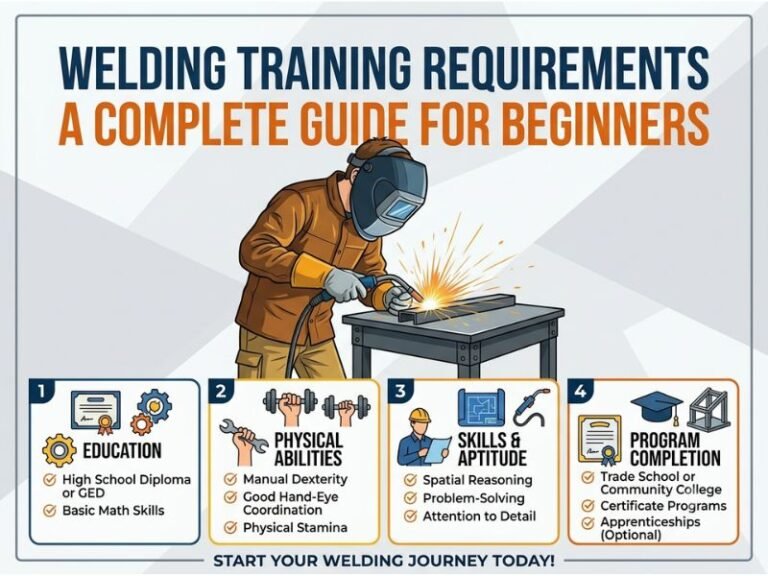
Admission requirements vary by school, but reputable commercial diving programs typically assess age, education, medical fitness, swimming ability, and the capacity to perform physically demanding work. A student should review the written requirements before paying a deposit because a short welding course may not qualify anyone to conduct commercial diving.
Common entry requirements
- A high school diploma, GED, or equivalent education may be required.
- A commercial diver medical examination or physician’s approval is commonly part of the process.
- Applicants may need to demonstrate swimming, water comfort, and basic physical conditioning.
- Some programs expect prior welding experience, while others teach welding fundamentals from the beginning.
- Students may need to pass a school interview, aptitude review, drug screening, or background requirement.
- Technical reading, measurement, basic mathematics, and mechanical reasoning are valuable preparation.
Medical clearance deserves special attention. Commercial diving can involve pressure exposure, breathing-gas changes, confined spaces, heavy tools, cold water, and emergency response. A person should not assume that recreational diving clearance automatically qualifies for occupational diving. The training provider should explain which medical standard applies and who is authorized to perform the examination.
Physical strength is helpful, but endurance, calm decision-making, coordination, and procedural discipline matter just as much. A diver-welder may work in low visibility while wearing restrictive equipment and communicating through a surface team. I would treat comfort with checklists and repetition as a professional advantage rather than a minor classroom habit.
Core Subjects in the Curriculum
A complete program should make the relationship between diving safety and welding quality clear. The exact course sequence differs, but the following subjects are central to a serious training pathway.
Commercial diving fundamentals
Students learn pressure and gas laws, buoyancy, decompression theory, dive planning, equipment inspection, underwater orientation, and safe ascent procedures. They also practice using helmets, masks, umbilicals, harnesses, communications equipment, and breathing-gas systems.
Surface-supplied diving is especially important in industrial work because the diver is connected to a surface team through an umbilical. The umbilical may carry breathing gas, communications, strength members, and other services. Understanding its management and limitations is essential for both the diver and the tender.
Welding processes and metallurgy
Instruction may include shielded metal arc welding, gas metal arc welding, gas tungsten arc welding, oxyfuel cutting, and other processes. The process taught should match the type of underwater work the school and target employers actually perform.
Students should understand base metals, heat-affected zones, hydrogen, cracking, porosity, slag inclusion, undercut, lack of fusion, and distortion. Hyperbaric pressure and water cooling can alter the welding environment, so an instructor should explain why a procedure qualified on land may not transfer directly to a submerged application.
Underwater tools and electrical safety
Underwater electrical work requires strict control of power sources, cables, connections, grounding, switching, and communication between the diver and surface personnel. Training should cover equipment inspection, isolation procedures, emergency shutdown, and the hazards of damaged insulation or unintended current paths.
Students may also handle hydraulic tools, pneumatic tools, cutting equipment, grinders, water jets, and rigging. Each tool creates distinct risks involving stored energy, entanglement, kickback, noise, visibility, and structural instability.
Welding procedures and qualification
A professional project generally uses a written welding procedure that specifies essential variables such as material, joint design, electrode or wire, polarity, preheat or interpass controls where applicable, current range, technique, and inspection requirements. Training should teach students how to read and follow a procedure rather than improvise from memory.
AWS D3.6M, the American Welding Society specification for underwater welding, is a key reference in the United States. It addresses requirements for underwater welding and classifies welds according to the level of quality and intended use. A course may teach the principles of this standard, but classroom exposure is not the same as project-specific qualification.
Inspection and documentation
Welders should learn visual inspection and the basics of nondestructive examination. Depending on the project, inspection can involve visual testing, magnetic particle testing, ultrasonic testing, radiographic testing, or other methods performed by qualified personnel.
Documentation may include dive logs, equipment checks, welding parameters, consumable control, joint identification, inspection results, and incident reports. Accurate records protect the worker, the contractor, and the asset owner. They also help an employer determine whether a welder’s qualification applies to a particular job.
How the Training Path Usually Works
There is no single universal license called a hyperbaric welding license in the United States. The normal path combines commercial diver training with welding education and employer- or project-specific qualifications.
- Complete medical and admission screening. Confirm that the school’s medical requirements, physical standards, and documentation are understood before enrollment.
- Build commercial diving competence. Learn surface-supplied diving, equipment use, emergency procedures, decompression practice, and team operations.
- Develop welding skill. Practice on land first, then progress to controlled underwater exercises. A student should be able to produce consistent surface welds before attempting complex underwater joints.
- Study underwater construction. Add rigging, cutting, burning, inspection, salvage, marine structures, and work planning as the program requires.
- Practice under supervision. Repetition should include realistic communication, limited visibility, equipment checks, procedure compliance, and recovery from mistakes.
- Earn applicable credentials or qualifications. The exact documentation depends on the school, employer, client, and governing standard. Ask what certificate is issued and what it actually permits the holder to do.
- Gain entry-level commercial diving experience. Many workers begin as tenders or junior divers and develop welding responsibilities as their competence and qualifications grow.
The length of training can range from a short specialty course to a comprehensive commercial diving program lasting many months. A short course may be useful for an already qualified commercial diver or experienced welder who needs a specific skill. It may be inadequate for someone starting with no diving or welding background.
How to Choose a Credible Training School
I would evaluate a program based on what it can document, not only on dramatic videos or broad claims about high earnings. The school should state the credential, curriculum, facilities, instructor qualifications, practical training hours, and limitations of the course.
Questions to ask before enrollment
- Does the program train commercial divers, underwater welders, or only surface welders?
- What type of diving equipment and welding processes do students use?
- How much supervised underwater practice is included?
- Does the curriculum address OSHA commercial diving requirements and relevant industry practices?
- How does the school teach AWS D3.6M or other applicable welding standards?
- What medical examination and physical prerequisites apply?
- What certificate, card, or qualification does a graduate receive?
- Do employers recognize that credential for entry-level work?
- Are equipment, consumables, medical screening, housing, testing, and other costs included?
- What employment support is provided, and are placement claims independently verifiable?
Look for a program with a functioning dive team, maintained equipment, clear emergency procedures, and instructors who can explain why a task is performed a particular way. Students should spend meaningful time practicing, not merely watching demonstrations.
Industry alignment matters. Depending on the employer and region, a school may discuss organizations such as the Association of Diving Contractors International, the American Welding Society, OSHA, or other applicable authorities. No logo guarantees quality, so the student should still verify the scope of recognition and whether it applies to the intended job.
Safety Risks and Professional Controls
Hyperbaric welding combines several high-consequence hazards. The risks are manageable only through planning, equipment control, qualified supervision, and a surface team with authority to stop the operation.
Pressure and decompression
Pressure exposure can cause decompression illness, barotrauma, gas toxicity, and other medical emergencies. A dive plan must account for depth, bottom time, breathing gas, decompression requirements, environmental conditions, and available emergency support. A welder’s ability to complete a joint never overrides the dive plan.
Electric shock and arc hazards
Wet environments increase the consequences of electrical failures. The operation requires suitable power sources, correct cables and connections, controlled switching, insulation checks, and reliable communication. The diver should never depend on personal judgment alone to determine whether a circuit is safe.
Entrapment and umbilical hazards
Structures, cables, lines, wreckage, and changing currents can trap a diver or compromise the umbilical. Training includes route planning, line management, tool control, and procedures for responding to a lost or fouled diver.
Fire, explosion, and gas hazards
Cutting and welding can create heat, sparks, gases, and pressure changes. Enclosed spaces and habitats require careful atmosphere monitoring and fire prevention. A worksite may also contain fuel, coatings, residues, or cargo that makes hot work unsafe without isolation and testing.
Structural instability
Removing metal, cutting supports, or applying heat can change the strength and balance of a structure. The diver-welder needs a work plan that addresses load paths, falling objects, suspended components, and the possibility that a damaged structure will move during the repair.
Good training teaches stop-work authority. I consider that one of the clearest signs of a mature safety culture: the worker is expected to pause when visibility, equipment condition, communication, gas supply, or structural behavior falls outside the plan.
Career Options and Realistic Expectations
Graduates may pursue work with commercial diving contractors, marine construction companies, shipyards, offshore service providers, salvage firms, inspection companies, ports, utilities, or specialized repair contractors. Job titles can include commercial diver, tender, underwater welder, diver-inspector, marine construction diver, or habitat technician.
Welding is only one part of the labor market. Employers may value rigging, burning, nondestructive testing, mechanical repair, inspection, pipe work, underwater photography, and strong documentation skills. A person who can safely support a complete underwater work package may have more opportunities than someone who wants to weld exclusively.
Entry-level work may involve tending, equipment handling, surface support, maintenance, inspection assistance, and basic underwater tasks before advanced welding assignments. Travel, irregular schedules, weather delays, cold conditions, and extended time away from home are common considerations in commercial diving.
Pay varies by location, employer, project type, experience, diving method, depth, schedule, and qualifications. I would be cautious about any school that presents a guaranteed salary or implies that a certificate alone leads directly to high-paying offshore work. Career progression depends on safe performance, verified experience, applicable qualifications, and the actual demand in the market.
Common Mistakes to Avoid
Confusing recreational diving with commercial diving
Recreational certification does not prepare a person for surface-supplied systems, industrial tools, decompression procedures, commercial dive-team roles, or construction-site accountability. It may show comfort in the water, but it is not a substitute for occupational training.
Choosing a welding-only course
A course that teaches an underwater arc without commercial diving, emergency response, and worksite controls may provide a narrow skill demonstration rather than job readiness. Ask exactly what the graduate is qualified to do.
Assuming a surface welding qualification transfers automatically
A surface welding qualification can be valuable preparation, but underwater conditions and project procedures may require a separate qualification. Material, position, process, electrode, thickness, pressure, and inspection requirements can all affect applicability.
Ignoring fitness and medical requirements
Delaying medical screening can lead to an expensive surprise after enrollment. Obtain the school’s requirements in writing and use an appropriately qualified physician.
Underestimating communication
A diver may not see the surface team or the full work area. Clear line signals, hard-wire communications, planned terminology, and repeated confirmation are safety controls, not administrative details.
Paying for vague promises
Before signing a contract, compare the curriculum, hands-on hours, equipment access, credential wording, refund policy, and total cost. Verify employer recognition rather than relying on testimonials alone.
FAQ About Hyperbaric Welding Training
Is hyperbaric welding training the same as underwater welding school?
Not always. “Underwater welding school” may describe a full commercial diving program with welding or a short specialty course for people who already have diving experience. Hyperbaric welding can include wet welding and dry habitat welding, so the student should confirm the exact environment and credential.
Do I need to be a certified commercial diver before learning hyperbaric welding?
Not necessarily. Some schools accept beginners into an integrated commercial diving and welding program. Other courses are advanced and require prior commercial diving experience. The admission requirements should identify whether the course is entry-level, specialty-level, or employer-specific.
Can a certified welder become an underwater welder?
Yes, a welding background can provide a strong technical foundation, but the person still needs commercial diving education, medical clearance, underwater practice, and any required project qualifications. Surface welding certification alone does not authorize commercial diving work.
Is wet welding or dry welding better?
Neither is universally better. Wet welding can be practical for certain repairs and is often more mobile. Dry hyperbaric welding can offer a more controlled weld environment but requires habitat systems, pressure management, and more complex support. The structure, depth, material, procedure, schedule, and engineering requirements determine the appropriate method.
How long does hyperbaric welding training take?
It depends on the starting point and course scope. A short class may teach a specific underwater welding skill to an experienced professional, while a complete commercial diving pathway can take many months. The important comparison is not only calendar length but also supervised dive time, welding practice, emergency training, and the credential awarded.
What standard is associated with underwater welding in the United States?
AWS D3.6M is a major American Welding Society specification associated with underwater welding. It is used alongside applicable commercial diving rules, project specifications, engineering requirements, and employer procedures. Training on a standard does not replace the qualification required for a particular job.
Can hyperbaric welding training guarantee a job?
No reputable program can guarantee employment solely because a student completes a course. Hiring depends on qualifications, experience, location, physical and medical eligibility, project demand, safety record, and employer requirements. A school should explain its employment data without promising a predetermined outcome.
Conclusion
Hyperbaric welding training is best understood as a combined professional pathway not a quick underwater welding shortcut The strongest preparation develops commercial diving competence controlled welding technique procedure.