Industrial Welding Training: Clear Overview and Expert Insights
Many people assume welding training is mainly about learning to strike an arc and make a visible bead. In industrial work, that is only the starting point. Employers also need welders who can interpret drawings, select the correct process, control heat, follow safety procedures, inspect work, and document results consistently.
Industrial welding training connects hands-on welding practice with the production, quality, and safety requirements found in fabrication shops, construction projects, manufacturing plants, pipelines, shipyards, and maintenance operations. I will explain what the training includes, how programs differ, which credentials matter, and how to choose a path that matches a specific welding career.
The right program can shorten the distance between classroom instruction and employable skill. The wrong one may provide limited practice, outdated equipment, or a certificate that does not satisfy a hiring manager or job-specific qualification. Understanding the difference helps a prospective welder make a better decision before paying tuition or applying for work.
What Industrial Welding Training Covers
Industrial welding training is structured education for welding materials and assemblies used in commercial or industrial settings. It normally combines technical instruction, supervised shop time, safety education, and performance evaluation.
Training may cover one process or several. Common processes include:
- SMAW, commonly called stick welding, which is widely used for structural steel, field repairs, and outdoor work.
- GMAW, commonly called MIG welding, which supports efficient production on many steel, stainless steel, and aluminum applications.
- GTAW, commonly called TIG welding, which offers precise control for thin materials, stainless steel, aluminum, pipe, and high-quality applications.
- FCAW, or flux-cored arc welding, which is useful for structural fabrication, heavy equipment, and high-deposition work.
- Oxyfuel cutting, plasma cutting, carbon arc gouging, and related metal preparation methods.
A strong program also teaches how welds fit into a larger production system Students learn joint design fit-up tack welding distortion control weld symbols material identification measurement grinding.
Why Industrial Welding Skills Matter
Industrial welding affects structural strength, equipment reliability, worker safety, and production cost. A poor weld can lead to cracking, leakage, premature failure, rework, or an unsafe assembly. For that reason, industrial employers evaluate more than speed.
A trained welder must usually demonstrate several connected abilities:
- Read engineering drawings, weld symbols, dimensions, and material notes.
- Prepare surfaces and joints according to the work instructions.
- Set voltage, amperage, wire speed, gas flow, polarity, and other process variables.
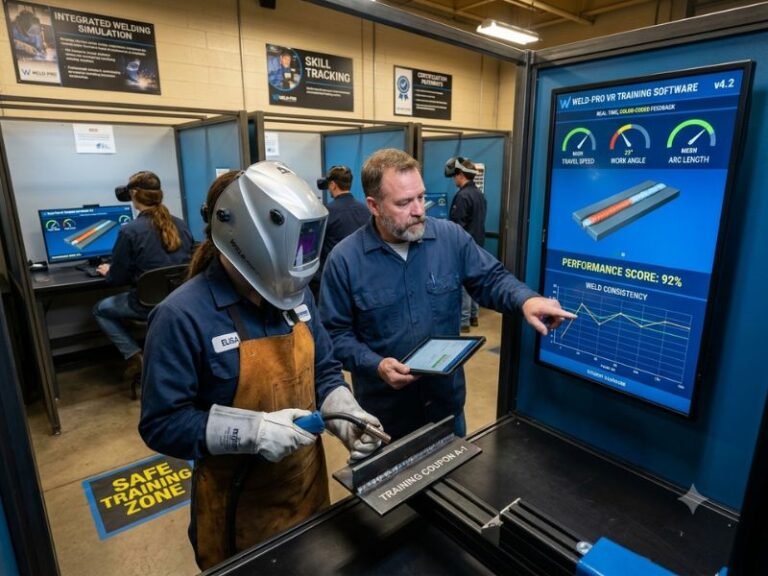
- Maintain correct travel angle, arc length, travel speed, and heat input.
- Recognize defects such as porosity, undercut, lack of fusion, incomplete penetration, overlap, and cracking.
- Use gauges, calipers, templates, and other measuring tools accurately.
- Follow a welding procedure specification, or WPS, instead of relying only on personal habit.
- Protect nearby workers, equipment, and combustible materials from welding hazards.
I consider repeatability one of the clearest differences between beginner practice and industrial readiness. A beginner may create one acceptable weld under favorable conditions. An employable welder must produce acceptable work across multiple joints, positions, materials, and production demands.
Core Subjects in a Quality Program
Welding safety
Safety instruction should begin before a student touches a torch or welding gun. Topics typically include eye and face protection, protective clothing, gloves, hearing protection, ventilation, fire prevention, compressed-gas handling, electrical safety, confined spaces, and hazard communication.
Welding creates ultraviolet radiation, fumes, heat, sparks, and electrical hazards. Some coatings, paints, and base metals can produce especially dangerous fumes when heated. A responsible program teaches students to identify the hazard, control exposure, and follow site-specific requirements rather than treating personal protective equipment as the only solution.
Blueprints and weld symbols
Blueprint reading allows a welder to understand what the finished assembly should look like before fabrication begins. Instruction may include orthographic views, sections, dimensions, tolerances, material callouts, joint types, weld sizes, contour symbols, length requirements, and location information.
Weld symbols are particularly important because they communicate the type, size, length, and location of a weld. A welder who cannot interpret them may complete technically sound beads in the wrong place or with the wrong dimensions.
Metals and metallurgy
Training introduces carbon steel, stainless steel, aluminum, and other common alloys. Students learn that each material responds differently to heat, contamination, expansion, contraction, and cooling.
Basic metallurgy helps explain why preheating may be required why some steels are vulnerable to cracking why stainless steel must be protected from contamination and why aluminum demands careful cleaning and heat control The instruction does not need to turn every student into a metallurgist but it should connect material.
Equipment setup and maintenance
A welder must know how to inspect leads, guns, torches, regulators, cylinders, ground clamps, contact tips, liners, hoses, and consumables. Training should include correct machine setup, polarity selection, gas selection, storage procedures, and basic troubleshooting.
Equipment problems can imitate skill problems. Porosity may result from poor shielding gas coverage, while inconsistent wire feeding may come from a worn liner or incorrect tension. Learning to isolate those causes saves time and reduces unnecessary rework.
Practical Training and Weld Positions
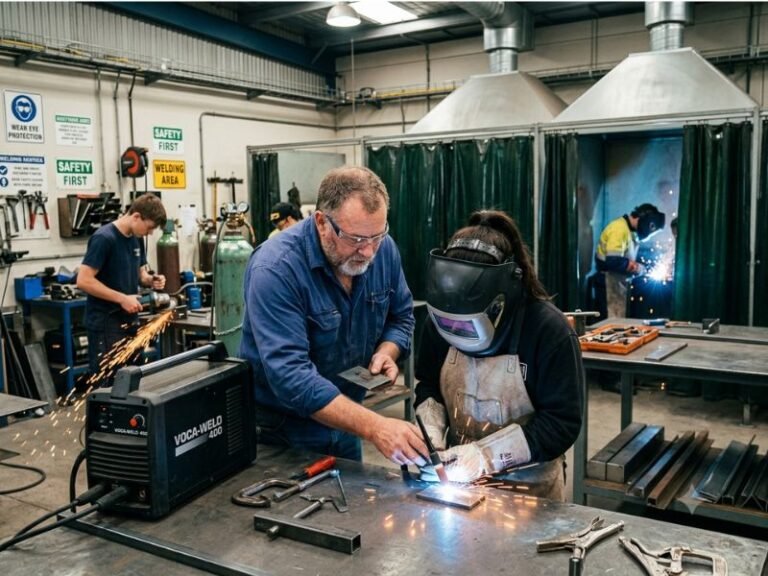
Hands-on practice is the center of welding education. A useful program provides enough booth or shop time for students to prepare metal, set up equipment, weld, inspect the result, identify problems, and repeat the exercise.
Students commonly practice flat, horizontal, vertical, and overhead positions. They may also work on fillet welds, groove welds, lap joints, butt joints, T-joints, corner joints, and pipe configurations. Plate welding often comes first because it allows a student to build control before moving into more demanding pipe or field applications.
Position matters because gravity changes the way molten metal behaves. Vertical and overhead welding require different travel speeds, angles, bead sizes, and heat control than flat welding. Pipe adds another challenge because the welder may need to maintain consistency around a changing position while managing access and visibility.
Practice should progress in stages
- Learn safety, machine controls, and the purpose of each adjustment.
- Practice bead placement on clean plate.
- Perform fillet welds while controlling size and shape.
- Prepare and weld groove joints with attention to penetration and fusion.
- Work in multiple positions and on increasingly complex joint designs.
- Inspect welds, correct defects, and repeat work under time and quality expectations.
Instructor feedback matters throughout this process. A student may see an uneven bead but not understand whether the cause was travel speed, arc length, electrode angle, contamination, or incorrect settings. Timely correction prevents a poor technique from becoming a habit.
Industrial Welding Certifications and Qualifications
A course completion certificate shows that a student attended or completed a program. It does not automatically prove qualification for every welding job. Employers may require a performance qualification test, a procedure-specific test, or a credential connected to a recognized industry organization.
In the United States, certification and qualification requirements vary by employer, project, material, position, process, and governing code. Some jobs follow requirements associated with the American Welding Society, while others may use standards from organizations such as the American Society of Mechanical Engineers, the American Petroleum Institute, or the American Institute of Steel Construction.
A qualification test typically specifies conditions such as:
- Welding process and equipment.
- Base-metal type and thickness.
- Filler metal classification.
- Joint design and backing requirements.
- Welding position.
- Preheat, interpass temperature, and post-weld requirements.
- Visual, bend, tensile, radiographic, ultrasonic, or other examination methods.
A qualification is usually limited to the conditions tested and the rules of the applicable code It is not a universal license to weld every material joint or.
Choosing the Right Training Format
Trade school or technical college
A trade school or community college often offers a broad foundation. Students may receive classroom instruction, shop practice, career support, and exposure to several processes. This option can work well for beginners who want structured progression and access to equipment before entering the workforce.
The main limitations can be program length, tuition, class size, and limited access to advanced pipe or specialized equipment. I would compare actual booth hours with total program hours because a long course is not necessarily a hands-on course.
Union apprenticeship
An apprenticeship combines paid employment with organized instruction. Depending on the trade and local agreement, an apprentice may rotate through job assignments while learning safety, welding processes, tools, and industry practices.
This path can provide valuable jobsite exposure and a clear wage progression. Entry requirements, application schedules, testing, and availability differ by location. Applicants should verify the welding processes used in the apprenticeship and whether the work matches a preferred career direction.
Employer-sponsored training
Some fabricators, contractors, manufacturers, and maintenance companies train entry-level hires internally. Employer training can be highly relevant because it reflects the company’s equipment, materials, procedures, and quality system.
The tradeoff is that the training may be narrow. A worker trained for one production line may have less exposure to pipe, field welding, or other processes. I would ask whether the employer supports outside qualifications and whether the skills transfer to other workplaces.
Short-term intensive programs
Accelerated programs can help a person enter a specific entry-level role quickly. They are most useful when the student already has mechanical experience or has a clear target, such as structural fabrication or MIG production welding.
Short courses have limits. They may not provide enough repetition for difficult positions, and they may not include the theory needed for advanced inspection, pipe work, or code-based fabrication. A fast course should be judged by its practical scope, not simply by its short completion time.
How to Evaluate a Welding School
Before enrolling, I would ask for specific answers rather than relying on promotional language. Important questions include:
- How many supervised shop hours does each student receive?
- Which processes, materials, thicknesses, and positions are taught?
- How many students share each welding booth or machine?
- Are equipment, consumables, protective gear, and testing fees included?
- Are instructors qualified and experienced in the type of work being taught?
- Does the program prepare students for employer or code-based performance tests?
- Are welding procedures current and clearly explained?
- What safety, ventilation, and maintenance practices are used in the shop?
- Does the school provide job placement information without guaranteeing employment?
- Can prospective students observe a class or speak with current students?
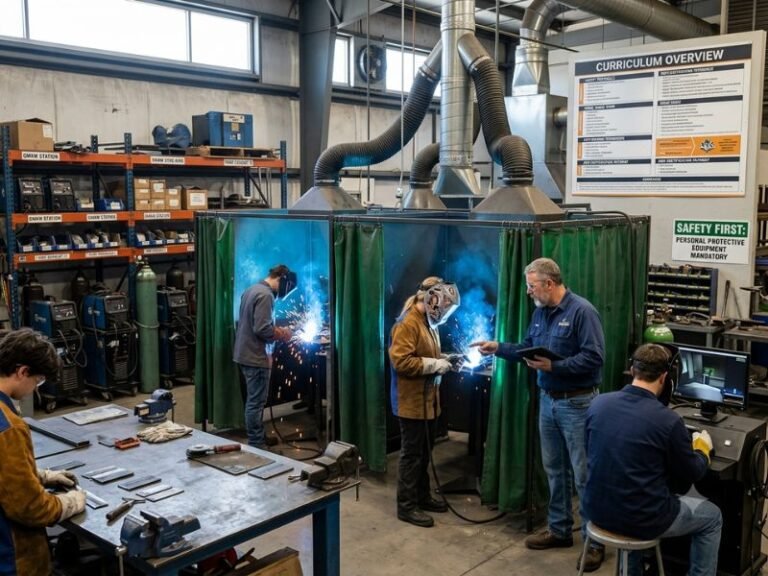
Facility condition provides useful evidence. Organized booths, functioning ventilation, maintained machines, clearly labeled cylinders, clean work areas, and accessible safety equipment suggest that the school takes industrial habits seriously. A neglected shop may still contain talented instructors, but it creates a weaker model for professional practice.
Career Paths After Training
Welding skills apply across several industries, although job titles and requirements vary. Entry-level roles may include welder helper, production welder, fabrication welder, tack welder, welding machine operator, or structural welding trainee.
With additional experience, a welder may move toward:
- Pipe welding in industrial construction, utilities, food processing, or energy-related facilities.
- Structural welding for buildings, bridges, platforms, and heavy steel assemblies.
- Fabrication of machinery, trailers, pressure-related equipment, or industrial components.
- Maintenance and repair welding, where diagnosis and adaptability are especially important.
- Robotic welding setup, programming support, and production quality control.
- Welding inspection, quality assurance, supervision, or instruction.
Career advancement usually depends on more than collecting process names. Employers value reliable attendance, safe work habits, drawing comprehension, measurement skills, troubleshooting, productivity, and the ability to meet documented quality requirements. Additional training in inspection, non-destructive testing, robotics, metallurgy, or supervision can expand options.
Common Mistakes New Welders Make
Choosing a program by price alone
The lowest tuition may not be the lowest total cost. Extra fees, limited shop time, retesting, transportation, and equipment purchases can change the calculation. A slightly more expensive program may offer substantially more practice and testing support.
Confusing appearance with quality
A smooth, shiny bead can still contain lack of fusion, insufficient penetration, or internal defects. Visual appearance matters, but it is only one part of evaluation. Students should learn how inspection methods relate to the intended service of the joint.
Ignoring fit-up and preparation
Many weld problems begin before the arc starts. Incorrect root gap, poor alignment, mill scale, oil, paint, moisture, and inadequate bevel preparation can make a sound weld difficult or impossible. Preparation is part of welding, not a separate chore.
Practicing only one position
Flat welding can build confidence, but industrial work rarely stays within one comfortable position. A student who avoids vertical, overhead, or out-of-position practice may be surprised by the demands of a hiring test.
Relying on settings without understanding them
Machine settings are useful starting points, not universal answers. Material thickness, joint design, electrode or wire type, shielding gas, position, and operator technique all affect the result. Training should teach why a setting changes, not only what number to copy.
Neglecting documentation
Industrial work may involve weld maps, inspection reports, material records, procedure documents, repair notes, and qualification records. A welder who can produce good work but cannot follow or complete required documentation may still struggle in a regulated workplace.
Safety Practices That Training Should Reinforce
Welding safety must be specific to the task and worksite. A training program should teach students to inspect the area, remove or shield combustible materials, verify ventilation, protect nearby workers from arc flash, secure gas cylinders, and inspect equipment before use.
Respiratory exposure deserves careful attention. Local exhaust ventilation and other engineering controls should be considered before depending on a respirator. Students also need to understand that confined spaces can create separate atmospheric and rescue hazards requiring formal procedures.
Electrical safety includes checking insulation, connections, grounding, and machine condition. Wet conditions, damaged leads, and improvised repairs increase risk. Fire watch requirements may apply when hot work occurs near combustible construction or hidden spaces.
Good training makes safe behavior routine rather than treating safety as a lecture completed once. That habit can influence hiring decisions because industrial employers need people who recognize hazards before an incident occurs.
Cost, Time, and Preparation
Training costs vary widely by location, program length, equipment access, testing, and whether the student receives financial assistance. I would create a complete budget that includes tuition, transportation, work clothing, boots, gloves, eye protection, hood or helmet, tools, consumables, examination fees, and lost income during attendance.
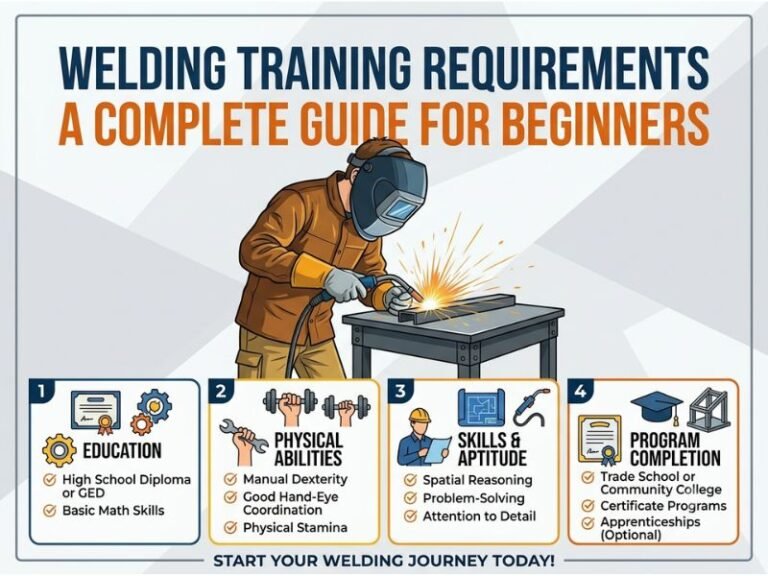
Preparation can improve the value of formal training. Basic measurement practice, mechanical drawing familiarity, hand-tool use, and introductory metalworking knowledge can make the first weeks easier. Physical conditioning also helps because welding may involve awkward positions, lifting, standing, and repetitive movement.
Students should avoid buying expensive equipment before understanding program requirements. Schools may specify approved helmet ratings, lens shades, clothing materials, or tools. Employers may also provide some equipment, while others expect workers to bring a personal kit.
How to Become Job-Ready
A practical job-readiness plan has several parts. First, choose a target such as structural fabrication, production welding, pipe welding, maintenance, or robotic welding. Each path emphasizes different processes, materials, positions, and credentials.
Next, build evidence of competence. This may include completed weld samples, qualification records, course transcripts, safety training, and a concise résumé that identifies processes and positions practiced. A portfolio should be accurate and should never imply qualifications that have not been earned.
Prepare for hiring tests by asking what the employer uses. A test may involve a particular joint, thickness, position, process, or visual standard. Practice under similar conditions while focusing on preparation, fit-up, settings, consistency, and cleanup.
Finally, continue learning after the first job. Industrial welding changes with new materials, automation, inspection requirements, and production methods. Experienced welders still benefit from procedure review, refresher safety training, and deliberate practice when moving into a new application.
Industrial Welding Training FAQ
How long does industrial welding training take?
There is no single standard length. Introductory courses may last several weeks, while comprehensive school programs, apprenticeships, and advanced pipe or structural pathways may take much longer. The necessary time depends on the starting skill level, target process, required positions, and qualification tests.
Is industrial welding training required for an entry-level job?
Some employers hire and train beginners, while others require a school certificate, prior shop experience, or a performance qualification. Formal training improves safety and basic competence, but it does not guarantee employment. Hiring requirements should be checked with employers in the intended local market.
Which welding process should a beginner learn first?
MIG welding is often an accessible starting point in production and fabrication settings, while stick welding is valuable for field and structural work. TIG offers precision but usually requires more patience and fine control. The best first process depends on the local job market and the type of work the student wants to pursue.
Does completing a course make someone a certified welder?
Not necessarily. Course completion and welding certification are different. A certification or qualification may require a specific performance test under an applicable standard. Students should ask whether a program includes recognized testing and exactly what the resulting documentation proves.
Can industrial welding training prepare someone for pipe welding?
It can provide the foundation, but pipe welding usually requires dedicated practice in pipe positions, joint preparation, root control, and process-specific techniques. A general plate course may not provide enough experience for pipe qualification. Look for a program that clearly lists pipe diameter, wall thickness, process, and positions.
What should a student bring to welding school?
Requirements differ, so students should follow the school’s list. Common items include flame-resistant clothing, leather boots, gloves, safety glasses, hearing protection, a welding hood, and basic hand tools. Protective clothing should be selected for the process and hazard rather than fashion or convenience.
Is online-only welding training enough?
Online lessons can explain safety, theory, symbols, metallurgy, and equipment controls, but they cannot replace supervised arc time. Industrial readiness requires physical practice, instructor feedback, joint preparation, and performance evaluation. Online material works best as a supplement to hands-on training.
Conclusion
Industrial welding training is most valuable when it combines repeated hands-on practice with safety drawing interpretation material knowledge equipment control inspection and job-specific qualifications I would choose a.