International Welding Engineer Training: IWE Course & Career
International Welding Engineer training is an advanced engineering-level education pathway that develops knowledge in welding processes, materials, welded-joint design, fabrication, and quality control. Successful candidates who meet the International Institute of Welding (IIW) requirements and pass the required examinations can earn the International Welding Engineer, or IWE, diploma.
Unlike a practical welder course, International Welding Engineer training is designed primarily for engineers and technical professionals who need to understand and manage welding at a higher technical level. The focus is not simply on making welds by hand. Candidates learn how to select processes, evaluate material behavior, understand welded-structure design, manage welding procedures, solve manufacturing problems, and support welding coordination.
IIW describes IWE as its highest welding-coordination qualification. Its current Standard Route includes more than 400 hours of education and practical training together with a structured examination process.
What Is International Welding Engineer Training?
International Welding Engineer training is the education and examination pathway leading to the IIW International Welding Engineer qualification.
The program develops advanced knowledge across four major technical areas:
- Welding processes and equipment
- Materials and their behavior during welding
- Construction and design
- Fabrication and applications engineering
These four modules are specified in IIW’s current 2026 welding-coordination guideline. The curriculum progresses from process fundamentals and metallurgy to design, quality assurance, testing, and engineering case studies.
This makes the IWE substantially different from training intended for a production welder.
A welder primarily needs the practical ability to produce an acceptable joint using a specified procedure. An International Welding Engineer needs a broader understanding of why the process, material, design, and production controls were selected in the first place.
What Is an International Welding Engineer?
An International Welding Engineer is a professional who has completed the applicable IIW education and examination requirements at the IWE level.
IIW describes the IWE as its highest qualification and states that it develops the knowledge needed to address welding-manufacturing issues across different processes, materials, and applications. IWE-qualified personnel can also undertake welding-coordination activities required by various standards and codes when the applicable organizational requirements are met.
That does not mean an IWE diploma is a license to perform every engineering activity in every country. National professional-engineering laws, employer authorization, project requirements, and industry regulations can still apply.
Who Can Take International Welding Engineer Training?
IWE training is primarily intended for people with an appropriate higher-education background.
Typical candidates may include:
- Mechanical engineers
- Materials engineers
- Metallurgical engineers
- Manufacturing engineers
- Welding engineers
- Production engineers
- Quality engineers working with welded fabrication
IIW’s current public guidance describes access as being at postgraduate level, with a primary engineering degree given as a typical example. The detailed 2026 guideline defines mandatory access conditions that Authorized Nominated Bodies must apply.
The current guideline recognizes appropriate higher-education routes at ISCED Levels 6 and 7 and provides detailed conditions concerning the candidate’s technical educational background.
Because eligibility can depend on the exact degree and national education system, candidates should have their qualifications checked by the relevant IIW Authorized Nominated Body before enrolling.
Where Do You Take IWE Training?
Candidates should take approved IWE education through the IIW qualification network.
IIW uses two important types of organizations:
Authorized Nominated Bodies (ANBs) administer qualification activities, examinations, assessment, and the issuing of IIW diplomas within their authorized scope.
Approved Training Bodies (ATBs) provide the training that prepares candidates for IIW qualifications. ANBs authorize and oversee ATBs under the IIW system.
IIW advises candidates to enroll through an authorized training body. It also provides lists of ANBs so prospective students can identify the appropriate organization for their country or training location.
This authorization matters because taking an unrelated commercial course called “welding engineering” does not automatically make it an IIW IWE program.
How Is International Welding Engineer Training Structured?
Under the current 2026 IIW guideline, the Standard Route includes 449 contact hours at IWE level. Of those, 60 hours are allocated to fundamental practical skills. IIW defines a contact hour as at least 50 minutes of direct teaching time.
The IWE route is divided into stages.
The current route diagram identifies:
- IWE Part 1
- IWE Part 2
- IWE Part 3
- Intermediate examination
- Final examination
- Written and oral examination components
Part 2 contains 60 hours of fundamental practical skills, while Part 3 accounts for a substantial portion of the advanced technical education.
The calendar length can vary because an ATB may offer the program full-time, part-time, or with permitted distance-learning components. IIW’s public IWE information confirms that some training may be delivered partly through distance learning.
Module 1: Welding Processes and Equipment
The first major IWE module covers welding processes and equipment.
It includes conventional welding and cutting processes along with advanced welding technologies.
An engineer studying this module needs to understand more than the operating steps of a welding machine. The emphasis is on how process characteristics affect manufacturing decisions.
Topics can include:
- Arc welding fundamentals
- Welding power sources
- SMAW
- GMAW
- GTAW
- FCAW
- Submerged Arc Welding
- Resistance welding
- Cutting processes
- Advanced joining technologies
- Process parameters
- Equipment selection
At IWE level, IIW expects advanced understanding and the ability to evaluate process suitability and potential manufacturing problems. Its 2026 curriculum also includes advanced processes such as laser, electron-beam, plasma, friction-based, and other specialized joining technologies.
Module 2: Materials and Their Behavior During Welding
Material behavior is a major part of welding engineering because welding subjects a component to localized heating and cooling.
The current IWE curriculum includes metallic materials, steels and their weldability, fracture, corrosion, wear, structural and high-strength steels, and materials other than steel.
Students therefore study subjects such as:
- Weldability
- Heat-affected zones
- Metallurgical transformations
- Cracking mechanisms
- High-strength steels
- Stainless and heat-resistant steels
- Dissimilar-material joining
- Heat treatment
- Corrosion
- Fracture behavior
The aim is to understand how the selected welding procedure can influence the properties and service performance of a welded component.
For example, changing heat input is not simply a question of making the weld easier to deposit. An engineer may need to consider microstructure, hardness, distortion, residual stress, toughness, and the requirements of the material or product standard.
Module 3: Construction and Design
The third module is Construction and Design, with the current IIW curriculum specifically including design for welding and brazing.
This section connects welding technology with engineering design.
Subjects may involve:
- Welded-joint configuration
- Weld sizing
- Load transfer
- Structural behavior
- Stress concentration
- Fatigue
- Fracture considerations
- Design for manufacturability
- Brazed and welded joint design
A welding engineer needs to recognize that a joint can be easy to draw but difficult or expensive to manufacture.
Good welding-oriented design therefore considers access, process capability, material behavior, inspection, distortion, welding sequence, and production cost before fabrication begins.
Module 4: Fabrication and Applications Engineering
The fourth module focuses heavily on manufacturing and quality.
The 2026 IIW curriculum lists:
- General quality-management principles
- Quality assurance and quality control of welded joints
- Tests used for quality control
- Engineering case studies
This part of the course is particularly relevant to welding coordination because real production requires engineers to connect drawings, materials, procedures, personnel, equipment, inspection, and documentation.
Students learn to evaluate welding as a complete manufacturing system rather than an isolated workshop operation.
What Practical Training Is Included?
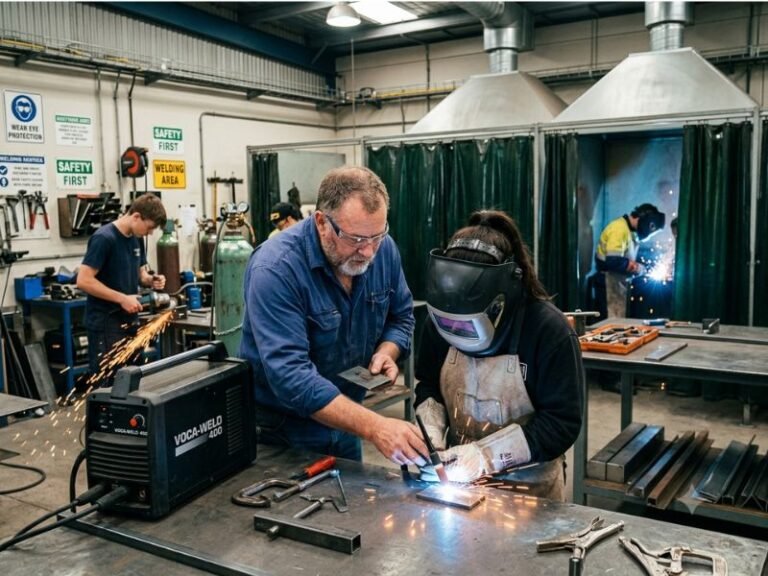
IWE is an engineering qualification, but the program still includes practical welding exposure.
The current Standard Route assigns 60 contact hours to fundamental practical skills.
The purpose is not necessarily to turn the engineer into a production welder.
Instead, practical training helps the candidate understand how welding variables behave in actual operation. An engineer who has seen the effects of poor torch positioning, incorrect travel, unsuitable parameters, joint preparation, or shielding problems can connect classroom theory with production reality more effectively.
Practical work may expose students to several welding and cutting processes, equipment configurations, joint-preparation methods, and common process limitations according to the approved syllabus and training facility.
Welding Procedures and Qualification
Welding procedure control is another important part of engineering-level welding work.
An IWE should understand the relationship among documents and activities such as:
- Welding Procedure Specifications
- Procedure qualification
- Welder and welding-operator qualification
- Base materials
- Filler materials
- Welding variables
- Inspection
- Production control
IIW describes welding coordinators as having responsibilities that can include reviewing requirements, establishing working procedures, selecting suitable welding personnel, and dealing with WPSs and procedure-qualification records.
The engineer does not simply ask whether a weld “looks good.” The more important question is whether the manufacturing process satisfies the technical requirements established for the product.
Quality Control and Weld Testing
The IWE curriculum includes quality assurance, quality control, and testing of welded joints.
That can include understanding the role and limitations of:
- Visual testing
- Penetrant testing
- Magnetic particle testing
- Ultrasonic testing
- Radiographic testing
- Destructive mechanical tests
- Acceptance criteria
At IWE level, the objective is to understand when and why appropriate testing may be needed and how inspection fits into the overall quality plan.
The IWE diploma itself should not be confused with separate personnel certification for a particular nondestructive-testing method.
Welding Coordination and ISO 14731
One major reason professionals pursue IWE training is welding coordination.
IIW states that its welding-coordination qualifications are designed to support competence required by ISO 14731 and other global standards and codes.
Welding-coordination responsibilities can include technical matters related to:
- Requirements review
- Material selection
- Welding procedures
- Welder qualification
- Consumables
- Equipment
- Production planning
- Inspection
- Repairs
- Quality documentation
The exact responsibilities assigned to an individual still depend on the manufacturer, product standard, contract, and applicable quality system.
How Many Exams Are Required for IWE?
IIW’s current public IWE information states that candidates following the Standard Route must pass four qualification examinations.
The current 2026 guideline also shows an intermediate examination in the training route and final written and oral examination stages. Students must successfully pass the intermediate requirement before progressing through the subsequent stages under the applicable route.
Because examination administration is handled through the IIW ANB system, candidates should use the current instructions supplied by their ANB or ATB rather than relying on old online exam descriptions.
IWE Diploma vs. IWE Certification
Qualification and certification are related concepts within the IIW system, but they should not be used as though they always mean exactly the same thing.
The IWE education and examination route results in an IIW qualification diploma when the requirements are successfully completed. IIW also operates separate personnel-certification systems within its broader international framework.
An IWE diploma also does not automatically replace:
- National professional-engineering licensure
- Employer authorization
- Project-specific competency requirements
- Separate inspection certifications
- NDT personnel certification
Those requirements depend on the work and jurisdiction.
IWE vs. IWT vs. IWS
IIW provides several welding-coordination qualification levels.
IWE — International Welding Engineer: the highest IIW qualification level for this pathway, with advanced engineering-level knowledge.
IWT — International Welding Technologist: a separate qualification with its own access requirements, syllabus depth, and responsibilities.
IWS — International Welding Specialist: focuses on specialized welding-technology knowledge and the supervision of more common or standard welding applications.
IIW also provides the International Welding Practitioner level.
The right qualification depends on educational background and the level of welding responsibility required by the candidate’s intended role. IIW’s system applies different access and education requirements at each level.
What Skills Should You Have After IWE Training?
After successfully completing the IWE pathway, a candidate should have developed the technical foundation to address welding issues at an advanced engineering level.
Important capabilities include:
- Evaluating welding processes
- Understanding weldability and metallurgy
- Assessing welding-related material problems
- Understanding welded-joint design
- Interpreting welding procedures
- Supporting procedure qualification
- Understanding personnel qualification
- Evaluating quality-control requirements
- Understanding inspection and testing
- Supporting welding coordination
- Analyzing fabrication problems
- Comparing technical manufacturing solutions
The IIW describes the IWE knowledge level as suitable for solving welding-manufacturing problems across processes, materials, and applications.
Where Can International Welding Engineers Work?
IWE knowledge can be relevant wherever welded products require substantial engineering, manufacturing, and quality control.
Possible fields include:
- Structural fabrication
- Pressure equipment
- Piping
- Heavy manufacturing
- Transportation equipment
- Shipbuilding
- Welding quality management
- Manufacturing engineering
- Technical consulting
- Research and development
The qualification is deliberately broad rather than tied to one welding process or industry. IIW states that IWE education develops knowledge across processes, materials, design, quality control, and welding manufacturing applications.
Frequently Asked Questions
What Is International Welding Engineer Training?
International Welding Engineer training is the IIW education and examination pathway that develops advanced knowledge in welding processes, materials, design, fabrication, and quality control. Successful completion of the applicable requirements leads to the IWE qualification diploma.
What Does IWE Stand For?
IWE stands for International Welding Engineer. It is the highest welding-coordination qualification offered by the International Institute of Welding.
Do You Need an Engineering Degree for IWE Training?
IWE has higher-education access requirements. IIW describes entry as postgraduate-level and identifies an engineering degree as a typical route. The detailed 2026 rules use defined ISCED education levels and technical-background requirements, so eligibility should be confirmed with the appropriate ANB.
How Many Hours Is IWE Training?
The current 2026 Standard Route specifies 449 contact hours for IWE, including 60 hours of fundamental practical skills. Course schedules can still vary between approved providers.
How Many Exams Are Required for the IWE Diploma?
IIW’s public IWE information states that Standard Route candidates must pass four qualification exams. The current guideline also includes intermediate and final examination stages, with written and oral elements in the route structure.
Can IWE Training Be Completed Online?
Not necessarily in its entirety. IIW states that IWE training may be offered partially through distance learning. Approved delivery arrangements depend on the IIW qualification system and the training provider.
Is an IWE a Certified Welder?
No. IWE is an engineering-level welding qualification. A production welder’s qualification demonstrates practical welding ability under specified test conditions, while IWE training focuses on advanced welding technology and coordination.
Is an IWE Diploma the Same as a Professional Engineer License?
No. The IWE diploma is an IIW welding qualification. Professional engineer licensing or registration is governed separately by the applicable country or jurisdiction.
Conclusion
International Welding Engineer training provides advanced education for engineers who need to understand welding as a complete manufacturing technology rather than only as a hands-on joining process. The curriculum connects welding processes and equipment with materials, metallurgy, welded-joint design, fabrication, quality assurance, testing, and welding coordination.
Under the current 2026 IIW Standard Route, IWE education totals at least 449 contact hours, including 60 hours of fundamental practical training, followed by the applicable examination requirements. Candidates must also satisfy the IIW access conditions and complete the qualification through the authorized IIW system.
For engineers working toward greater responsibility in welded manufacturing, the value of the IWE pathway is its breadth. It develops the ability to connect process selection, material behavior, design, production, inspection, and quality requirements—a combination of skills that is central to advanced welding engineering and welding-coordination work.