Certified Welding Instructor Training: Skills, Exams & Careers
Certified Welding Instructor training prepares experienced welding professionals to teach welding theory, demonstrate practical techniques, manage a safe welding lab, evaluate student work, and prepare trainees for industry qualification tests. In the United States, an important terminology distinction is that the American Welding Society’s formal educator credential is called Certified Welding Educator (CWE) rather than “Certified Welding Instructor.”
For someone searching for Certified Welding Instructor training, the AWS CWE pathway is therefore one of the main credentials worth understanding. Good instructor preparation combines welding knowledge with teaching methods, safety management, curriculum planning, inspection skills, Welding Procedure Specification interpretation, and objective student assessment. AWS also offers separate Train the Trainer instruction specifically for welding educators who want to improve classroom and shop-teaching skills.
What Is Certified Welding Instructor Training?
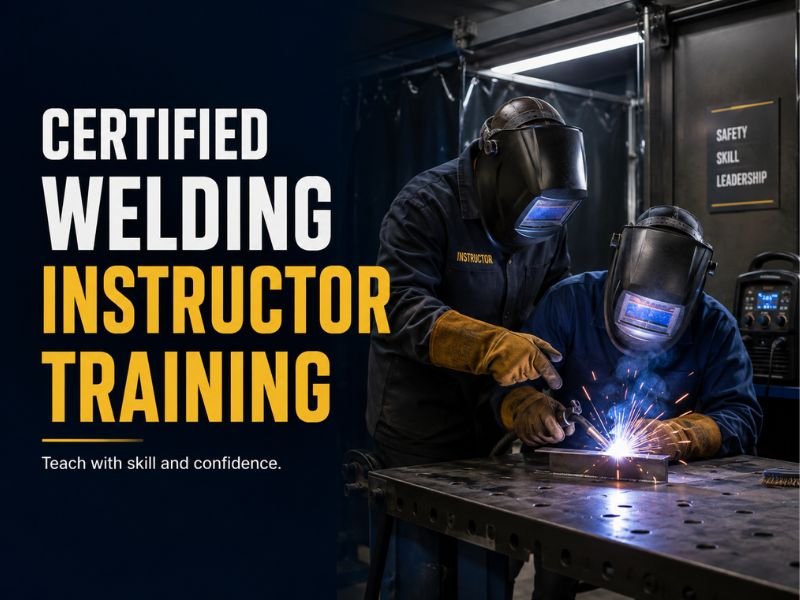
Certified Welding Instructor training is professional development designed to help a knowledgeable welder become an effective welding teacher or trainer.
A skilled production welder may know how to make a sound weld but still need additional training to explain the process clearly, diagnose a student’s technique, build a lesson plan, grade work consistently, and manage a welding lab safely.
Instructor preparation can cover:
- Welding theory
- Welding processes
- Teaching methods
- Curriculum development
- Welding safety
- Welding symbols
- Blueprint reading
- Weld inspection
- WPS and PQR basics
- Student assessment
- Qualification-test preparation
AWS’s current Certified Welding Educator program covers instructional strategies, curriculum design, classroom management, welding processes, welding symbols, technical drawings, metallurgy, and material science.
Is “Certified Welding Instructor” an AWS Certification?
Not under that exact credential name.
AWS currently offers the Certified Welding Educator (CWE) certification for welding instructors, trainers, and educators. AWS describes the credential as a way to validate a professional’s ability to teach welding principles, safety procedures, and practical techniques.
This distinction matters when searching for training or applying for a credential.
A school or employer may use titles such as:
- Welding instructor
- Welding trainer
- Welding teacher
- Welding educator
- Technical welding instructor
Those job titles do not automatically mean the person holds an AWS CWE credential.
Likewise, an experienced welder can work as an instructor where an employer permits it without necessarily holding AWS educator certification. Hiring requirements depend on the institution and position.
Who Should Take Welding Instructor Training?
Instructor training is most useful for people who already have substantial welding knowledge and want to teach others.
That may include:
- Experienced welders
- Welding supervisors
- Fabrication trainers
- Apprenticeship instructors
- Technical-school instructors
- Community-college welding faculty
- Corporate welding trainers
- Welding professionals transitioning into education
AWS specifically positions its CWE credential for current instructors as well as experienced welders who want to move into teaching.
Do You Need Welding Experience?
For the AWS CWE credential, yes.
AWS currently lists a high school diploma or equivalent, completion of welding training or equivalent education, and a minimum of five years of experience related to welding codes or standards among its eligibility requirements. Relevant experience can include production, construction, inspection, and weld repair work.
That requirement makes practical sense. An instructor needs enough process experience to explain not only what students should do, but why a weld changes when technique, settings, material condition, or fit-up changes.
What Do You Learn in Welding Instructor Training?
Welding instructor education combines technical and instructional skills.
A strong program should develop the ability to teach rather than simply test whether an experienced welder can still make a bead.
Important subjects include:
- Instructional techniques
- Lesson planning
- Classroom management
- Welding-process theory
- Safety procedures
- Equipment operation
- Welding metallurgy
- Symbols and drawings
- Inspection
- Student evaluation
AWS’s current CWE program specifically identifies teaching techniques, curriculum design, classroom management, SMAW, GMAW, GTAW, FCAW, welding symbols, drawings, metallurgy, and material science among the knowledge areas for educators.
Welding Processes an Instructor Should Understand
An instructor does not necessarily need to teach every welding process, but multi-process knowledge can be valuable in a broad welding program.
AWS’s Train the Trainer course currently includes practical instruction across SMAW, FCAW, GMAW, and GTAW.
Shielded Metal Arc Welding
SMAW, commonly called stick welding, requires the instructor to explain subjects such as electrode selection, amperage, polarity, arc length, electrode angle, travel speed, slag removal, and welding positions.
Students often struggle because the electrode becomes shorter while welding, forcing them to continually maintain correct arc length.
Gas Metal Arc Welding
GMAW or MIG instruction typically involves:
- Voltage
- Wire-feed speed
- Shielding gas
- Gun angle
- Travel speed
- Contact-tip distance
The instructor needs to help students understand how machine settings and gun technique interact rather than encouraging them to memorize one group of settings.
Flux-Cored Arc Welding
FCAW adds subjects such as tubular electrodes, slag control, shielding method, wire feeding, and interpass cleaning.
Students also need to understand that self-shielded and gas-shielded FCAW are not identical processes from an operating standpoint.
Gas Tungsten Arc Welding
GTAW or TIG requires precise torch, heat, and filler-metal control.
Teaching GTAW can involve explaining tungsten preparation, arc length, shielding gas, torch angle, filler placement, cleanliness, and heat control.
AWS educator training currently covers all four of these major processes.
Teaching Welding Theory
Good instructors connect hands-on technique with the science behind the weld.
Students should understand basic concepts such as:
- Current
- Voltage
- Polarity
- Heat input
- Penetration
- Fusion
- Filler-metal selection
- Shielding
- Heat-affected zones
The instructor does not need to turn every booth session into an engineering lecture. However, students should understand why a parameter change affects the weld.
For example, telling a student to reduce amperage may correct a problem once. Explaining how excessive heat is affecting the weld helps the student diagnose similar problems independently later.
Teaching Hands-On Welding Skills
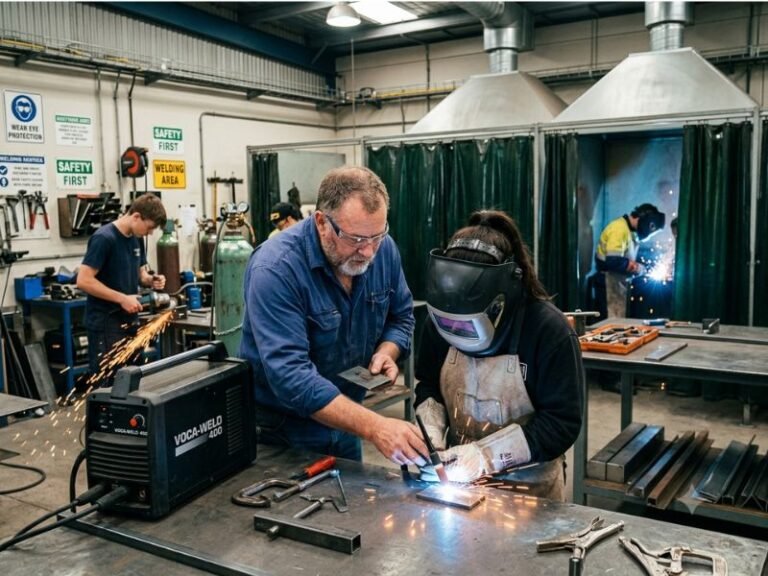
Demonstration ability is one of the most important differences between a welding instructor and a classroom-only teacher.
An instructor may need to demonstrate:
- Equipment setup
- Arc starting
- Electrode or torch angle
- Travel speed
- Puddle control
- Starts and stops
- Tie-ins
- Multi-pass welding
The best demonstrations break a technique into observable steps.
Instead of simply making a good weld and asking students to copy it, an instructor can explain what to watch for at the leading edge of the puddle, how body position affects travel, and which visual signs indicate that the technique needs adjustment.
AWS’s Train the Trainer program combines classroom instruction with hands-on shop training specifically to develop this kind of instructional ability.
Welding Safety Instruction
Safety is a central responsibility for anyone teaching welding.
OSHA identifies welding hazards including exposure to metal fumes and ultraviolet radiation as well as burns, eye damage, electrical shock, cuts, and crushing injuries. OSHA notes that many of these hazards can be controlled through proper work practices and personal protective equipment.
Personal Protective Equipment
Students need instruction in selecting and using appropriate:
- Welding helmets
- Eye protection
- Gloves
- Protective clothing
- Safety footwear
- Hearing protection where required
The instructor also needs to enforce safe practices consistently rather than treating PPE as optional when students are performing short practice welds.
Fumes and Ventilation
Welding fumes vary with the process, electrode, material, coatings, and work environment.
Students should learn to recognize that visible smoke is not the only indicator of an exposure concern and that adequate ventilation or other controls may be required. OSHA specifically addresses welding-fume and radiant-energy hazards in its welding safety guidance.
Electrical and Fire Hazards
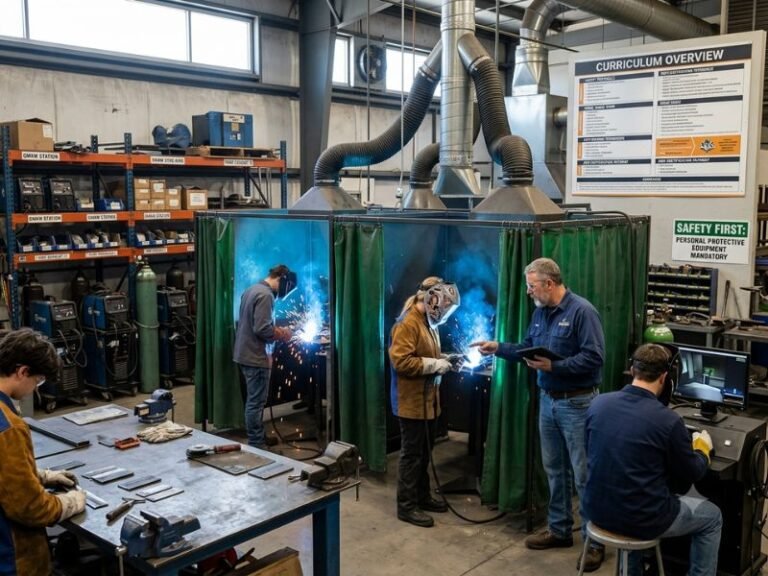
Welding labs contain power sources, cables, hot metal, sparks, compressed gases, grinders, and other equipment.
Instructor training therefore needs to include shop organization, equipment condition, hot-work awareness, and emergency procedures.
AWS’s Train the Trainer course currently includes welding safety and shop-safety orientation as part of educator preparation.
Teaching Welding Symbols and Blueprint Reading
A student who can make a good weld still needs to know where the weld belongs and what the drawing requires.
Instructor training may therefore include:
- Fillet-weld symbols
- Groove-weld symbols
- Arrow-side and other-side information
- Weld dimensions
- Joint location
- Basic blueprint interpretation
AWS includes welding symbols, blueprints, and technical drawings within its CWE program content.
Connecting drawing interpretation to actual shop exercises makes the training more realistic. Instead of simply welding two pieces of plate together, students can learn to read the specified joint and then produce it.
Understanding Welding Procedure Specifications
A welding instructor should also be comfortable explaining a Welding Procedure Specification, or WPS.
A WPS can control variables such as:
- Welding process
- Base metal
- Filler metal
- Joint design
- Position
- Current
- Voltage
- Polarity
- Preheat
- Other procedure requirements
Teaching students to follow a WPS helps them understand that production welding is not simply a matter of selecting whatever settings feel comfortable.
WPS and PQR application is also part of the practical preparation associated with AWS’s CWE examination pathway.
Weld Inspection Skills for Instructors
An instructor must be able to evaluate student work consistently.
Visual inspection may include checking:
- Weld size
- Bead profile
- Undercut
- Porosity
- Cracks
- Reinforcement
- Joint alignment
- Overall consistency
Instructor training may also involve the use of weld gauges and other basic inspection tools.
AWS’s CWE Part B preparation specifically includes WPS/PQR application, inspection tools, and realistic weld replicas used for practical examination training.
An instructor does not automatically become a qualified NDT technician or code inspector simply by learning basic inspection. Those are separate professional roles with their own requirements.
Curriculum and Lesson Planning
Teaching welding effectively requires a logical progression.
A beginner course might move from:
Basic safety → equipment setup → bead practice → joints → positions → multi-pass welds → testing.
Trying to introduce difficult pipe welding before students can control a simple weld pool usually creates unnecessary frustration.
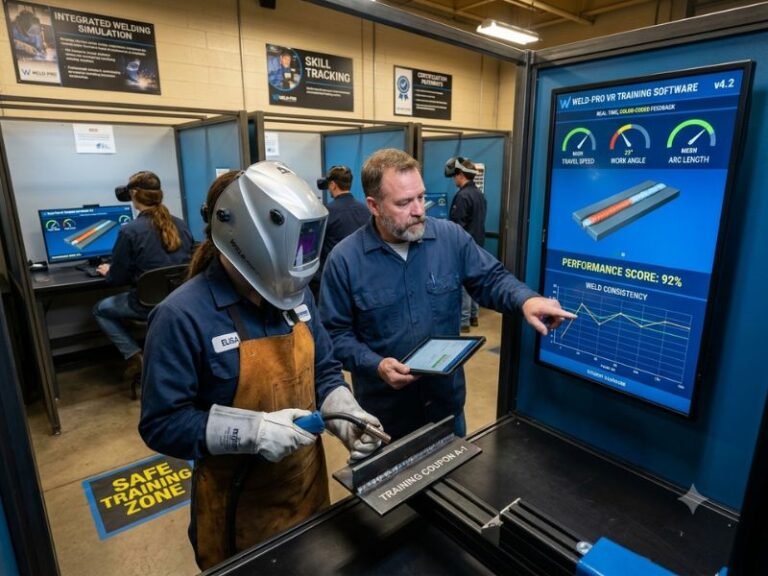
Instructor development therefore includes setting learning objectives, organizing lessons, balancing theory with booth practice, and determining how skills will be assessed.
AWS’s current educator programs specifically include curriculum development, lesson planning, instructional strategies, and classroom management.
Student Assessment and Feedback
Welding students need more useful feedback than “good weld” or “bad weld.”
Effective feedback identifies:
- What is wrong.
- What probably caused it.
- What the student should change.
- What improvement should look like.
For example, if a bead has undercut, the instructor should evaluate travel speed, heat, arc placement, and technique rather than simply telling the student to slow down without explanation.
Objective grading also matters when multiple instructors teach the same program. Clear weld criteria help students receive consistent expectations regardless of who evaluates their work.
Preparing Students for Welding Qualification Tests
Many welding students eventually need to complete a welder performance qualification test.
Instructor preparation can therefore include:
- Test-coupon preparation
- WPS compliance
- Joint fit-up
- Welding positions
- Visual acceptance
- Bend-test concepts
- Qualification documentation
AWS’s Train the Trainer program specifically includes preparation of trainees for welder performance qualification examinations.
An instructor should be careful not to promise that completing a welding course automatically makes a student certified. Training prepares the student; the applicable qualification or certification process determines whether the test results produce a credential.
AWS Certified Welding Educator Exam
As of August 2026, AWS states that CWE candidates must pass two of the three examinations associated with the CWI examination system: Part A and Part B.
Part A – Fundamentals
AWS lists Part A as a 150-question examination covering subjects that include welding safety, metallurgy, destructive testing, welding symbols, and other welding fundamentals. CWE candidates must currently score at least 60% on the required exam parts.
Part B – Practical
The practical portion evaluates the candidate’s ability to apply WPSs and PQRs, use inspection tools, and work with practical weld-inspection material.
Is Part C Required?
Not for the CWE credential alone under current AWS requirements.
AWS states that the Part C Code Book exam is not required for CWE certification. Candidates pursuing both CWE and CWI need to meet the additional CWI examination requirements.
CWE vs. CWI
The Certified Welding Educator and Certified Welding Inspector credentials serve different primary purposes.
A CWE focuses on welding education and training.
A CWI focuses on welding inspection and code-related quality verification.
The current CWI program requires Parts A, B, and C and a minimum score of 72% on each examination section.
Someone can pursue both credentials if they meet the applicable requirements, but holding one should not be described as automatically granting the other.
How Long Does Welding Instructor Training Take?
There is no universal duration because instructor preparation can refer to several different training paths.
For current AWS options, the CWE Part A Fundamentals pre-seminar is a self-paced program with approximately 80 hours of content, while Part B preparation is offered as a three-day in-person practical seminar.
AWS also offers a separate Train the Trainer Welding Educator program lasting approximately 40 hours over five days. That course focuses on teaching methods, curriculum development, safety, and hands-on instruction across multiple welding processes.
These are separate programs rather than one mandatory universal instructor-training sequence.
How Long Does the AWS CWE Credential Last?
AWS currently states that the CWE credential is valid for four years.
For renewal, the holder must complete the renewal process and affirm two years of activity in welding education or related work during the certification period. AWS currently states that CWE requires renewal rather than a separate recertification cycle.
Because credential policies can change, instructors preparing an application or renewal should always check the current AWS requirements rather than relying on older course material.
Where Can Welding Instructors Work?
Welding educators can work in a variety of training environments, including:
- High schools
- Career and technical education programs
- Community colleges
- Trade schools
- Apprenticeship programs
- Private welding schools
- Manufacturing facilities
- Employer training departments
The specific academic credentials, teaching licenses, welding qualifications, or certifications required can vary by employer and education system.
Frequently Asked Questions
What Is Certified Welding Instructor Training?
Certified Welding Instructor training develops the technical, instructional, safety, inspection, and assessment skills needed to teach welding effectively. In AWS terminology, the formal educator certification is the Certified Welding Educator credential.
Is Certified Welding Instructor an AWS Certification?
AWS does not currently list a professional credential with that exact name. Its formal welding-instructor credential is Certified Welding Educator (CWE).
What Welding Processes Should an Instructor Know?
The required processes depend on the program being taught. AWS educator training currently covers SMAW, FCAW, GMAW, and GTAW, making these useful core processes for instructors in broad welding programs.
How Much Experience Do You Need for AWS CWE?
AWS currently requires a minimum of five years of qualifying welding-related experience along with the specified education requirements. Candidates should verify the latest eligibility documentation before applying.
Is the CWE Exam the Same as the CWI Exam?
Not completely. Current CWE candidates need Parts A and B, while CWI candidates must pass Parts A, B, and C. The required passing scores also differ between the two credentials.
How Long Does Certified Welding Instructor Training Take?
There is no single duration. AWS currently offers an 80-hour self-paced CWE Fundamentals program, a three-day Part B practical seminar, and a separate approximately 40-hour Train the Trainer program.
Can a CWI Become a Welding Instructor?
Yes, a CWI can work toward an instructional role if the employer’s requirements are met. However, CWI is primarily an inspection credential, while CWE is the AWS certification specifically focused on welding education.
Does a Welding Instructor Need to Be a Certified Welder?
Requirements depend on the employer, institution, and credential being pursued. Strong practical welding ability is highly valuable because instructors may be expected to demonstrate processes and evaluate student technique.
Conclusion
Certified Welding Instructor training develops the combination of welding knowledge and teaching ability required to train welders effectively. For professionals interested in an AWS credential, the formal certification to understand is the Certified Welding Educator (CWE) rather than a credential literally named Certified Welding Instructor.
Effective instructor preparation covers welding processes, classroom and shop teaching, safety, symbols and drawings, WPS interpretation, inspection, curriculum design, student assessment, and preparation for welder performance tests. AWS’s current CWE and Train the Trainer programs reflect this combination of technical and instructional skills.
Being able to weld well is an important foundation, but teaching requires another skill set. A capable instructor must be able to explain cause and effect, identify why a student’s weld is failing, demonstrate a correction safely, and evaluate improvement consistently. For experienced welders who want to move into technical education, apprenticeship instruction, or industrial training, developing those teaching skills is the central purpose of Certified Welding Instructor training.