Spot Welding Training: Skills, Costs, Certification, Careers
Spot Welding training teaches students and manufacturing professionals how to create localized welds by applying electrical current and pressure through two electrodes. The process is used extensively in automotive production, appliance manufacturing, sheet-metal fabrication, aerospace, electronics, and automated assembly.
Spot welding may appear simple because a machine can complete a weld in a fraction of a second. Reliable production, however, depends on much more than placing two sheets between electrodes and pressing a control. Operators and technicians must understand electrode force, welding current, cycle timing, material coatings, part fit-up, cooling, equipment safety, and quality testing.
In this guide, I will explain what professional training should include, how long courses may take, what they can cost, how certification works, and how to compare programs in the United States. The goal is to help beginners, operators, technicians, and manufacturing employees understand the skills needed to produce consistent resistance spot welds.
What Is Spot Welding?
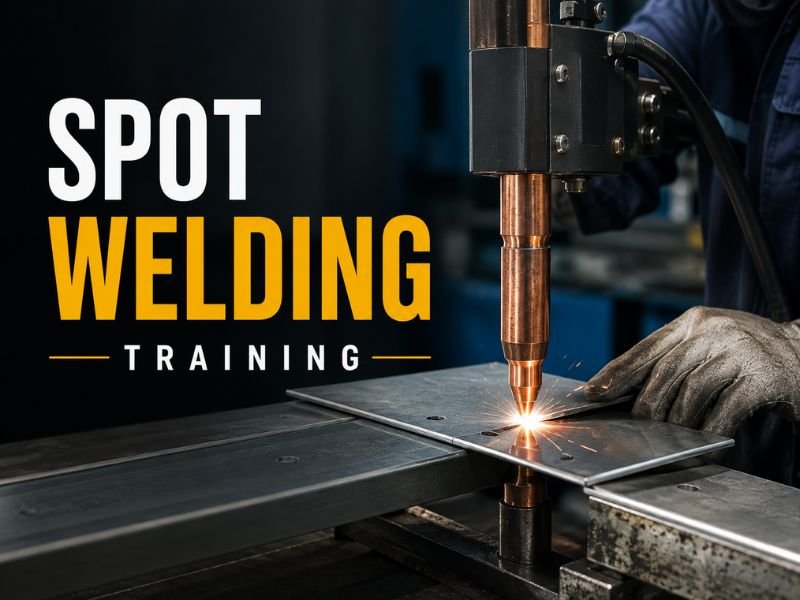
Spot welding is a type of resistance welding that joins overlapping metal components at individual points. Two electrodes clamp the parts together and pass a high electrical current through the contact area. Resistance within the materials and their interfaces generates concentrated heat, creating a small molten region known as the weld nugget.
The electrodes continue applying force while the nugget cools and solidifies. This combination of heat, pressure, and time creates the joint. Most common applications do not require filler wire, flux, or shielding gas.
The process is particularly useful for sheet-metal assemblies because welds can be produced quickly and repeated at accurately controlled locations. A vehicle body, metal cabinet, appliance housing, or industrial enclosure may contain many spot welds completed manually, with a stationary machine, or by robotic equipment.
Why Learn Resistance Spot Welding?
Resistance spot welding is one of the most important joining methods in high-volume manufacturing. Its short cycle time makes it suitable for repetitive production, while modern controls allow manufacturers to monitor current, time, force, displacement, and other variables.
Training is valuable for more than machine operators. Maintenance technicians must understand electrical, mechanical, pneumatic, hydraulic, and cooling systems. Quality personnel need to recognize process variation and evaluate welded samples. Engineers and supervisors must understand weld schedules, materials, tooling, and production limits.
The process also connects welding knowledge with automation. Even when robots control movement, trained people must validate the process, inspect equipment, respond to alarms, and investigate defects.
How Does Spot Welding Work?
A typical spot-welding machine includes a power source, transformer, welding control, electrodes, force system, cooling circuit, and fixture or work support.
The machine converts incoming power into low-voltage, high-current output. When the electrodes close, current flows through the workpieces and heat concentrates at their interface.
The resulting joint is affected by three central variables: welding current, current-flow time, and electrode force. These variables interact. Increasing one setting does not automatically improve the weld because the others, along with material condition and electrode geometry, also influence the result.
The Welding Cycle
The basic machine sequence includes squeeze time, weld time, hold time, and off time.
During squeeze time, the electrodes close and establish force before current begins. Weld time is the interval during which welding current flows. Hold time maintains pressure after the current stops so the nugget can cool and solidify. Off time separates cycles during repetitive production.
Modern controllers may add preheat, multiple pulses, or adaptive functions, but students should understand the basic cycle first.
Welding Current
Current provides the energy needed to form the weld nugget. If current is too low, the joint may be small or weak. If it is too high, molten metal may be expelled from the interface, electrodes may stick, or the part surface may be damaged.
A good training program teaches students to work from validated schedules and approved adjustment limits. Randomly increasing current to compensate for worn electrodes or poor fit-up may temporarily change the result without correcting the real problem.
Electrode Force
The electrodes do more than carry current. They clamp the parts, establish contact, contain the molten metal, and help shape the joint as it cools.
Insufficient force can contribute to unstable contact, excessive heating, or metal expulsion. Excessive force may reduce interface resistance, deform the workpieces, or require a different energy level to form the required nugget.
Technicians should learn how force is measured. Air pressure alone does not always reveal the actual force at the electrode tips because machine friction, alignment, tooling weight, and component wear can influence the result.
What Does Spot Welding Training Include?
A complete Spot Welding training program should combine process theory, safe equipment operation, practical machine setup, electrode maintenance, weld testing, and structured troubleshooting. The depth should match the learner’s job.
Operators need approved controls, safe loading, routine inspections, and quality checks. Setup and maintenance personnel require deeper instruction in weld schedules, force verification, tooling, cooling, controls, and process variation.
Equipment Identification and Setup
Students should learn the functions of the transformer, welding control, electrodes, arms, cables, force system, cooling lines, fixtures, and emergency devices. They also need to understand how machine configuration affects access and current flow.
Spot welders may be stationary machines, portable guns, robotic systems, or specialized production equipment using pneumatic, hydraulic, or servo-electric force.
Training should include pre-use inspection, safe startup, approved schedule selection, part positioning, trial-weld procedures, and controlled shutdown. Machine-specific instruction is important because control interfaces and safety systems vary.
Electrode Materials and Tip Geometry
Electrodes must carry high current, apply force, remove heat, and resist deformation. Copper alloys are common because they combine conductivity with suitable strength, although electrode selection depends on the workpiece and application.
Electrode face diameter and shape affect current density, indentation, nugget formation, and access to the joint. Misaligned tips may produce uneven force and irregular welds.
As electrodes complete repeated cycles, their faces can mushroom, pit, wear, or pick up material from coated sheets. This changes the contact area and can gradually shift the welding process. Students should learn how to inspect, dress, align, replace, and document electrodes according to the approved maintenance plan.
Cooling-System Operation
Many spot-welding systems use water to cool electrodes, transformers, cables, and welding guns. Adequate flow helps control electrode temperature and extends component life.
Restricted flow, clogged passages, damaged hoses, or excessive water temperature can lead to rapid tip wear and inconsistent welding. Leaks may also affect electrical equipment or create slip hazards.
Technician training should include flow checks, hose routing, water quality, temperature, and cooling-alarm response.
Spot Welding Safety
Resistance spot welding does not usually create a sustained open arc, but it still presents serious mechanical, electrical, thermal, and production hazards.
Pinch and Crushing Hazards
The electrodes can close with substantial force. Hands, fingers, tools, loose clothing, and other objects must remain outside the point of operation.
Safeguards may include guards, two-hand controls, sensors, interlocks, barriers, or automated loading. Operators should never bypass them.
Training must also cover emergency stops, safe methods for removing misloaded parts, and lockout/tagout procedures before maintenance or entry into hazardous areas.
Electrical Hazards
The secondary circuit commonly operates at low voltage but extremely high current. Primary electrical cabinets, transformers, capacitors, and supply circuits can still expose workers to serious hazards.
Only trained and authorized personnel should open cabinets or perform electrical diagnostics. Servicing requires control of hazardous energy through appropriate lockout and tagout procedures.
Loose terminals, damaged insulation, overheated conductors, and water leaks near electrical components should be reported immediately.
Heat, Sparks, and Metal Expulsion
Parts and electrodes may remain hot after a weld. Incorrect settings, contamination, poor fit-up, or insufficient force can eject molten metal from the joint.
Workers need eye and face protection, suitable clothing, gloves, and safety footwear based on the operation and hazard assessment. Screens or barriers may be necessary to protect nearby employees.
A clean, controlled work area reduces the risk that sparks or expelled metal will ignite combustible materials.
Materials, Coatings, and Part Fit-Up
Spot welding is widely used on steel and other conductive metals, but each material has different resistance, thermal conductivity, coating behavior, and process requirements.
Sheet thickness and stack configuration influence current flow. A two-sheet stack may behave differently from a three-sheet stack.
Galvanized and other coated steels are commonly spot welded in manufacturing, but coatings can affect contact resistance and electrode wear. Aluminum alloys require different equipment capabilities and process control because they conduct heat and electricity differently from steel.
Part fit-up is equally important. Large gaps may consume electrode force as the machine pulls the components together. Misalignment can change the contact area and current path. Students should learn to verify material identity, thickness, coating, overlap, stack-up, and fixture condition before adjusting the weld schedule.
Manual, Robotic, and Automotive Spot Welding
Manual spot welding may use a pedestal machine or portable gun. The operator positions the parts and initiates the cycle while following an approved work instruction.
Robotic systems add programmed motion, automatic gun positioning, tip dressing, monitoring, and integrated controls. Training may include cell safety, recovery, calibration, and alarm response.
Automotive manufacturing is one of the best-known applications. Body structures contain many overlapping steel or aluminum panels joined at controlled locations. Quality depends on consistent material stacks, access, electrode condition, force, current, and cycle timing.
Automotive standards may define visual and measurable acceptance requirements for resistance spot welds. The applicable requirements depend on the company, product, material, and customer specification.
Spot Weld Quality Testing
A surface indentation does not prove that a suitable nugget formed inside the joint. Training therefore needs to include practical inspection and testing.
Visual Inspection
Visual checks can identify missing welds, excessive indentation, surface cracking, expulsion, severe discoloration, electrode marks, and part deformation.
Visual inspection is fast and useful for production, but it has limits. A joint may appear acceptable externally while having insufficient internal size or poor fusion.
Peel and Chisel Tests
Peel and chisel tests are common destructive methods for evaluating sample welds. They separate or deform the sheets so the tester can observe the failure mode and estimate the weld button or nugget size.
These tests require consistent sample preparation, acceptance criteria, and documented results.
Tension and Cross-Tension Testing
Mechanical testing measures how the joint performs under controlled loading. Tension-shear and cross-tension tests may be used during procedure development, qualification, validation, or investigation.
Results depend on specimen geometry, material, thickness, loading direction, and test method.
Metallographic Examination
A weld cross section can be cut, mounted, polished, etched, and examined to reveal nugget size, penetration, cracks, voids, and heat-affected regions.
Metallography requires specialized preparation and is commonly used during development or validation rather than for every production weld.
Common Spot Welding Defects and Troubleshooting
| Problem | Likely Causes | Corrective Direction |
| Small or weak nugget | Low current, short weld time, excessive force, worn tips, or poor contact | Verify material, force, electrode geometry, and the approved schedule |
| Metal expulsion | Excessive current, insufficient force, contamination, gaps, or poor timing | Correct fit-up and balance current, time, and force |
| Excessive indentation | High force, excessive heat, small tip face, or weak support | Review electrode design, tooling, force, and heat input |
| Electrode sticking | Excess heat, poor cooling, contamination, or unsuitable electrode material | Inspect cooling, tips, alignment, and the welding schedule |
| Inconsistent welds | Changing coatings, worn tooling, unstable force, damaged tips, or part variation | Identify the source of variation before changing settings |
| Rapid tip wear | Poor cooling, misalignment, high heat, coatings, or incorrect tip material | Restore alignment and cooling, then confirm electrode selection |
Troubleshooting should follow a consistent sequence. The technician verifies the part, material, coating, stack-up, fixture, electrodes, force, cooling, current, timing, and machine condition.
Changing several variables simultaneously may hide the original cause and make the process harder to control. I recommend documenting each adjustment and confirming the result through an approved test.
Spot Welding Training Options in the United States
Training is available through employers, equipment manufacturers, industry organizations, technical schools, community colleges, and specialized seminars.
Employer training is common because spot-welding systems are often customized for a particular product. Operators learn approved work instructions, quality checks, tooling, safety devices, and alarm responses.
Equipment manufacturers may offer machine-specific instruction for controllers, welding guns, robotic systems, transformers, force systems, and monitoring software.
The American Welding Society and the Resistance Welding Manufacturing Alliance provide resistance-welding education for operators, technicians, supervisors, and engineers. Broader welding or manufacturing programs may also introduce spot welding, although course depth varies.
Online learning can explain process theory, safety, controls, and quality concepts. Hands-on training remains valuable for equipment setup, force measurement, tip maintenance, testing, and troubleshooting.
How Long Does Spot Welding Training Take?
A basic operator course may be completed in several hours or a few days. It should cover machine safety, part loading, control functions, approved schedules, routine inspection, and defect reporting.
A setup or maintenance technician may need several weeks of combined instruction and supervised workplace practice. Advanced responsibilities require understanding of force measurement, electrode management, quality testing, electrical systems, cooling, automation, and process monitoring.
Industry seminars provide concentrated instruction, while development continues through machine-specific training and field experience.
Course length should match the job. A short class may prepare an operator for one controlled production task, but it cannot replace the broader development required for troubleshooting or process engineering.
How Much Does Spot Welding Training Cost?
There is no standard national price. Cost varies by provider, course duration, laboratory access, instructor expertise, certification preparation, travel, and equipment specialization.
Basic employer training may be included in onboarding. Manufacturer classes and industry seminars may involve tuition, travel, lodging, examination fees, and course materials.
Before registering, ask whether the price includes practical machine time, manuals, testing, examination fees, retesting, and continuing-education credit.
A more expensive course may provide better value when it uses operating equipment and directly matches the machines in your workplace.
Certification and Professional Credentials
A course completion certificate confirms that a learner attended or passed a training program. It is not automatically the same as an industry certification or employer qualification.
The Certified Resistance Welding Technician credential offered through the American Welding Society validates technical knowledge related to resistance welding operations, safety, equipment, quality, and production. It may be relevant to technicians, supervisors, engineers, quality personnel, and experienced operators.
Applicants should review current eligibility, examination, and renewal requirements. Employers may also maintain internal qualifications for production and technical roles.
Spot-weld quality may be governed by automotive, aerospace, customer, or company specifications. A general credential does not replace training on the exact standard and equipment used for a particular job.
How to Choose a Spot Welding Course
Start by identifying the role you want to perform. An operator, maintenance electrician, robotic technician, quality inspector, and process engineer need different levels of instruction.
Review the curriculum for machine safety, process variables, electrode maintenance, cooling, material effects, testing, troubleshooting, and documentation. Courses aimed at technical personnel should include practical exercises rather than relying entirely on presentations.
Ask which machines and controllers are used, how much hands-on time is included, and whether the training applies to manual, robotic, automotive, or specialized production.
I recommend selecting a program that connects theory with measurable weld quality. Students should leave understanding not only which buttons to press, but also how current, time, force, electrodes, and part condition affect the joint.
Career Opportunities After Training
Spot-welding knowledge supports careers in automotive manufacturing, appliances, aerospace, sheet-metal fabrication, electronics, battery production, industrial equipment, and robotic assembly.
Entry-level roles may include machine operator, production associate, assembly technician, or weld-cell operator. With additional training, workers may progress into setup, maintenance, quality, robotics, manufacturing technology, supervision, or process engineering.
Employers may also value industrial electricity, programmable controls, pneumatics, robotics, preventive maintenance, and statistical process control.
Career growth generally comes from combining welding knowledge with manufacturing and troubleshooting skills. Reliable attendance, careful documentation, safe behavior, and the ability to recognize process drift can be as important as operating the machine.
Frequently Asked Questions
Is Spot Welding Easy to Learn?
Basic machine operation can be learned quickly, but consistent weld quality requires an understanding of current, time, force, electrodes, cooling, material condition, and part fit-up.
Is Spot Welding the Same as Resistance Welding?
Spot welding is one type of resistance welding. Other resistance processes include seam, projection, butt, and flash welding.
Does Spot Welding Use Filler Metal?
Most conventional resistance spot welds join overlapping workpieces without separate filler wire. The weld forms from the base materials at their interface.
Can Spot Welding Be Automated?
Yes. Spot welding is widely used with industrial robots and automated production cells. Automation still requires validated schedules, tip maintenance, monitoring, and quality testing.
Can I Learn Spot Welding Online?
Online training can teach theory and terminology, but practical instruction is valuable for safe machine operation, electrode maintenance, force measurement, testing, and troubleshooting.
Is Spot Welding Certification Required?
Requirements vary by employer and job. Operators commonly receive machine-specific training, while technical professionals may pursue industry credentials or employer qualifications.
What Industries Use Spot Welding?
Major users include automotive manufacturing, appliances, sheet-metal fabrication, aerospace, electronics, battery production, and automated assembly.
Conclusion
Spot Welding training provides the knowledge required to operate, inspect, maintain, and improve a critical manufacturing process. Effective instruction should cover machine safety, welding current, cycle timing, electrode force, tip condition, cooling, material variation, quality testing, and structured troubleshooting.
Before choosing a program, compare its intended audience, practical equipment access, instructor expertise, industry relevance, total cost, and certification preparation. I recommend selecting training that connects machine settings to measurable weld performance.
With hands-on experience and continued technical development, Spot Welding training can support long-term opportunities in automotive production, aerospace, appliances, electronics, quality assurance, robotics, and industrial maintenance.