Shielded Metal Arc Welding Training: Courses, Costs, Careers
Shielded Metal Arc Welding training teaches students how to join metal using a flux-coated electrode and an electric arc. Commonly called stick welding, this process remains important in structural construction, pipe work, equipment repair, shipbuilding, industrial maintenance, and field fabrication throughout the United States.
SMAW may look simple because the equipment is compact, but producing a sound weld requires precise control. The welder must maintain the correct arc length, electrode angle, travel speed, amperage, and weld-puddle position while the electrode becomes shorter. Students must also learn to remove slag, identify defects, prepare joints, and follow safe working procedures.
In this guide, I will explain what a professional training program should cover, how long it may take, what it can cost, how welding qualifications work, and how to choose a suitable course. The goal is to help beginners and career changers understand what they are paying for before enrolling.
What Is Shielded Metal Arc Welding Training?
Shielded Metal Arc Welding training is structured instruction in SMAW, an arc-welding process that uses a consumable electrode coated with flux. When the electrode contacts the workpiece and the arc is established, heat melts both the base metal and the electrode core. The molten materials combine to form the weld.
As the coating burns, it produces gases that protect the weld pool from the atmosphere. It also forms a layer of slag over the cooling weld. The slag helps protect the metal during solidification but must usually be removed before inspection or another pass is deposited.
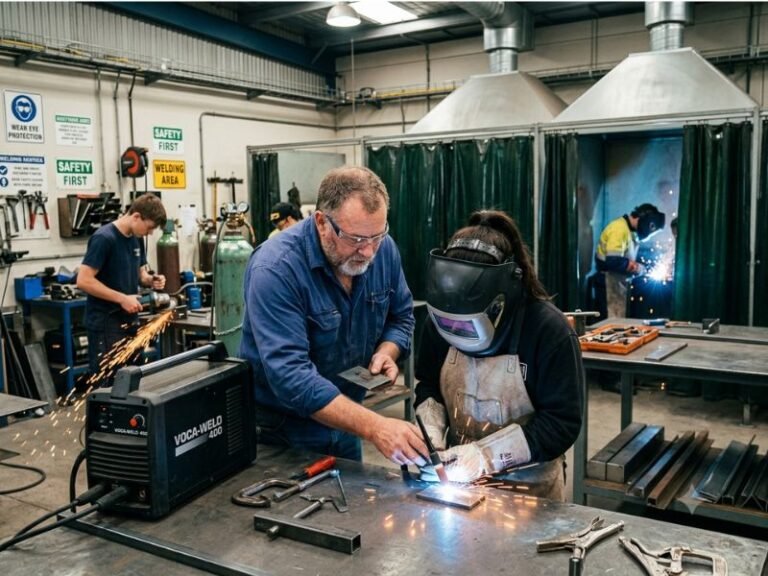
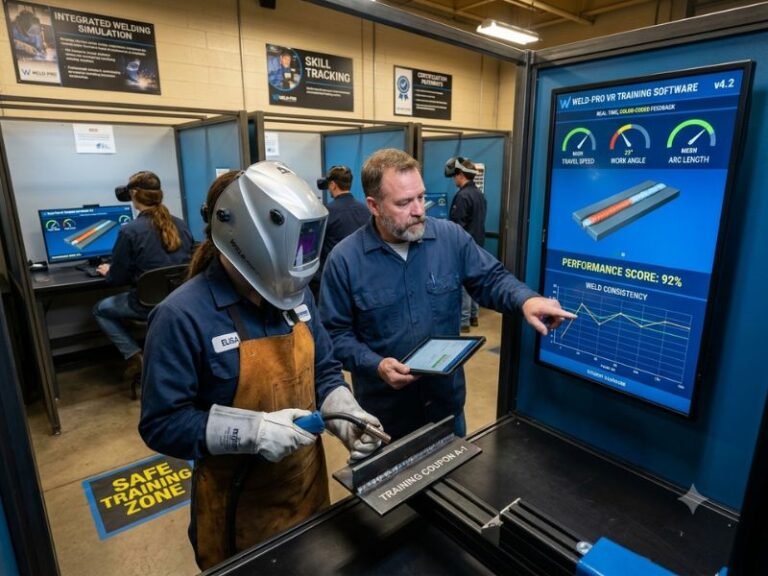
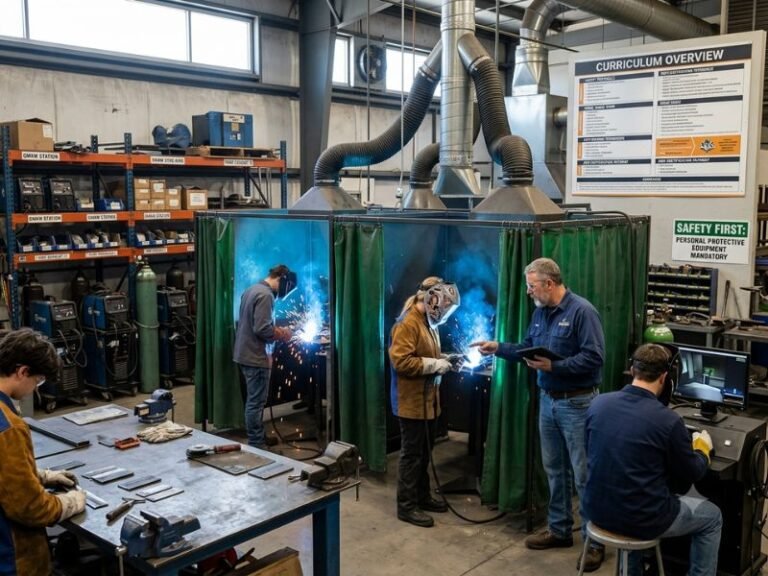
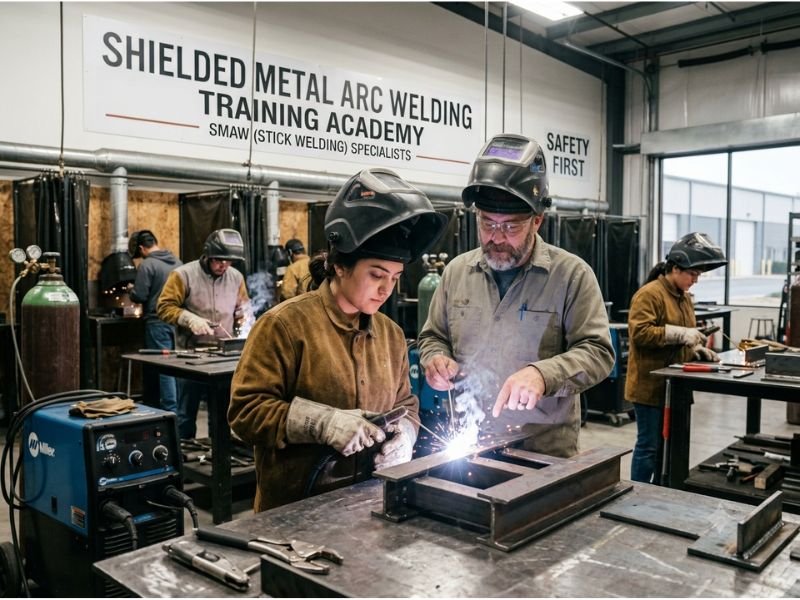
A complete course combines technical lessons, demonstrations, supervised booth practice, visual inspection, and practical testing. Students should not spend most of the program in a classroom. Welding is a physical skill, so repeated practice and immediate correction are essential.
Why SMAW Is Still Widely Used
Stick welding remains relevant because it is portable and relatively tolerant of outdoor conditions. It does not depend on an external shielding-gas cylinder, so wind has less effect on its protection than on many gas-shielded processes.
With the correct electrode and procedure, SMAW can be used on several ferrous materials. Its limitations include slower production, slag removal, frequent electrode changes, and significant operator skill. Employers therefore use it where its portability and versatility outweigh those disadvantages.
Who Should Consider SMAW Training?
SMAW instruction can serve complete beginners, experienced tradespeople, maintenance workers, and welders adding a new process. It is especially relevant for people interested in structural steel, pipe welding, field repair, heavy equipment, marine construction, and industrial maintenance.
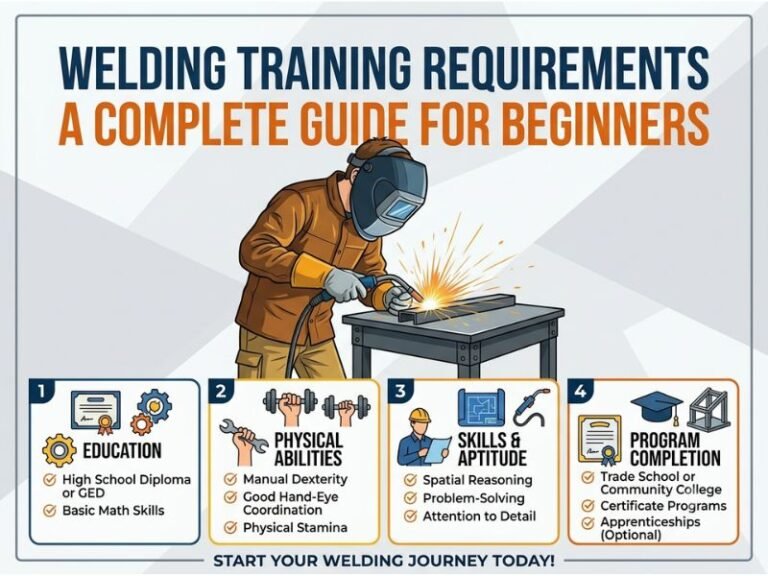
Beginners do not need prior welding experience, but mechanical awareness, coordination, and the ability to follow detailed safety instructions are valuable. Career changers should also expect physically demanding conditions, including heat, noise, awkward positions, shift work, travel, or overtime.
What Students Learn in SMAW Courses
A strong program starts with safety and equipment fundamentals before moving into joints, positions, and performance testing. The curriculum should build skills in a logical order so students understand why a weld succeeds or fails.
Welding Safety and Protective Equipment
Arc welding creates ultraviolet and infrared radiation, sparks, fumes, electrical hazards, hot metal, and fire risks. Students should learn to inspect the work area, identify nearby combustible materials, position screens, maintain ventilation, and handle hot workpieces safely.
Typical personal protective equipment includes a welding helmet with an appropriate filter shade, safety glasses, dry welding gloves, flame-resistant clothing, and protective boots. Hearing protection and respiratory protection may be required depending on the task and exposure assessment.
The course should address electrical safety and fume control. Damaged leads, wet gloves, poor connections, unsuitable conditions, coated metal, and inadequate ventilation can increase risk. Unidentified or contaminated materials should not be welded until the hazards and controls have been evaluated.
Understanding the Welding Machine
SMAW normally uses a constant-current power source. Students learn how current affects arc behavior, penetration, electrode burn-off, and bead shape. They should also understand duty cycle, cable size, work-lead placement, and the difference between alternating and direct current.
Polarity matters because electrode classifications may be designed for direct-current electrode positive, direct-current electrode negative, alternating current, or more than one option. Using the wrong polarity can make the arc unstable or prevent the electrode from performing as intended.
Loose terminals, worn holders, damaged insulation, weak work connections, or undersized cables can interfere with performance and safety.
Electrode Classification and Selection
Electrode selection is a central part of Shielded Metal Arc Welding training. Students should learn how classification numbers communicate tensile strength, welding position, coating characteristics, and current compatibility.
Common training electrodes include E6010, E6011, E6013, and E7018. E6010 and E6011 are associated with forceful arcs and deeper penetration, while E6013 is often used for lighter work and smoother operation. E7018 is a low-hydrogen electrode commonly used where strength and controlled hydrogen levels are important.
The correct electrode depends on the material, joint, position, mechanical requirements, power source, and procedure. Low-hydrogen electrodes can absorb moisture, so students should learn appropriate storage, exposure limits, and handling.
Arc Starting and Arc-Length Control
Beginners often struggle to start the arc without sticking the electrode to the plate. Instructors normally demonstrate striking methods and help students develop a controlled motion.
Once the arc starts, maintaining the correct arc length becomes the priority. A long arc can increase spatter, reduce control, and expose the molten metal to contamination. An arc that is too short may cause the electrode to stick or make travel irregular.
Because the electrode shortens continuously, the welder must feed the holder toward the joint while traveling. This coordination takes time to master.
Electrode Angle and Travel Speed
The work angle positions the electrode relative to the sides of the joint. The travel angle positions it relative to the direction of movement. Both affect fusion, penetration, slag flow, and bead profile.
Travel speed controls how much weld metal is deposited in a given area. Moving too quickly may produce a narrow bead, undercut, or incomplete fusion. Moving too slowly may create excessive buildup, a wide bead, or unnecessary heat input.
Students should learn to watch the weld puddle rather than stare only at the arc. The puddle shows whether the metal is flowing into both sides of the joint and whether travel speed is consistent.
Stringer Beads, Weaves, and Multipass Welds
Early practice usually begins with straight beads on plate. This helps students control starts, stops, arc length, speed, and electrode consumption without the added difficulty of joining separate pieces.
After basic control improves, students may practice stringer beads, limited weaving, and multipass welds. The correct technique depends on the electrode, position, joint, and applicable procedure.
Each pass must be cleaned and inspected before the next is added. Slag left between layers can create slag inclusions.
Joint Preparation and Common Weld Types
Weld quality begins before the arc is struck. Material must be identified, cleaned, aligned, and secured because technique cannot compensate for poor preparation.
Fillet Welds
Fillet welds join surfaces that meet at an angle, such as T-joints, lap joints, and corner joints. They are common in structural fabrication, frames, brackets, machinery, and repair work.
Students learn to position the electrode so the arc reaches both joint members. They also practice controlling leg size, throat, profile, and tie-in at the edges.
Groove Welds
Groove welds join prepared edges and may require a root pass, fill passes, and a final cap. Depending on thickness and access, the joint may use a square groove, V-groove, bevel groove, or another configuration.
Students should understand root opening, groove angle, land thickness, backing, and fit-up. Inconsistent preparation can cause penetration or fusion problems.
Welding Positions
Training usually begins in the flat position and progresses to horizontal, vertical, and overhead work. Position designations may include 1G, 2G, 3G, and 4G for groove welds, with separate designations for fillet welds.
Vertical-up welding is important for many structural applications because it can provide controlled penetration on thicker material. Overhead welding requires careful heat control and strict attention to protective clothing because sparks and molten particles can fall toward the welder.
A program advertising “all-position training” should provide enough practice time in each position. Brief exposure is not the same as demonstrated competence.
Reading Drawings and Welding Symbols
Career-oriented courses should include basic blueprint reading and welding symbols. Welders need to understand where a weld belongs, what type is required, how large it should be, and whether it is continuous, intermittent, field-applied, or placed on a particular side of the joint.
Students may learn reference lines, arrows, fillet symbols, groove symbols, dimensions, contour requirements, and supplementary symbols. They should also practice reading material dimensions and identifying part orientation.
Drawing interpretation reduces costly mistakes. A visually attractive weld in the wrong location or at the wrong size may still be unacceptable.
Weld Inspection and Defect Correction
Students need to evaluate their own work honestly. Training should introduce visual inspection and explain how procedure, technique, and preparation affect weld quality.
Porosity
Porosity appears as cavities or gas pockets. Possible causes include contamination, moisture, an excessively long arc, or unsuitable electrode handling. Correction begins by identifying the source rather than simply covering the defect with another pass.
Slag Inclusion
Slag inclusion occurs when nonmetallic material becomes trapped in the weld. It may result from poor cleaning, incorrect electrode angle, an unsuitable bead shape, or depositing metal over an unfilled area.
Undercut
Undercut is a groove melted into the base metal near the weld toe that is not adequately filled. Excessive current, fast travel, a long arc, or poor manipulation can contribute.
Lack of Fusion and Incomplete Penetration
Lack of fusion means the deposited metal did not bond properly with part of the base metal or a previous pass. Incomplete penetration occurs when the weld does not extend adequately through the joint root. Poor preparation, low current, incorrect positioning, or excessive travel speed may cause these conditions.
Cracking
Cracks are serious discontinuities. They may relate to material composition, hydrogen, restraint, cooling rate, joint design, or an unsuitable welding procedure. Students should never be taught to treat cracking as a cosmetic issue.
A useful instructor explains why a defect formed, demonstrates a correction, and observes the student repeating the task.
Shielded Metal Arc Welding Training Options in the United States
Students can learn SMAW through technical schools, community colleges, union or nonunion apprenticeships, employer programs, and short continuing-education courses.
Trade schools often provide intensive employment preparation. Community colleges may offer certificates, diplomas, or degrees, while apprenticeships combine paid work with related instruction. Employer programs teach procedures used in a particular facility.
Short courses suit hobbyists, maintenance workers, or experienced welders adding a skill. Online education can support theory and troubleshooting, but it cannot replace supervised booth practice or physical correction.
How Long Does SMAW Training Take?
Course length varies from a few days to several months. A short introduction may teach basic safety, machine setup, and flat-position beads. A process-specific course may run for several weeks, while a comprehensive welding program may include SMAW, GMAW, FCAW, GTAW, cutting, fabrication, and blueprint reading over a longer period.
Time alone does not prove quality. A six-month program with limited booth access may offer less practical development than a shorter intensive course with daily supervised welding.
Progress depends on previous experience, practice frequency, material thickness, electrode type, position, instructor feedback, and the standard students are expected to meet. I recommend asking for the actual number of supervised welding hours and the competencies required for completion.
How Much Does SMAW Training Cost?
There is no single national price. Tuition varies by institution, location, program length, credential, and included equipment.
Additional expenses may include registration, lab fees, books, electrodes, practice plate, tools, protective clothing, testing, transportation, and housing. Request a written estimate and confirm whether machines, consumables, PPE, open-lab time, and retesting are included.
Eligible students may have access to financial aid, veterans’ benefits, workforce funding, scholarships, employer assistance, or payment plans.
SMAW Certification and Welder Qualifications
A course completion certificate and a welder performance qualification are different.
A school certificate confirms that a student completed the program. A performance qualification shows that the welder produced an acceptable test weld under defined conditions. Those conditions may include the welding process, electrode, base metal, thickness, joint design, position, backing, and governing code.
The American Welding Society offers performance-based certification pathways, and employers may conduct their own tests. Structural, pipe, pressure, shipyard, and industrial work may follow different codes or specifications.
Passing one test does not authorize every type of welding. A qualification earned with a particular process and position has a defined range. Employers may also require documentation showing that the welder has maintained continuity with that process.
Students should ask which tests a program prepares them for and whether testing is included. Marketing phrases such as “certification-ready” should be supported by a clear explanation of the procedure, position, acceptance method, and credential.
How to Choose a Quality Training Program
The program should match the student’s goal because structural steel, pipe welding, and maintenance require different preparation.
Compare supervised booth time, class size, instructor access, equipment, ventilation, and testing opportunities. Ask how many students share each booth, whether open practice is available, and which electrodes, joints, materials, and positions students complete.
I recommend speaking with local employers or apprenticeship sponsors before enrolling. They can explain which qualifications, schools, and skills they value.
Avoid programs that promise guaranteed employment, immediate high wages, or qualification in every process. Welding careers can be rewarding, but advancement depends on skill, reliability, experience, location, and industry demand.
Career Opportunities After SMAW Training
SMAW skills support work in structural fabrication, construction, pipe systems, heavy equipment repair, shipyards, industrial maintenance, power facilities, agriculture, and infrastructure.
Entry-level titles may include production welder, fabrication welder, maintenance welder, structural welding trainee, or welder-fitter. Specialized roles may require additional processes, code qualifications, rigging knowledge, confined-space training, travel, or years of field experience.
Employers also value blueprint reading, measuring, cutting, fitting, grinding, inspection, and safe work habits. Learning GMAW, FCAW, or GTAW can expand options because no single process suits every material or environment.
Frequently Asked Questions
Is Shielded Metal Arc Welding Difficult to Learn?
SMAW can be challenging because the welder must maintain arc length while the electrode continuously shortens. Beginners also need to control travel speed, angle, and the weld puddle. Structured instruction and frequent practice make the process more manageable.
How Long Does It Take to Become Job-Ready?
Basic operation can be introduced quickly, but job-ready consistency usually takes weeks or months of supervised practice. The required time depends on the positions, joints, electrodes, and quality standards involved.
Is SMAW the Same as Stick Welding?
Yes. Stick welding is the common name for Shielded Metal Arc Welding. SMAW is the formal process designation used in technical documents, training programs, and welding standards.
Can I Learn SMAW Online?
Online courses can explain theory, electrodes, safety, symbols, and defects. They cannot replace hands-on practice, physical coaching, or practical weld evaluation.
Do I Need a Certification to Work as a Stick Welder?
Requirements depend on the employer and type of work. Some entry-level jobs use an employer-administered test, while code-regulated work may require a formal performance qualification.
Which Electrode Should a Beginner Use?
The appropriate electrode depends on the machine, material, and training objective. E6013 is sometimes used for basic practice, while many career programs introduce E6010, E6011, and E7018 because they are relevant to structural and industrial work.
Does Welding School Guarantee a Job?
No. Training can develop skills and improve readiness, but employment depends on practical ability, local demand, reliability, safety behavior, qualifications, and employer requirements.
Conclusion
Shielded Metal Arc Welding training provides a practical foundation for structural welding, repair, construction, pipe work, and industrial maintenance. A strong course should combine safety, equipment knowledge, electrode selection, joint preparation, position practice, inspection, and extensive supervised booth time.
Before enrolling, compare the full cost, instructor access, equipment, curriculum, practical hours, and qualification opportunities. I recommend choosing a program that measures demonstrated skill rather than attendance alone.
With disciplined practice and realistic career expectations, Shielded Metal Arc Welding training can help students develop a durable trade skill that remains useful across demanding industries in the United States.