Welding Training Duration Guide: From Beginner to Certified Welder
One of the first questions beginners ask before entering the trade is how long welding training takes. The answer depends on the type of program, the welding processes being taught, the student’s schedule, and the level of skill required for a specific job.
In the United States, welding training duration can range from a few weeks for an introductory course to several years for an apprenticeship. A short welding training program may teach basic safety and equipment operation, while a longer program may include multiple welding processes, blueprint reading, fabrication, inspection, and workplace experience.
I do not consider program length alone to be the best measure of training quality. A six-month program with extensive hands-on practice may prepare a student better than a longer program with limited lab time. The amount of actual welding practice, instructor support, equipment access, and certification preparation can all affect how quickly a student becomes job-ready.
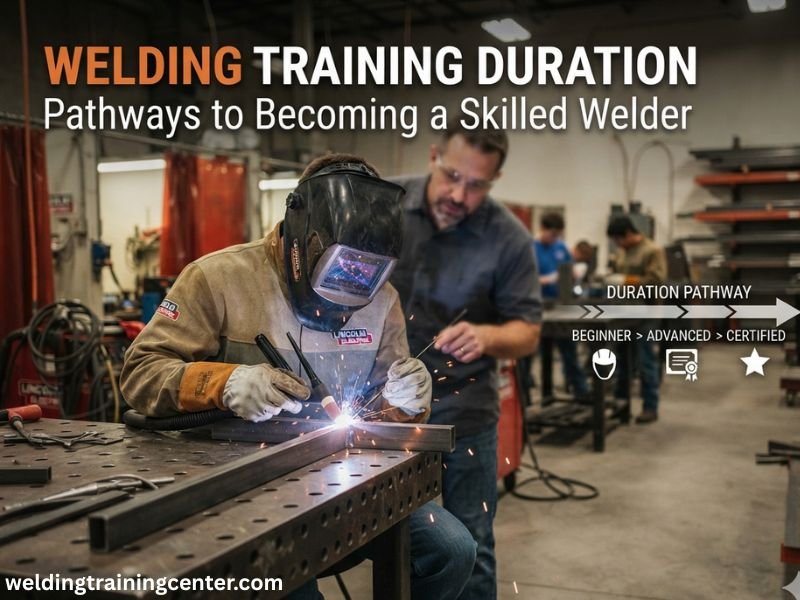
In this guide, I will explain the common training timelines in the United States, how different programs compare, and which factors can shorten or extend the time needed to learn welding.
What Is the Average Welding Training Duration?
The average welding training duration depends on the training path a student chooses. Some people start with a short introductory course, while others complete a technical diploma, associate degree, or apprenticeship.
A general training timeline may look like this:
| Training Path | Typical Duration |
| Introductory welding course | A few weeks |
| Short certificate program | 3–6 months |
| Comprehensive certificate or diploma | 6–12 months |
| Associate degree | About 2 years |
| Apprenticeship | 3–5 years |
| Specialized welding training | Varies |
These ranges are only general estimates. A program’s actual length can depend on weekly class hours, hands-on lab requirements, school scheduling, and whether the student attends full-time or part-time.
It is also important to separate program completion from professional mastery. A student may complete an entry-level course within a few months but still need additional practice to meet an employer’s production or quality standards.
How Long Is a Basic Welding Course?
A basic welding course may last from several weeks to a few months. These programs are usually designed for beginners who want an introduction to welding rather than complete career preparation.
A basic course may cover:
- Welding safety
- Personal protective equipment
- Machine setup
- Basic metal preparation
- Simple welding joints
- Introductory welding positions
- Basic equipment maintenance
Short courses can be useful for people who want to explore welding before committing to a longer program. They may also help workers who need limited welding knowledge for maintenance, repair, or fabrication tasks.
However, I would not assume that a short course makes someone ready for every entry-level welding job. Employers may expect applicants to weld consistently, read basic drawings, recognize defects, and pass a practical test. Those abilities usually require more repetition than a brief introductory course can provide.
Welding Certificate Program Duration
A welding certificate program commonly takes several months to one year. These programs are often focused on practical career preparation and usually include more hands-on instruction than a basic course.
A certificate program may include training in:
- Shielded Metal Arc Welding
- Gas Metal Arc Welding
- Gas Tungsten Arc Welding
- Flux-Cored Arc Welding
- Blueprint reading
- Welding symbols
- Cutting and fabrication
- Weld quality and inspection
- Workplace safety
Some certificate programs focus on one or two welding processes, while others cover several processes. A narrow program may be completed more quickly, but a broader program usually takes longer because students need time to practice different machines, materials, and welding positions.
Full-time certificate programs may be completed faster because students spend more hours per week in the classroom and welding lab. Part-time programs may extend over a longer period, especially when classes are offered only during evenings or weekends.
Welding Diploma Program Duration
A welding diploma program often takes approximately six to twelve months, although some programs may be longer. Diploma programs may offer broader instruction than short certificate courses.
Students may study:
- Welding theory
- Safety procedures
- Multiple welding processes
- Blueprint interpretation
- Metal cutting
- Joint design
- Fabrication methods
- Metallurgy basics
- Weld inspection
- Workplace communication
The additional subjects can help students understand why certain welding techniques are used instead of simply learning how to operate equipment.
A diploma may be useful for students who want a structured path into construction, manufacturing, repair, or industrial work. Still, the value of a diploma depends on the quality of instruction and the amount of practical experience included in the program.
Associate Degree Welding Training Duration
An associate degree in welding technology usually takes about two years of full-time study. It is generally longer than a certificate or diploma because it combines technical welding courses with general education classes.
A degree program may include:
- Welding processes
- Welding codes and standards
- Blueprint reading
- Metallurgy
- Quality control
- Fabrication
- Technical mathematics
- Communication courses
- General education requirements
An associate degree may be appropriate for students who want a wider technical education or who may later pursue roles in inspection, supervision, training, quality assurance, or welding technology.
The longer welding training duration does not automatically mean a degree is necessary for every welder. Many entry-level welding jobs are available to people who complete shorter technical programs and pass employer qualification tests. The best option depends on the student’s long-term career goals.
How Long Does a Welding Apprenticeship Take?
A welding-related apprenticeship may take three to five years, depending on the trade, employer, union, and industry. Apprenticeships combine classroom instruction with paid on-the-job training.
Unlike a short school program, an apprenticeship allows a worker to develop skills while working in real job environments. Apprentices may begin with basic tasks and gradually move into more complex work as their skills improve.
Apprenticeship training may include:
- Welding and cutting
- Safety procedures
- Equipment maintenance
- Blueprint reading
- Layout and measurement
- Structural work
- Pipe systems
- Fabrication
- Jobsite procedures
The total duration is longer because apprentices are not only learning welding. They may also be learning a broader trade such as ironworking, pipefitting, boilermaking, or industrial maintenance.
I consider apprenticeships valuable for people who want extensive workplace experience. However, they are a different training path from a short welding school program and usually require a longer commitment.
Full-Time vs. Part-Time Welding Training
A student’s schedule has a major effect on program length.
Full-Time Welding Training
Full-time students may attend classes and labs several days per week. This schedule allows them to complete required training hours more quickly.
Benefits may include:
- Faster program completion
- More consistent practice
- Regular access to instructors
- Stronger continuity between lessons
The main challenge is the time commitment. Full-time training may be difficult for students who are already working or caring for family members.
Part-Time Welding Training
Part-time programs often offer evening or weekend classes. These options can make welding education more accessible for working adults.
Benefits may include:
- Greater scheduling flexibility
- Ability to continue working
- More time between sessions to review material
The main disadvantage is that the total welding training duration may be longer. Students who attend fewer hours each week need more calendar time to complete the same amount of instruction.
Long gaps between practice sessions can also make skill development more difficult. Welding requires repetition, so consistent booth time is important.
Welding Training Duration by Welding Process
Different welding processes require different levels of coordination, equipment knowledge, and practice.
Stick Welding Training
Stick welding is commonly used in construction, repair, and structural work. Beginners must learn how to start and maintain an arc, control the electrode, manage travel speed, and remove slag.
A student may learn the basic process within a relatively short time, but producing consistent welds in multiple positions may require months of practice.
MIG Welding Training
MIG welding is often considered easier for beginners to start because the machine continuously feeds the wire. Students can often create basic welds relatively quickly.
However, professional MIG welding still requires knowledge of voltage, wire-feed speed, shielding gas, joint preparation, travel angle, and defect prevention. Becoming production-ready takes more than simply learning how to pull the trigger.
TIG Welding Training
TIG welding usually requires more coordination because the welder may control the torch, filler metal, and foot pedal at the same time.
Students also need precise control of heat, travel speed, and filler placement. TIG welding may take longer to master, especially when working with stainless steel, aluminum, or thin materials.
Flux-Cored Welding Training
Flux-cored welding is widely used in structural fabrication and heavy industry. Students must learn wire selection, machine settings, slag removal, and position control.
The process may be learned relatively quickly at a basic level, but job-ready performance requires consistent practice.
A multi-process program naturally takes longer than a program focused on one process. Each method involves different equipment, consumables, techniques, and applications.
How Long Does It Take to Become Job-Ready?
Becoming job-ready is different from completing a training program. A student may understand the basic process but still need time to develop speed, consistency, and confidence.
A job-ready welder should generally be able to:
- Follow safety procedures
- Set up equipment correctly
- Prepare joints
- Read basic welding instructions
- Maintain a stable arc
- Produce repeatable welds
- Identify common defects
- Work in required welding positions
- Pass an employer’s practical test
Some students become ready for basic entry-level work within several months. Others may need a year or more, especially if they are learning advanced processes or specialized applications.
Progress depends on the quality of practice. Spending many hours repeating poor technique is less useful than practicing under effective instruction and receiving regular feedback.
How Long Does Welding Certification Take?
Welding training and certification are not the same thing. A training program teaches skills, while a certification or qualification test evaluates whether a welder can meet a specific standard.
The testing process itself may be completed in a relatively short time, but preparation can take weeks or months. A welder may need to practice a specific:
- Welding process
- Material
- Joint type
- Plate or pipe position
- Thickness range
- Testing procedure
A person who already has strong skills may prepare quickly. A beginner may need much more time before attempting a certification test.
Certification also does not prove that a welder is qualified for every type of work. A test may apply only to the process, material, position, and procedure used during the examination.
Factors That Affect Welding Training Duration
Several factors can make training shorter or longer.
Previous Experience
Students with prior shop, fabrication, mechanical, or welding experience may progress more quickly. Complete beginners often need additional time to become comfortable with tools and equipment.
Number of Welding Processes
Learning one process takes less time than learning four. Programs that cover stick, MIG, TIG, and flux-cored welding require more practice hours.
Weekly Training Schedule
Students attending five days per week usually complete training faster than students attending one or two evenings per week.
Hands-On Practice Hours
Lab time is one of the most important factors. Welding cannot be learned through classroom instruction alone.
Career Specialization
Basic manufacturing welding may require less training than advanced pipe, aerospace, pressure-vessel, or code-related welding.
Certification Goals
A student preparing for a specific performance test may need extra practice in certain positions or materials.
Individual Learning Speed
Students develop coordination and technique at different rates. Some become comfortable quickly, while others need more repetition.
How Long Does Pipe Welding Training Take?
Pipe welding usually requires advanced control and may take longer to learn than basic flat-position plate welding.
Students must understand:
- Pipe preparation
- Root openings
- Fit-up
- Tack welding
- Travel angles
- Heat control
- Multiple passes
- Fixed-position welding
- Defect prevention
Many pipe welding students first develop basic welding skills before moving into pipe work. The total training period may range from several additional months to a year or more, depending on the process and required qualification.
Pipe welding can be demanding because the welder may need to work around the entire joint without rotating the pipe. This requires strong control in several welding positions.
How Long Does Structural Welding Training Take?
Structural welding training may take several months, depending on the program and employer expectations.
Students may practice:
- Plate welding
- Fillet welds
- Groove welds
- Vertical welding
- Overhead welding
- Structural joint preparation
- Blueprint reading
- Safe material handling
A student may learn the fundamentals quickly, but passing a structural welding test requires consistent weld quality. Extra practice may be needed for vertical and overhead positions.
How Many Hours a Week Do Welding Students Train?
Weekly training schedules vary widely.
A full-time student may spend twenty to forty hours per week in classes and labs. A part-time student may attend six to fifteen hours per week.
The schedule may include:
- Classroom theory
- Instructor demonstrations
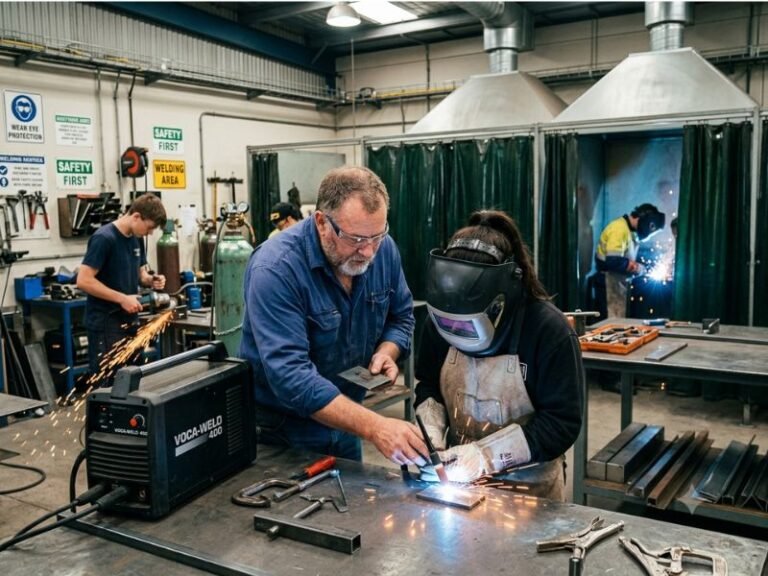
- Welding booth practice
- Blueprint exercises
- Safety instruction
- Equipment setup
- Practical assessments
This is why program length in months can be misleading. A six-month full-time course may include more total training hours than a twelve-month evening program.
When comparing programs, I recommend looking at total instructional hours and total lab hours, not only the start and completion dates.
Can You Learn Welding in a Few Months?
Yes, a beginner can learn basic welding skills in a few months. A focused program may teach safety, equipment operation, basic joints, and one or more welding processes.
However, learning the basics is not the same as mastering the trade.
Within a few months, a student may be able to:
- Set up a welding machine
- Follow basic safety rules
- Prepare metal
- Perform simple welds
- Recognize obvious defects
- Complete basic shop projects
More advanced skills, such as pipe welding, code work, complex fabrication, or high-precision TIG welding, usually require additional training and practice.
Is a Longer Welding Program Better?
A longer program is not always better. Training quality matters more than calendar length.
When comparing programs, I look at:
- Total hands-on hours
- Instructor experience
- Class size
- Equipment condition
- Processes taught
- Welding positions practiced
- Safety instruction
- Certification preparation
- Opportunities for feedback
A shorter program with strong instruction and extensive practice may be more effective than a longer program with limited access to welding booths.
Students should also consider whether the curriculum matches their intended career. There is little value in spending extra time on unrelated topics if the program does not prepare the student for the type of work they want to pursue.
How to Choose the Right Welding Program Length
The right program length depends on career goals, schedule, finances, and previous experience.
Before choosing a program, I suggest considering:
- The type of welding job you want
- The processes employers use in that industry
- Whether you need basic training or advanced specialization
- Whether you can attend full-time
- How many hands-on hours the program provides
- Whether certification preparation is included
- Whether the program includes workplace experience
Someone seeking fast entry into basic fabrication may choose a shorter certificate. Someone interested in advanced technical roles may prefer a diploma, associate degree, or apprenticeship.
Welding Training Duration Checklist
Before enrolling, review the following:
- Total program length
- Weekly class schedule
- Classroom hours
- Hands-on lab hours
- Welding processes covered
- Welding positions taught
- Full-time or part-time format
- Certification preparation
- Graduation requirements
- Additional practice opportunities
- Career specialization
- Equipment availability
This checklist can help students compare programs more accurately.
Frequently Asked Questions About Welding Training Duration
How long does it take to complete welding training?
Training may take from a few weeks to two years, depending on whether the student chooses an introductory course, certificate, diploma, or degree.
Can I become a welder in six months?
It is possible to complete an entry-level welding program in six months. Whether a student becomes job-ready depends on hands-on practice, skill development, and employer expectations.
How long is welding school in the United States?
Many welding school programs take between six and twelve months. Shorter and longer options are also available.
Does welding certification increase training time?
It can. Students may need extra practice before taking a certification or employer qualification test.
How long does it take to learn MIG welding?
The basic process may be learned within weeks, but producing consistent, professional-quality welds can take several months of practice.
How long does it take to learn TIG welding?
TIG welding often takes longer because it requires precise coordination and heat control. The timeline depends on the material and quality level required.
Is an apprenticeship longer than welding school?
Yes. Apprenticeships often last several years because they combine technical instruction with extensive paid workplace training.
Can I complete welding training while working full-time?
Yes. Many schools offer evening or weekend classes, although part-time attendance usually increases the total completion time.
Conclusion
The welding training duration in the United States can vary from a few weeks to several years. Short courses teach introductory skills, certificate and diploma programs provide focused career preparation, associate degrees offer broader technical education, and apprenticeships combine instruction with long-term workplace experience.
There is no single timeline that works for every student. Career goals, welding processes, weekly schedule, hands-on practice, and certification plans all affect how long training takes.
I believe the most useful way to evaluate a program is to look beyond the number of months. Total lab hours, instructor quality, equipment access, and practical skill development are often more important than the program’s calendar length.
A beginner may learn basic welding in a few months, but professional ability develops through continued practice. Understanding welding training duration helps students choose a realistic training path and prepare for the time needed to become safe, consistent, and employable welders.