Welding QC Inspector Training: Skills, Codes & Career Guide
Welding QC inspector training prepares professionals to verify that welded fabrication meets drawings, Welding Procedure Specifications, project requirements, codes, and defined acceptance criteria. The training combines welding-process knowledge with visual inspection, measurement, documentation, procedure control, weld-discontinuity recognition, testing awareness, and quality-control practices.
A Welding Quality Control inspector does more than examine a finished bead. Inspection may begin with materials and joint preparation, continue while welding is underway, and end with dimensional checks, examination results, repairs, and final documentation. AWS B5.1:2025 identifies welding processes, welding procedures, nondestructive examination, destructive testing, welding metallurgy, reports, mathematics, safety, quality assurance, and inspector responsibilities among the knowledge areas relevant to welding inspectors.
For professionals pursuing formal credentials, the AWS Certified Welding Inspector (CWI) and Certified Associate Welding Inspector (CAWI) pathways may be relevant. However, “Welding QC Inspector” is a job description rather than one universal certification title, so employer, project, code, and industry requirements still determine which qualifications are needed.
What Is Welding QC Inspector Training?
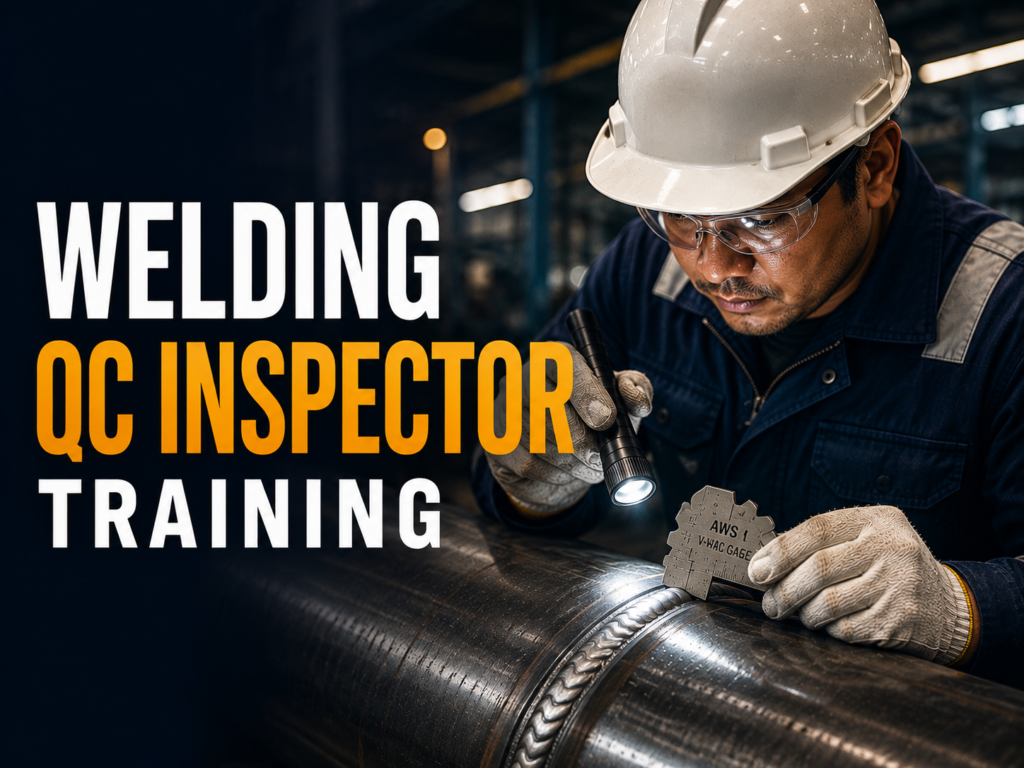
Welding QC inspector training develops the technical skills required to evaluate welding work objectively.
Typical subjects include:
- Welding processes
- Welding symbols and drawings
- WPS and PQR documents
- Welder qualification
- Material identification
- Visual inspection
- Weld gauges
- Weld discontinuities
- NDT fundamentals
- Destructive-testing awareness
- Welding metallurgy
- Codes and standards
- Inspection reporting
- Quality documentation
AWS B5.1 establishes qualification requirements for visual welding inspectors and describes experience, examinations, demonstrated capabilities, and visual acuity as important parts of inspector qualification.
Training develops knowledge, but completing a course does not automatically provide every certification that an employer or project may require.
What Does a Welding QC Inspector Do?
A Welding QC inspector checks whether fabrication conforms to specified requirements.
The exact responsibilities vary, but they may include reviewing:
- Materials
- Drawings
- Welding procedures
- Welder qualifications
- Joint preparation
- Fit-up
- Welding conditions
- Completed weld dimensions
- Inspection or NDT results
- Repair records
- Final quality documentation
The purpose of welding inspection is to determine whether a weldment meets acceptance criteria established by the applicable code, standard, or other governing document. AWS B5.1 also emphasizes that inspectors need familiarity with welding procedures, welder qualifications, materials, testing limitations, drawings, records, and responsible technical judgment.
This means an inspector should not reject or accept a weld based simply on whether it looks attractive.
Welding QC vs. Welding QA
Quality Control and Quality Assurance are closely related, but they are not identical.
Quality Control (QC) focuses largely on verifying the product or fabrication. Activities can include measuring welds, performing or reviewing inspections, checking dimensions, identifying nonconformities, and documenting results.
Quality Assurance (QA) operates at a broader system level. It can involve procedures, quality plans, auditing, organizational controls, documentation systems, and processes intended to prevent quality problems.
In real welding organizations, responsibilities can overlap. AWS maintains a Welding Coordination and Quality Assurance endorsement specifically for CWI and SCWI holders who want additional specialization in welding QA and coordination, illustrating that quality-system responsibilities extend beyond basic visual inspection.
Who Should Take Welding QC Inspector Training?
This training can be useful for:
- Experienced welders
- Welding supervisors
- Fabrication technicians
- Junior inspectors
- QA/QC personnel
- Welding coordinators
- Mechanical inspectors
- Engineers involved in welded fabrication
Practical welding experience can provide a strong foundation because an experienced welder already understands arc behavior, joint preparation, consumables, welding positions, and common production problems.
Inspection requires additional skills, however. A person needs to understand how to measure, document, interpret procedures, navigate requirements, and make objective acceptance decisions.
For professionals who do not yet have enough experience for CWI certification, AWS positions the Certified Associate Welding Inspector (CAWI) credential as an entry pathway. A CAWI performs inspection activities alongside a CWI or SCWI, with final acceptance determined by the supervising inspector.
Welding Processes a QC Inspector Should Understand
Inspectors need enough process knowledge to recognize whether welding is being performed appropriately under the applicable procedure.
Shielded Metal Arc Welding
SMAW uses a flux-coated consumable electrode.
QC training may address:
- Electrode classification
- Current and polarity
- Slag
- Interpass cleaning
- Storage and handling considerations
Gas Metal Arc Welding
GMAW uses continuously fed wire and external shielding gas.
Inspectors may need to understand:
- Voltage
- Wire-feed speed
- Shielding gas
- Transfer characteristics
- Gun position
- Consumable identification
Flux-Cored Arc Welding
FCAW uses tubular wire and can involve either external gas shielding or self-shielded consumables.
Slag removal, filler-metal identification, and process-specific procedure requirements may be important.
Gas Tungsten Arc Welding
GTAW uses a nonconsumable tungsten electrode.
Important inspection considerations can include shielding, filler metal, cleanliness, purge requirements where specified, and welding parameters.
Submerged Arc Welding
SAW uses continuous electrode wire with granular flux and is frequently mechanized or automated.
AWS B5.1 specifically includes welding-process knowledge within the technical requirements expected of welding inspectors.
Welding Symbols and Drawing Interpretation
A QC inspector must know what the fabrication is supposed to look like before evaluating it.
Training can include:
- Fillet weld symbols
- Groove weld symbols
- Arrow-side requirements
- Other-side requirements
- Weld size
- Length
- Contour
- Joint location
- Fabrication dimensions
- Tolerances
A visually smooth weld can still be unacceptable if it is the wrong size, located incorrectly, or fails another drawing requirement.
AWS B5.1 includes terminology, definitions, welding symbols, and related technical interpretation among inspector knowledge areas.
Understanding the WPS
A Welding Procedure Specification (WPS) provides welding instructions for production.
Depending on the process and applicable standard, it may address:
- Welding process
- Base material
- Filler material
- Joint configuration
- Position
- Electrical characteristics
- Preheat
- Interpass conditions
- Technique
The QC inspector’s role is not to invent a preferred welding technique. The inspector verifies the relevant production conditions against the applicable procedure and project requirements.
Understanding the PQR
A Procedure Qualification Record (PQR) documents the actual conditions used to qualify a welding procedure and the resulting test information.
The distinction is useful:
WPS = instructions for production.
PQR = record of procedure qualification.
For example, ASME’s current QW-483 suggested PQR format contains sections for joint details, base metals, filler metals, gases, electrical characteristics, position, preheat, welding technique, and mechanical-test results.
AWS CWI Part B preparation also specifically teaches analysis and application of WPSs and PQRs.
Welder Performance Qualification
Welder performance qualification is separate from procedure qualification.
The procedure qualification establishes the basis for a welding procedure under the applicable rules.
Welder qualification demonstrates an individual’s ability under defined test variables and conditions.
QC inspectors may need to review qualification records to confirm that personnel assigned to work are appropriately qualified for the process and application.
A statement such as “the welder is qualified” is therefore incomplete unless the relevant qualification range actually covers the work being performed.
Inspection Before Welding
Good QC starts before the arc is struck.
Material Verification
Depending on project requirements, the inspector may review:
- Material specification
- Identification
- Condition
- Traceability documentation
Joint Preparation
The inspector may check:
- Bevel geometry
- Root opening
- Root face
- Cleanliness
- Joint configuration
Fit-Up
Fit-up inspection may include:
- Alignment
- Pipe mismatch or hi-lo
- Tack weld condition
- Joint dimensions
Documentation
The inspector should have access to the applicable drawing, procedure, inspection requirements, and relevant personnel records.
Finding an incorrect joint before welding is normally more useful than discovering the same problem after the weld is completed.
Inspection During Welding
QC inspection can continue while welding is underway.
Items may include:
- Correct welding process
- Required consumables
- Welding position
- Preheat where specified
- Interpass conditions
- Cleaning between passes
- Welding sequence
- Environmental restrictions
- Other relevant WPS variables
What must actually be monitored depends on the governing WPS, code, inspection plan, and project requirements.
Inspection After Welding
After welding, visual and dimensional inspection can include:
- Weld size
- Weld length
- Profile
- Reinforcement
- Undercut
- Alignment
- Surface condition
- Overall dimensions
The inspector compares findings with applicable acceptance requirements rather than using an informal standard such as “it looks good enough.”
Common Weld Discontinuities
Porosity
Porosity consists of gas cavities in weld metal. It can occur individually or in groups.
Acceptance depends on the governing requirements rather than the presence of any single pore automatically creating a rejection.
Undercut
Undercut is a groove at the weld toe that may need to be measured for depth or extent.
Incomplete Fusion
Incomplete fusion occurs when required fusion is missing between weld metal and base metal or between weld beads.
Incomplete Joint Penetration
This condition relates to insufficient penetration through a joint where the required joint configuration calls for greater penetration.
Slag Inclusion
Slag can become trapped in weld metal, particularly with slag-forming welding processes.
Cracks
Cracking is an important welding discontinuity that must be evaluated under the applicable acceptance requirements.
Discontinuity vs. Defect
An inspector should understand that a discontinuity is not automatically a defect.
A discontinuity becomes unacceptable when it fails the applicable code, standard, specification, or other acceptance criteria. AWS describes welding inspection specifically in terms of determining conformance to such requirements.
Welding QC Inspection Tools
Common tools can include:
- Fillet weld gauges
- Bridge Cam-type gauges
- Hi-Lo gauges
- Steel rules
- Calipers
- Tape measures
- Straightedges
The tool is only useful when the inspector knows where to place it, how to read it, and which dimension matters.
This is why practical training matters. AWS’s current Part B seminar provides three full days of instruction involving the Book of Specifications, WPS/PQR exercises, inspection tools, weld replicas, and a timed practice examination.
Nondestructive Testing for Welding QC Inspectors
A Welding QC inspector should usually understand the basic purpose of common NDT methods.
Visual Testing
VT evaluates accessible surface conditions, weld dimensions, profile, and visible discontinuities.
Liquid Penetrant Testing
PT is used to reveal surface-breaking discontinuities in suitable nonporous materials.
Magnetic Particle Testing
MT is applicable to ferromagnetic materials and can reveal certain surface and near-surface discontinuities.
Ultrasonic Testing
UT uses sound energy to evaluate internal material conditions.
Radiographic Testing
RT uses penetrating radiation to obtain information about internal conditions.
Knowledge of NDT does not automatically qualify a Welding QC inspector to perform every NDT method. ASNT operates separate NDT certification pathways, including method- and level-specific credentials. ASNT also has a pathway through which current AWS CWIs/SCWIs can obtain a related Level II Visual Testing credential after meeting its requirements.
Destructive Testing and Metallurgy
QC training may also cover destructive-test concepts such as:
- Guided bend testing
- Tensile testing
- Fillet-break testing
- Macro examination
The inspector should understand what these tests are intended to evaluate and how the results relate to qualification records.
Basic metallurgy can include:
- Base metals
- Filler metals
- Heat-affected zones
- Weldability
- Heating and cooling
- Preheat
- Postweld heat treatment
- Cracking mechanisms
AWS B5.1 includes both destructive testing and welding metallurgy in its welding-inspector knowledge requirements.
Codes and Standards in Welding QC
Inspection needs a defined technical basis.
Depending on the project, that basis may include:
- AWS structural welding codes
- ASME requirements
- API standards
- Project specifications
- Customer requirements
- Internal quality procedures
Different standards can establish different acceptance criteria and qualification requirements.
This is why code-navigation skills matter. AWS CWI certification includes a dedicated code-book examination in addition to fundamentals and practical inspection testing.
QC Documentation and Reporting
Good inspection needs good records.
A welding inspection report may document:
- Weld identification
- Location
- Drawing or procedure reference
- Inspection method
- Measurements
- Findings
- Acceptance status
- Repair status
- Inspector identity
Nonconformance documentation should identify the requirement that was not met rather than relying on vague language.
Traceability may connect the weld to the material, welder, WPS, inspection results, NDT reports, and repair history.
AWS B5.1 includes reports and record-related knowledge among inspector qualification areas, reinforcing that documentation is part of inspection competency rather than an administrative afterthought.
Repair and Reinspection
When a weld is rejected, the inspector generally should not invent an unauthorized repair method.
The appropriate quality process may include:
- Recording the unacceptable condition.
- Obtaining an approved repair method where required.
- Having the repair completed by appropriately qualified personnel.
- Performing the required reinspection or examination.
- Updating the documentation.
The exact repair and reinspection rules depend on the applicable project and governing standard.
CWI and CAWI Pathways
AWS provides two relevant inspection credentials for different experience levels.
Certified Associate Welding Inspector
AWS describes CAWI as a credential for professionals beginning a welding inspection career and building experience toward CWI. CAWIs work under the guidance of a CWI or SCWI, with the supervising inspector determining final acceptance.
Certified Welding Inspector
CWI is AWS’s established professional welding-inspection credential. The current certification examination consists of Part A Fundamentals, Part B Practical, and Part C Code Book. Current AWS information lists Part A as 150 questions and identifies inspection-tool use and WPS/PQR application among Part B activities.
A QC job does not universally require CWI certification, however. The actual requirement depends on the employer, contract, industry, and code.
How Long Does Welding QC Inspector Training Take?
There is no universal duration.
A short course may focus only on visual inspection or welding documentation. A broader program may include codes, procedures, metallurgy, NDT concepts, and practical gauge work.
Certification preparation can require additional study. For example, AWS’s current CWI Part B seminar consists of three full instructional days, while AWS also offers multi-week CWI preparation formats.
Someone with extensive welding experience may progress faster through process fundamentals than a person who is new to welded fabrication, but both still need to develop objective inspection and documentation skills.
Welding QC Inspector Safety
QC inspectors frequently work near welding arcs, hot metal, grinders, electrical equipment, fumes, and active fabrication operations.
OSHA identifies welding hazards including metal fumes, ultraviolet radiation, burns, eye damage, electrical shock, cuts, and crushing injuries. OSHA notes that proper work practices and PPE can help control many of these risks.
Safety requirements also vary by environment. OSHA maintains welding-related standards for general industry, maritime work, and construction.
Frequently Asked Questions
What Is Welding QC Inspector Training?
Welding QC inspector training teaches professionals to verify welded fabrication using drawings, procedures, inspection tools, acceptance criteria, testing knowledge, codes, and quality documentation.
What Is the Difference Between Welding QC and QA?
QC focuses more directly on inspection and verification of the fabricated product, while QA focuses more broadly on quality systems, planning, procedures, and process controls. Actual responsibilities can overlap depending on the organization.
Do You Need to Be a Welder to Become a QC Inspector?
Not necessarily, but welding experience is valuable. An inspector still needs additional skills in inspection, procedures, measurements, codes, documentation, and quality control.
Is AWS CWI Required for Welding QC Inspectors?
Not universally. CWI is a major professional welding-inspection credential, but specific employer, project, contract, or code requirements determine whether it is required.
What Is the Difference Between WPS and PQR?
A WPS provides production welding instructions. A PQR documents the actual variables and test results from procedure qualification.
What Tools Does a Welding QC Inspector Use?
Common tools include weld gauges, Hi-Lo gauges, rules, calipers, tape measures, and other dimensional inspection equipment appropriate to the work.
Does a Welding QC Inspector Need NDT Certification?
Not for every QC position. However, independently performing particular NDT methods may require separate training, experience, employer qualification, or certification. ASNT maintains distinct certification systems for NDT personnel.
Can a CAWI Work as a Welding Inspector?
AWS describes a CAWI as performing inspection activities under the guidance of a CWI or SCWI, who determines final acceptance.
How Long Does Welding QC Inspector Training Take?
There is no fixed duration. Training length depends on existing welding knowledge, course scope, codes being studied, practical inspection requirements, and whether the student is preparing for a credential such as CWI.
Conclusion
Welding QC inspector training develops the technical discipline required to verify welding quality against documented requirements. Effective training covers welding processes, drawings, WPS/PQR documents, welder qualifications, visual inspection, gauges, weld discontinuities, NDT awareness, metallurgy, codes, documentation, and safety.
The most important skill is objective evaluation. A QC inspector should not make an acceptance decision because a weld looks attractive or because production needs to continue quickly. The decision should be supported by the applicable drawing, procedure, specification, code, and acceptance criteria.
Formal credentials such as AWS CAWI and CWI can support an inspection career, while NDT activities may require separate qualifications. For experienced welders, fabrication personnel, and QA/QC professionals moving toward greater inspection responsibility, that combination of process knowledge, measurement, code interpretation, and accurate documentation is the central purpose of Welding QC inspector training.