Welding Inspector Training: Skills, CWI Exams & Career Guide
Welding inspector training prepares professionals to evaluate welded work against drawings, welding procedures, codes, specifications, and acceptance criteria. Training typically combines welding-process knowledge with visual inspection, measurement, weld-discontinuity recognition, WPS/PQR interpretation, metallurgy, nondestructive testing awareness, code navigation, and technical reporting. AWS Certified Welding Inspector (CWI) preparation is one of the most established U.S. pathways for developing and demonstrating these skills.
A welding inspector does more than look at a finished bead and decide whether it appears acceptable. Inspection can begin before welding, continue while the joint is being welded, and finish with dimensional and quality checks after welding. The inspector must compare what was produced with the requirements that actually govern the job rather than relying on personal preference.
For candidates pursuing AWS CWI certification, training and certification are separate. AWS currently requires qualifying education and welding-based work experience, a vision examination, and successful completion of Parts A, B, and C of the CWI exam, with at least 72% required on each part.
What Is Welding Inspector Training?
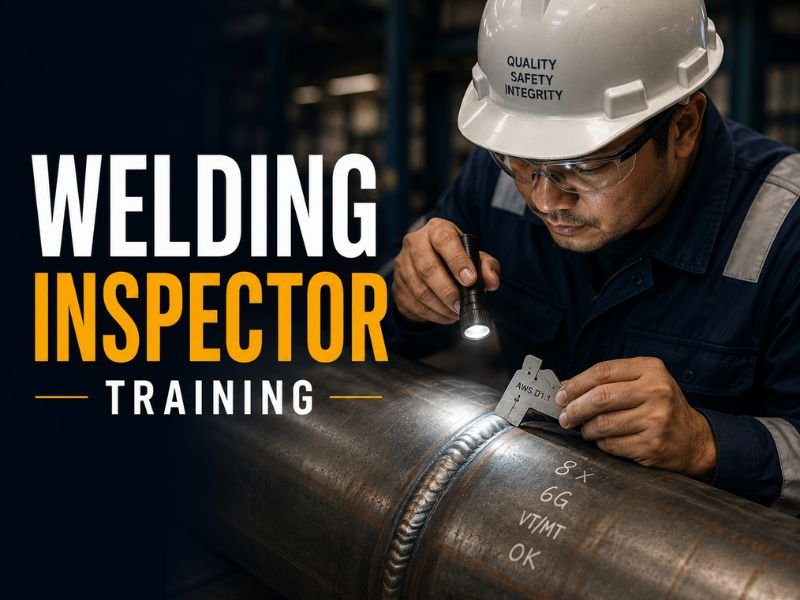
Welding inspector training is technical education designed to develop the knowledge and practical skills needed to evaluate welded fabrication.
A comprehensive program can cover:
- Welding processes
- Welding symbols and drawings
- Visual inspection
- Welding discontinuities
- Inspection gauges and measuring tools
- WPS and PQR interpretation
- Welder qualification
- Metallurgy
- Destructive testing
- Nondestructive testing
- Codes and standards
- Documentation and reporting
AWS’s current CWI preparation programs include welding fundamentals, material properties, procedure and performance qualification, visual inspection tools, discontinuity acceptance, codes, standards, and professional inspection practices.
What Does a Welding Inspector Do?
A welding inspector evaluates whether fabrication satisfies the applicable requirements.
The work can involve reviewing documents before production, checking joint preparation, observing welding conditions, measuring completed welds, identifying discontinuities, and recording inspection results.
An inspector may need to verify:
- Joint type and dimensions
- Material identification
- Welding procedure
- Welder qualification
- Filler material
- Fit-up and alignment
- Weld size
- Finished profile
- Visible discontinuities
- Applicable acceptance criteria
The key principle is conformance to specified requirements. AWS Part B training emphasizes determining whether discontinuities are acceptable by applying defined acceptance criteria and tolerances.
Do You Need Welding Experience to Become an Inspector?
Practical welding knowledge is extremely useful, but the exact experience requirement depends on the credential or employer.
For AWS CWI certification, education and welding-based work experience are linked. Under current AWS eligibility requirements, a candidate with a bachelor’s or higher degree in welding engineering or welding technology needs at least one year of welding-based work experience. An associate or higher degree in engineering, engineering technology, or physical science can reduce the minimum to two years.
Other current examples include:
- Relevant technical coursework: minimum three years of welding-based experience
- Trade or vocational education: minimum four years
- High school diploma or equivalent: minimum five years
- Eighth-grade education: minimum nine years
- Less than eighth-grade education: minimum twelve years
AWS also requires CWI candidates to submit evidence of qualifying experience and complete a visual-acuity examination.
These are certification eligibility requirements, not a statement that every welding-inspector job in the United States uses exactly the same prerequisites.
Welding Processes Inspectors Should Understand
An inspector does not necessarily need to be qualified to weld with every process, but process knowledge helps explain what is happening during production.
Common processes include:
Shielded Metal Arc Welding
SMAW, or stick welding, uses a flux-coated consumable electrode. Inspectors need to understand issues such as electrode handling, current, polarity, slag, and interpass cleaning.
Gas Metal Arc Welding
GMAW or MIG uses continuously fed wire and external shielding gas. Process variables can include voltage, wire-feed speed, shielding gas, and transfer characteristics.
Flux-Cored Arc Welding
FCAW uses tubular wire and may be self-shielded or gas-shielded. Slag control and consumable selection can be important inspection considerations.
Gas Tungsten Arc Welding
GTAW or TIG uses a nonconsumable tungsten electrode. Cleanliness, shielding, filler-metal control, and heat management are important process characteristics.
Submerged Arc Welding
SAW commonly uses continuous wire beneath granular flux and is often mechanized or automated.
AWS’s current CWI seminar includes knowledge of arc welding, gas welding, resistance welding, and other welding processes as part of inspector preparation.
Welding Symbols and Blueprint Reading
Inspectors need to understand what the drawing requires before they can determine whether the fabricated joint is correct.
Training can include:
- Fillet-weld symbols
- Groove-weld symbols
- Arrow-side and other-side notation
- Weld size
- Weld length
- Contour
- Supplementary symbols
- Dimensions and tolerances
Welding-symbol knowledge is also part of the current AWS CWI Part A examination content.
An attractive weld can still be wrong if it is placed on the wrong side of a joint, has the wrong size, or fails to match the drawing.
Understanding a Welding Procedure Specification
A Welding Procedure Specification, or WPS, provides instructions for making the weld.
Depending on the applicable code or procedure, it can address:
- Welding process
- Joint configuration
- Base material
- Filler material
- Position
- Electrical characteristics
- Preheat
- Interpass requirements
- Welding technique
Inspectors often need to verify that production follows the applicable WPS rather than whichever settings or technique a welder happens to prefer.
AWS Part B directly tests and trains candidates in the application of WPSs and PQRs.
What Is a PQR?
A Procedure Qualification Record, or PQR, documents the variables and test results from a welding procedure qualification test.
The distinction is straightforward:
WPS: tells production personnel how the weld is to be made.
PQR: records qualification-test data supporting the procedure where qualification is required.
Understanding this difference is important both in the field and on the AWS CWI exam. WPS/PQR knowledge is included in Part A, while practical application appears in Part B.
Welder Performance Qualification
Procedure qualification and welder qualification answer different questions.
Procedure qualification addresses whether the welding procedure can produce acceptable results under the governing rules.
Welder performance qualification addresses whether the individual welder can demonstrate the required ability under specified test conditions.
AWS’s CWI training includes the principles of qualifying welding procedures and welding personnel.
An inspector may therefore need to verify that the person assigned to production is appropriately qualified for the process and work involved.
Visual Welding Inspection Training
Visual inspection is one of the core skills taught to welding inspectors.
Before Welding
The inspector may evaluate:
- Joint preparation
- Root opening
- Bevel condition
- Alignment
- Surface cleanliness
- Material condition
- Procedure availability
Problems identified before welding are often easier to correct than defects found after fabrication is complete.
During Welding
Inspection may involve checking whether production follows required conditions such as process, consumables, sequence, cleaning, or temperature controls where those items are part of the applicable requirements.
After Welding
Completed welds may be checked for:
- Weld size
- Length
- Profile
- Reinforcement
- Undercut
- Surface discontinuities
- Alignment
- Dimensional conformity
AWS Part B is specifically structured around practical inspection activities and the use of inspection tools and methods.
Common Weld Discontinuities
Welding inspector training teaches candidates how to identify discontinuities and, equally important, how to determine whether they are acceptable under the governing criteria.
Porosity
Porosity consists of gas cavities in weld metal. Surface porosity may be visible, while internal porosity can require another examination method.
Undercut
Undercut is a groove adjacent to the weld toe that has not been filled with weld metal. Inspectors may need to measure its depth or length against the applicable criteria.
Incomplete Fusion
Incomplete fusion occurs where fusion is lacking between weld metal and base metal or between weld beads.
Incomplete Joint Penetration
Incomplete joint penetration concerns insufficient penetration through the joint where the required joint configuration calls for complete penetration.
Slag Inclusion
Slag can become trapped between weld beads or between weld metal and base metal in slag-producing processes.
Cracks
Cracking can occur in different locations and forms and is a significant welding quality concern.
An important inspection concept is the difference between a discontinuity and a defect. A discontinuity is not automatically rejectable; acceptance depends on whether it exceeds the limits established by the applicable code, standard, drawing, or specification. AWS CWI training specifically emphasizes applying acceptance criteria and tolerances.
Welding Inspection Tools
Practical inspection requires more than theory.
Common tools can include:
- Fillet-weld gauges
- Bridge Cam-type gauges
- Hi-Lo gauges
- Steel rules
- Calipers
- Tape measures
- Straightedges
- Flashlights and mirrors where appropriate
AWS’s Part B seminar uses a visual inspection toolkit and replica weld specimens so candidates can practice taking measurements and evaluating discontinuities.
Correct measurement technique matters because an acceptance decision can depend on a relatively small dimensional difference.
Nondestructive Testing Basics
Welding inspectors should understand the purpose and limitations of common nondestructive examination methods.
Visual Testing
Visual testing evaluates accessible surfaces, geometry, workmanship, and visible discontinuities.
Liquid Penetrant Testing
PT is used to reveal surface-breaking discontinuities in suitable nonporous materials.
Magnetic Particle Testing
MT can reveal surface and near-surface discontinuities in ferromagnetic materials.
Ultrasonic Testing
UT uses sound energy to investigate material and weld conditions below the surface.
Radiographic Testing
RT uses penetrating radiation to produce information about internal weld conditions.
Nondestructive testing is included in the current CWI Part A knowledge areas.
However, becoming a CWI does not automatically make someone qualified or certified to perform every NDT method. Separate employer, written-practice, training, experience, or personnel-certification requirements can apply.
Destructive Testing Knowledge
Welding inspectors should also understand the purpose of common destructive tests.
These can include:
- Guided bend testing
- Tensile testing
- Fillet-weld break testing
- Macro examination
Destructive testing is one of the specific subjects listed for the AWS CWI Part A Fundamentals exam.
An inspector may not personally perform every laboratory test, but understanding what the test demonstrates helps in reviewing qualification and production records.
Welding Metallurgy for Inspectors
Inspectors need enough metallurgy to understand how welding affects materials.
Training can introduce:
- Base and filler-metal properties
- Heat-affected zones
- Heating and cooling
- Hardness
- Cracking
- Preheat
- Postweld heat treatment
- Material compatibility
Metallurgy is another defined knowledge area on the current AWS CWI Part A exam, and the AWS in-person seminar includes instruction on how welding changes material properties.
Codes and Standards
Professional welding inspection depends on requirements.
The inspector cannot simply decide that a weld is acceptable because it “looks strong.”
Depending on the industry, applicable documents may address structural steel, pipelines, bridges, aluminum, aerospace fabrication, pressure-related work, or other applications.
Code-navigation skill is especially important for AWS CWI candidates because Part C is specifically designed to test the ability to locate and understand requirements in an approved code book.
AWS Certified Welding Inspector Exam
The current AWS CWI examination has three parts.
Part A – Fundamentals
Part A currently contains 150 questions covering:
- Destructive testing
- Fabrication math
- Safety
- Metallurgy
- Nondestructive testing
- Welding symbols
- WPS/PQR
- Welding fundamentals
AWS administers Parts A and C through computer-based testing at Prometric centers.
Part B – Practical
The current Part B practical exam contains 46 questions linked to hands-on activities.
AWS identifies activities involving:
- WPS and PQR application
- Inspection tools and methods
- Required practical activities
The practical exam is conducted at designated AWS educational exam locations rather than through the standard Prometric computer-based format.
Part C – Code Book
Part C is an open-book examination containing 50 to 65 questions, depending on the selected code option.
AWS currently lists options that include AWS structural codes, API 1104, an ASME code combination, and ISO material. Candidates should use the exact code edition identified for their examination rather than assuming that the newest published edition is automatically the exam edition.
What Is the CWI Passing Score?
AWS currently requires a score of at least 72% on each of Parts A, B, and C to earn the CWI credential.
Welding Inspector Training Formats
Candidates can prepare in several ways.
Self-Paced Fundamentals Preparation
AWS currently offers an online pre-seminar containing approximately 80 hours of instruction focused on the fundamentals portion of CWI preparation.
This can be useful for candidates who need substantial review before attending more intensive instruction.
CWI In-Person Seminar
The current AWS in-person CWI seminar runs from Sunday through Friday and covers Fundamentals, code-book preparation, and the visual inspection workshop. Participants currently receive 40 PDHs for attending.
Part B Practical Seminar
Candidates wanting extra practical preparation can take the dedicated Part B seminar.
AWS currently structures this as three full days of instruction using inspection tools, weld replicas, the Book of Specifications, WPS/PQR exercises, and a timed practice exam.
No training seminar can guarantee a passing exam result. Preparation needs depend heavily on the candidate’s existing welding, inspection, math, metallurgy, and code knowledge.
Welding Inspector Safety Training
Inspectors often work close to active welding operations even when they are not performing the weld themselves.
OSHA identifies welding-related health hazards including metal fumes and ultraviolet radiation, as well as safety hazards such as burns, eye injuries, electrical shock, cuts, and crushing injuries. OSHA notes that work practices and appropriate PPE are important controls.
Inspectors therefore need awareness of:
- Eye and face protection
- Welding radiation
- Fumes
- Hot metal
- Electrical hazards
- Fire hazards
- Work-area conditions
- Other site-specific hazards
AWS’s current CWI seminar also includes safety best practices as part of inspector preparation.
Welding Inspector Training vs. CWI Certification
The difference is straightforward.
Welding inspector training develops knowledge and prepares someone for inspection duties or an examination.
CWI certification is an AWS credential requiring the candidate to satisfy eligibility requirements, complete the vision requirement, and pass the three required exam parts.
Completing a seminar does not automatically create a CWI credential.
Likewise, someone can build useful inspection knowledge through employer training or another education provider without automatically becoming an AWS Certified Welding Inspector.
CWI Recertification
CWI professional development does not end after the initial examination.
AWS currently identifies a nine-year certification period for CWI recertification. At the end of that period, current recertification options include taking the Part B practical examination, earning 80 qualifying Professional Development Hours, obtaining certain eligible credentials, or completing a qualifying endorsement pathway.
AWS also offers a dedicated 9-year recertification seminar designed around the 80-PDH continuing-education requirement.
Because certification policies can change, inspectors approaching renewal or recertification should always confirm the current AWS requirements.
Where Can Welding Inspectors Work?
Welding inspection knowledge can be relevant in:
- Structural fabrication
- Construction
- Pipeline work
- Pressure-related fabrication
- Manufacturing
- Shipbuilding
- Transportation
- Welding shops
- Quality-control departments
- Third-party inspection organizations
The credential or additional qualifications needed can vary by employer, project, industry, and governing code. A CWI credential should therefore not be treated as automatic authorization to perform every inspection activity in every industry.
Frequently Asked Questions
What Is Welding Inspector Training?
Welding inspector training teaches professionals to evaluate welded fabrication using visual inspection, measuring tools, procedures, drawings, codes, acceptance criteria, metallurgy, testing knowledge, and technical documentation. AWS CWI preparation is one established route for developing these skills.
Do You Need to Be a Welder Before Becoming a Welding Inspector?
Not every inspector must first hold a production-welder qualification. However, AWS CWI eligibility requires qualifying welding-based work experience, with the minimum amount depending on education.
How Many Parts Are in the CWI Exam?
The AWS CWI examination currently consists of three parts: Part A Fundamentals, Part B Practical, and Part C Code Book.
What Is Covered on CWI Part B?
Part B evaluates practical inspection activities. AWS currently uses 46 questions involving areas such as WPS/PQR application and use of inspection tools and methods.
What Score Do You Need to Pass the CWI Exam?
AWS currently requires at least 72% on each of Parts A, B, and C.
How Long Does Welding Inspector Training Take?
There is no universal duration. AWS currently offers an approximately 80-hour fundamentals pre-seminar, a Sunday-through-Friday in-person CWI seminar, and a separate three-day Part B practical seminar.
Can Welding Inspector Training Be Completed Online?
Some preparation can be completed online, including fundamentals instruction. Practical inspection skills still benefit from hands-on work with gauges, specimens, procedures, and measurement exercises. AWS currently provides both online and in-person CWI preparation options.
Does Completing CWI Training Make You Certified?
No. Training prepares you for the certification process. AWS CWI certification additionally requires eligibility, a vision examination, and passing Parts A, B, and C.
Conclusion
Welding inspector training develops the technical judgment needed to evaluate welded work against defined requirements rather than appearance alone. A capable inspector needs knowledge of welding processes, visual inspection, measuring tools, welding symbols, WPSs and PQRs, welder qualification, metallurgy, NDT, destructive testing, codes, and safety.
For professionals pursuing the AWS Certified Welding Inspector credential, the current pathway requires qualifying education and welding-based experience, a vision examination, and successful completion of three exams: Part A Fundamentals, Part B Practical, and Part C Code Book. Each part currently requires a minimum score of 72%.
The strongest inspectors combine practical welding awareness with careful measurement, code knowledge, documentation skills, and consistent application of acceptance criteria. For experienced welders, supervisors, and QA/QC professionals who want to move into inspection work, developing those abilities is the central purpose of welding inspector training.